I recently rewatched President Tinubu’s 2023 Chatham House engagement when he was still a presidential candidate.
What stood out again was how, after addressing some questions himself, he invited members of his team to handle others. To me, that reflected a leader who had clearly shared his vision with his team and was confident they understood it well enough to communicate it on his behalf.
It showed an understanding that governing a country of over 230 million people is not a one-man job. Leadership is about building a capable team and trusting them with responsibility.
The same cannot be said for the candidate who went on live television and told Nigerians he would keep his plans to himself. That's hardly reassuring. After all, people with a clear plan are usually eager to explain it, not hide it.
I'm glad Nigerians made the right choice in President Tinubu, and they will make the same choice again in 2027.
OPERATION HADIN KAI DELIVERS ANOTHER DECISIVE BLOW TO ISWAP TERRORISTS
The Joint Task Force (North East) Operation HADIN KAI has once again demonstrated its operational dominance and combat readiness by successfully defeating ISWAP attack and launching a devastating counter-offensive against the terrorists in the Buratai axis.
In the early hours of 19 June 2026, ISWAP terrorists launched multiple attacks on troops' locations at Dusten Kura and Chara road in Buratai, Biu Local Government Area of Borno State. The alert troops, supported by robust intelligence, promptly detected the incursion and responded with superior firepower in a well-coordinated air and ground counter-attack.
The prompt and effective employment of the Air Component of OPHK, particularly Intelligence Surveillance and Reconnaissance as well as precision strike platforms from the Nigerian Air force, proved decisive. The precision air support integrated seamlessly with ground forces, disrupted the terrorists' assault and inflicted heavy casualties on the attackers, forcing them to flee in confusion. It is worthy to note that no casualties were recorded on own troops, while the terrorists suffered significant losses in personnel and equipment.
This latest success underscores the high state of readiness of OPHK troops and the synergy between the ground and air components in maintaining relentless pressure on the terrorists. The Theatre Command remains committed to denying insurgents freedom of action and ensuring the safety of law-abiding citizens across the North East theatre.
The public is urged to continue providing timely intelligence to security forces and to remain vigilant. OPHK would comtinue to sustain aggressive offensive operations to decisively degrade terrorist capabilities and restore lasting peace to the region.
MOHAMMED GONI
Captain
Acting Military Information Officer
Headquarters Joint Task Force North East Operation HADIN KAI
MAIDUGURI
19 June 2026
Energy in Nigeria: From potential to reality
Keynote Address by Mrs. Olu Arowolo Verheijen, Special Adviser to the President on Oil and Gas, at the Nigerian-British Chamber of Commerce Energy Day 2026
June 18, 2026
Distinguished members of the Nigerian-British Chamber of Commerce, Your Excellency the British Deputy High Commissioner, captains of industry, investors, regulators, development partners, ladies and gentlemen — good morning.
We meet under a theme that captures both the challenge and the promise of our time: energy in Nigeria, from potential to reality.
Nigeria has never lacked potential. We have oil. We have gas. We have sunlight, water, land, talent and scale. What we have lacked is conversion — the discipline to turn resources into results.
Reserves into production. Production into revenue. Gas into power. Power into productivity. Refining into supply security. And reform into confidence.
That is the work President Bola Ahmed Tinubu mandated us to do: to move Nigeria's energy sector from promise to performance.
Energy is not simply a sector. It is the foundation of national competitiveness. When energy works, factories run, farms process, transport gets cheaper, and government can invest in its people. When energy fails, every Nigerian pays — in diesel costs, food prices, lost jobs and pressure on the naira. That is why energy reform is economic reform.
When we came into office, the sector was under severe strain. Subsidies had become fiscally unsustainable. Foreign-exchange distortions had weakened investment.
Production was below potential. Power-sector debt was strangling the gas-to-power chain. The country had resources, but the system was not converting them into national value. So our first task was to stop the bleeding and rebuild the foundations.
First, we restored fiscal credibility.
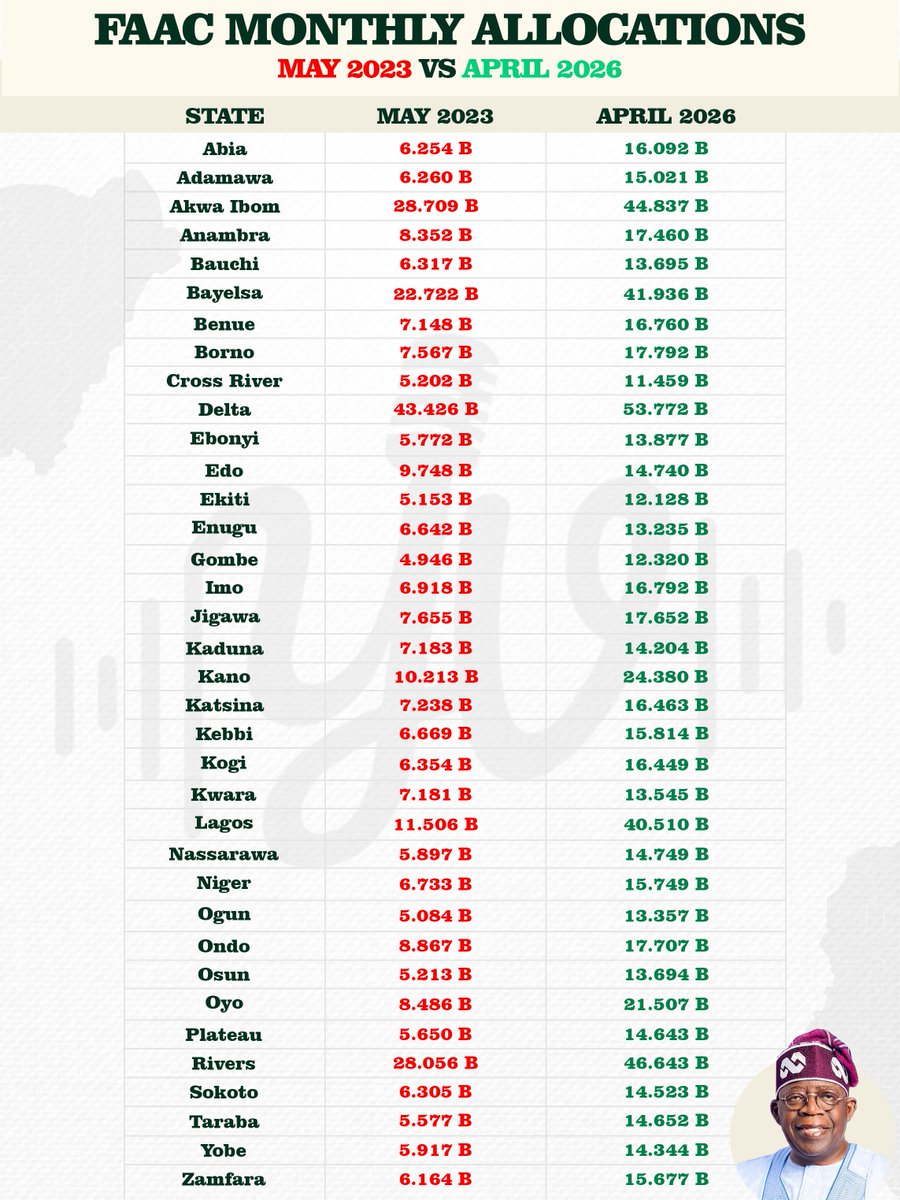
Removing the fuel subsidy and reforming the exchange rate were hard decisions — but necessary. The results are visible. Total federation revenue rose to about ₦21 trillion in 2024, up from roughly ₦12 trillion in 2023 — nearly doubling in a single year.
And despite deregulation, we have avoided the chronic nationwide petrol queues that once defined scarcity.
Local production of petrol has moved from effectively zero in 2023 to about 48 million litres per day — for the first time in a generation, the majority of the petrol Nigerians consume is now refined here at home, not imported.
And this is where energy reform meets the strength of the naira. For decades, every cargo of imported petrol was a standing demand for scarce dollars — a structural drain that weakened our currency. As local refining has risen, that drain has eased: petrol imports fell from about ₦2.3 trillion in the first quarter of 2025 to under ₦90 billion a year later.
Fewer dollars spent on fuel means less pressure on the naira. Energy security and currency stability are not separate goals. They are the same goal.
Second, we restored production and investor confidence.
Crude oil and condensate production averaged 1.64 million barrels per day in 2025 — up by roughly 400,000 barrels a day since 2023, and the highest onshore level in two decades.
Over four billion dollars in international oil company divestments were concluded — deepening indigenous participation onshore while the majors refocus on deepwater and integrated gas. Pipeline uptime is now consistently high, and illegal refining sharply reduced.
Every additional barrel matters — for revenue, for jobs, and for the strength of the federation.
Third, we brought capital back.
Capital is not moved by speeches. It is moved by clarity, competitiveness and confidence. Through targeted presidential directives we improved the environment for deepwater, non-associated gas and midstream infrastructure — and we attacked the cost of doing business.
Contracting that once took thirty-six months now takes around fourteen — and we are driving toward a target of six.
BREAKING: Nigeria 🇳🇬 Foreign reserves rise to $51.04 billion, highest level in 17 years.
Central Bank of Nigeria (CBN) data showed that gross external reserves stood at $51,035,544,733.65, the highest level since January 20, 2009
For decades, structural leakages bled Nigeria's economy dry.
The recent 49% surge in our revenue shows that the systemic fixes by President Bola Tinubu has finally hit the system even outperforming the government's own baseline expectations...
This isn't accidental. It is a deliberate structural blueprint setting up a self-sustaining economy the President promised the populace during the campaign.
May God continue to bless Nigeria!
When we came into office, we made a promise to Nigerians that food security would be a major pillar of our Renewed Hope agenda.
We promised to support our farmers, strengthen local production, reduce dependence on imports, and build an agricultural system strong enough to withstand shocks from beyond our borders.
That promise is being kept.
1/
Nigeria’s revenue surged 49% in the first five months of the year, exceeding government projections as an overhaul of the tax system and new levies on industries including petroleum and mining boosted collections. https://t.co/c0II3HRuJL
“President Tinubu has allocated 250bn to small holder farmers financing under the Presidential Smallholder Financing Program with 500,000 beneficiaries targeted. @bankofagricng is currently disbursing to 320,000 farmers.”
- @ayosotinrin (MD Bank of Agriculture)
Foreign investors have shown renewed confidence in Nigeria’s fixed income market, with about $3.23 billion channeled into Nigerian bonds in the first quarter of 2026, underscoring strong appetite driven by elevated yields, improving foreign exchange stability, and growing confidence in the country’s debt instruments.
The inflow forms a significant portion of the $9.86 billion portfolio investments recorded during the period, accounting for over 31% of total capital importation and reflecting a sharp increase of 267.6% compared to the same period in 2025, as well as a 63.7% rise from the preceding quarter.
Cancer Patients: Joy don come as FG not Tinubu provides cancer subsidies and financial relief funds.
2: These include the Social Determinants of Health (SDOH); the Cancer Health Fund (CHF), and NHIA cost-sharing subsidy for radiotherapy.
3: FG not Tinubu via HM @Fmohnigeria@muhammadpate has approved initial N50 million for verified cancer patients.
4: Under SDOH, FG not Tinubu has approved N100,000 to offset non-medical costs like transportation,food and accommodation.
5: pls let us inform our fathers, mothers, brothers, and sisters e da kun
Hosting a Formula 1 Grand Prix in Abuja will not be as difficult as many may assume. Recently, Nigeria officially submitted a $500 million bid to host a Formula 1 Grand Prix in the nation’s capital. The proposal, led by Opus Racing Promotions in partnership with the National Sports Commission, seeks to bring Formula 1 back to the African continent for the first time since 1993.
"We have seen a massive construction site, the residents appreciate the good work of Mr President and the Governor, and we are seeing the usage of the allocation from the federal level in play"