Sopron, Hungary: 1921 Major Ostenburg leads a detachment of gendarmes through Sopron in support of the West-Hungarians who are protesting the Trianon Treaty which would turn over Burgenland to Austria.
I love these old contemporary illustrations. How the soldiers are either tall and thin or short and fat. There is this regality to the military men that the humour prevents from seeming violent or intimidating.
Picture of a captured Austro-Hungarian soldier during one of their only engagements against America. Taken during the last year of the war, on the western front, the soldiers were a small group sent to reinforce Germany after the surrender of Russia.
The crew of the Austro-Hungarian SMU 12 submarine in 1915. The navy of Austria hungary used foreign built submarines during the great war and even the SMU 12 was a german built U-5 Class submarine. The SMU 12 was sunk by a mine.
Join our discord server: https://t.co/lNG7BObfmN
https://t.co/tpjhs6SkXT This video looks at the experimental organization of the U.S. Army's Rifle Company for the new Mobile Brigade Combat Team (MBCT), how the MBCT differs from the IBCT, and the purpose of the Infantry Squad Vehicle it's based on.
After the US entered World War II, the Army updated its Rifle Platoons to an organization that would only see minor updates throughout the war. They went back to an organic BAR in the squad, plus an M1903 for grenade launching before the M7 launcher for the Garand was adopted.
As the U.S. was mobilizing in 1940, the Army issued new T/Os. In Rifle Cos the large HQ Platoon (which was really an HQ + Weapons Platoon combo) had a new Weapons Platoon split off. Further, BARs were transferred back to the Rifle Platoons in the form of an AR Squad
I believe the reason their Platoon Sergeant is described as an Assistant Platoon Commander ranking Staff Sergeant by Sayen is they repurposed the Demolitions NCO in the Battalion HQ (MOS 533 Demo Specialist) who ranked Staff Sergeant. I don't have the original T/O though
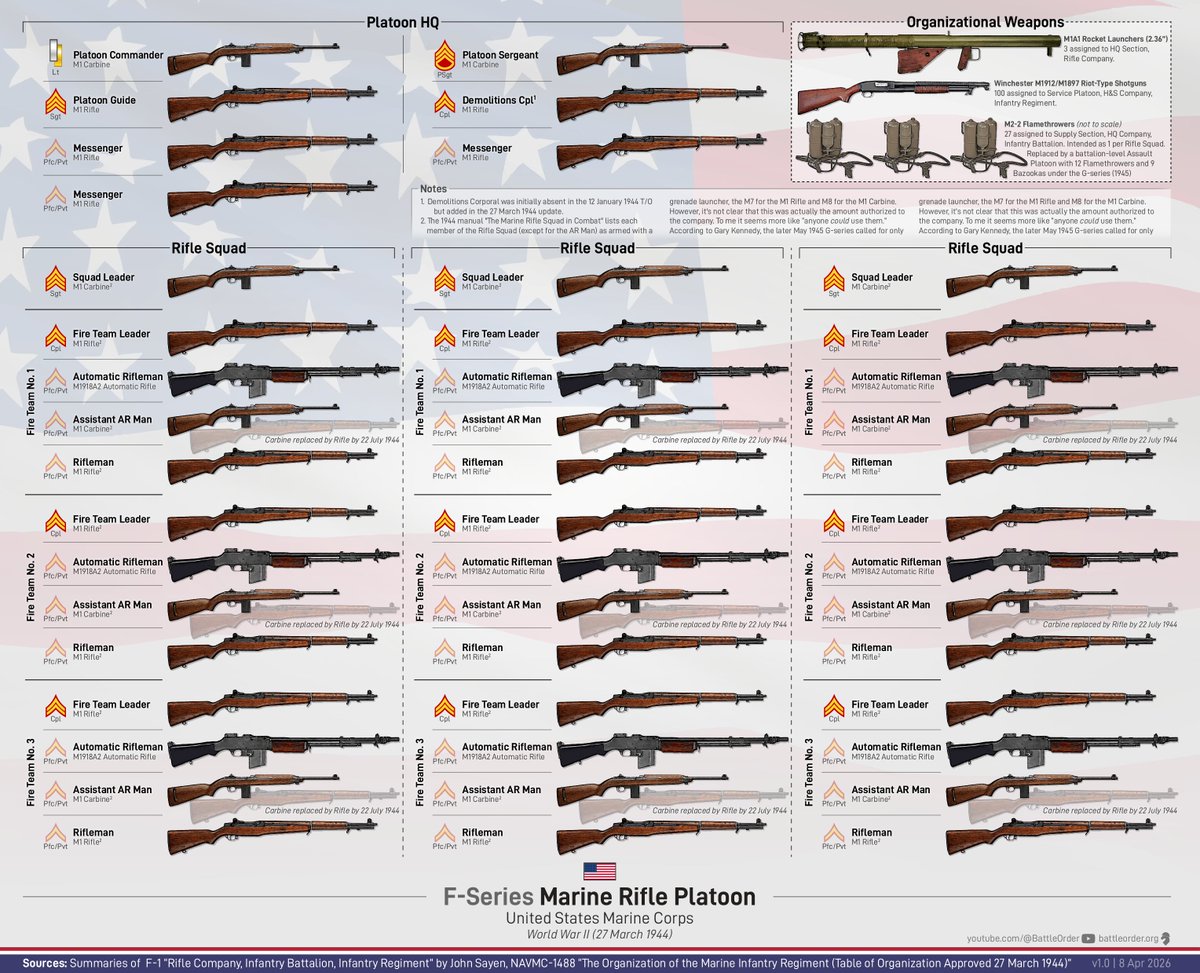
🇺🇸 The U.S. Marine Rifle Platoon's organization as it was reorganized in early/mid-1944. This was the first time the Marine Corps as a whole implemented its longstanding 12-man, 3-fire team structure within squads based on the yeoman work of the Raiders and Paramarines.
@BribesBrutus Infact they had Feuerwerkers on the company level who did assist these platoons however they were in the company HQ not the platoons themselves.
Organization of a 1914 K. u. K. infantry company.
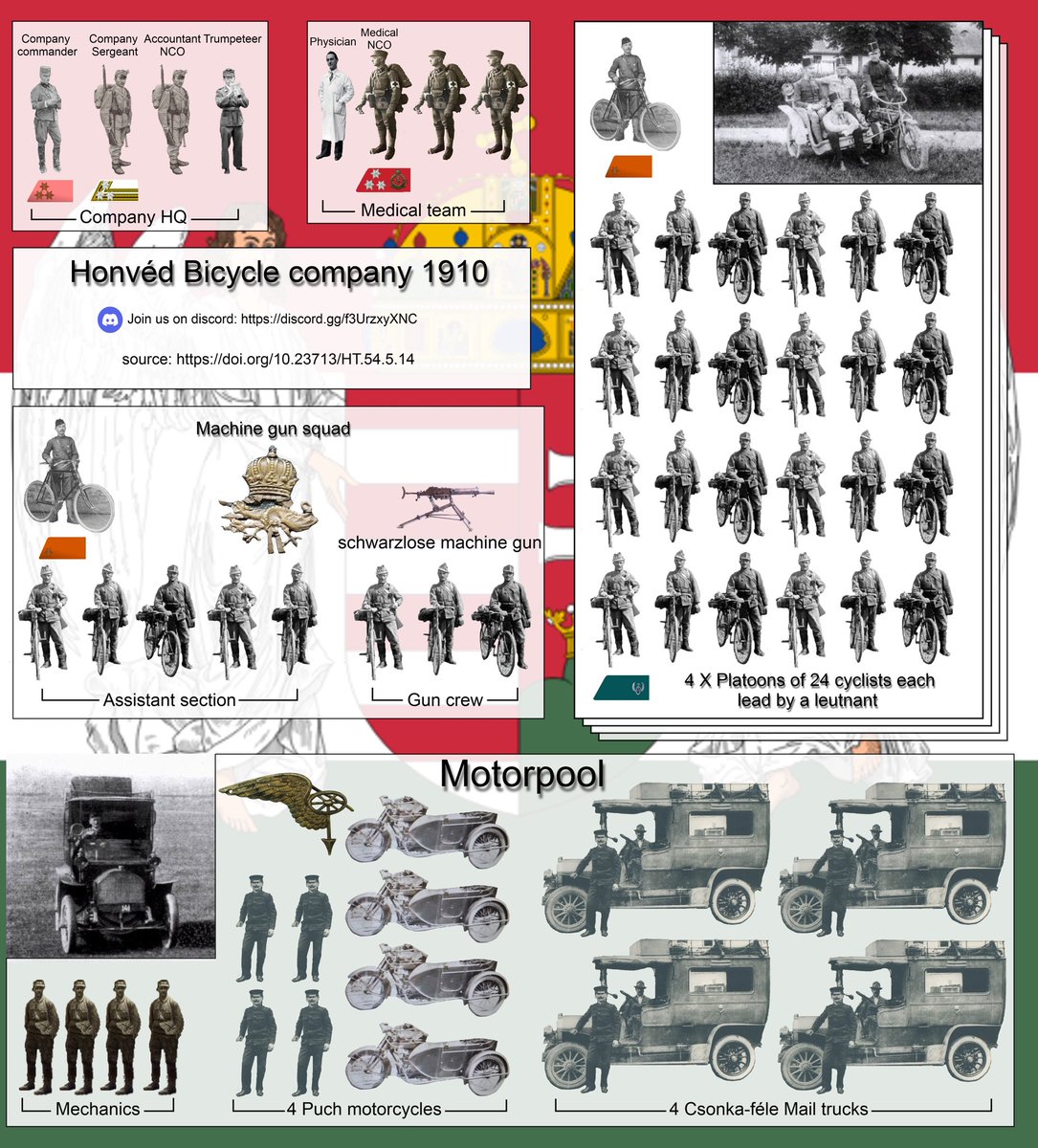
This Austro-Hungarian unit has went through several change through the war this is doctrinal wartime organization. The primary source I used for this was written by Colonel Jenő Pilch.