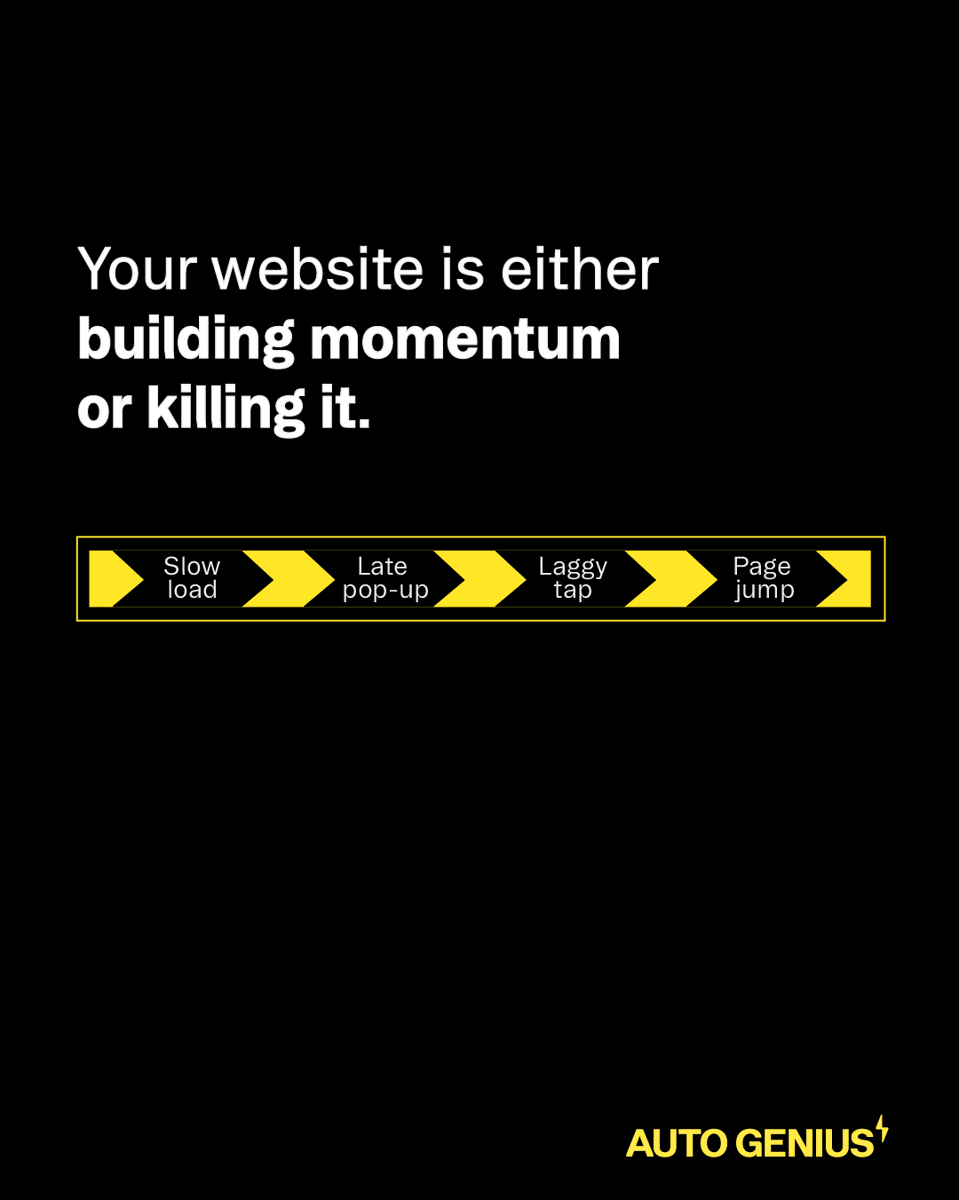
More buttons don’t always mean more opportunity.
Sometimes, they just create more tension.
A shopper lands on a VDP and sees a test drive CTA, a payment tool, a trade tool, a chat bubble, a pop-up, a finance form, a price alert, and three different ways to “get started.”
That doesn’t feel helpful. It feels like homework.
The strongest digital experiences usually do less, better.
Clear path. Clear next step. Less friction between intent and action.
Watch the full session: https://t.co/b8hJbXjyKr
Every click either moves a buyer forward or slows them down.
A slow load.
A late pop-up.
A laggy tap.
A page that jumps right as they try to click.
None of these moments feel huge in isolation. But together, they chip away at momentum.
And momentum matters.
By the time a shopper reaches your VDP, schedule form, or lead path, your website has already told them what kind of experience to expect.
Make sure it is building confidence, not killing it.
Dealership websites used to be built for human shoppers.
But the next version of the web will include more crawlers, more AI tools, more agent-assisted research, and more machine-readable shopping behavior.
That does not make human experience less important.
It makes clarity more important.
A site that is slow, cluttered, unstable, or difficult to parse creates problems for everyone.
Humans lose patience.
Crawlers waste effort.
AI agents struggle to extract clean information.
Analytics become harder to interpret.
Marketing teams lose confidence in what the traffic means.
The winning websites will not just be prettier.
They will be faster, cleaner, more structured, and easier to understand.
For whatever comes next.
Trust forms through response.
Long pauses introduce doubt.
Fast, clean reactions build confidence.
In a world shaped by instant feedback, responsiveness signals preparedness before anything else does.
The internet has trained buyers to expect everything now.
Not soon.
Not after a spinner.
Not once the pop-up clears.
Now.
That is the standard your website is competing against, whether you like it or not.
A slow page does not feel like a technical issue to a shopper. It feels unreliable. It feels clunky. It feels like friction before the conversation even starts.
Your website gets milliseconds to earn trust.
Make them count.
Slow has become the norm in automotive.
Most shoppers aren’t comparing your dealership website to another dealer's website. They’re comparing it to every fast, clean, mobile-first experience they use all day.
When a page drags, jumps, or hesitates, people feel it before they define it. And that feeling changes how much they trust the experience.
Speed is technical on the back end.
To the shopper, it’s emotional.
Watch the full session: https://t.co/b8hJbXjyKr
A lot of paid media performance conversations stop too early.
The ad gets the buyer to the page.
Your website influences what happens next.
If that page loads slowly, hesitates, jumps, or interrupts the shopper too early, the media spend has to overcome unnecessary friction. You are paying to create attention, then asking the buyer to spend that attention waiting.
Before increasing your budget, it is worth asking whether your landing experience is ready to receive the traffic you are already buying.
Does the main content appear fast?
Does the page feel stable on mobile?
Does the CTA respond cleanly?
Are third-party tools delaying the first useful moment?
Is the buyer being interrupted before they even orient themselves?
Better media efficiency is not always found inside the ad account.
Sometimes it is hiding on the page.
Every website add-on has a cost.
Not just a subscription cost.
Every tool adds work for the browser. Each one adds another decision about timing, priority, visibility, and interaction. Each one has the potential to help the buyer or interrupt the buyer depending on how and when it shows up.
That is the part worth auditing.
Not “Is this tool good or bad?”
Instead, ask:
When does it load?
What does it block?
Does it appear before the buyer is ready?
Does it duplicate another action?
Does it improve the journey or just add pressure?
Is it earning the space it takes up?
Modern dealer websites need tools.
They also need discipline.
The stack is not the enemy.
An unmanaged stack is.
Stop over-indexing on one marketing channel.
Email can work. Direct mail can work. Social can work. Events can work. Search can work.
The real question is whether your message earns attention and creates a reason to act.
Dealership marketers don’t need to chase every shiny new platform. They need to understand where their audience is paying attention, what problem they’re trying to solve, and how to show up with enough clarity to matter.
More channels won’t fix weak positioning.
Better thinking will.
Watch the full session: https://t.co/b8hJbXjyKr
Most dealer websites are competing in a sea of sameness.
Same inventory feeds.
Same OEM offers.
Same third-party tools.
Same payment modules.
Same “shop online” language.
Same three or four platform ecosystems.
So the question becomes: where does a buyer actually feel a difference between you and your competitor?
Often, it is not in your offers.
It is in your website experience.
When two dealers have similar inventory and similar pricing, the faster site gets an immediate advantage because it feels easier to trust. The VDP appears faster. The buyer can compare, click, scroll, and move without feeling the drag.
A shopper may not consciously say, “This dealership has better site performance.”
They simply feel less friction.
And less friction creates more momentum.
If your competitive strategy depends entirely on price, incentive, or inventory, you are playing the same game as everyone else. A faster, smoother digital experience gives the buyer a different reason to keep going with you.
Speed is not just a technical improvement.
It is one of the few ways to make a dealership feel meaningfully different before the first conversation ever happens.
Open source AI is moving fast.
Really fast.
The gap between open source models and frontier models is shrinking, which means AI is becoming less about who has access to the biggest tool and more about who knows how to apply the right intelligence in the right place.
Smaller models. Faster deployment. More practical use cases. More ways to build experiences that actually respond to how people shop, search, compare, and decide.
As AI becomes more accessible, the brands and dealers that move fastest will have a real advantage.
Not by chasing every new tool.
By building digital experiences that are ready for the way people and agents will interact with the web next.
Speed builds trust.
And every millisecond counts.
Website traffic is about to get stranger.
As AI agents become more involved in shopping and research, one human buyer may be represented by multiple automated visits before they ever submit a lead or speak to the store.
More visits may not mean more humans.
A quick bounce may not always mean low intent.
A lower conversion rate may not automatically mean weaker demand.
A fast scan may be useful behavior, not wasted behavior.
Your reporting layer is going to need more nuance.
Dealers will need to understand the difference between human browsing, bad bot traffic, useful crawler behavior, and agent-assisted research.
But one thing stays consistent:
Fast, readable, structured websites will matter more.
Humans need the site to feel clear.
Machines need the site to be easy to parse.
Crawlers need the site to be efficient to process.
AI agents need the site to deliver information without unnecessary friction.
AI isn’t just answering questions anymore.
It’s shaping recommendations. Narrowing options. Building confidence. Helping people decide what to trust before they ever talk to a human.
For dealers, your next shopper may not start by browsing your website the way they used to. They may start by asking AI what to buy, where to go, and who deserves their attention.
And when that happens, the brands that win will be the ones with digital experiences that are fast, clear, structured, and easy to understand.
Speed matters. Clarity matters. This is why your website cannot be an afterthought.
The close is coming.
Get in the game.
Car shoppers carry more uncertainty today.
Affordability matters more.
Availability still gets questioned.
Experiences that reinforce confidence early help buyers move forward with less hesitation.
A “good enough” website is harder to fix than a broken one.
Broken creates urgency.
Good enough creates comfort.
The forms work. The inventory loads. The homepage looks fine. The tools are technically functioning. Nothing is on fire, so performance becomes a future conversation.
But average performance still has a cost.
It just does not always show up as a single obvious failure.
It shows up as slightly shorter sessions.
A little more bounce.
A little less trust.
A little more wasted paid traffic.
A little more hesitation before the next step.
A little more effort required from the buyer.
The best operators do not wait for the site to break before asking better questions. They look for the hidden drag inside the experience.
“Good enough” may keep the site alive.
It will not necessarily keep the buyer moving.
Slow websites usually do not get complaints.
They get abandoned.
Most shoppers are not going to call the dealership and explain that the VDP loaded awkwardly, the CTA froze, the mobile experience felt heavy, or the page shifted while they were trying to read. They are not going to tell you the site created doubt.
They are just going to leave.
That makes website friction easy to underestimate.
The feedback loop is quiet. There is no angry survey. No dramatic support ticket. No obvious failure. Just a buyer who had intent, hit friction, and disappeared into another tab.
This is why operators need to inspect the experience before the lead form.
Look at where momentum slows down.
Where does the page hesitate?
Where does the buyer get interrupted?
The back button is too easy to ignore.
Until it becomes your real competitor.
A lot of website performance problems are really order problems.
The question is not only, “How much is loading?”
The better question is, “What gets to go first?”
Most dealer websites have a lot of necessary pieces. Inventory. Images. Analytics. Chat. Retailing tools. Tracking. OEM scripts. Service tools. Payment modules.
If a shopper arrives to view a vehicle, the vehicle should not be waiting behind background scripts. If a buyer taps a CTA, the response should not be competing with non-essential work. If a page is still stabilizing, it should not be interrupted by a tool asking for attention before the main site experience is ready.
This is where teams can start asking better questions.
What absolutely needs to appear first?
What can wait?
What is creating trust?
What is interrupting it?
What is helping the buyer move?
What is just adding noise?
A faster website is not always about removing add-ons.
Sometimes it is about putting things in the right order.
Personalization is one of the most tempting traps in automotive marketing.
It feels sophisticated and sounds like progress, but it comes with a quiet cost: it makes your website heavier, slower, and significantly less stable.
Online frustration carries forward.
When research isn’t clear, showroom and BDC teams spend time resetting basics instead of guiding decisions.
Strong digital experiences protect in-person conversations and keep momentum intact.
We rely too much on standard metrics and accidentally destroy trust. If 1% of your traffic converts, what about the other 99%?. Pounding them with ads might get a click, but it can create a nauseating feeling. Stop chasing bad clicks.