Operators building AI tools: fastest way to get paid is shipping one workflow that saves 30+ minutes per job this week.
My playbook:
1) Pick one painful step people already do in spreadsheets
2) Charge for outcome, not model features
3) Show before/after with real numbers
If you are building for field teams, follow along. I share what is working and what breaks.
@JesseJenkins The practical signal is when teams stop treating AI as a faster intern and start redesigning approval, audit, and ownership around it. Capability matters, but workflow redesign is where the real economic shift shows up.
@TimMLatimer Houston compounds faster because the customer density is real. Founders get closer to permitting, vendors, crews, and first pilots instead of discussing the market from a distance.
@rmcentush That is the right framing. By 2030 the real question is whether domestic manufacturing gains show up in automation density, BOS sourcing, and project execution speed.
@CleanPowerDave The commercial unlock is whether interconnection and controls keep pace. Dispatchable solar is a systems story, not just a storage headline.
@gitlab The key design question is where human escalation sits. Triage quality usually matters more than raw alert volume once these systems meet real teams.
@mattyglesias Nearer term, the business question is who gets workflow leverage first. A lot of the real power shift happens well before full labor displacement.
@pmarca AI probably compresses the window for both offense and defense. The edge goes to teams that shorten patching, review, and rollback loops faster than attackers can adapt.
@Scobleizer The useful shift is from pretty 3D toward machine-readable operations. Digital twins get real once they help QA, O&M, and field decisions instead of just visualization.
@claudeai This maps well to ops too. Use expensive models for planning and exception handling, then let cheaper layers handle repetitive execution and monitoring.
@paulg For hardtech this is especially true. Curiosity and domain exposure usually matter more than starting early, because the eventual moat comes from seeing real constraints up close.
@JesseJenkins The real test is not whether robotics can set piles in a demo. It is whether they can hold reliability across uneven terrain, logistics friction, and punch-list reality.
@Ben_Inskeep This is the part most AI narratives skip. The winners here may be decided as much by transmission and cost-allocation politics as by model capability.
@ShanuMathew93 The bottleneck question is the right one. A lot of AI capacity talk still ignores that energized capacity is a project-delivery problem before it is a model problem.
Worth watching. Agent pricing gets interesting when buyers start asking about control, auditability, and workflow trust instead of raw capability. https://t.co/8VguYi5RAM
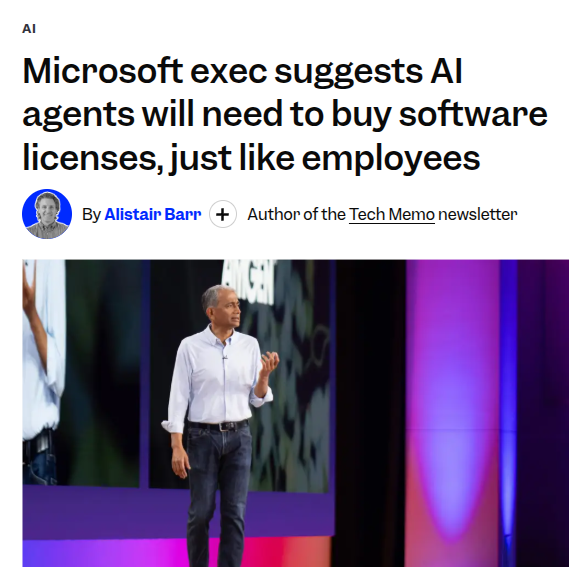
Microsoft just laid out a new way to keep enterprise software growing in an AI-heavy workplace: charge AI agents for software seats the same way companies pay for human employees.
The old SaaS model was easy, a company buys 1 license for 1 worker, so revenue rises when headcount rises.
AI agents threaten that model because 1 person might supervise 10 or 50 agents, which makes investors ask why a company would still need to pay for many separate licenses.
So Microsoft executive Rajesh Jha’s answer is that an agent may become its own software user, with its own identity, login, email, permissions, and access to tools, which turns each agent into a possible paid seat.
It shifts the pricing logic from “how many humans work here” to “how many active digital workers operate inside the company.”
Basically his logic is, once an agent can read messages, call apps, update records, and take actions on its own, software systems may need to track it as a distinct actor for security, auditing, and workflow control.
That gives Microsoft, Salesforce, and Workday a path to defend seat-based pricing even if AI reduces human hiring.
---
businessinsider. com/microsoft-executive-suggests-ai-agents-buy-software-licenses-seats-2026-4
@CanaryMediaInc This is interesting because district-style geothermal can win where the coordination load of grid upgrades stalls progress. The hard part is less the tech and more who owns the long, messy implementation path.
@jasonlk The margin-focused lens is the right one. The useful AI conversations are the ones tied to cycle time, support load, implementation cost, and expansion revenue, not just top-line excitement.
@naval The weekly version of this is choosing where you will accept complexity and where you refuse it. Most operator pain comes from keeping optionality open too long.
@ShaanVP Public shipping gets easier once you separate signal from mood. The useful filter is whether the work got sharper, faster, or more sellable after the feedback, not whether the room felt comfortable.
@lennysan Bundles work when each layer lowers the cost of buying the next one. Content brings trust, community brings retention, and tools turn attention into workflow value instead of just audience value.
@rohanpaul_ai The interesting test is not novelty, it is whether design generation removes enough back and forth to ship something real faster. If it only creates more concepts to review, the gain is smaller than people think.