Pulmonary hypertension causes stiffening and the loss of anisotropy in the right ventricular (RV) wall. These are strongly related to RV maladaptation. #AHAJournals@AvazLab https://t.co/RKQCmeUyn7
Measuring end-diastolic pressure in the left ventricle is crucial in assessing diastolic dysfunction, which can potentially lead to diastolic heart failure. The current measurement method, invasive catheterization, involves discomfort and risk. We sought the possibility of predicting ventricular pressure from cardiac strains, which can be derived from standard cardiac imaging non-invasively. This approach holds promise to broaden access to crucial diagnostic data and reduce the need for invasive procedures in critically ill patients.
@DipanJShah @bmentamu @MethodistHosp
https://t.co/wgeW4bCfpu
While thoracic radiation therapy has been effective in treating lung and breast cancer, it is associated with radiation-induced cardiotoxicity (RIC). RIC is characterized by subclinical changes in cardiac function, which often go unnoticed by traditional global markers. Using a preclinical mouse model in collaboration with @PrasannaAlluri, we found that increased left ventricle stiffness and reduced contractile strains signal early biomechanical remodeling of the heart after radiation exposure. This finding moves us closer to developing advanced translational tools that can aid in the early detection of RIC, supporting improved cancer patient outcomes. https://t.co/R6ESmUKnpV @bmentamu @UTSWMedCenter
Myocardial infarction (MI) leads to scarring and significant biomechanical remodeling of the left ventricle (LV). Global assessment of the LV remains inadequate in the timely detection of LV decompensation post-MI. Our results indicated an excessive loss of LV anisotropy associated with diminished cardiac function post-MI. Quantifying such tissue-level biomechanical markers through cardiac imaging offers to improve early prognostication of heart failure post-MI. https://t.co/81MdvOpwPb
@Texas_Heart @bmentamu
4D cardiac motion tracking is an increasingly important diagnostic tool for many heart diseases. Though several image processing techniques are already being used to quantify regional and global strains, the lack of “ground-truth” measurements challenges evaluating their accuracy. In this work, we propose an in-silico platform to synthesize cardiac images from digital twins for which ground-truth strains are available to assess and improve the accuracy of strain calculation techniques. https://t.co/TSTOFSESr0 @sadayappanlab@DipanJShah @bmentamu
Excited to be at #AHA24 and catch up with friends and mentors! Please check out our short presentation tomorrow on the role of LV anisotropy in the outcome of MI. https://t.co/dQeKAHKx1X
@bmentamu @Texas_Heart
I was honored to present our collaborative work with @GChoudharyMD at the Advances in Right Heart Biology Symposium! We discussed using RV biomechanical remodeling to define the border between RV adaptation and maladaptation and the interaction between RV and PA remodeling. Thank you, @Brownpvd, for the invitation! @CheslerLab@FarahSheikhLab@RRVdpool@BrownPVD @bmentamu https://t.co/UtSqq5Lk4U
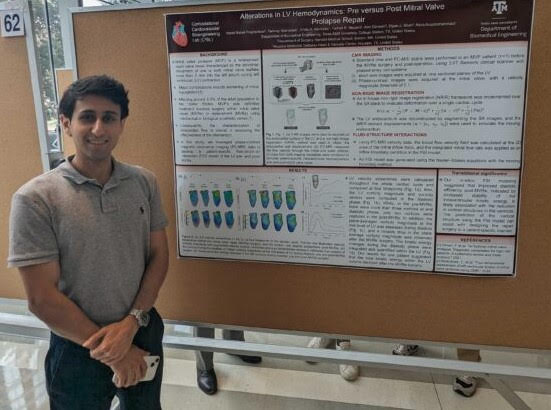
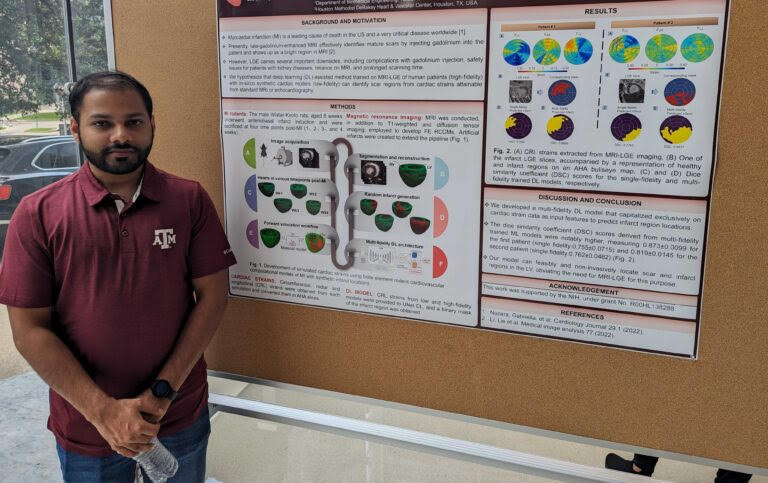
I was grateful to present two of a few cardiac biomechanics posters at #BCVS2024 on behalf of my group. Enjoyed excellent posters on molecular mechanisms and tried to "chime in" and address why we need to study biomechanical mechanisms of cardiac dysfunction too. We studied 1) the biomechanics of radiation-induced cardiotoxicity and 2) the viscoelastic remodeling of the myocardium following infarction. @BCVSearlyCareer @bmentamu @UTSW_RadOnc@Texas_Heart
The quantification of lung regional motion promises to improve the diagnosis of lung injuries. This quantification, however, remains challenging for CT images with low temporal resolution. An in-silico lung phantom replicating realistic lung geometry, microstructure, and motion offers a feasible benchmark for developing, fine-tuning, and validating algorithms to address this challenge. https://t.co/r8mchXhvjJ
@bmentamu @PennRadiology@SPIEtweets@CUDenverENGR
Congratulations to Raza Mehdi for winning a student paper competition award at #SB3C2024. Raza and Nikhil Kadivar, from Dr. Karniadakis's group, demonstrated the possibility of combining limited human data with extensive in-silico data to produce a highly predictive AI model for humans. Preprint: https://t.co/I3S6DdYJmK @SB3Corg @bmentamu @BrownUniversity@MethodistHosp
Congrats to Tanmay, Raza, and Babak from @bmentamu on being finalists in PhD/MS student paper competitions at #SB3C2024. I wish them the best of luck, and many thanks to the SB3C community for their support!
Congratulations to Raza and Babak for winning the best abstract awards, cash prizes, and a junior trainee talk at CVBE 2024 (https://t.co/15FjgksmNY).
Raza: Composite in-silico-human data learning, in collaboration with Dr. Karniadakis @BrownUniversity
Babak: CMR-driven LV hemodynamics with @DipanJShah
@bmentamu @MethodistHosp
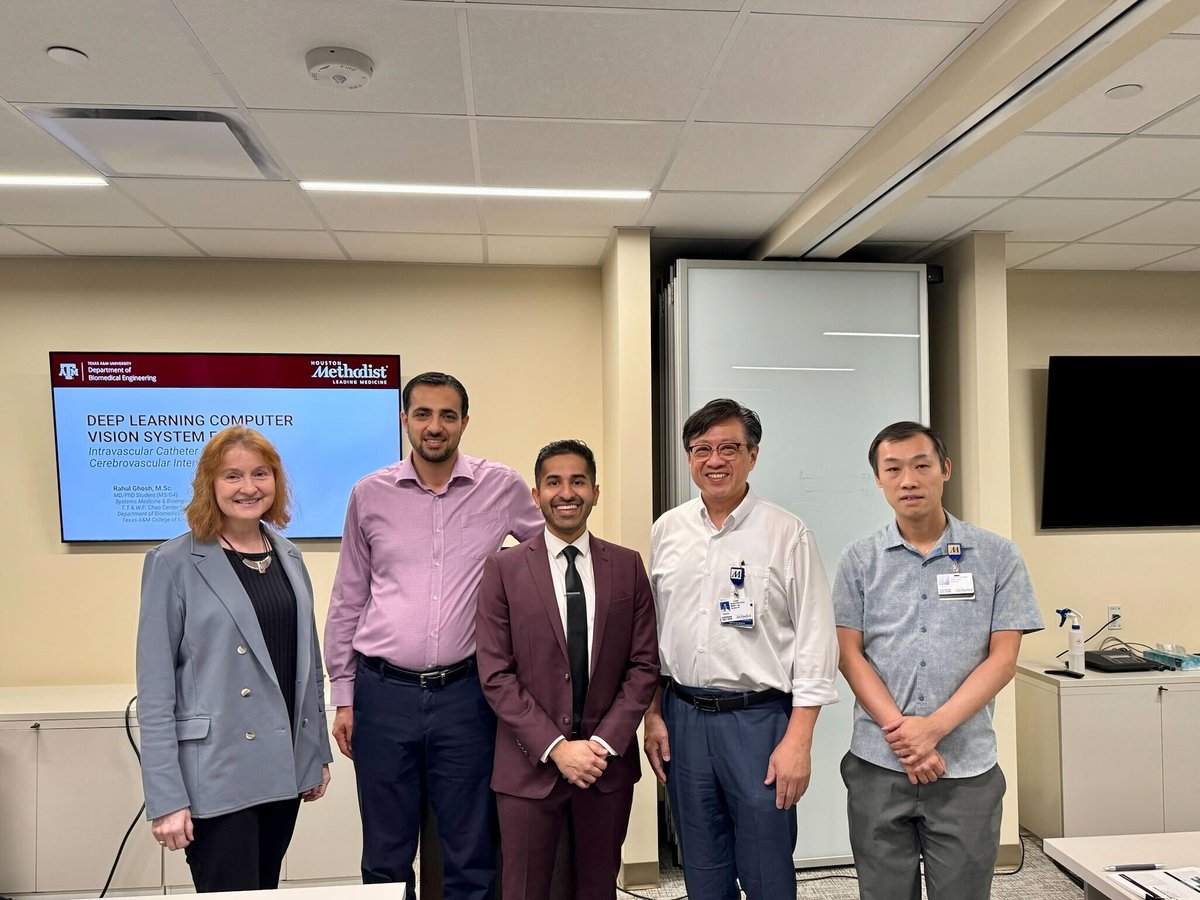
Very proud of @ghoshrx, my first PhD student, who defended his dissertation last week. Co-chaired by Dr. Stephen Wong, @ghoshrx developed an AI system to track a catheter tip within cerebral arteries on X-ray fluoroscopy, advancing future vascular robotics systems. @MethodistHosp @bmentamu
Cardiac strains, presented in (Radial, Circumferential, and Longitudinal) axes, are used as regional and global contractility measures. While these "normal" strains represent the thickening/shortening of the wall, they do not contain information on shearing. "Shearing" drives LV torsional motion that would complement "normal" strains to describe LV contractility. We are investigating the importance of LV torsion in the assessment of MVP patients. https://t.co/dcESAG4FDD @DipanJShah
Left ventricular impaired relaxation is a common result of LV diastolic dysfunction. The role of LV passive remodeling in slowing LV relaxation (which is an active behavior) remains elusive. Our early results suggest that LV passive stiffening not only passively restricts LV filling but may also contribute to the slow restoration of active forces in diastole. @sadayappanlab
https://t.co/GAsjsiU3oz
Remodeling studies in pulmonary hypertension have focused on either the RV or PA side, leaving the understanding of the RV-PA remodeling relationship elusive. We're studying the effects of PA stiffening on RV afterload and on RV remodeling. https://t.co/fd6VEdtgeK @GChoudharyMD
Myocardial remodeling, a key determinant in many cardiac diseases, is often described by dimension & ECM content. We took a multiscale approach, dissecting fiber remodeling shares to organ dysfunction & seeking to enable the inverse estimation.@Texas_Heart https://t.co/GQW3AkGxYS