But here is the problem:
The volume and speed of generated code have outpaced our ability to read it. And that changes the game entirely. If you are treating AI generated output as something you need to carefully read, line by line, you have already fallen behind.
We were probably never meant to write or read code.
Programming began at the lowest level: Assembly.
You had to think in registers, memory addresses, and ports. Every instruction was explicit, mechanical, and unforgiving.
And now we have taken it even further.
AI can generate entire codebases fast, functional, and often nearly flawless.
What once took days now takes minutes.
Open-source XLeRobot Perception Engine
- Real-time pan/tilt camera head tracking (moving objects in FOV)
- Scene description and conversational interaction
-@LeRobotHF Compatible robot wrapper for easy migration to hardware
New milestone: we trained a robot foundation model on a world model backbone, and enabled zero-shot, open-world prompting capability for new verbs, nouns, and environments. If the world model can "dream" the right future in pixels, then the robot can execute well in motors. We call it "DreamZero", our first World Action Model (WAM).
Our team had tons of fun at the lab typing anything we like into an open text prompt, and watch the robot perform tasks it was never trained on. An emergent capability we didn't quite expect. Obviously not GPT-3 reliable yet, but we are marching into the GPT-2 era.
Discoveries:
- Model and data recipe co-evolve. Compared to VLAs, WAMs learn best from diverse data, breaking away from the conventional wisdom that lots of repeated demos per task are the bread and butter. Diversity >> repetitions.
- X-embodiment is extremely hard. Pixels are the answer. Different robot morphologies traditionally have a hard time sharing knowledge well. But if we put video first, pixels become the universal bridge connecting different hardware - even videos of human first-person view.
DreamZero shows significant robot2robot and human2robot transfer. With only 55 trajectories on a *new*, unseen hardware (~30 min of teleop), it adapts so quickly and retains zero-shot prompting ability.
Yesterday I posted about the "Second Pre-training Paradigm": world models are the next-gen foundation of Physical AI, not language backbones.
Today, we are proving it works. And 2026 has just begun.
Paper: World Action Models are Zero-Shot Policies.
Read it now: (thread)
Robotics eras
- Era 1: Passive dynamics, intelligence can live in the body.
- Era 2: Kinematics replaced perception. Fixtures replaced planning.
- Era 3: Perception produced state. State fed planners. Planners fed controllers.
Era 4: RL as discovery
Era 5: foundation models that blur the boundary between perception, reasoning, and control.
source:
https://t.co/3UXJ31Y7O3
OpenMind is an open-source robotics library for building, training, and deploying embodied AI systems that connect perception, reasoning, and action in real robots and simulators.
Moltbook is nothing more than a puppeted multi-agent LLM loop.
Each “agent” is just next-token prediction shaped by human-defined prompts, curated context, routing rules, and sampling knobs.
There is no endogenous goals.
There is no self-directed intent.
What looks like autonomous interaction is recursive prompting: one model’s output becomes another model’s input, repeated.
Controversial outputs aren’t “beliefs,” they’re the model generating high-engagement extremes it learned from the internet, because the system rewards that behavior.
"robotics is an inherently interactive domain; small errors in action prediction accumulate over time, and lead to different outcomes"
source:
https://t.co/GyhUPrH79v
"The problem with this warehouse style data collection approach is that what you are trying to do is mimic the complexity an realism of the real world, but at the end of the it is just a rough approximation. The way to get the most real data is to put robots in the real world doing real things"
source
https://t.co/ZeaN381iwk
We profiled the most hyped robotics company in the world. Inside Physical Intelligence with Co-founder @lachygroom
Exclusive interview in the Physical Intelligence robotics lab, who’re backed by top investors to build robots which work in the real world. Not just scripted environments.
We cover:
0:00 So…What is Physical Intelligence?
1:41 Why can’t we solve Marovec’s Paradox?
2:33 Live Demo: Meet the Machines
4:17 Why robots still struggle today…
6:14 Meet PI’s Investors (Thrive Capital)
7:19 Teaming up with the mega-brilliant co-founder group of Karol Haussman, Sergey Levine, Chelsea Finn, Brian Ichter, Adnan Esmail & Quan Vuong
9:20 PI’s Robot Capabilities
11:37 How are they making intelligent robots?
13:43 The Future Impact of Everyday Robots
15:49 Jeff Bezos Investment in Physical Intelligence 16:43 What will the next 1-3 years look like?
17:54 Revealing PI’s Work Culture
19:23 Outro
Real-world data beats surrogate shortcuts.
"Just like you won’t become an expert tennis player by hitting balls against the backboard or watching Roger Federer on TV, even though both replicate some aspects of the true tennis pro experience, the robot won’t master the real world unless it gets to see itself doing stuff in the real world."
"System 2 (S2) reasons slowly about goals: interpreting scenes, understanding language, and sequencing behaviors.
System 1 (S1) thinks fast, translating perception into full‑body joint targets at 200 Hz.
System 0 (S0) executes at 1 kHz, handling balance, contact, and coordination across the entire body.
Together, they form a tightly integrated hierarchy from pixels to torque."
source: https://t.co/Ll9fEr6pXG
"if we continue to find that vision is ‘good enough’ to keep solving harder and harder tasks, that would make useful manipulation a data collection problem (apply effort: get data) not an invention problem (try things over and over hoping that someday one works)."
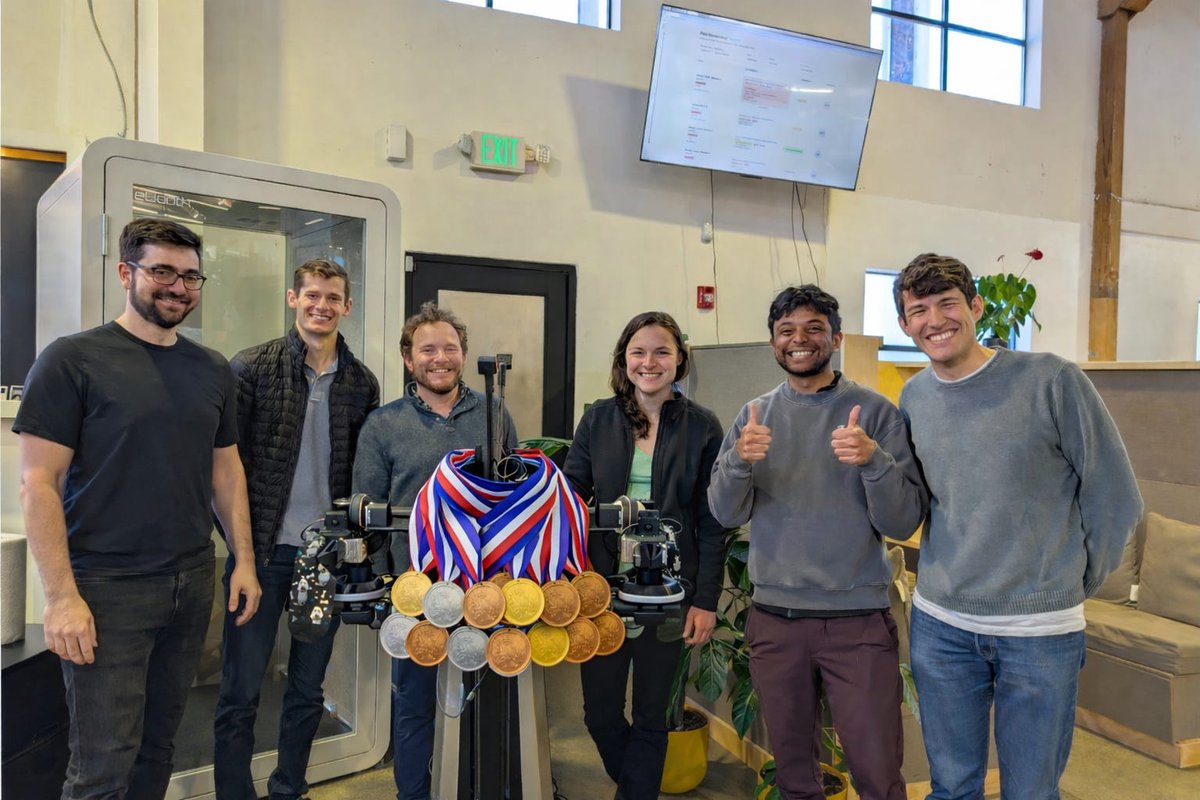
Benjie posted a reply to the Physical Intelligence "Olympics" attempt: https://t.co/sPkc5DK4ls
Some nice discussion about what makes a task hard, how current learning methods should change how people think about robotic capability, and some interesting commentary.