AI credits for less.
Unified access to leading AI models, powered by intelligent inference optimization.
$ANR Ca:- 0x1d08d2e96e7712b754048dd1c2e7a6e878ed4913
The demo walkthrough is live , showing the end-to-end integration workflow:
• Base URL configuration ([https://t.co/hLbxTJYq9B](https://t.co/hLbxTJYq9B))
• Multi-model access across Anthropic, OpenAI, Google, xAI, and DeepSeek
• Per-key spending limits and zero-storage memory execution
AI agents need more than intelligence. They need operational boundaries.
As autonomous agents move from experimentation into real workflows, they will increasingly make decisions that consume resources, trigger API calls, and execute tasks without constant human supervision.
That creates an important engineering challenge: how do you let an agent operate independently while keeping its resource usage predictable and its actions within defined limits?
The answer lies in treating financial control as part of the infrastructure, not an afterthought.
Autonomy should not mean unlimited authority.
It should mean the ability to act independently within clearly defined constraints.
This is an important consideration for the next generation of AI systems.
What if holding $ANR could unlock more than just a token?
What if it gave you access to a deeper layer of Avenro advanced analytics, better visibility into inference costs, and tools built for developers who want more control?
We’ve been thinking about how $ANR can become part of the product itself.
Not just something that exists alongside Avenro.
Something that gives it utility.
More soon.
Every API call generates a trail of operational data. The key is making that telemetry clear without compromising sensitive payloads.
Avenro provides end-to-end trace visibility into every request tracking execution from authorization to final token delivery.
With dedicated headers for request identification, exact token metering, real-time cost calculation, and execution paths, teams have the full context needed to trace issues and reconcile spending.
This observability stays strictly anchored to execution metadata, keeping prompts and generated responses out of persistent logs.
As AI infrastructure matures, having granular insight into what a request costs and how it executes is essential.
That transparency is core to Avenro.
Built for inference you can inspect and audit.
The Avenro roadmap is live on our website.
Today, we shipped Request-Level Observability another step forward for $ANR
More updates are planned and you can explore our Under Consideration section to see what’s being considered for future releases.
We’ll keep building and shipping according to the roadmap, with updates as each release goes live.
Check it out
https://t.co/bQZy9EDg11
As AI agents become more autonomous, controlling their access to compute becomes an infrastructure problem.
An agent can execute workflows, make repeated model calls, and operate across multiple stages without direct human intervention at every step.
The cost of an individual request may be negligible. The cumulative cost of an unrestricted workflow may not be.
This changes how AI infrastructure needs to be designed. Budgeting cannot exist only at the account level; it must also account for the applications, credentials, and automated processes consuming inference.
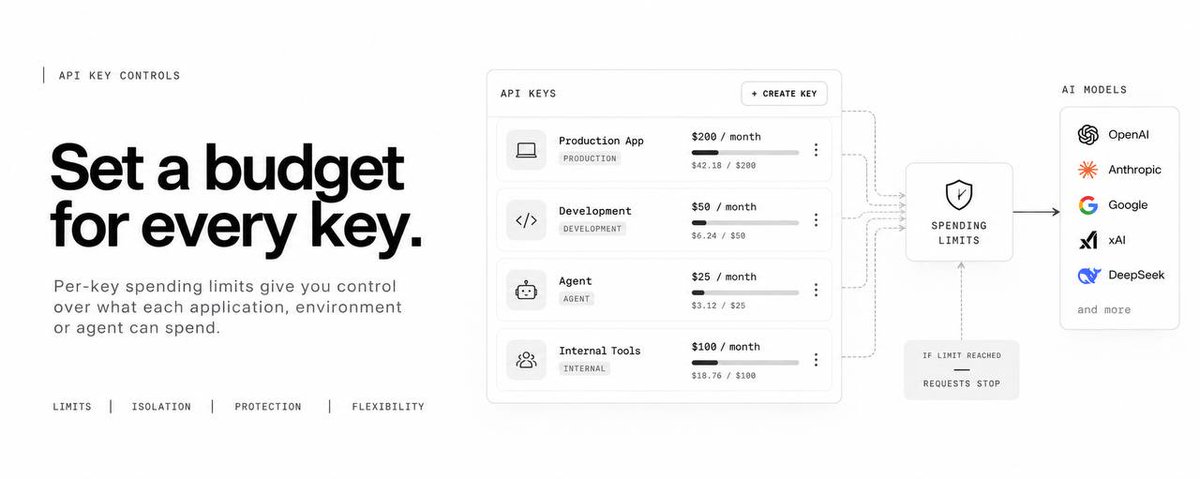
Avenro’s per-key spending limits provide one layer of that control, allowing developers to establish financial boundaries for individual workloads.
Autonomy should not mean an absence of financial constraints.
Request-level observability is now live.
Every inference call leaves behind useful operational information. The challenge is making that information accessible without compromising the data being processed.
Avenro now provides request-level metadata that helps developers connect API activity with actual usage and execution.
With request identifiers, token accounting, cost reporting, and execution-path details, developers have a clearer basis for investigating unexpected behavior and reconciling inference spend.
The implementation keeps observability focused on operational metadata rather than making prompts and generated responses part of persistent logs.
As AI workloads move into production, understanding how requests execute and what they cost becomes just as important as receiving the response.
That visibility is now part of Avenro.
Built for inference you can inspect and account for.
https://t.co/CiNV7wTGyV
The cost of inference is not just a model-pricing problem.
It is a workload allocation problem.
A production application rarely sends every request through the same reasoning path. Some tasks require advanced reasoning. Others involve extraction, classification, summarization, or routine generation.
Using the same model for every task can introduce unnecessary cost and complexity.
A more efficient architecture considers the requirements of each workload, the capabilities of the available models, and the economics of executing the request.
This is where model choice and inference infrastructure intersect.
Avenro is built around that intersection: unified access to multiple model providers, with a focus on reducing the cost and operational overhead of inference.
The objective is not to use the largest model for everything.
It is to make model access more efficient at the application level.
GM everyone.
Next update: Request level observability.
Understanding an AI request shouldn’t end when the response arrives.
We’re extending Avenro’s API observability with request level execution metadata, giving developers a clearer view of how inference requests are processed.
The focus is on four things:
— Request identification
— Token usage
— Exact request cost
— Execution path
The objective is straightforward: make inference easier to inspect, debug, and account for without exposing prompts or generated outputs through observability data.
Better visibility into every request. Without adding complexity to the integration.
An API key should not be able to spend more money than you intended.
In many AI applications, an API key is effectively a bearer credential with access to an account level balance. If that key is exposed, the financial blast radius can become much larger than the workload it was created for.
Avenro treats spending limits as part of the API key itself.
A production key can have its own predefined limit.
A development key can have another.
An agent can be restricted to its own budget.
If a key reaches its limit, requests stop regardless of how much balance remains in the broader account.
This creates a simple boundary:
Account balance ≠ key budget.
It also means teams can distribute credentials across applications, environments, and automated workflows without giving every key unrestricted access to the entire account.
Authentication tells you who can make a request.
Avenro’s per-key limits also define how much that credential is allowed to spend.
Financial controls should be part of the inference infrastructure, not something developers have to build around it.
The Model Catalog is now live.
Avenro now provides a dedicated view of the models available through the API, bringing the key information into one place:
Provider
Input & output pricing
Avenro pricing
Context window
Capabilities
Availability
The catalog is connected to Avenro’s underlying model configuration, so the information reflects the models and pricing the API actually supports.
One less place for developers to look when choosing a model.
Most AI gateways need to see your requests.
That doesn’t mean they need to keep them.
Avenro is designed around a zero-storage inference pipeline.
Prompts and generated outputs pass through the gateway in transient memory while the request is being processed. They are not written to a permanent prompt database or retained as application data.
What Avenro needs to retain for billing and infrastructure purposes is separated from the content itself:
The system can record the information required to account for usage such as token counts, cost, request identifiers and execution metadata without turning customer prompts into a persistent dataset.
This distinction matters.
Developers increasingly send proprietary code, internal documents, customer data and application context through AI APIs. A gateway sitting between an application and a model provider should minimize the amount of sensitive information it retains.
Avenro is built around that principle:
Process the inference.
Meter the inference.
Don’t build a database of the inference.
Privacy shouldn’t require developers to give up observability, billing accuracy or multi-model access.
We’re 50% through the next Avenro update.
The Model Catalog is taking shape, with the core model data layer and catalog structure now in place.
The remaining work is focused on completing the model metadata, pricing presentation, availability states, and final interface details.
The goal is to make model discovery and comparison clear without adding another layer of abstraction between developers and the models they use.
More soon.
Next up : Model Catalog.
We’re building a dedicated model catalog to make the model layer easier to inspect and work with from a single interface.
It will bring together the models available through Avenro across Anthropic, OpenAI, Google, xAI, and DeepSeek, with the information developers actually need when choosing a model:
Provider
Input & output pricing
Avenro pricing
Context window
Capabilities
Availability
The catalog will be tied directly to Avenro’s underlying model configuration, so the information shown reflects what the API actually supports.
Currently in development.
The current model landscape is increasingly heterogeneous.
OpenAI, Anthropic, Google, xAI, and DeepSeek are optimizing different parts of the inference stack, resulting in meaningful differences in reasoning, context handling, latency, capability, and cost.
For production systems, model selection is therefore becoming a workload-level decision rather than a vendor-level decision.
Avenro provides a common interface across these models, allowing applications to select and switch models without changing their integration layer.
Monitoring Usage
Track consumption metrics, token counts, and remaining balances directly through the https://t.co/a9QLnQX4ET dashboard or via response headers returned with each execution.
Avenro provides a single OpenAI-compatible endpoint (https://t.co/jD5DhVlbIj) to access 9 frontier models across Anthropic, OpenAI, Google, xAI, and DeepSeek at ~40% below retail list prices.
Here is the setup process for integration into existing pipelines.
Privacy and Data Handling
The gateway enforces a zero-storage memory policy. Prompt and completion payloads reside exclusively in volatile memory during transit and are not written to persistent storage or logs.