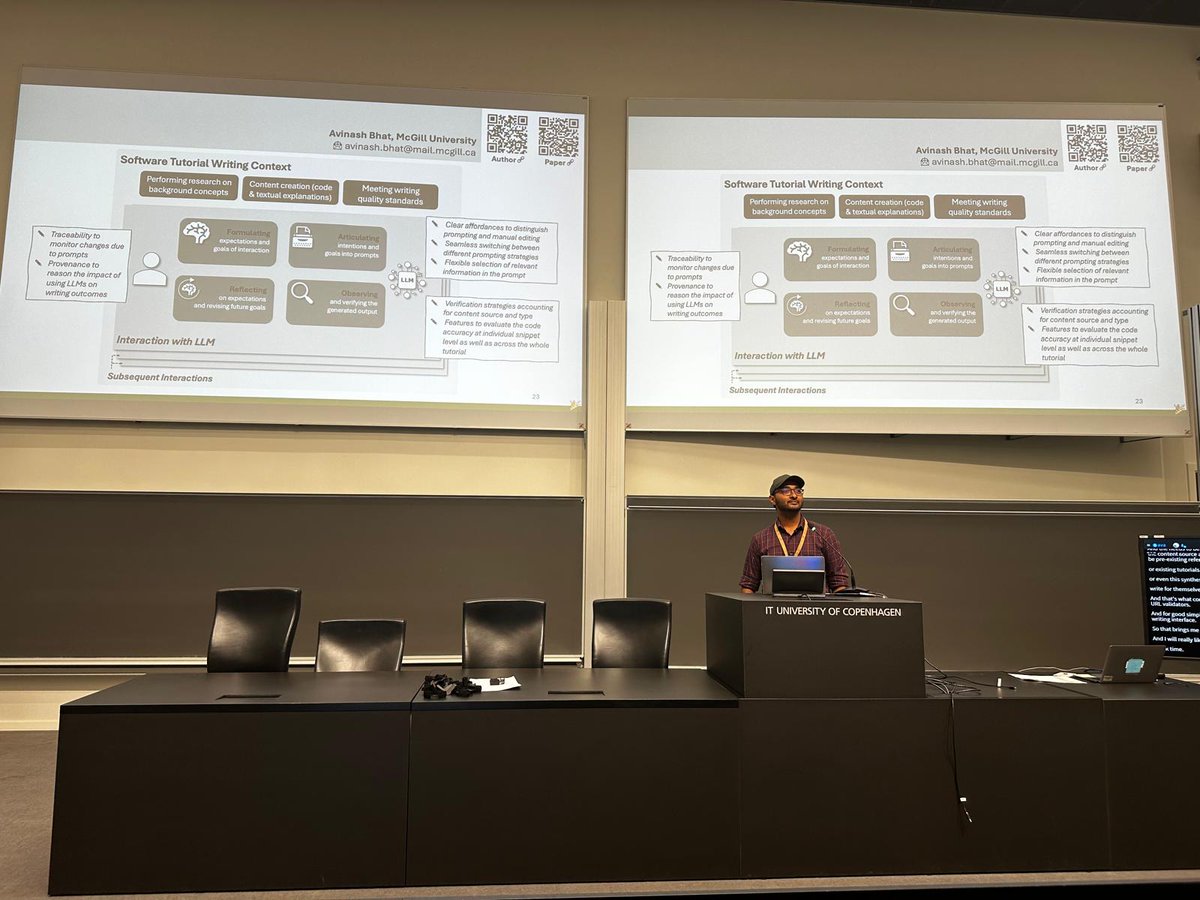
Presented our paper "Do LLMs Meet the Needs of Software Tutorial Writers?" at ACM #DIS2024 today.
Work done with @DishaShrivasta9 and @Jin_LC_Guo.
Read the article here: https://t.co/kvhG3df4E6 (Open access).
Lost my phone at the office and spent 30 minutes turning the place over. Find My was disabled by MDM.
Out of ideas, I asked Claude how I could find it. It suggested tracking the Bluetooth signal strength, then wrote me a meter in about a minute.
I walked around watching the number climb. Found it.
Apparently you can just make the tool you need now.
Code: https://t.co/fmnISzHfZ2
Last Friday, the Montréal HCI group had the pleasure to welcome two HCI superstars for a visit and extended demo session at our lab. Thank you for visiting us, Wendy and Michel—we all learned a great deal!
The study has been approved by the McGill Research Ethics Board (REB file 26-01-103).
Please fill out our short interest form if interested: https://t.co/tZAuSUhnJe (4/4)
We are recruiting IT and software professionals for a study on AI adoption in organizations: https://t.co/tZAuSUhnJe. It is a ~60 minute interview on Microsoft Teams. Your responses will be kept confidential and fully anonymized. (1/4)
Who we're looking for: Software engineers, developers, technical writers, instructional designers, product managers, program managers, or professionals in sales, marketing, or legal at an IT or software company. (3/4)
Being a PhD student is hard for many reasons. On paper, the flexibility can seem like an advantage: you often do not have a fixed schedule or many strict deadlines. In practice, however, that same freedom can become a trap. Since your progress depends so much on your own initiative, it is easy to convince yourself that every extra hour of work is an investment in your future. For students who are already inclined to overwork, this can blur the line between dedication and self-exploitation, eventually leading to burnout.
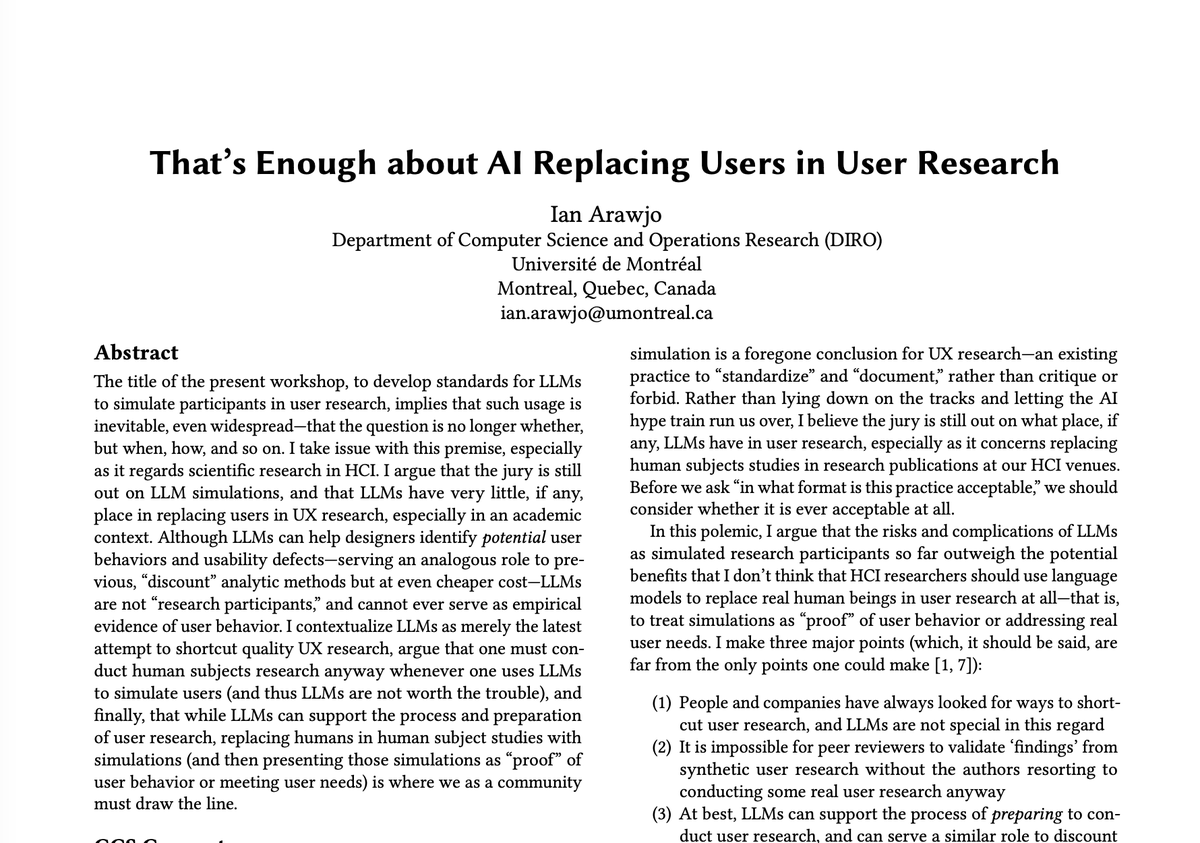
At CHI '26 I presented my position piece, "That's Enough about AI Replacing Users in User Research," at the Workshop on LLMs as Simulated Research Participants. It was controversial, although (imo) well-received. I've now posted it on my site: https://t.co/1YrD3j9aEE
Looking forward to our TechAide AI Conference today, during which we're raising funds to fight poverty and social exclusion in Montreal.
If you'd like to contribute, you can make a donation here:
https://t.co/cMOCWblnhI
Any amount is greatly appreciate!!
A few months ago, I released Splat: an affinity diagramming tool in a single file. Today, a bright PhD student at Northeastern extended Splat to create "Splatter", with many more features for qualitative analysis, like tags and a codebook. Try it here: https://t.co/ukUwtxUfp9
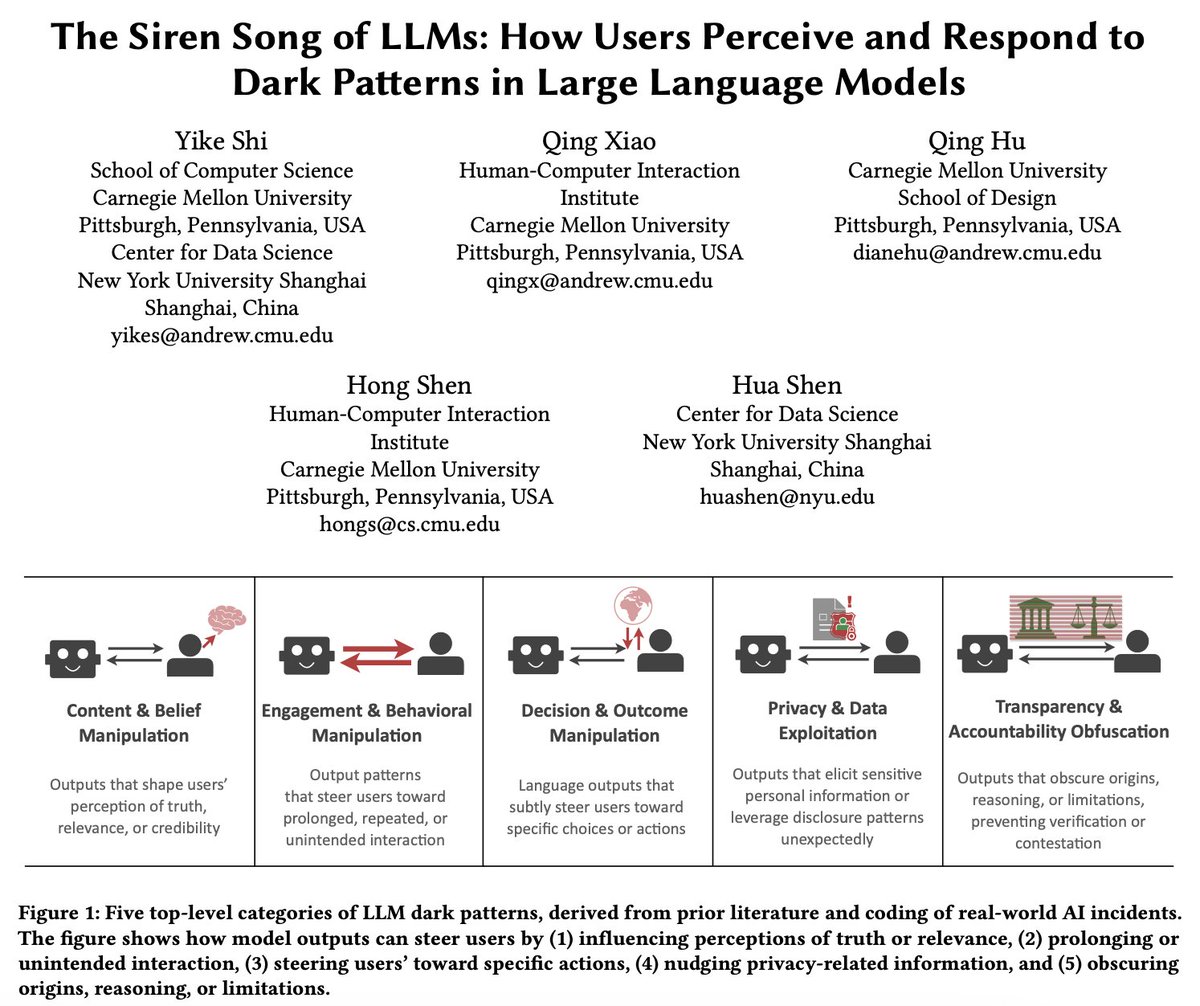
Thrilled to share our #CHI2026 paper “The Siren Song of LLMs: How Users Perceive and Respond to LLM Dark Patterns” received a Best Paper Honorable Mention🏆!
We take a first step in defining "LLM Dark Patterns" and identify 5 categories (11 subcategories). Would love to learn from your experiences —please share with us via our website🙌!
🌐 LLM Dark Pattern - Website: https://t.co/zO46AFSVAU
🔗 Paper: https://t.co/K8IQOQqmz6
🥰A few special *firsts* in this work: @YikeS101003's first *first-author* & CHI paper, my first paper as a professor🙏, our first CHI Award — and welcoming Yike to be the first PhD student in our BiAlign Lab @NYUShanghai🥳!!!
💗Very grateful for the incredible work from Yike and our wonderful collaborators @hongshenus@QingXIAO__Comm @ Diane Hu, thank you all🥰!
We’ll be at #CHI2026 in Barcelona for the paper and hosting our Human-AI Alignment Workshop 🎉 — love to connect over ☕️🍩 chat!
I'm happy to share that we (@AnthropicAI) are investing $1.5 million in support of the Python Software Foundation and open source security.
Python powers so much of the AI industry. Supporting the folks that make our work possible is an honor.