the figs will rot if you don’t eat them. the jasmine blooms for three weeks and then it’s over. your body at twenty-five will never come back, and neither will your body at forty-five. everything you’re saving for later spoils in the waiting. 1/6
writing will genuinely change your life more than motivation ever will. not in some cringe “manifest your dream life” way. i mean in a very real, practical way. most people never actually stop long enough to understand what’s going on inside their own head. they just react to life all day. scroll when they feel uncomfortable. distract themselves when things get quiet. jump from one dopamine hit to the next. but writing forces you to slow down for a second and actually look at your thoughts instead of running from them. and the weird part is you usually don’t even realize what you truly think until you start writing it down.
writing doesn’t just record your thoughts it creates them. ideas start flowing that you didn’t even know were there. patterns start showing up. emotions start making sense. problems become easier to solve because they’re no longer this giant fog floating around in your head. writing organizes your mind. every high performer, every sharp thinker, every person who just gets it, they all write. It keeps showing up as the common thread. not the expensive stuff. not the complex stuff. Just pen and paper. they write because feelings are vague but words are precise. every time they sit down and search for the exact word to describe what’s inside them, they become a sharper, more powerful communicator.
“people follow the person who can say what they mean and mean what they say. writing every day is how you build that muscle until it becomes second nature.”
over time, all that accumulated writing becomes a resource you can draw from forever. the more you write, the more material you have to solve problems, connect dots and think bigger.
the better you get at putting thoughts into words, the better you get at communicating in general. and honestly, communication controls a huge part of your life. like relationships, opportunities, business, confidence, influence, all of it comes down to how clearly you can express yourself. and no, you don’t need to be some amazing writer either. your grammar doesn’t need to be perfect. nobody cares. half the benefit comes from simply getting thoughts out of your head and onto paper.
some of the best writing advice i’ve ever heard was:
“write badly. just write.”
because the moment you stop trying to sound smart or perfect, your real thoughts finally start coming out.
even 30 minutes a day changes something in you. you become calmer because your mind isn’t carrying around a thousand unprocessed thoughts anymore. you become more self aware because you start noticing your own habits and emotional patterns. you become more articulate because you’re practicing turning feelings into language every single day.
if you write every day, your future self gets to sit down and read exactly how far you’ve come. i think that’s more valuable than any photo album.
who knows maybe one day all that writing becomes a book, a course, something you give your children. at the very least, it becomes proof that you were here, that you grew, that you tried.
that’s one of the coolest parts about it. writing lets you watch yourself evolve with time.
seriously. start writing. doesn’t matter if it’s in a notebook, your notes app, twitter wherever. just sit, think about your thoughts and write.
just sit down for 30 minutes and let your mind speak for once. and watch yourself becoming unstoppable.
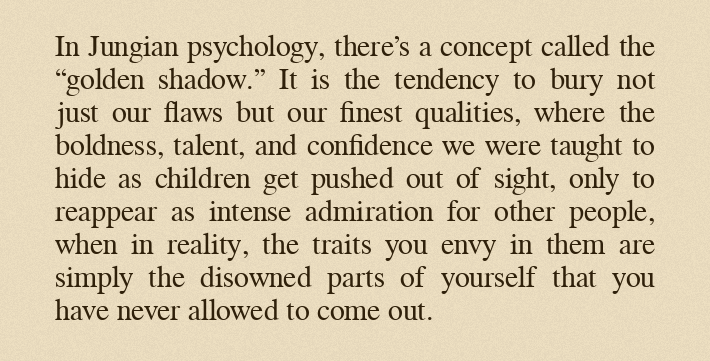
The kindest thing literature does is remind you that your peculiar little feelings have always existed. Someone, in some century, was equally confused by love, bored by society, tired of performing, and hungry for meaning.
biggest loss of third spaces is the death of spontaneous "building ke niche" sports culture. we used to grab a bat or a racket at 10pm and just play. now, if it isn’t ₹2,500/hr on an app, adults refuse to show up. we forgot how to have unmonetized fun!!
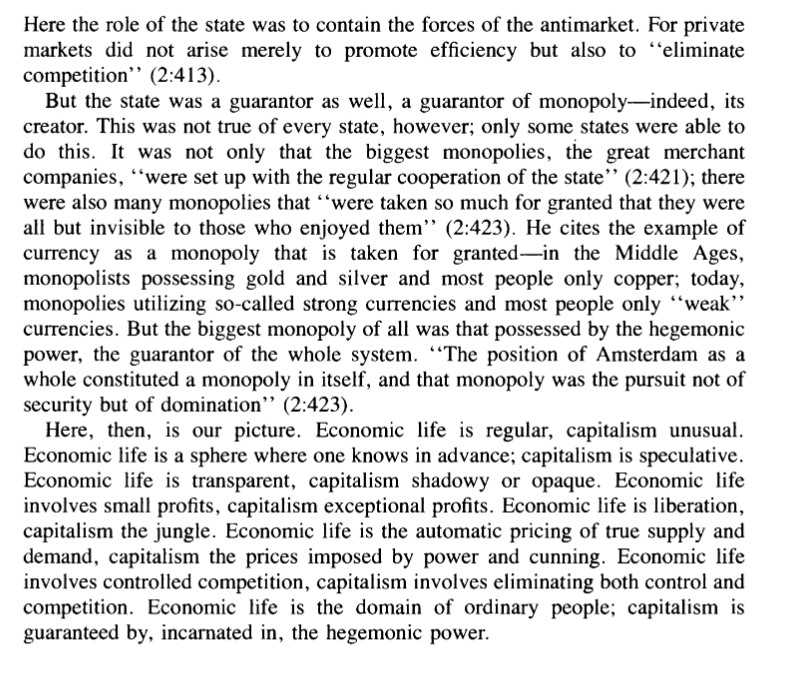
@nntaleb That's very close to the Braudel's definition of Capitalism: free market is not capitalism, capitalism are the big players that play the system, set up monopolies and are guaranteed by the State.
A friend asked, 'I moved but luck didn’t change. Does Feng Shui work?' Actually, Feng Shui is more about mindset. For example, treat interviews or tasks like a fun game, not a life-or-death situation. Zen teaches us 'Don’t cling too hard.' At home, add something moving—a small water feature or a dynamic painting—to remind you: Tasks are like clouds. They come and go. Relax.
Actor Sivakumar's painting of Mumbai is a remarkable work of observation and dedication. Seated on the 25th floor of the Indian Express building, he spent nearly three hours sketching the sprawling cityscape in meticulous detail
Niklas Luhmann wrote 70 books out of a wooden box of index cards and refused to fully explain how the system worked while he was alive, and 19 years after his death a German researcher named Sönke Ahrens finally cracked the manual.
The story of the wooden box has been told a thousand times.
Luhmann was a civil servant in a small German town in the 1950s. He started taking notes on index cards, one idea per card, linking each card to other cards in the box.
By the time he died in 1998, the box held over 90,000 handwritten notes. He had produced 70 books and over 400 academic papers from it. He had invented an entirely new theory of modern society that sociologists are still arguing about today.
He gave interviews about the system. He told people that the box was smarter than he was.
He said it was his communication partner. He said it remembered connections his conscious mind had long since forgotten making.
He answered the question of how he was so productive with a single sentence. He said he never worked against resistance. He followed what the box was pulling him toward.
What he never did was write the manual.
He never sat down and explained, in a step-by-step way, what kinds of notes went into the box, how they were structured, how they linked together, how a person sitting in front of an empty box was supposed to actually start using one.
He treated the system the way a craftsman treats a craft. It was something he did. Not something he taught.
For 20 years after his death, hundreds of academics, writers, and knowledge workers tried to reverse-engineer the box.
People photographed the actual cards. People wrote dissertations on the linking structure. People built software trying to replicate the network.
Most of them ended up with elaborate filing systems that looked like Luhmann's box from the outside and produced almost nothing.
The problem was that everyone was copying the surface of the system and missing the engine inside it.
The cards were not the point. The links were not the point. The point was a specific cognitive workflow that Luhmann had been running inside his own head for 30 years, and nobody had been able to articulate it clearly.
In 2017, a German education researcher named Sönke Ahrens published a 178-page book called How to Take Smart Notes.
He had spent years studying Luhmann's archive, comparing it to modern research on learning and writing, and trying to extract the actual method from the physical artifact.
The book did not get a big release. It came out through self-publishing. It spread by word of mouth through writers, students, and knowledge workers, and within a few years it had become the single most cited modern guide to thinking on the internet.
The reason is that Ahrens finally explained what Luhmann had refused to explain.
The system, Ahrens said, runs on three kinds of notes, and almost everyone trying to copy Luhmann was failing because they were confusing the three.
The first type is fleeting notes.
These are the quick captures. The scrap of an idea you have in the shower. The thought that hits you on a walk. The half-formed reaction to something you just read.
Fleeting notes are written fast, by hand if possible, with no concern for structure or grammar. Their only purpose is to make sure the thought is not lost before you can do something useful with it.
Most people stop here. Their notebooks are full of fleeting notes that never go anywhere because nothing was ever done with them.
The second type is literature notes.
These are written while you are reading something. The rule is brutal. You are not allowed to copy and paste. You are not allowed to highlight. You are not allowed to summarize in the author's words.
You must read a passage, close the book or look away from the screen, and write down what the author was claiming in your own words. The act of translating into your own language is the act of finding out whether you understood it.
Most people skip this step because it is uncomfortable. The discomfort is the entire point. The discomfort is where the learning happens.
The third type is the one that makes the whole system work.
Permanent notes. These are written from your fleeting notes and literature notes once a day, ideally, while the material is still fresh in your mind.
Each permanent note contains one idea, written in your own words, structured as if it would be read by a stranger years later. The note must stand on its own. It must be specific enough to be useful and short enough to fit on a single card.
Then you do the thing almost nobody does.
Before you file the new note, you go into the box and find every other note it connects to. You write the links explicitly.
This new note about a behavioral economics experiment connects to that older note about a Stoic principle. This new note about a coding pattern connects to that older note about a biological system.
You force yourself, every single time you add a note, to physically interrogate the box for what it already knows that this new idea touches.
Over time the box stops being a storage system and becomes a thinking partner.
When you sit down to write, you do not stare at a blank page. You go to the box. You find the cluster of notes that has been quietly accumulating around a topic you did not know you were obsessed with.
You pull those notes out. You arrange them. You discover that you have been writing the article, the essay, the book chapter for months without knowing it.
The writing becomes assembly, not invention.
This is the part Luhmann never explained out loud, and the part Ahrens spent the entire book hammering on.
The system does not store knowledge. The system generates it.
The act of forcing every new idea into conversation with everything you already know is what makes the new idea sharper, and the act of linking thousands of ideas to each other over decades is what produces the kind of dense network where original thinking actually lives.
Ahrens called the book a manual for how to write a PhD thesis or a nonfiction book. The book turned out to be much bigger than that.
The system inside it is the operating manual for any person who works with ideas for a living. Researchers use it. Writers use it. Engineers use it. Entrepreneurs use it.
AI researchers use it to keep up with papers that are being published faster than any human can read.
The reason Luhmann would not have predicted any of this is that he was working alone in a quiet German town with a wooden box on his desk.
He did not know that the system he had built by accident was the answer to a problem the entire world was about to have.
Ahrens did what Luhmann never quite did. He turned the private habit into a public method.
And the most original thinkers of the next 20 years will not be the ones reading more books than everyone else.
They will be the ones with a better box.
I used to love a web tool called StumbleUpon. Added a button to your browser that would take you to random blogs and websites. Found so much fascinating stuff that way, and it was the antithesis of today’s winner-take-most centralised web.
Founder of lululemon on what he'd tell every 25 year old:
"I'd tell them that every person in the world is an individual with a different genetic makeup and a different upbringing and the way that you're thinking is so radically different than every other person in the world and incomparable that if you have an idea and you want to move forward with it, don't worry so much about the competition because nobody will be able to replicate you and the way you think about it."
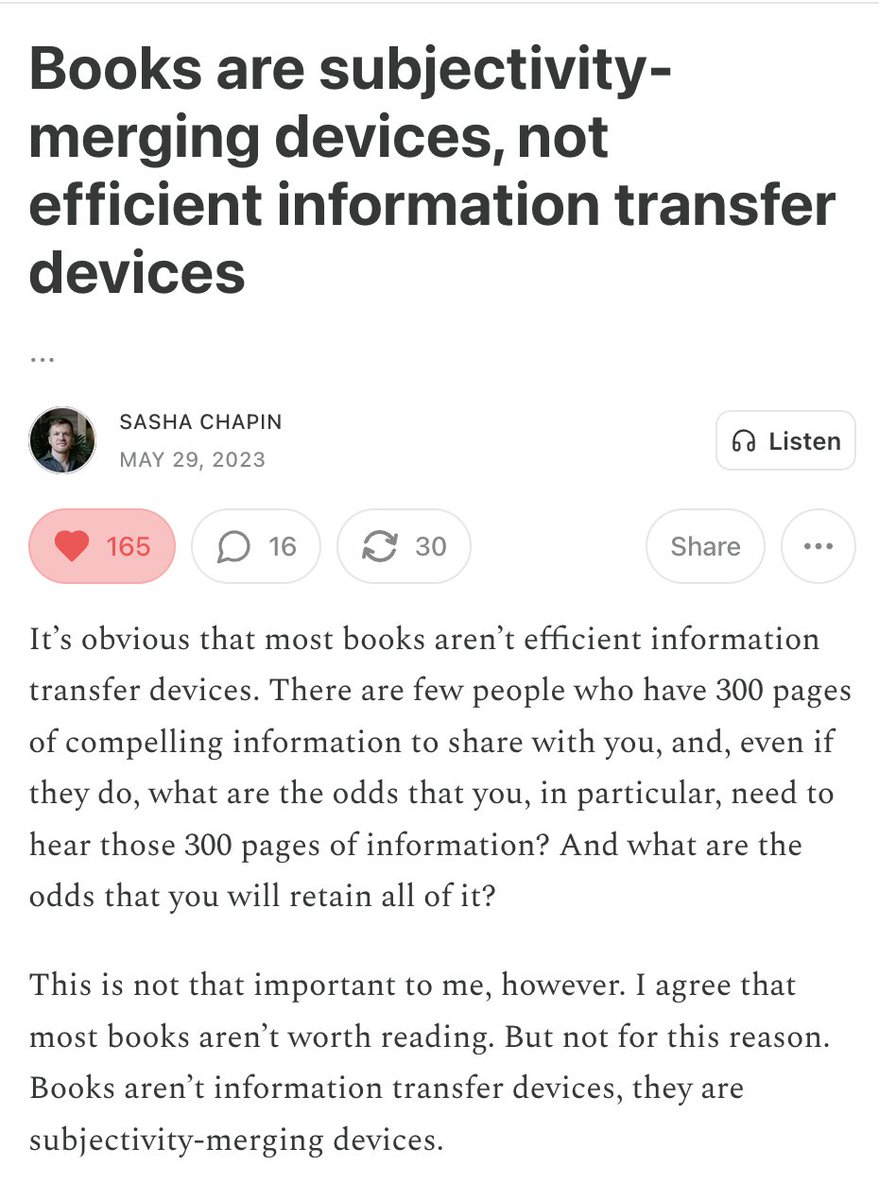
now that AI makes information consumption and transformation easier than ever I would like to bring back this old banger by Sasha Chapin about how books are not information transfer devices but subjectivity-merging devices
in fact I would say content consumption in general is more about subjectivity-merging than information transfer, which is why I am generally much more interested in writing by humans than by AI
the internet 10 years ago was a completely different place
over the last few months, I have been trying to collect all the best material gathered over the years and put it into one place to help others
110+ hours of content so far
Think @andymukherjee70 explained it well 👇
Indian business is more about wealth management than productive investment. And the top oligarchs operate in captured markets via State patronage.
All enabled by a neoliberal state where the bottom 90% have little influence on policy.
Do not use your energy to worry. Life is too short to worry about stupid things.
Have fun. Fall in love. Regret nothing and do not let people bring you down.
Study, think, create and grow. Teach yourself and teach others.
—Professor Richard Feynman
If you want to increase your ability to concentrate and have more control over your own mind, try this exercise daily for 5 minutes. It was created by one of the most intelligent men of the 20th century, Rudolf Steiner.
Use an ordinary object (a pencil, clothe spin, clip, book, etc.) and think about it for five minutes every day. You take an object in front of you or in your mind and the first time you describe it to yourself aloud. You can also imagine yourself describing it to a blind person.
Use all your senses and make as many observations as you can in five minutes. Repeat this the next day, you will probably notice new details.
After a while you can ask questions about the object: "What can I do with it?", "What is it made of?", "Why this shape?", "What other shapes could it have?", "Where was it made?", "How did I get it?"," How are the raw materials mined?", etc. You will be able to answer some of these questions. If not, you can search for an answer in an encyclopaedia or on the internet.
Your should be able to determine whether your thoughts are correct, otherwise your thoughts will wander. which is not the intention.
You can repeat what you did the day before and build on your previous thoughts. After some time you will have covered all possible questions, then do it one or two more times until you can really find no more issues to think about. Then follow the same procedure with another object.
When doing this exercise you may notice that your thinking gets clearer and sharper, and that your perception, concentration and objectivity increase. Also, your interest grows.
The difficulty of the exercise is that your mind wanders. The challenge is to be able to think about the object for five minutes, but you will find that your mind wanders to something else very easily, that your thoughts are associative and work automatically. E.g. you think of a pencil and suddenly you see in your mind your grandma with a pencil in her hand, grandma has a budgerigar and suddenly you are thinking about the whistling of this bird. Interrupt such thoughts: you wanted to think about the pencil.
The exercise is called control of the mind. The example just given shows that often there is no control over our thinking. We are thought, our thinking is associative and automatic. We believe that we think, but our thinking is often not focused.
Make sure that you do the exercise every day. You can choose a fixed time. Choose a time when you are awake and clear-headed, so not after dinner, but for example before or after breakfast or at 8 o'clock at night. You can also do it while waiting for the train, in a spare moment. Doing the exercise with two or three objects should be sufficient.