My apologies for the delay in responding to your question. I needed to prepare a few graphs, and with Vesak holidays in between, the response was delayed.
Below are three graphs. The first shows the total taxes per litre on imported CPC refined fuel products. For Petrol and Diesel, the explicit tax component consists primarily of an excise duty of Rs. 72 and Rs. 50 per litre respectively, in addition to VAT. The increase seen in the March and April figures is largely due to VAT increasing alongside higher fuel prices — roughly Rs. 28 per litre for Petrol and Rs. 22 for Diesel. Therefore, based on your proposal, this VAT increment is effectively the amount that could theoretically be returned as a subsidy.
However, excise duty serves a different purpose. It is intended as a corrective tax to account for externalities such as accidents, congestion, and pollution — in that order, according to IMF analysis conducted over a decade ago. Petrol carries a higher excise burden because it is more heavily associated with private vehicle usage, which contributes disproportionately to congestion and road accidents. While I doubt the precise quantum has been determined scientifically, the structure itself is directionally correct.
VAT, on the other hand, is simply a consumption tax. When prices rise, VAT collections rise automatically. Attempting to offset this increase by cutting excise duty — which is arguably already lower than the economically optimal level — is not necessarily sound policy. Nevertheless, let us assume such a policy is implemented.
Now consider Graphs 2 and 3, which break down March 2026 and April 2026 fuel pricing respectively: retail price, formula-based price, landed cost, taxes, loss per litre, and net tax.
Take Diesel in March as an example. The loss per litre was Rs. 283, while total taxes amounted to only Rs. 138. In other words, the loss per litre was more than double the total tax collected. This is therefore not merely a “tax subsidy”; it becomes a direct subsidy of approximately Rs. 145 per litre, reflected as the net tax figure in the graph.
The situation worsened in April. Taxes on Diesel amounted to Rs. 163 per litre, but the loss per litre rose to Rs. 367. That implies a subsidy burden of Rs. 367 per litre. These are extreme figures, and we will need to wait a few more days to see the May numbers, where losses may have moderated somewhat.
The government has allocated Rs. 57 billion for fuel subsidies through September 2026. Sri Lanka typically consumes around 150 million litres of Petrol and 160 million litres of Diesel each month. Let us conservatively assume:
* consumption has declined by 20% due to higher prices; and
* roughly 20% of Diesel demand is met through CPC’s refinery output, which has a lower production cost.
Even under those assumptions, the imported Diesel component alone would amount to roughly 96 million litres per month. At a subsidy of Rs. 100 per litre, that already translates to approximately Rs. 9.6 billion per month.
But if the full loss is absorbed, the fiscal cost becomes staggering:
* approximately Rs. 27 billion in March; and
* approximately Rs. 35 billion in April,
and this is only for Diesel, assuming the other market players faced similar landed costs, which may not even be the case.
In effect, within just two months, the subsidy allocation of Rs. 57 billion — intended to last until September — would already have been exhausted.
And this calculation excludes Petrol, where the losses are smaller but still material, and Kerosene, where volumes are much lower but per-litre losses are exceptionally high. Once those are incorporated, the scale of the subsidy burden becomes almost mind-boggling.
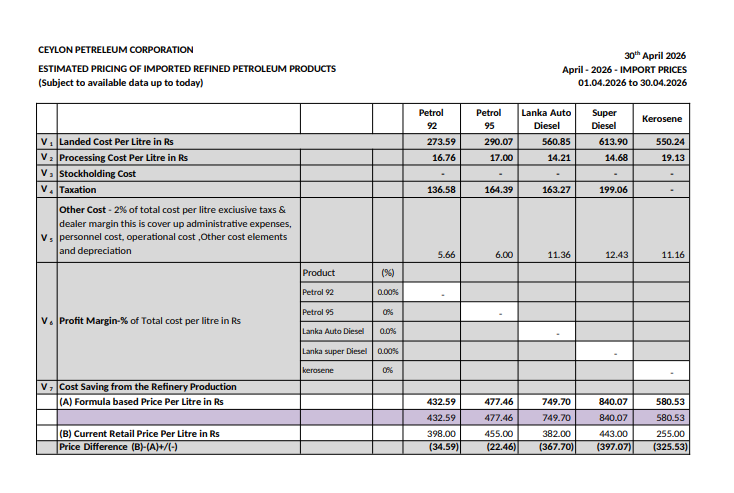
Kudos to the Ministry of Energy for disclosing CPC’s fuel cost. Based on imported fuel prices in April — with part of those stocks being consumed in May — the scale of the losses, even before accounting for the subsidy component, is significant.
Some figures are worth repeating given their magnitude. The loss per litre is approximately Rs. 35 for Petrol 92, Rs. 367 for Auto Diesel, and Rs. 325 for Kerosene. In the case of Kerosene, there are no taxes, meaning the entire amount translates directly into a loss with no tax offset whatsoever.
For Auto Diesel, the total tax component is around Rs. 163 per litre. Even after offsetting this against the pricing gap, the net loss still stands at roughly Rs. 162 per litre. For Petrol 92, despite a pricing loss of Rs. 35 per litre, the tax component that follows is approximately Rs. 101 per litre.
Sad news. My friend Simon who did the original bird for Twitter, Octocat for GitHub and Redid Sammy The Shark for DigitalOcean has passed away, he was 56.
He was a great guy. What a loss.
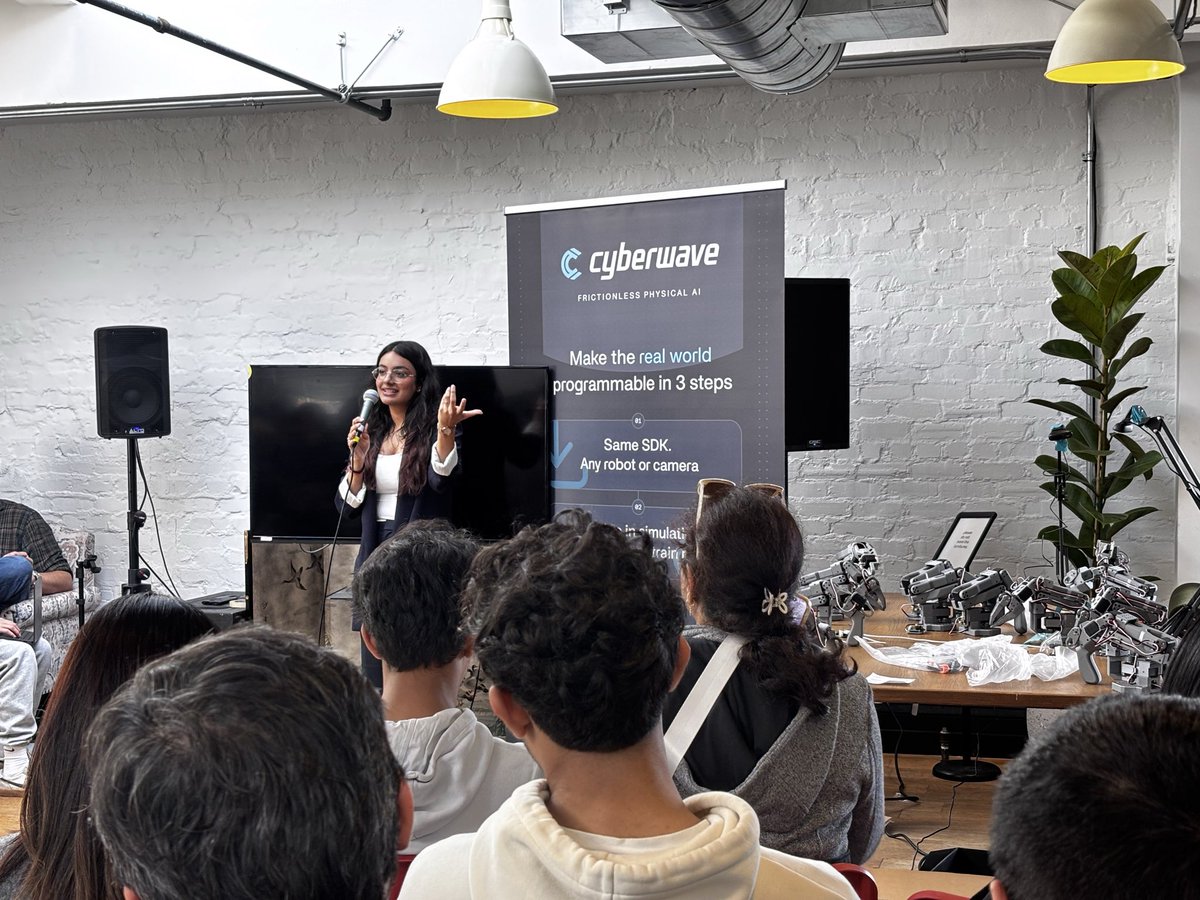
@smallest_AI is at the Robotic Agents Hackathon today with @cyberwave_com!
Come hack with us and win Meta Ray-Ban glasses along with free API credits. The energy is impeccable