For decades, autism has been described as a spectrum. Now, advances in science are revealing discreet biological subtypes.
The discoveries could one day lead to more accurate diagnoses and treatments.
https://t.co/7jwYK3hiYU
New paper alert! 🔥 By developing engram-specific epigenetic editing tools, our new study provides the first causal evidence that locus-specific epigenetic modifications are necessary and sufficient to drive memory expression. And that irrespective of the memory phase! 🧠🧬
A central mistake in biology was to name genes.
This over-simplification made reconciling what is happening on the molecular level a mess - it's not rare to find reports of opposite mechanisms in different contexts, claimed involvement in dozens if not hundreds of different processes, sometimes inhibiting and sometimes amplifying and most of the time being oblivious to the potential for sequence-level variation.
Nobody would be surprised about this diversity of findings if we instead recognized genes as (sometimes quite lengthy and complex) pieces of sequence that carry state and interact with and are interpreted by their environment - often producing dozens of gene products that are in turn themselves context-dependent and modulated. Naturally, such a highly amorphous composition of objects has many diverse effects, and masking this complexity behind a single name more often than not ends up being a harmful abstraction.
The primary role of gene names then is to give us the false appearance of comfort in the face of enormous biological complexity.
One under-appreciated potential of the emergence of AI tools in biology is to undo this mistake, and - instead of assuming it away - extend our ability to lean further into this complexity.
I and my colleague, Sahar Gelfman, at RGC had the privilege to write a News and Views article for @nature about a recent work on Huntington's disease by @s_mccarroll and team.
In this incredible work, through an innovative single cell RNA sequencing methodology, Handsaker et al. demonstrate that CAG repeats in HTT expand to extreme lengths (800+) in striatal medium spiny neurons (MSNs) in individuals with Huntington's. The work brings in an important insight into a long-standing puzzle of cell type-selective neurodegeneration in Huntington's: the MSNs selectively die in Huntington's brain not because they are specifically vulnerable to toxicity by mutant huntingtin proteins but because they are uniquely prone to undergo somatic repeat expansions. What drives MSNs' vulnerability to repeat expansion is still a mystery.
The most important finding however is the discovery of toxicity threshold for CAG repeat length in HTT. In germline, CAG repeat > 40 copies is considered fully penetrant for HTT. At the neuronal level, the authors show that the toxicity doesn't seem to arise until 150 copies. It turns out the 40 threshold in germline doesn't represent a direct toxicity but rather a tipping point beyond which CAG repeat can somatically expand to toxic lengths.
Lastly, using computational modeling the authors show that HTT in MSNs undergo two phases of somatic expansion: a slow and stochastic phase that lasts for decades and a rapid and predictable phase that lasts for months. Since the transition from first to second phase in asynchronous, at most time points during the disease course, most of the neurons are in early phase (hence could be rescued) allowing a wide therapeutic window of opportunity to intervene.
The current work will inspire many future therapeutic efforts to focus on halting or slowing somatic repeat expansion rather than blindly reducing huntingtin proteins in the brain. Whether such efforts will succeed is something we need to wait and see.
https://t.co/Cwx7RsY3NQ
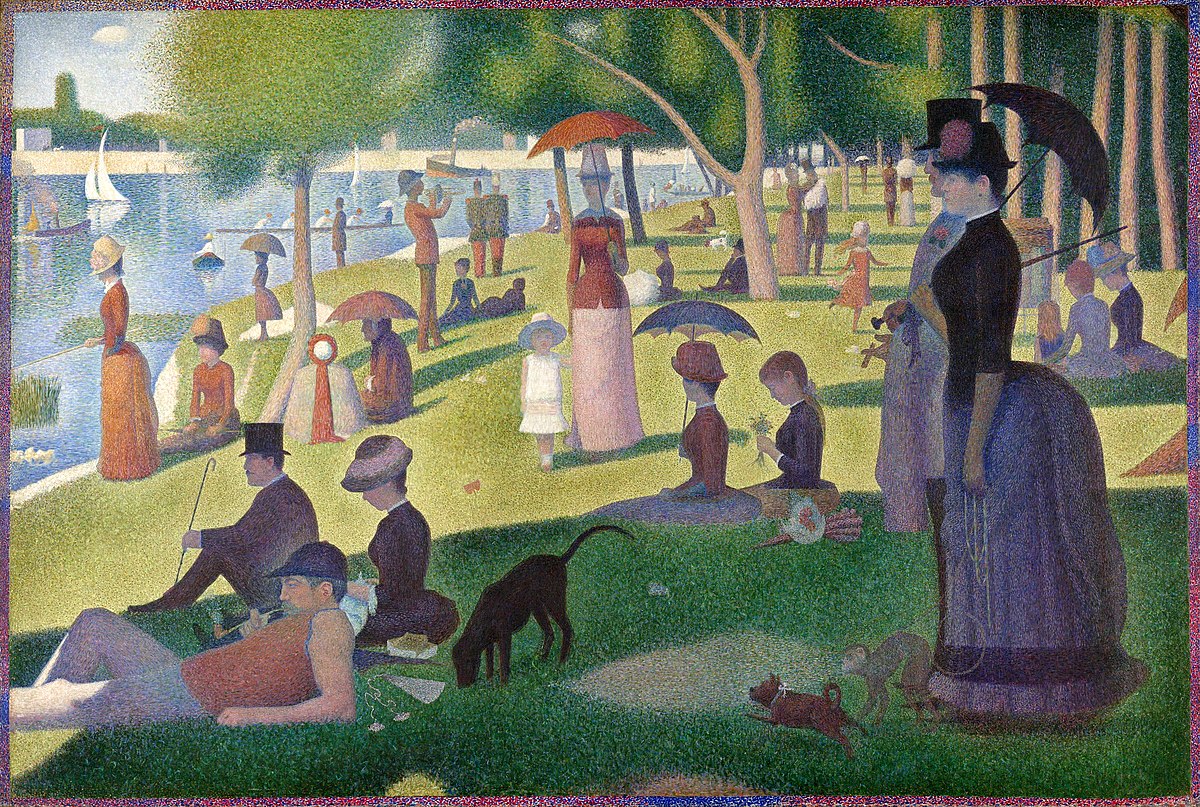
Can't believe that I had to visit the Art Institute of Chicago to see Georges Seurat's paintings in distinctive pointillism to realize that the single-cell RNA-seq analysis package in R is named Seurat because the appearance of cell clusters resembles the artist's style. 🫠
Excited to share our latest work from @ceclindgren lab! We combine rare variant testing 📊 + CRISPR KO ⚡️ in human adipocytes to nominate new therapeutic targets for obesity and fat distribution ✨
🧵 [1/9] https://t.co/btVxzOShMh
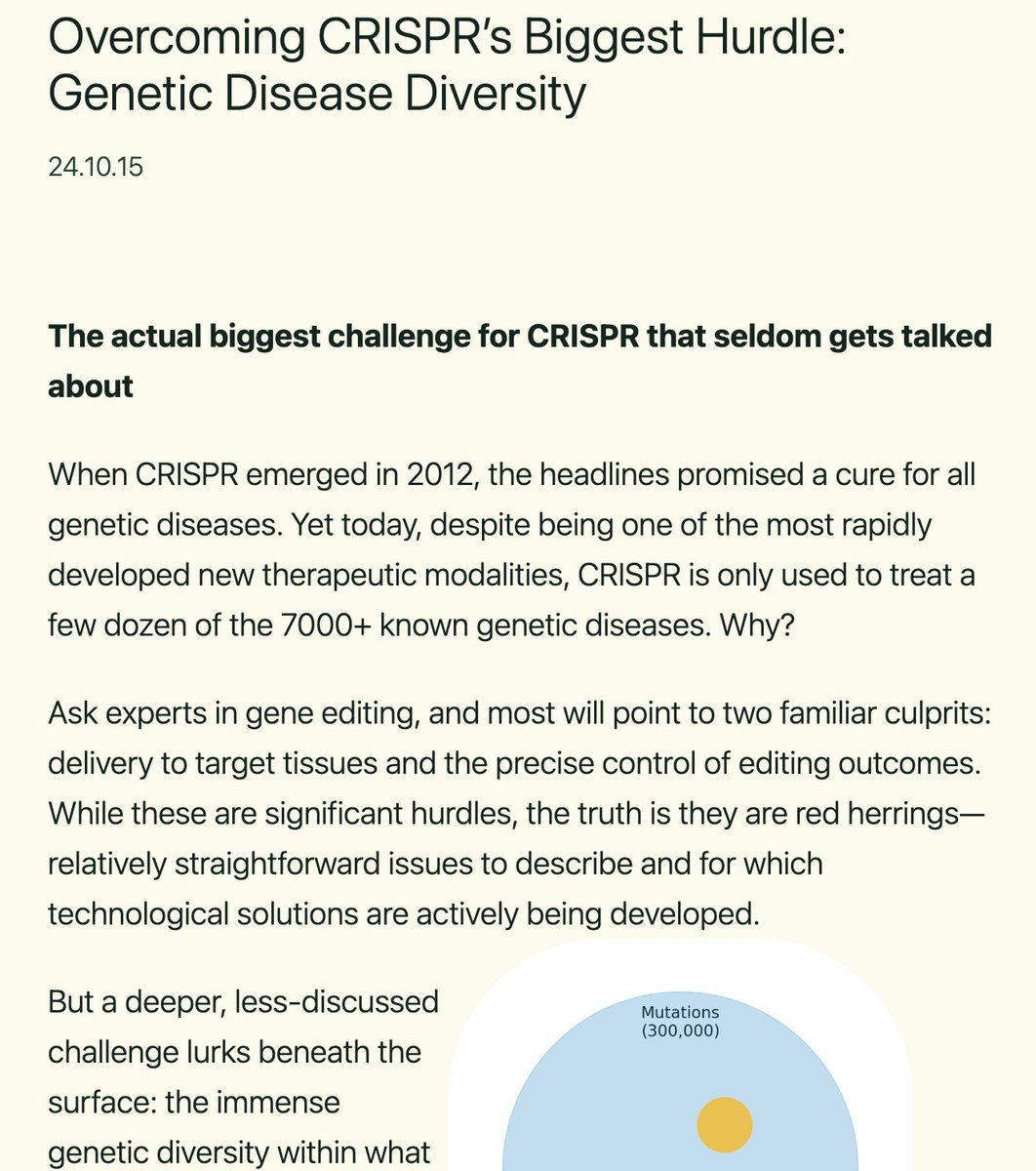
The biggest hurdle to implementing CRISPR at scale seldom gets discussed: genetic diversity within a single disease.
I wrote a post about it to explain this bottleneck and some of the emerging solutions I’m excited about.
Excited to share our latest preprint! With a great team led by @natsauerwald and @avithemicrobe: “Decomposition of phenotypic heterogeneity in autism reveals distinct and coherent genetic programs.” Our paper sheds light on structures of heterogeneity in autism, and how underlying genetic factors can contribute to different developmental outcomes and clinical manifestations of the condition. Here’s a short 🧵to explain our approach (1/6)