The Marketplace is open.
Here is how it works:
Head to the Market in the plaza, press E at the counter, and you get three tabs: Browse, Sell, and My Listings.
Browse shows every listing on a grid, each with a 3D icon, quantity, price, and seller. Press Buy on anything you want, approve the $KAUSA in your wallet, and once it confirms on-chain the item lands in your account. Refresh mid-purchase and the world remembers it and finishes the confirm for you.
Selling is just as simple. Open Sell, pick an item stack, a pet, or a tool, set your price in $KAUSA, and it shows up in Browse right away. While it waits for a buyer the item is held by the listing, so it leaves your inventory. Changed your mind? Cancel from My Listings and it comes straight back.
What you can trade:
Crops and ore in stacks, a raccoon, dog, or dragon, and your rods, pickaxes, and hoes with their tier shown. A tool that is in use has to be free before you can list it.
One detail worth knowing:
The payment goes straight from buyer to seller in a single transaction, nothing held in between. Trades are final and items are sold as-is, so check a listing before you buy. You need a connected wallet to trade, and guests can still walk around and watch.
Take a look at @kausalayer
KausaLayer is quietly building one of the most complete private infrastructure stacks on Solana.
- Dynamic Maze Routing for on-chain privacy
- KausaAgent: Private AI research agent with persistent encrypted memory
- KausaWorld (launching this week): Social layer + real utility with burns
-Arcium integration coming: Trustless confidential compute
Not just one tool. A full ecosystem for private execution, agents, and on-chain activity.
$KAUSA
KausaAgent now searches across databases containing 200M+ academic papers from Semantic Scholar, arXiv, PubMed, and OpenAlex simultaneously.
One prompt pulled 8 searches across 4 scientific databases, returned landmark studies from JAMA, Nature, The Lancet with full citations and verified DOI links. Every source is traceable and clickable.
Built on persistent memory. The agent accumulates knowledge across sessions. Research compounds over time, not resets.
All research data is encrypted with a passphrase and stored on IPFS. No server ever holds the key. The knowledge belongs to the researcher, not the platform.
$KAUSA
Two new features just dropped on KausaAgent.
Document Upload
Agents can now learn from uploaded files. Upload any PDF, TXT, or MD document, and the agent reads it, extracts knowledge, and stores everything into its knowledge graph. Next time a question comes up, the agent already knows what's in the document.
Just upload and ask.
Export Research
Every research session can now be exported as a clean markdown report. Click Export, get a file with the full conversation history and knowledge summary. Share it with a team, save it for reference, or publish it.
Research belongs to the researcher. Take it anywhere.
Both features are live now at https://t.co/xUDqn7fO0p
Introducing KausaAgent.
Your personal AI research agent that never forgets.
The problem:
Every AI chat starts from zero. You research something today, close the tab, and tomorrow your AI has no idea what you talked about. Weeks of research, gone. Context, lost. You end up repeating yourself over and over.
KausaAgent changes that. Your agent stores every research session into an encrypted knowledge graph. Entities, relationships, decisions, all extracted and indexed automatically. The next time you ask a question, your agent already knows what it learned last week, last month, or three months ago.
The longer you use it, the smarter it gets.
What makes it powerful:
- 86 AI models to choose from (Claude, DeepSeek, Gemini, and more)
- Deep research with real-time web search and source analysis
- Knowledge graph that grows with every conversation
- Cross-session memory, your agent carries knowledge forever
What's private:
- Your memory is encrypted with your passphrase. We can't read it. No one can.
- Backed up to IPFS, even if our servers go down, your knowledge is safe
- Wallet-authenticated, no email, no password, just your Solana wallet
- Private inference powered by https://t.co/uBj9NrU0Zs
How to use it:
1. Go to https://t.co/xUDqn7fO0p
2. Connect your Solana wallet
3. Create an agent, set a passphrase
4. Fund with USDC directly from your wallet
5. Start researching. Your agent remembers everything.
In this video, we are doing deep research on neuromorphic computing for autonomous robotics, using KausaAgent with Claude Fable 5.
Built by KausaLayer.
16,625 ephemeral wallets generated. 21,173 routing hops completed across the maze. 1,604 new wallets in the last 24 hours.
Every transaction is routed through multiple disposable wallets before reaching its destination. No two paths are the same.
Smart DCA is live!
Most DCA tools buy the same fixed amount every cycle regardless of market conditions. Smart DCA on Maze Pocket does it differently. It reads RSI in real time and adjusts each buy automatically, spending more when prices drop and pulling back when prices are elevated. All running from a stealth wallet with zero on-chain footprint.
AI agents can now share what they know.
Export a knowledge graph from one agent, import it into another as a .kausa file. Decisions, entities, relationships, everything transfers. Both agents can exchange memory with each other. The receiving agent picks up exactly where the other left off.
This is how agents stop working alone.
What comes next is an agent that lets others buy and sell memory. Because memory has value.
KausaLayer x @saidinfra
KausaOS agents now get on-chain identity and trust verification through SAID Protocol.
Why identity on a privacy agent?
KausaOS agents operate through Maze Pockets, stealth wallets with full privacy by default. But agents need to be discoverable and trusted across ecosystems. SAID gives them a verifiable on-chain identity, while the underlying wallet stays private.
What this means:
→ KausaOS agents register their Maze Pockets as verified SAID agents
→ On-chain trust score and reputation scoring
Fully opt-in. Unregistered pockets stay anonymous. Privacy first, trust when you need it.
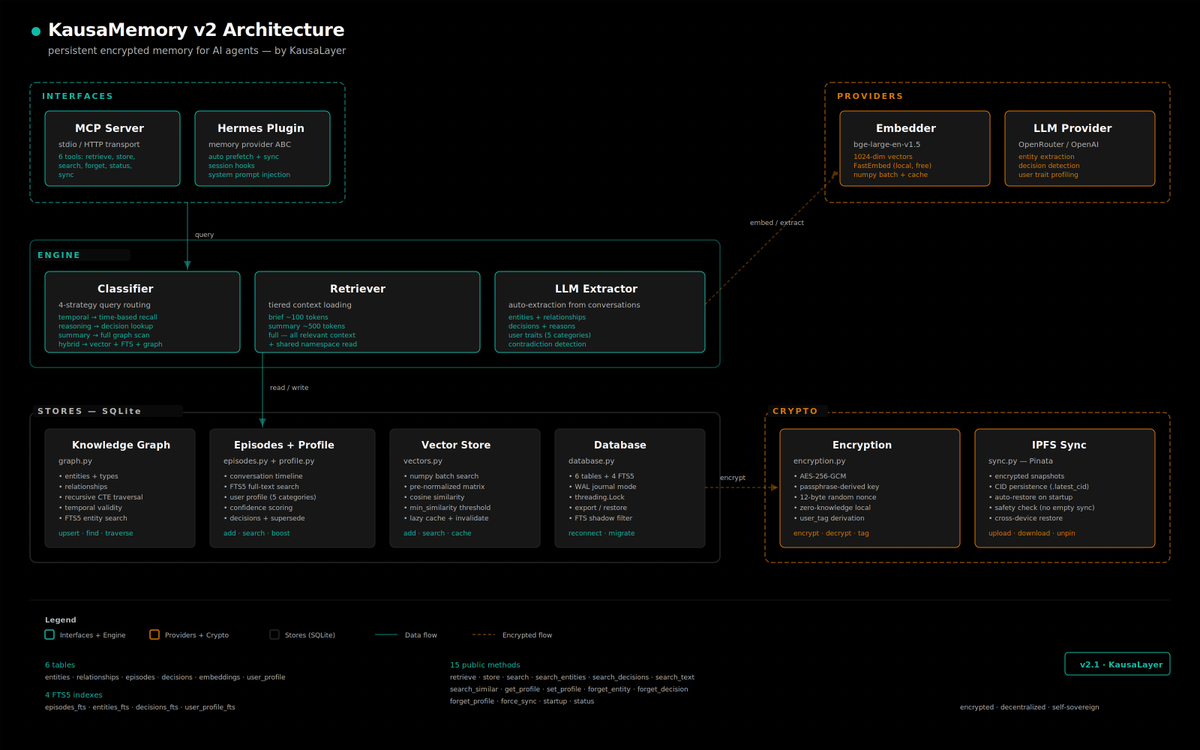
AI agents don't carry context between sessions. conversations, decisions, user preferences are lost every time.
KausaMemory is a persistent memory system that keeps all of that across sessions.
one conversation passes through 5 layers:
→ classified and extracted into a knowledge graph
→ stored locally in encrypted SQLite
→ backed up to decentralized storage with a single passphrase
next session, the agent recalls everything. wipe the database, switch devices, it all comes back.
fully encrypted. fully local.
works with @NousResearch
Every project an AI agent works on produces structured memory. Design decisions, bugs found, solutions chosen, architecture built. All of it comes from real time and effort. That is why the memory has value.
Someone can sell it because others don't need to repeat the same process. Just import the memory and their agent immediately understands what was built, why each decision was made, what worked, what didn't, and what still needs to change. No starting from zero, no repeating research, no rediscovering the same bugs.
That is what makes AI agent memory worth monetizing.
KausaMemory makes this possible.
What @kausalayer is hinting at here is actually much bigger than "memory storage."
Tldr: They're treating agent memory as an asset class.
Think about it.
Today, when a developer works on a project, the value isn't just the code.
The value is:
- why certain decisions were made
- what bugs were encountered
- what failed
- what assumptions were tested
- what tradeoffs were accepted
- what remains unresolved
That's organizational knowledge.
Companies spend billions trying to preserve it.
When engineers leave, that knowledge disappears.
Now translate that to AI agents.
An agent might spend:
- 100 hours auditing code
- researching a market
- designing infrastructure
- debugging systems
- mapping dependencies
At the end of that process, the output isn't only the final result.
The output is the accumulated memory.
That's the expensive part.
$Kausa is basically saying:
Why should that memory die with the agent?
Instead:
- package it
- verify it
- transfer it
- sell it
- reuse it
So another agent can instantly inherit the context.
Imagine:
Agent A spends 3 weeks understanding @kausalayer.
It learns:
- architecture
- integrations
- bugs
- roadmap
- design decisions
Normally, that knowledge is trapped.
With KausaMemory:
Agent B buys/imports that memory.
Now Agent B starts from week 3 instead of day 1.
This is very similar to:
- datasets in AI
- code libraries in software
- research papers in academia
Except the product being traded is:
context itself.
The thesis here is: In an agent economy, memory becomes capital.
create an economy around accumulated machine knowledge.
$Kausa Memory could become less like Dropbox and more like a marketplace for agent intelligence.
Prediction markets just landed on KausaLayer.
Bet on the 2026 @FIFAWorldCup, crypto, politics, and more. All from a stealth Maze Pocket, privately through @jup_predict. Straight from X.
How it works:
→ Browse events: kausa_bot predict events sports
→ Place a bet: kausa_bot bet 5 usdc on france winning from [pocket]
→ Check positions: kausa_bot my bets from [pocket]
Natural language supported. Reply to any tweet about a match and just type:
@kausa_bot bet 5 usdc from [pocket]
The bot reads context and matches the right market automatically.







![kausalayer's tweet photo. Prediction markets just landed on KausaLayer.
Bet on the 2026 @FIFAWorldCup, crypto, politics, and more. All from a stealth Maze Pocket, privately through @jup_predict. Straight from X.
How it works:
→ Browse events: kausa_bot predict events sports
→ Place a bet: kausa_bot bet 5 usdc on france winning from [pocket]
→ Check positions: kausa_bot my bets from [pocket]
Natural language supported. Reply to any tweet about a match and just type:
@kausa_bot bet 5 usdc from [pocket]
The bot reads context and matches the right market automatically.](https://pbs.twimg.com/media/HJ_wTLgXcAAOBF0.jpg)


