The Census Bureau’s 2026 AI adoption data cuts through the hype.
Across all U.S. businesses, AI use is still only around 17–20%. But employment-weighted adoption rises to 32%, meaning the average employee is increasingly working somewhere that uses AI.
The real divide is by company size and sector:
Large firms are adopting faster.
Information and finance are ahead.
Retail and smaller businesses are still catching up.
The takeaway: AI adoption is not universal yet. It is concentrated, uneven, and highly dependent on industry, company size, and business function.
That makes Census data a powerful map for where AI demand is real versus where the market is still mostly noise.
#AI #EnterpriseAI #AIEconomy #Census #GenAI
https://t.co/pSSlT1k1ZP
By 2030, AI data centers will guzzle 9.3 trillion liters of water — equal to the annual needs of 1.3 billion people. And making AI more efficient might actually make it worse, since cheaper AI means more usage. The UN says we're solving one problem while creating others. https://t.co/h1eAqHZO1J
The next phase of enterprise AI won’t just be model adoption. It will be model substitution.
As frontier models get more expensive and open-source models become “good enough” for more use cases, AI buyers are starting to route work to the cheapest capable model.
That changes the economics:
Costs don’t simply fall.
Usage expands.
The winners will be the companies that build intelligent routing, benchmark performance by task, and optimize AI spend like cloud infrastructure.
AI strategy is becoming unit economics strategy.
#AI #EnterpriseAI #GenAI #OpenSourceAI #ArtificialIntelligence
https://t.co/TaEZxmkSnd
The real AI disruption may not be the model.
It may be the stack.
AI-native operating systems and tools are forcing a deeper rethink of software design itself, not just adding smarter features to old workflows.
#AI#AINative#DevTools#FutureOfComputing https://t.co/ZVNu7i8Xu2
New phase of the AI conversation:
It’s no longer just “how fast can we go?”
It’s “how fast is too fast?”
Anthropic says frontier labs may need to slow down so society, safety, and governance can catch up.
#AI#AISafety#Anthropic#FutureOfAI https://t.co/UovRaWmAWJ
A CISA contractor needed to move files from a work device to a home device.
So they created a public GitHub repo.
Named it "Private-CISA."
Disabled GitHub's secret scanning.
Left it there for 6 months.
Inside: AWS GovCloud admin keys. Plaintext passwords. SAML certificates.
The researcher who found it called it "the worst leak I've witnessed in my career."
https://t.co/X0OtHcZpJQ #CyberSecurity #SmallBusiness https://t.co/X0OtHcZpJQ
Organizations need accessible pathways that help everyone understand how AI works, where it applies, and how to use it responsibly. AI fluency is quickly becoming workforce. MIT’s new Universal AI program is a signal that AI fluency is becoming a baseline skill, not a specialist credential.
#AI #AIEducation #WorkforceDevelopment #MIT #GenerativeAI https://t.co/DL7uG84PmI
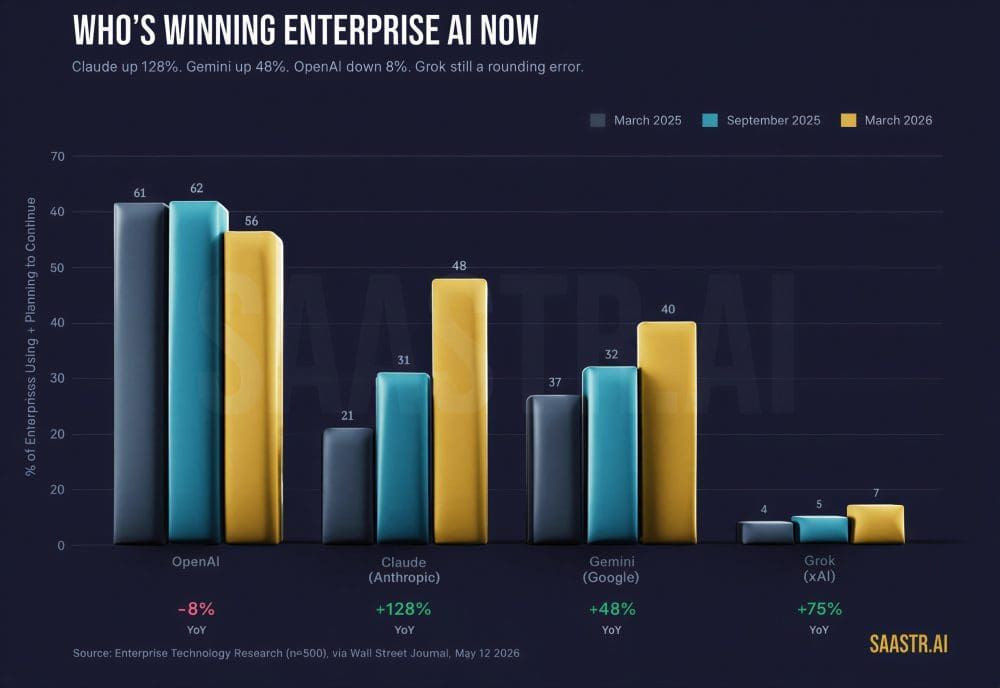
Enterprise AI is no longer a one-model race.
New ETR data shows OpenAI still leads, but Claude is closing fast:
OpenAI: 56% enterprise share, down from 62%
Claude: 48%, up from 21%
Gemini: 40%, up from 27%
Grok: 7%
The real signal: enterprises are moving to multi-model strategies, and coding assistants may be the workload driving the most near-term AI spend.
The winners won’t just have the best model. They’ll have the best enterprise fit, distribution, governance, and developer adoption.
#AI #EnterpriseAI #GenAI #Claude #OpenAI #Gemini https://t.co/g5YBeU8eg2
380,000 publicly accessible apps. 5,000 with sensitive corporate data. All built by employees who just wanted to ship fast.
Vibe coding is shadow AI's production layer — and your security stack was never built to find it.
The new S3 bucket crisis is already live. via @VentureBeat
#CyberSecurity #ShadowAI #AppSec #CISO https://t.co/6SJwPh8vDB
For years, cybersecurity feared quantum computing breaking encryption. That threat had a known shape.
AI-powered cyber weapons are different — they're here now, they scale, and they're democratizing capabilities once reserved for nation-states.
Can defenders adapt fast enough? @thecipherbrief
#AI #Cybersecurity #CyberDefense https://t.co/s12854VLUG
AI is powerful, but this Nature study is an important reality check: human scientists still outperform the best AI agents on complex, open-ended research tasks.
The future is not AI replacing experts. It is experts using AI to move faster, test more, and make better decisions.
#AI #AgenticAI #FutureOfWork
https://t.co/LCSzU8W7yl
AI security is entering a new phase.
Tomasz Tunguz argues that models like Claude Mythos could change the software landscape: bugs hidden for decades may surface in hours, but only for the organizations with access to the most advanced tools.
That turns security from a checklist into a structural advantage.
The companies that can harden faster will build, ship, and defend at a different speed.
#AI #Cybersecurity #SoftwareSecurity #ZeroDay #TechStrategy https://t.co/5nAlSQuo0L
AI is not just making teams faster. It is making a lot of Agile process look obsolete.
When founders show up on day one with MVPs that used to take weeks or months, the bottleneck is no longer building.
It’s judgment: picking the right problem, reading the market, and knowing what to test next. Steve Blank Your Startup Is Probably Dead On Arrival https://t.co/Efq6kB99ZP
🚨BREAKING: Anthropic just published a study mapping exactly which jobs its own AI is replacing right now.
The workers most at risk are not who anyone expected. They are older. They are more educated. They earn 47% more than average. And they are nearly four times more likely to hold a graduate degree than the workers AI is not touching.
The argument is straightforward. Anthropic built a new metric called "observed exposure." Not what AI could theoretically do. What it is actually doing right now in professional settings, measured against millions of real Claude conversations from enterprise users.
For computer and math workers, AI is theoretically capable of handling 94% of their tasks. It is currently handling 33% of them. For office and administrative roles, theoretical capability is 90%. Current observed usage is 40%. The gap between what AI can do and what it is already doing is enormous. The researchers are explicit about what comes next. As capabilities improve and adoption deepens, the red area grows to fill the blue.
The demographic finding is what makes the paper uncomfortable. The most AI-exposed workers earn 47% more on average than the least exposed group. They are more likely to be female. They are more likely to be college educated. This is not a story about warehouse workers or truck drivers. It is a story about lawyers, financial analysts, market researchers, and software developers. The exact group whose education was supposed to insulate them.
Computer programmers showed the highest observed AI exposure at 74.5%. Customer service representatives at 70.1%. Data entry keyers at 67.1%. Medical record specialists at 66.7%. Market research analysts and marketing specialists at 64.8%. These are not predictions. These are measurements of work that is already happening on AI platforms right now.
Then there is the pipeline finding nobody is talking about loudly enough.
Anthropic's researchers found a 14% decline in the job-finding rate for workers aged 22 to 25 in highly exposed occupations since ChatGPT launched. No comparable effect for workers over 25. Entry-level roles were never just jobs. They were the training ground where junior analysts became senior analysts, where junior lawyers learned how arguments hold together. If that layer disappears, nobody has answered the question of where the next generation of senior professionals comes from.
The detail buried in the paper that most coverage missed: 30% of American workers have zero AI exposure at all. Cooks. Mechanics. Bartenders. Dishwashers. The technology reshaping professional careers is completely irrelevant to roughly a third of the workforce. The divide is no longer between high skill and low skill. It is between presence and absence.
The company publishing this study is the same company selling the AI doing the replacing. Anthropic had every commercial incentive to soften these findings. They published them anyway.
If you spent four years and $200,000 on a degree to land a white collar career, the company that builds Claude just confirmed your job is more exposed than the bartender pouring drinks at your graduation party.
Source: Anthropic, "Labor market impacts of AI: A new measure and early evidence"
PDF: https://t.co/taYgsIfiTj
When MVPs can be built in a weekend, they stop being proof of technical competence.
Steve Blank argues AI has compressed product development so dramatically that the new constraint is no longer building. It’s learning, choosing the right problem, reading customer signals, and deciding what to build next. https://t.co/DhhZNwskkB
One of the most important AI breakthroughs may be teaching models to say: “I’m not sure.”
MIT researchers say their RLCR method cuts calibration error by up to 90% while maintaining or improving accuracy — a big step toward AI systems that are not just smart, but honest about uncertainty. https://t.co/X2rXSyHvjr
Story points are dying because AI is collapsing the cost of execution.
When software that used to take weeks can ship in a day, velocity theater, estimation rituals, and ceremony-heavy Agile start to look like process built for a slower era.
The new bottleneck is understanding the customer well enough to build the right thing. https://t.co/rvFCxVnW2j
This is the role to watch.
It’s not “AI engineer.”
It’s not “prompt engineer.”
The next wave won’t be defined by who can “use AI.” It will be defined by who can operationalize agents inside real workflows, connect tools and data, and manage performance over time.
The real leverage may belong to the Agent Operator.
🚨 BREAKING: A new role is quietly emerging and it’s about to dominate the next 5 years.
It’s not “AI engineer.”
It’s not “prompt engineer.”
It’s the Agent Operator.
And it will sit inside almost every organization.
Most people are still thinking about AI as a tool.
That framing is already outdated.
What’s actually happening is a shift from:
humans using software to humans managing autonomous agents that execute work
This is a fundamental redesign of how work gets done.
So what is an Agent Operator?
An Agent Operator is the person who:
• Designs how agents interact with real workflows
• Connects tools, data, and systems into agent pipelines
• Translates business problems into executable agent behavior
• Monitors, corrects, and improves agent performance over time
They don’t just “use AI.”
They orchestrate outcomes.
and this matter because
Every function marketing, legal, finance, biotech is becoming “agent-compatible.”
Not because companies want it.
Because they won’t have a choice.
Agents can:
• Run research loops
• Execute multi-step workflows
• Integrate across tools without APIs breaking the flow
• Operate 24/7 at near-zero marginal cost
The bottleneck is no longer capability.
It’s implementation inside real-world systems.
Required skills for AI Agent Operator role:
→ MCPs (Model Context Protocols)
Understanding how agents access tools, memory, and structured context.
→ CLIs (Command Line Interfaces)
Because serious agent workflows won’t live in GUIs—they’ll run in programmable environments.
→ Writing skills (the file kind)
Clear specs, instructions, and structured documents.
Agents run on precision, not vibes.
→ agents dot md fluency
The ability to define agent roles, constraints, memory, and tool usage in persistent formats.
→ Business acumen
Knowing what actually matters:
Where automation creates leverage, not noise.
What happens next
Enterprises will begin to redesign workflows:
Not around employees using dashboards…
But around agents executing tasks.
That means:
• SOPs → Agent playbooks
• Teams → Human + agent hybrids
• Tools → Composable agent systems
When that shift happens, companies won’t just need engineers.
They’ll need operators who understand both the system and the business.
The leverage is asymmetric
One strong Agent Operator can:
• Replace fragmented SaaS workflows
• Multiply team output without adding headcount
• Turn ideas into execution systems in days
This is not incremental productivity.
It’s operational transformation.
Musk vs. Altman is about to move from tech gossip to public spectacle.
What started as a lawsuit over OpenAI’s founding is now a broader fight over power, reputation, and billions in future AI stakes. In AI, the courtroom may shape the narrative as much as the verdict. https://t.co/ysXCph25tV