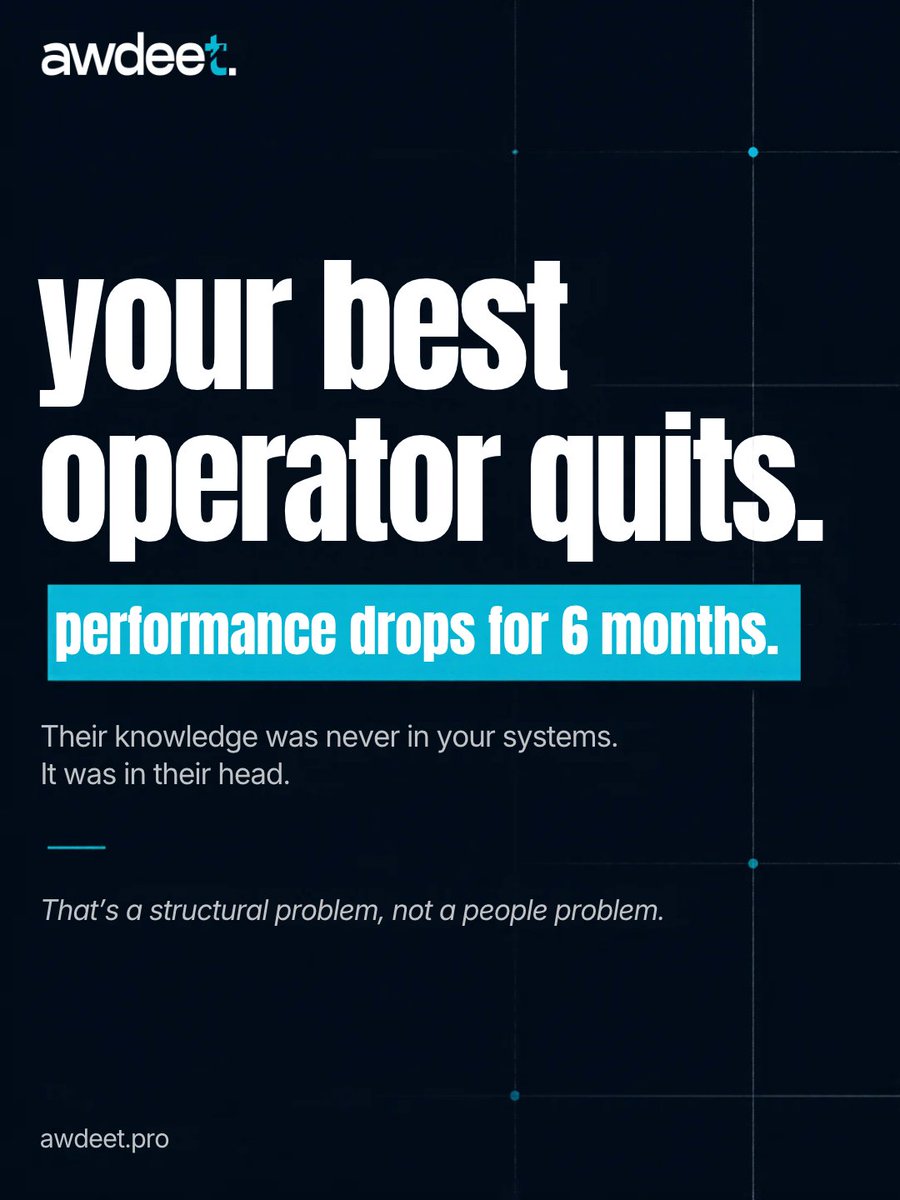
Your best operator quits. Performance drops for 6 months.
Their knowledge was never in your systems.
That's not a people problem. It's a structural one.
If this sounds familiar, our free 2-minute diagnostic shows where it's happening: https://t.co/NmRSASB8SB
Most agencies gatekeep their diagnostic process.
We're giving ours away for free.
Why we built the Awdeet constraint simulator (and what we're learning from it)
A thread 🧵
What we've learned (300+ companies so far):
Most common constraint ≠ tool sprawl
It's approval latency at handoffs with split state ownership
Decisions wait because approvers lack required context.
If your team can still create the problem your tool was supposed to solve, you built the wrong thing.
Constraint-based design isn't restrictive.
It's liberating.
— —
Awdeet Studio
Diagnosing frictions. Designing solutions.
https://t.co/kHMSjcwcqs
We design the opposite way:
Tools that constrain behavior to the optimal path;
Not "let users do anything"
But "prevent new problems while solving old ones"
Reduce degrees of freedom, don't add them.
If we walked into your operation, we wouldn’t ask:
“What’s slow?”
We’d ask:
“Where does work wait for certainty?”
That’s the constraint.
— —
Awdeet Studio
Diagnosing frictions. Designing solutions.
https://t.co/kHMSjcwcqs
Our diagnostic lens @awdeet_studio:
- Where does state change require human permission?
- Who owns the decision at each transition?
- What information is missing at the moment a decision stalls?