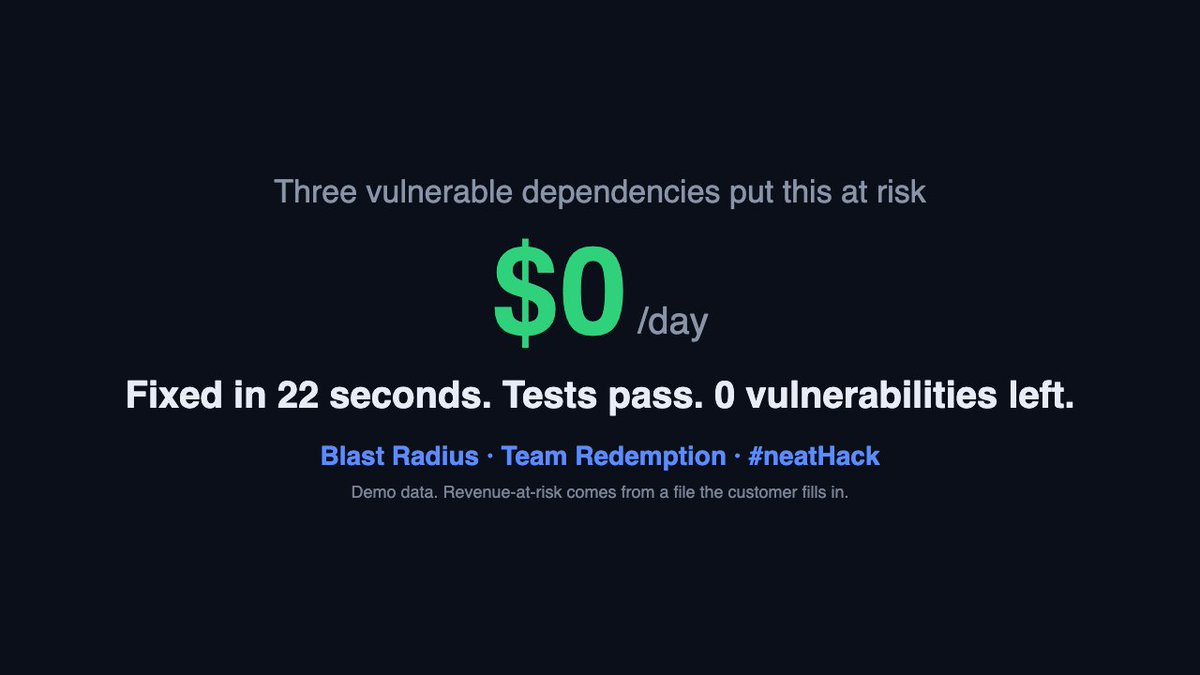
@arithecfo@EntireHQ@neatlogs Every company runs on software it didn't write.
Final cut of our #neatHack demo, now narrated: the run, neatlogs catching a real failure and recovering from it, Entire's graph + checkpoint, and the live AWS app.
@neatlogs@EntireHQ@arithecfo
Our #neatHack submission
Blast Radius: what a vulnerable dependency puts at risk ($, owner), then an agent fixes it and tests prove it. Real-repo failure and recovery traced in neatlogs.
https://t.co/78orgT3XdM
Built with @arithecfo@EntireHQ@neatlogs https://t.co/tI3AMVIiC4
@arithecfo@EntireHQ@neatlogs Thanks to the neatHack team and mentors. Next: Crustdata vendor-health signals. Live app: http://100.31.116.240/ #neatHack
@arithecfo@EntireHQ@neatlogs@EntireHQ: checkpoints appear automatically, nice. Confusing bit: the web link 404'd until we signed in, installed the GitHub App and imported the repo. A CLI hint would help.
@arithecfo: Ari built a pricing/cash model from one sentence and re-did it with our measured costs.
Day 2 of building Blast Radius for #neatHack.
New since yesterday: it runs on real open-source repos, recovers from a failed action on its own, uses @EntireHQ Graph, and has buyer onboarding.
Thread 👇 (demo video in the last reply)
Buyer onboarding: paste a repo URL, see the blast radius, confirm suggested owners and features (we never guess your revenue), choose how much to trust the agent.
Prototype, real scan. Code: https://t.co/78orgT3XdM #neatHack
Stack: @neatlogs for tracing, @EntireHQ for code context + checkpoints, @arithecfo for pricing and runway (in progress).
Next: vendor-health signals via Crustdata, licence risk.
Repo: https://t.co/78orgT3XdM
#neatHack#AIagents#BuildInPublic
Every company runs on software it didn't write.
When a dependency turns out to be vulnerable, who works out what breaks, who owns it, and what it costs?
Building Blast Radius for #neatHack 🧵
Fix, straight from the trace: give the agent only the files that import the package, fix all packages in one pass, cache repeat reads, re-scan OSV at the end.
3 runs each, tests pass 3/3 on both:
steps 19.7 → 4.3
cost ~$0.199 → $0.041
time 48s → 18.5s