The signal-to-noise ratio of the world is degrading, and it will keep degrading. Spotting signals from noise is the skill that will matter most.
There is so much information coming at us now. Papers, blogs, posts, updates, news, etc. And it is only going to get harder to tell what actually matters and what is worth reading and consuming.
Even I feel overwhelmed by everything happening around us. There are so many things to keep up with, and there is a constant pressure to make sure we are not missing something important.
Information is easy to find now and, worse, easy to generate. The hard part is knowing what to trust, what to skip, and what is worth holding onto.
I think the people who do well going forward will know what to ignore. Spotting signals from noise is the skill that will matter most.
Hope this helps.
Been painstakingly fixing touch areas of CTAs in Flutter for the last few days. I apologise to every frontend dev to whom I have wronged by exporting inconsistent size of icons.
AI needs to arrive incrementally at 100x slower pace than the present hype-fueled madness. I wish big players would choose meaningful use cases, environmentally sustainable data centers, and not make it a 'race' to nowhere.
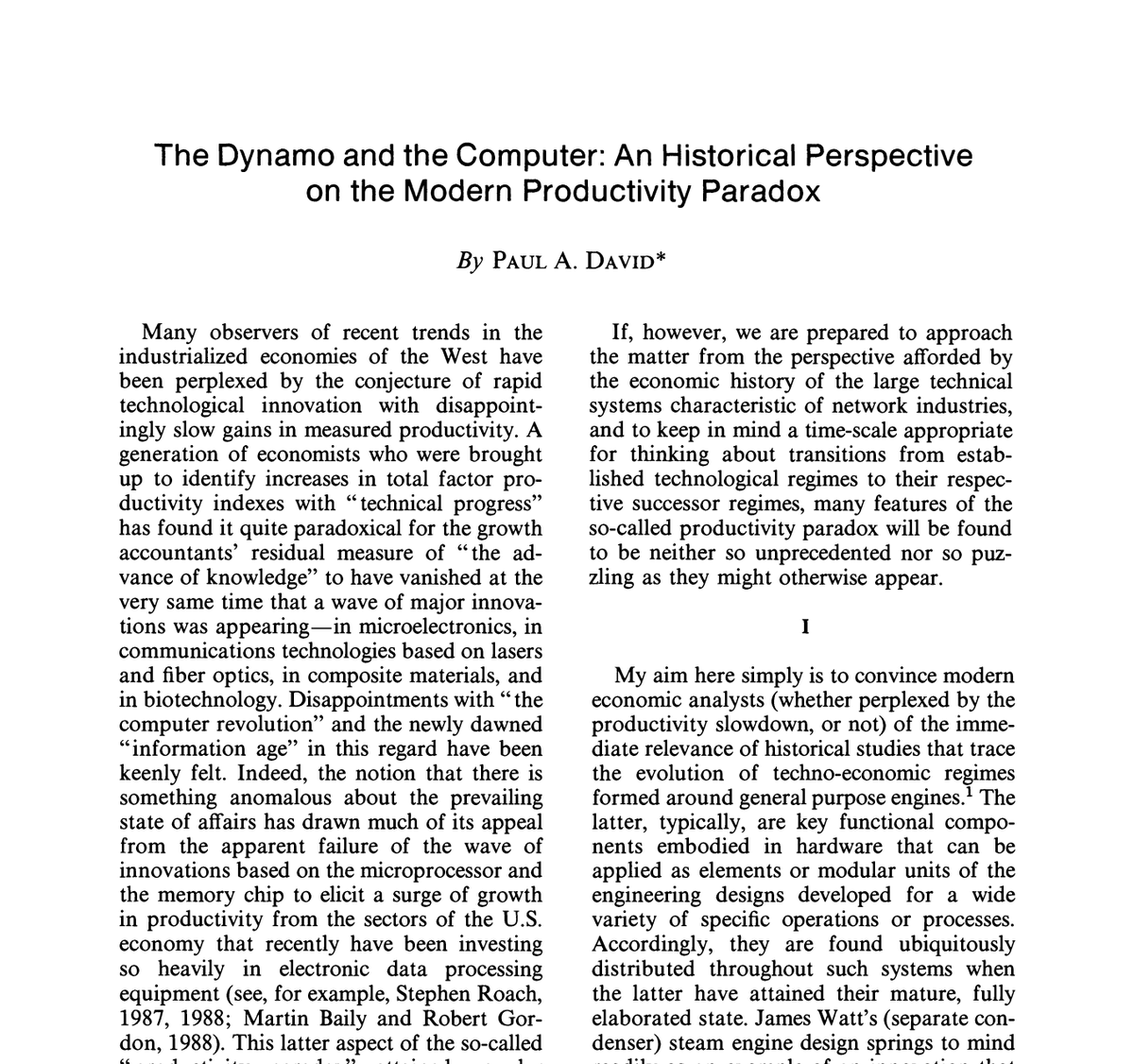
If you've adopted AI at your company but haven't seen any tangible results, read this 1990 article: "The Dynamo and the Computer" by Paul David.
When electricity first arrived, factories that "adopted" it barely got faster. They just swapped the steam engine for an electric one and ran everything else exactly as before: same machine layout, same workflow, same management. Electricity in, no real gains out.
The most common mistake with any new technology is to drop it into the old organization and then declare the transformation done.
The real leap came decades later, when each machine got its own small motor. Suddenly machines no longer had to be lined up around one central drive shaft. They could be rearranged around the actual flow of work.
The productivity gains didn't come from electricity. They came from REDESIGNING THE ENTIRE FACTORY around it.
AI is the same. Bolting it onto your existing process gets you a faster steam engine. The payoff comes when you redesign the work itself.
(link to paper in comments)
In India, most people are introduced to new systems through another person.
A bank manager helps update Aadhaar. A mutual fund broker explains insurance. A shopkeeper teaches UPI. A local agent makes the form less frightening.
The West over-indexes on DIY. India has always been mediated.
This is why many digital products fail when they assume the user wants independence. Often, the user does not want independence first. They want assurance. They want someone to say, "This is correct. Click here. Don't worry."
The middleman exists because systems are intimidating, language is confusing, consequences feel expensive, and trust is social.
Good Indian UX often has to replace the middleman.
That means clearer confirmations, human-like guidance, visible trust markers, assisted flows, easy reversibility, and language that reduces fear. The best interface in India is not always the shortest interface. Sometimes it is the one that holds your hand at the right moment.
A product team may think the broker is inefficiency. But ethnographically, the broker is assurance infra.
If you remove him without replacing the trust he provided, the user does not become empowered. They become abandoned.
I spent yesterday afternoon messing around with @frameo_ai , and somehow ended up creating a David Attenborough-style documentary about tech IPOs. 😭
I promise no capital allocator or elephants were harmed in the making of this.
Pathetic state of affairs when a citizen has to go through so much frustration after paying exorbitant tax. I wish VIPs feel an iota of shame for their actions. Your job can never be that important to hold traffic for 30 min!
SRS 2024 report has interesting demographic data. TFR (Total Fertitility Rate), a direct indicator of the population growth/decline trends in India is worth noting. At 2.1, the population stagnates, below it it falls and anything higher, it grows. Kerela is at 1.3. Bihar at 2.9
Bangalore has the best talent in the country.
Now imagine if that talent was obsessed with optimizing motor controllers or battery chemistries instead of building AI apps, that too with ChatGPT APIs.
That shift is the only one that truly matters.
A common dynamic I observe with AI: it feels most impressive when you don’t know much about the subject, don’t care or don’t have a clear idea of what the you want.
This applies across design, code, legal, and more. If I don’t know code very well, every piece of code it writes feels very impressive.
Once you know what something should feel or look like, it becomes almost impossible to guide AI there. And you definitely can’t one-shot it.
So prompt engineers learned English is imprecise for coding and started using stricter syntax. I wonder how long it will take before they come full circle and land back at programming languages again.
Only the ones who don't know design are excited about daily random 'design-killer' tools. Just saying.
Just by having a 3D printer doesn't make me a product designer.
HTML can't run Doom
But HTML can now run *inside* Doom! Thanks to HTML-in-Canvas!
Fully accessible DOM elements drawn into Doom's own wall textures. This demo uses a WebAssembly port (jacobenget/doom.wasm) of the original C source.
See it in action at https://t.co/2Wb7ha4lIF
- Requires Chrome with chrome://flags/#canvas-draw-element enabled.
On every Doom tick, HTML-in-Canvas's drawElementImage() captures the DOM form (child of <canvas layoutsubtree>) to an offscreen buffer, it's quantised to Doom's 256-colour palette, and the bytes are written straight into the cached patch for the appropriate texture in Doom.
Doom's own software renderer then paints it onto E1M1 as a wall texture - which means perspective warp, sector lighting, and even the damage-red tint all get included and applied to the HTML form elements. It's just a texture to Doom.