@Steve_Yegge help me understand if I am understanding what you are saying here.
To me, humans not being ‘special’ does not necessarily mean that machines of course are conscious, but merely that they could in theory be conscious (were they to posses whatever mechanism that creates consciousness).
Is that your take too, or are you saying that machines in general (or a specific subset) definitely are conscious (if so by what mechanism do you suggest that that is happening)?
For context, I share the view that consciousness could be created externally to the human brain in some form, but don’t understand by what mechanism it is created, so interested in hearing if you have any insight into that.
Today we've introduced Narrator to @EpiludeHQ. Your Mac can now read any text to you, in voices you'll actually like to listen to, completely privately on your Mac.
We've tried to make it the smoothest listening and reading experience possible, and think we've found a form factor that works pretty well.
Our goal is to give every Mac owner the voice tools they need to be productive and get things done, which now include accurate dictation, meeting notes with Notetaker, and text-to-speech with Narrator.
All using Epilude's EP-1 family of models, and all processing completely privately on your Mac so you stay in control of your data.
Check it out:
https://t.co/shsAdXEc1E
@awilkinson Meanwhile we’re (@EpiludeHQ) bootstrapped and can focus on optimized local models that let you dictate without sending your voice data to anyone’s servers
Today we're launching EP-1, our first local model that handles meeting notes summarisation on-device.
You can now transcribe and summarise your meetings all on your device without any data leaving your computer.
https://t.co/i8wrPoVc8D
If true, I’ve never heard a clearer case for why you should opt for verifiably private options like local models when it’s feasible.
Especially when you are working on novel stuff. Your voice and data is being listened to and trained on.
For dictation and meeting summaries, that’s EPILUDE DOT COM
Synthetic data derived from production user data of consumer AI tools is used for training. I’ve heard this rumour from both large labs’ employees.
In particular, if you’re doing something “interesting” like working on complex math/business/software/bio problems you’re dramatically more likely to get trained on because they filter/up-weight towards those usecases where the model has the most to learn.
Even in ZDR and “we won’t train on you” regimes, derivative data is usually carved out. The promise is only not to train on exactly the data you put in, rewritten data is fair game.
EP-1, our first local model that transcribes and summarises meeting notes end to end, is launching soon.
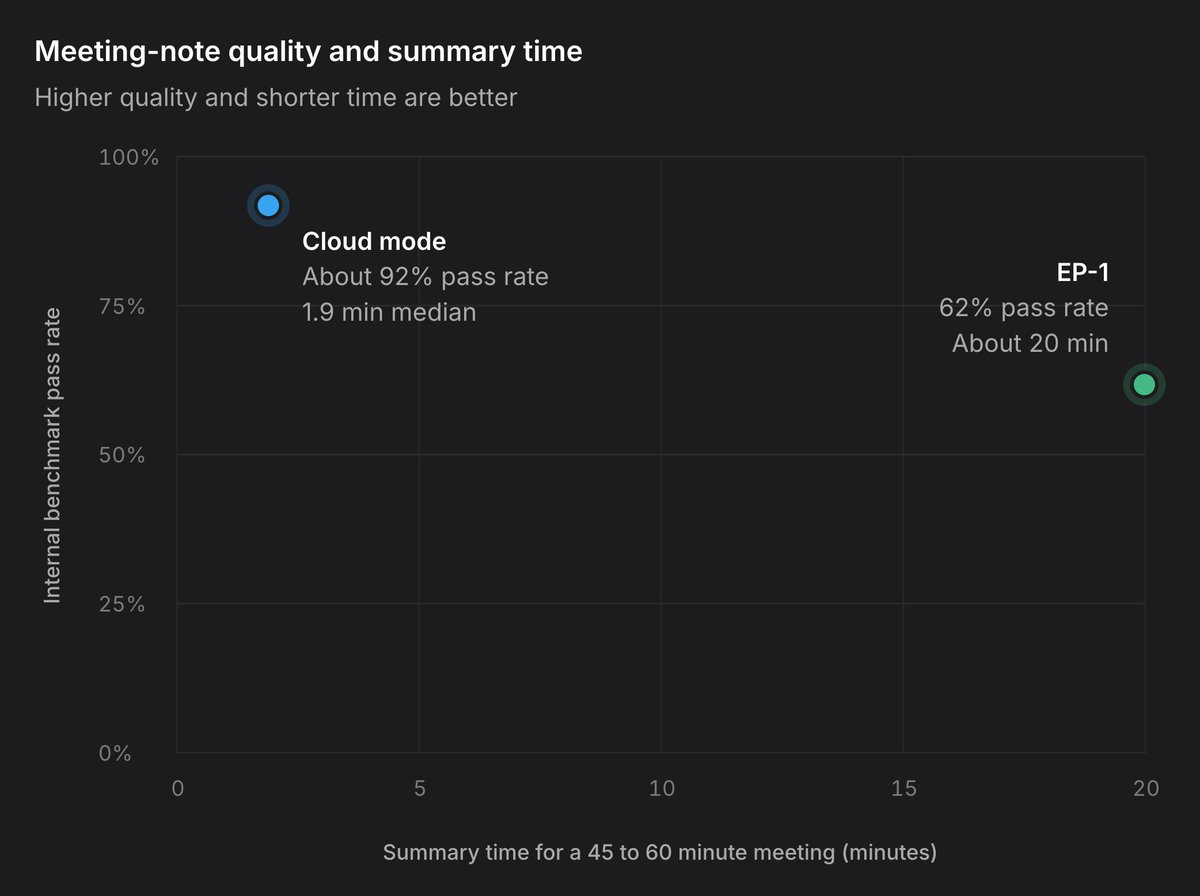
In our internal benchmarks it is getting closer and closer to the SOTA models used in cloud mode, but process everything completely privately on your Mac.
@andrewchen We’re solving the same painful dictation issue on Mac (completely using local models, nothing leaves your Mac) with https://t.co/ovRxE4uSut
Since we started @EpiludeHQ our goal has been to push the limit of what you can do with speech-to-text locally on a standard laptop.
This has led us down the path of retraining open-weight models to make them even better for dictation and capturing and analysing/summarising voice notes captured with our new Notetaker.
Model 5 (or do we call it something else?) should be out soon