end/
Clusters are pivotal to Arcium's decentralized confidential computing, offering customizable, scalable, and secure environments for executing sensitive computations. Embrace the future of encrypted computation with Arcium. 🔐🚀
@loosty@Magnonk909@kai_nft__
Article 25 for @arcium
move to Clusters
In the Arcium Network, Clusters are groups of Arx nodes that collaborate to execute confidential computations securely and efficiently.
Let's explore how these Clusters function and their significance in decentralized computing. 🧵👇
5/ Dynamic Adaptability
Clusters can undergo forking or migration to adapt to changing conditions, ensuring continuous and reliable computation execution.
4/ Parallelization and Scalability
Arcium's architecture allows multiple Clusters to operate concurrently, enabling efficient task distribution and high scalability across the network.
3/ Permissioned vs. Non-Permissioned Clusters
Clusters can be👇
Fully-Permissioned: Utilizing only an organization's internal nodes.
Partially-Permissioned: Combining internal and select external nodes.
Public/Non-Permissioned: Open to all verified nodes in the network.
2/ Key Attributes Defined
During setup, customers specify:
Computational Load Capacity: Maximum volume the Cluster handles.
Active Node Requirements: Minimum number of active nodes needed.
Security Requirements: Protocols and standards for the Cluster.
1/ Formation of Clusters
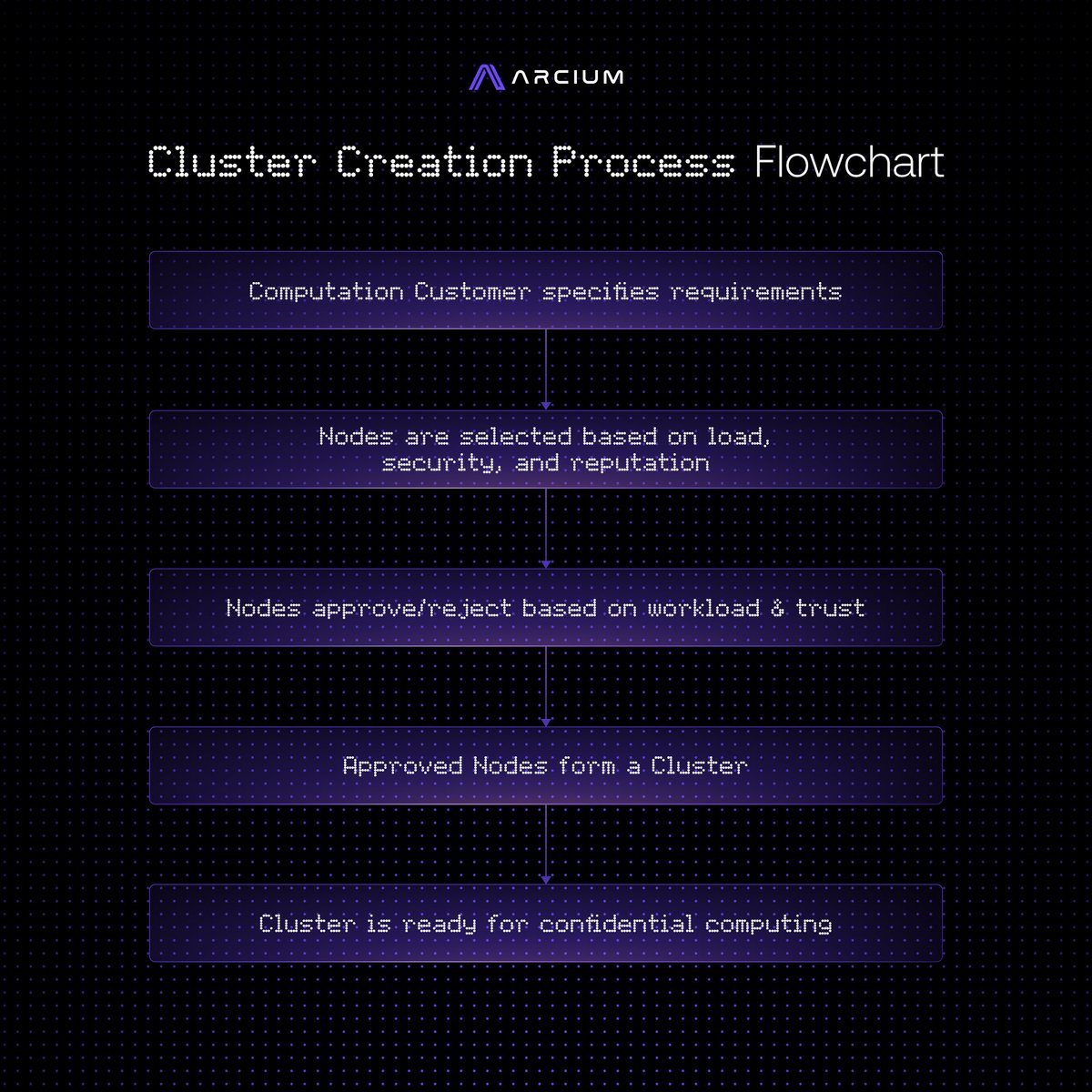
Computation Customers create Clusters by selecting Arx nodes based on factors like computational capacity, security features, and node reputations.
🔐Unlocking the Power of MPC with Arciumx
In a digital era , Arcium's Secure Multi-Party Computation (MPC) prtocols are redefining how sensitive information is processed. Let's delve into how MPC Protocols is revolutionizing confidential computing. 🧵👇
end/
Arcium's MXE Encryption offers a versatile and secure framework for data processing, addressing modern data security challenges. Embrace the future of confidential computing with Arcium. 🔐🚀
@loosty@kai_nft__@Magnonk909
GMPC
GMPC
final article for MXEs-MXE Encryption @arcium
Arcium's Multi-Party eXecution Environments (MXEs) offer customizable encryption solutions, ensuring data remains protected throughout its lifecycle. Let's delve into how MXE Encryption is revolutionizing data security. 🧵👇
5/ Advancing Confidential Computing
By integrating robust encryption and security measures, Arcium's MXEs set a new standard in confidential computing, enabling secure, efficient, and trustless data processing.
4/ Constant-Time Operations
To mitigate timing attacks, Arcium utilizes constant-time operations, preventing attackers from inferring information based on processing time variations.
3/ Side-Channel Attack Resistance
Unlike some platforms vulnerable to side-channel attacks, Arcium's Cerberus protocol employs computational and information-theoretic security, ensuring data integrity even against a majority of malicious participants.
2/ Independent Operation of MXEs
Each MXE functions independently, ensuring computations remain isolated. While Arcium doesn't provide protocol-level state storage, external solutions can enable encrypted data persistence across multiple MXEs.
1/ Customizable Encryption Protocols
Arcium empowers users to tailor encryption protocols within each MXE, balancing performance and security to meet specific needs.
article 22@ArciumHQ
Arcium's Multi-Party eXecution Environments (MXEs) are revolutionizing confidential computing by enabling encrypted data processing without compromising security.
Let's delve into how MXEs are transforming the landscape of data privacy and computation. 🧵👇
5/
Applications
Healthcare: Enabling collaborative research on patient data while maintaining confidentiality.
Finance: Facilitating secure multi-party financial analyses without exposing data.
AI: Allowing training of models on encrypted datasets, preserving data privacy.
4/ Key Features
Secret Sharing: Data is divided into fragments and distributed across Arx Nodes, ensuring no single node has access to the complete data.
Threshold Encryption: Requires collaboration among a specific number of authorized nodes to decrypt data.