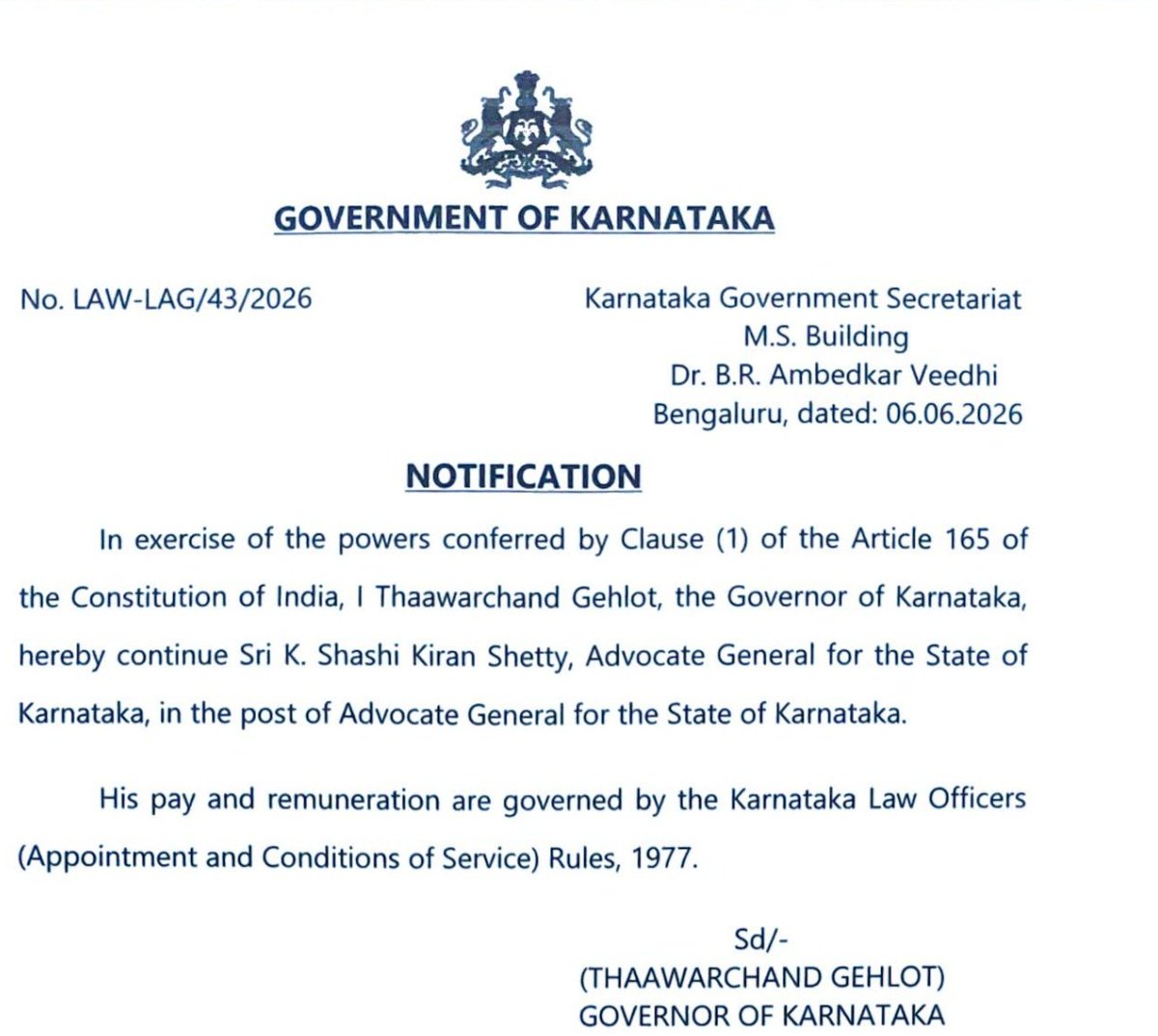
'Citizens Being Made Slaves Of Indian Govt; If People Protest, Cases Slapped', Says Bombay High Court |@NarsiBenwal
"Now so many papers have been leaked. If people protest, you will slap cases. What is all this?" HC asked.
https://t.co/agiV3ItF2m
#MadrasHighCourt Registrar General S. Alli has retired from service, on attaining the age of 60 years, pending a recommendation made by the Supreme Court collegium on May 18, 2026 to elevate her as a judge of the High Court. The recommendation was made after the High Court collegium proposed her name in November 2025. Principal District Judge Deepthi Arivunithi has been appointed as the next Registrar General @THChennai
https://t.co/Lef8mlRduW
The DVAC had registered a FIR yesterday (June 24, 2026) against former DMK Minister EV Velu and others on the basis of an April 2022 complaint lodged by Jayaram Venkatesan, Convenor of Arappor Iyakkam. The Tamil Nadu Government had accorded permission for the registration of the FIR on June 23, 2026. The complainant had alleged swindling of crores of rupees of public money without laying roads in State Highways department.
A #Delhi HC judgeship recommendation carries an unusual footnote: adv Amit Prasad was convicted in a 2011 fatal road accident case dating back to 1996 and later released on probation | @htTweets EXCLUSIVE
https://t.co/7yznSX50jv
Advocate General Vijay Narayan informs #MadrasHighCourt Chief Justice's Bench that Tamil Nadu Government has filed a memo to withdraw its review application, filed during the DMK regime, against an order passed by the #MadrasHighCourt on February 20, 2026 directing the DVAC to register a FIR regarding alleged cash for jobs scam during KN Nehru's tenure as Municipal Administration and Water Supply Minister. Senior Counsel Siddharth Luthra for Mr. Nehru, who has also filed a review application in his individual capacity, says, the State cannot be allowed to change its stand. A host of other senior counsel, representing Mr. Nehru's brothers and associates, seek the leave (permission) of the court file review applications against the February 20 order on the ground that it was passed without them being a party to the proceedings. @THChennai
https://t.co/qnOku1SIHP
Justice M. Dhandapani of the #MadrasHighCourt who had been nudging the Greater Chennai Corporation (GCC) and Chennai Metro Rail Limited (CMRL) to improve the green cover in the city, since 2022, has decided to pay a visit to the https://t.co/skW3xPcxk6.Ka. Park in Shenoy Nagar, Nehru Park in Egmore and Panagal Park in T. Nagar on June 26, 2026. He will be accompanied by amicus curiae Chevanan Mohan and GCC Commissioner G.S. Sameeran @THChennai
https://t.co/ijP4M1Ntm3
I grew up on Bangalore’s Brunton Cross Road.
I still live on the same road.
When I first came here as a 15-year-old beginning college in 1966, it was one of the most beautiful streets in the city. Tree-lined, shaded, peaceful. Bungalows stood amid gardens. There were pavements one could actually walk on. It was a residential neighbourhood, not a traffic corridor.
Today, almost every bungalow has disappeared, replaced by apartment blocks. The gardens are gone. The road has become a two-way thoroughfare carrying a relentless stream of vehicles. What was once a neighbourhood has become an artery.
The photographs below tell the rest of the story.
Broken pavements. Open drains. Excavated roads. Construction debris left strewn about. Garbage accumulating around work sites. Hazardous walkways. Traffic forced through improvised bottlenecks. Senior citizens pick their way through rubble simply to cross the street.
For more than a year, the authorities have ostensibly been repairing the road and drainage infrastructure. Yet the result has been months of disruption, chaos and inconvenience with little visible evidence of systematic planning or timely execution.
The issue is not that roads need repair. Every city requires maintenance. The issue is how it is done.
Why are roads dug up and left exposed for weeks and months? Why are drains left uncovered? Why are pedestrians treated as an afterthought? Why are debris allowed to remain on public land? Why are traffic diversions so poorly managed? Why is there no visible sense of sequencing, coordination or accountability?
These are not problems of poverty.
They are problems of governance.
India’s urban crisis is often discussed in terms of infrastructure deficits, but what I see outside my own front gate is something more basic: a deficit of civic management.
We build flyovers, metro lines and technology parks, yet struggle to maintain a pavement.
We speak of becoming a developed country, yet tolerate public spaces that would be unacceptable in much poorer societies.
This is why comments from outsiders such as Peter Thiel, however provocative, sometimes strike a nerve. When he describes India as “messed-up”, many of us instinctively object. Yet standing on Brunton Cross Road amid broken concrete, open trenches and unregulated traffic, one cannot entirely dismiss the criticism.
The uncomfortable truth is that our cities often function despite the system rather than because of it.
What is especially frustrating is that the solutions are neither revolutionary nor prohibitively expensive.
Road projects should be coordinated and completed within fixed timelines.
Pavements should be continuous, safe and accessible.
Residential roads should be protected from becoming uncontrolled traffic corridors.
Traffic rules should be enforced.
Construction waste should be removed immediately.
Public infrastructure should be maintained before it collapses rather than repaired after it does.
Most importantly, citizens should not have to negotiate danger merely to walk down their own street.
The decline of roads like Brunton Cross Road is not simply about nostalgia for a vanished Bangalore. Cities change. Growth is inevitable.
But growth without planning produces disorder. Development without civic discipline produces dysfunction.
A city is not measured only by the value of its real estate, the number of its startups, or the sophistication of its technology sector. It is measured by the quality of everyday life it offers its residents.
Bangalore still possesses extraordinary strengths: talent, enterprise, creativity, greenery and a climate most cities would envy.
What it increasingly lacks is the orderly civic management that allows those strengths to flourish.
Looking at these scenes outside my home, I cannot help but wonder: when did we begin to accept disorder as normal?
And more importantly, when will we decide that we deserve better? #Bengaluru #UrbanIndia #CityPlanning
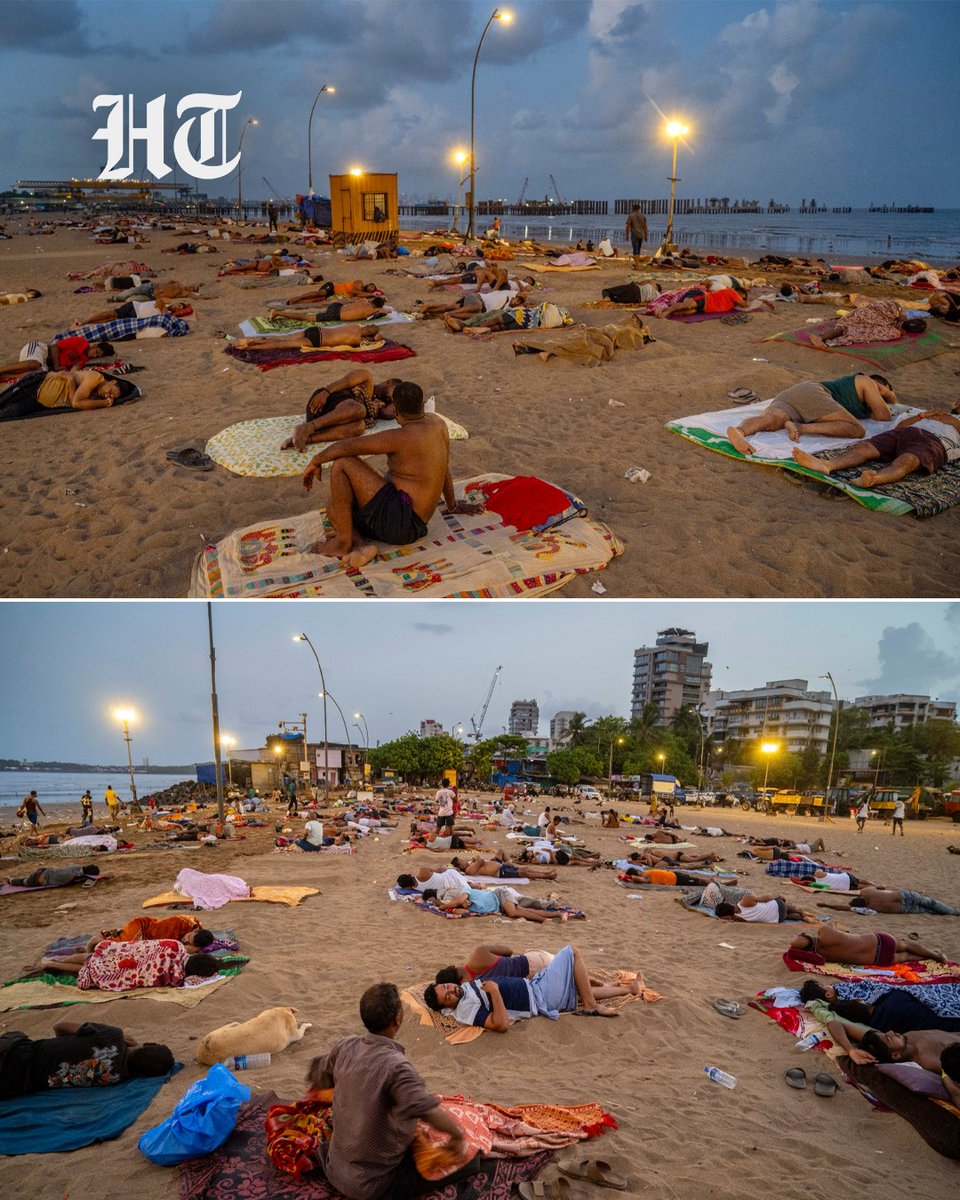
These photos truly capture Maharashtra's current development model.
Unprecedented heat levels forcing citizens to sleep on beaches. No State intervention. But in the backdrop, you can see a coastal road being constructed for 20,000 crores, after chopping off 45,000 mangroves.
#InPhotos: Residents from slum settlements near the Versova coastline spend the night on Versova Beach in Mumbai to escape intense heat and frequent power outages, returning home the next morning.
Stay updated with all the stories that matter — download the Hindustan Times App
(Photos: Satish Bate/HT)
Mumbai Airport T2
Arrival level
Airport staff is pouring water on this ledge
To prevent people from sitting on it
My Mumbai Airport
With special 'wet your pant' services
>12वें फ्लोर पर आग लगी
>6वें फ्लोर तक पानी जा पा रहा
यह देश के सबसे तेजी से उभरते शहर नोएडा के हाल हैं। यहां हर दूसरी बिल्डिंग हाईराइज है। तब भी फर्स्ट कॉल पर जो दमकल गाड़ी भेजी गई, वह होली की पिचकारी जैसी साबित हुई। बाद में हाइड्रोलिक मशीन ने आकर आग बुझाई।
Former Tamil Nadu BJP chief K Annamalai decides to quit the party; will convey his decision to BJP President Nitin Nabin during their scheduled meeting on Tuesday.
Annamalai to launch a “political movement” in the next few months.
https://t.co/z4mSgvHUyK