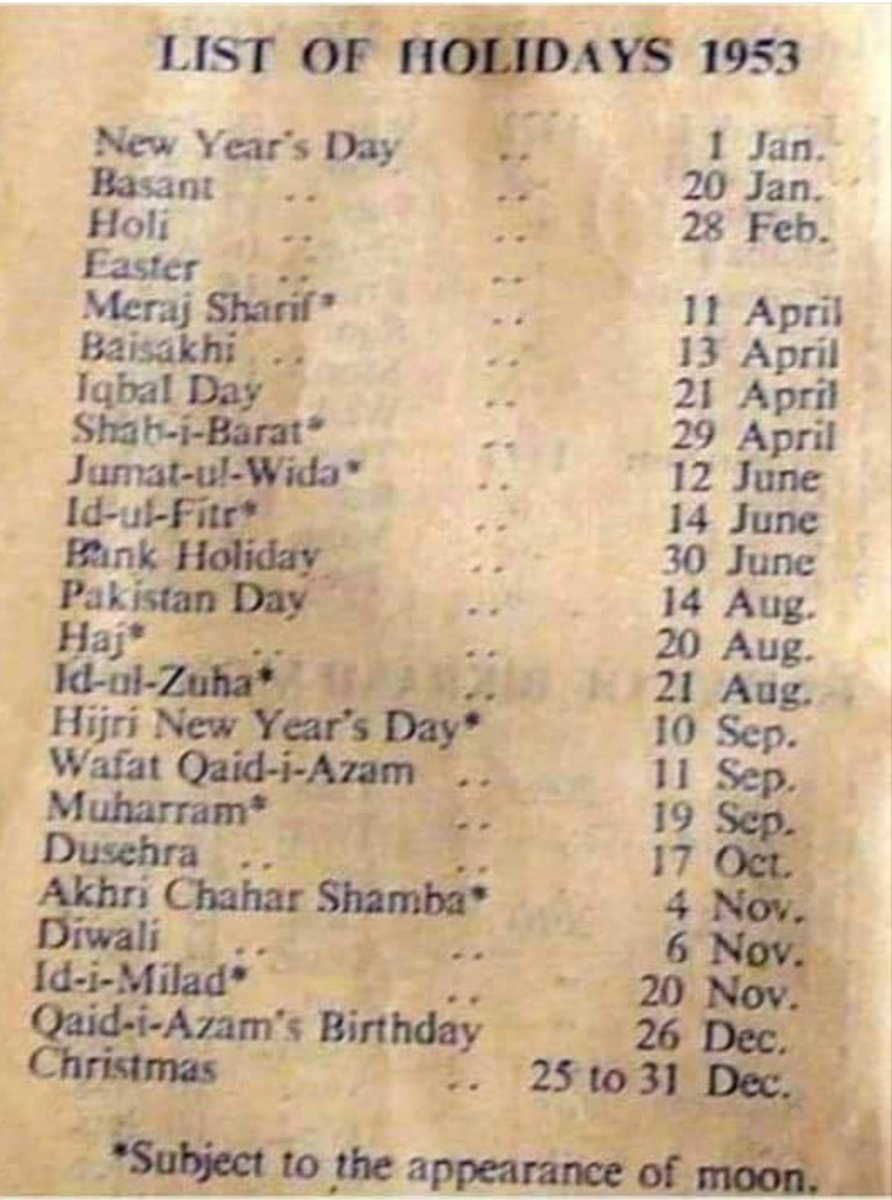
"Baisakhi" was celebrated as a holiday in Pakistan in 1953. Originally a pan-Punjabi cultural festival, the celebration became associated with the Khalsa Sajna Diwas of Sikhi. Punjabi Muslims gradually stopped observing Vaisakhi, perhaps due to it becoming too "Sikh-inflected".
A> For now we feature this short clip from Eqbal’s 1996 BBC Documentary ’Stories My Country Told Me’ . In this excerpt the two friends discuss Raza Kazim’s hopes for the newly established Pakistan .
Watch the full documentary at our project archive - https://t.co/oouow2jZ0C
2/x
Every time the West calls an African country "unstable" they mean the resources stopped flowing.
I made a glossary of 100 diplomatic words they use and what they actually mean.
https://t.co/hivzYl1N0Z
Bookmark this before your next history book. 🧵
Instead of strengthening the grid and building on the momentum of private investment in solar that Pakistan’s net metering policy had unlocked, the government went into overdrive to kill it. A rigid, outdated bureaucratic mindset couldn’t see beyond protecting an inefficient power system. The objective seemed less about enabling affordable, clean $30 energy alternatives, and more about maintaining a broken energy economy.
Amazing piece by Kasurian after a while.
This actually reminds of my all time fav of Iqbal’s Ghazals:
کمالِ تَرک نہیں آب و گِل سے مہجوری
کمالِ ترک ہے تسخیرِ خاکی و نوری
مَیں ایسے فقر سے اے اہلِ حلقہ باز آیا
تمھارا فقر ہے بے دَولتی و رنجوری
1/3
Readers Digest inspired Pakistan's first digest in a similar format Urdu Digest in 1959, which in turn sparked the digest revolution in Pakistan
https://t.co/6YVs1bKGWl
Even a single fictional book like The Count of Monte Cristo can teach you a lot more than a hundred self help books can. We are narrative creatures, shaped by stories that slip past our defenses. Our entire reality is subject to narrativization, and we cannot learn anything without them. Direct advice often bounces off because it feels abstract, preachy, or disconnected from lived experience.
Stories, by contrast, invite us in. We do not merely consume them, we inhabit them. Lessons must land unconsciously, and there must be some real stake involved. Transformations must happen without us being conscious of it and emerge as a byproduct rather than the direct goal.
Edmond Dantes does not receive a seven-step guide to overcoming adversity. He is thrown into the abyss, betrayed, imprisoned, and stripped of everything. Through years of isolation, a mentor's wisdom, relentless self education, and calculated transformation, he emerges as the Count.
This is an outstanding article from @DanQayyum, which reinforces much of what I learned about Pakistan during my five years living in the country.
"They are only finally being seen as who they are. A people who have absorbed war, terrorism, economic crisis, and decades of narrative assault, and who have responded not with bitterness but with tea, charity, laughter, music, and an insistence on dignity that no amount of external pressure has been able to break."
Pakistan Zindabad.
In the quiet lanes of old Lahore,Multan,Rawalpindi,Peshawar,Karachi and other Pakistani cities,stand the faded havelis of our forefathers,silent witnesses to a time when life moved slower and homes had soul.
Their weathered wooden doors intricately carved with Jasmine flowers and geometric patterns,once welcomed generations with open arms,courtyards where children laughed under the shade of neem trees,where summer evenings were spent on charpoys listening to the dadi or nani's stories.
These havelis were not just houses ,they were living poems of our heritage.
Today,as modern concrete rises and swallows the skyline,these crumbling beauties remind us of roots we must not forget.
May these havelis forever live in our memories and in the stories we pass on to our children .
#Oldhavelis
#Pakistaniheritage
Long before telescopes were invented, the moon was a character on paper with its own features, lighting up the night and keeping time.
Scribes working in medieval Europe meticulously crafted this face onto parchment. In the margins of prayer books and astronomy texts, they'd paint it using blue, yellow, and red pigments. On some pages, the moon appeared as a blue profile draped in a cloth hood. Sometimes, it'd gaze directly at the reader with a round face framed by gold leaf. In those years when lapis lazuli pigment was even more valuable than gold, masters used their finest materials to paint the moon.
Toward the end of the fifteenth century, the printing press became widespread. The Nuremberg Chronicle, printed by German publisher Hartmann Schedel in 1493, transferred the moon onto paper using an entirely new technique. Carved into woodblocks, the moon's face carried the serious expression of a man marked by deep lines of age. With the arrival of the printing press, colors vanished. The angular lines of black ink replaced the paints in the manuscripts.
When Eastern civilizations transferred the same celestial body onto paper, they used the features of their own people. In Zakariya al-Qazwini's cosmographical works and Persian manuscripts, the full moon took on a very different form from the European depictions. The masters who copied these texts drew a lunar face that resembled royal court members. A unibrow, dark almond eyes, and red cheeks gave this celestial body a directly human expression.
The blue profile drawn by a European monk and the thick-eyebrowed full moon painted by an Eastern master were the product of the exact same effort: they made this distant mass familiar using their own paints.