Presiden SBY: kami berhasil melalui Great Financial Crisis 2008-2009 dan Taper Tantrum 2013 dengan cukup baik
Presiden Jokowi: kami berhasil melalui Trade War 2018 dan Covid Crisis 2020 dengan cukup baik
Presiden Prabowo: GW YANG BIKIN KRISISNYA AJG AWOKWOKWOKWOK
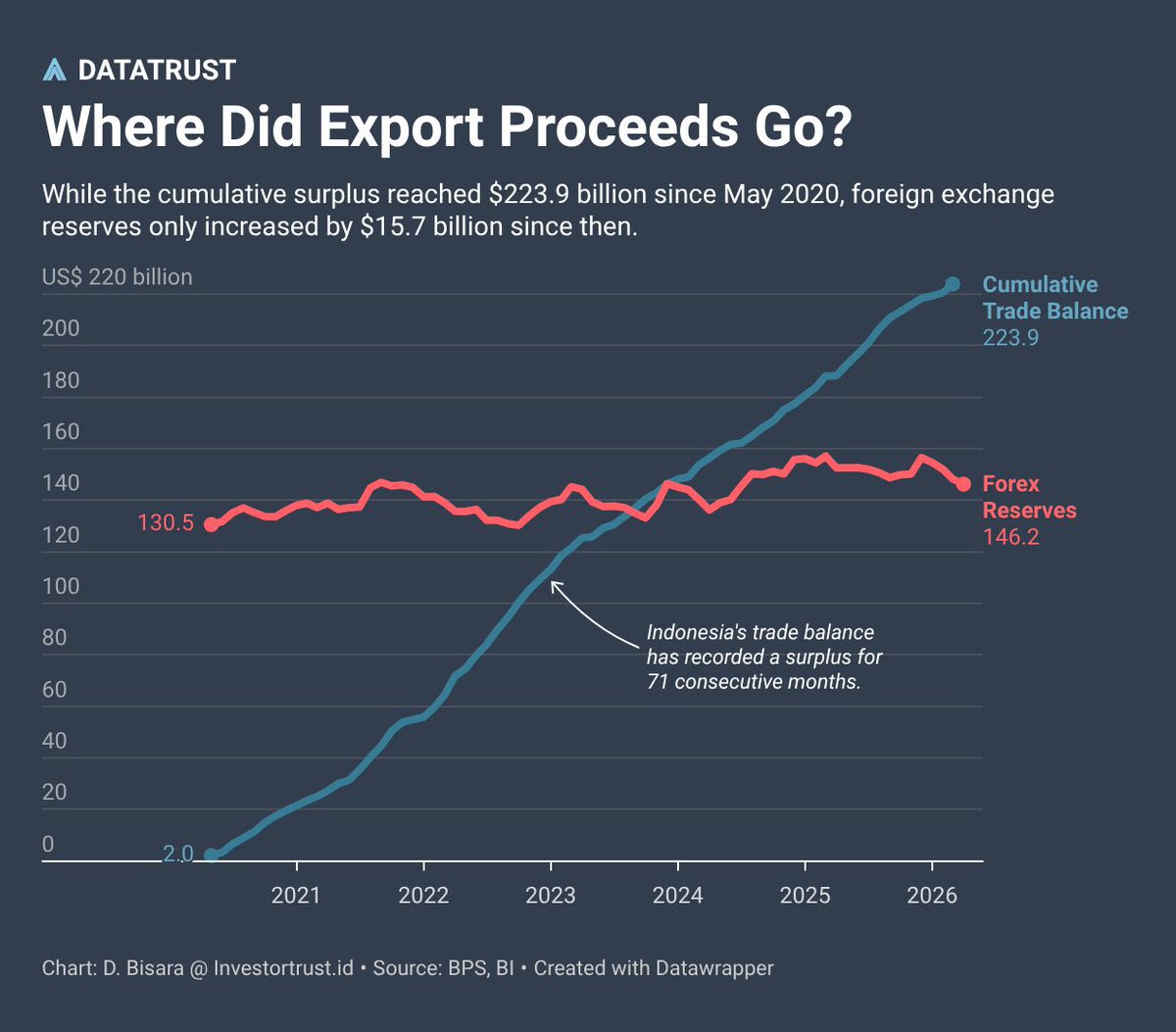
This chart is actually one of the most important visualizations explaining the structural fragility of Indonesia’s external position because it shows a deeply uncomfortable reality where the country accumulated roughly US$223.9 billion in cumulative trade surplus since 2020, yet official foreign exchange reserves only increased by around US$15.7 billion during the same period, which naturally raises the fundamental question of where the export proceeds and commodity windfall actually went.
And this is precisely why discussions around export retention rules, underinvoicing, offshore booking structures, transfer pricing practices, and capital leakage have become increasingly central inside Indonesia’s policy debate under President Prabowo’s administration.
In a textbook macroeconomic framework, a country running persistent and very large trade surpluses should normally experience much stronger reserve accumulation, stronger currency dynamics, or at minimum significantly larger domestic FX liquidity creation over time. But Indonesia’s experience has looked very different because despite 71 consecutive months of trade surplus, the rupiah remained structurally fragile while reserve accumulation stayed relatively modest compared with the scale of export earnings generated.
That discrepancy itself is the real story. A substantial portion of Indonesia’s export boom over the past several years came from nickel downstreaming and nickel-related byproducts, particularly ferronickel, stainless steel inputs, and battery materials flowing out from industrial parks largely funded by Chinese foreign direct investment and operated by mainland Chinese corporates rather than Indonesian-controlled entities themselves.
And that distinction matters enormously. While the exports are recorded as Indonesian exports statistically, a meaningful portion of the ownership structure, financing ecosystem, supply chain coordination, procurement flows, profit repatriation channels, and offshore trading relationships remain heavily tied to mainland Chinese corporates and affiliated networks. In practice, this means a considerable share of the economic value generated from the nickel boom may never fully circulate inside Indonesia’s domestic financial system for very long because profits, retained earnings, procurement payments, debt servicing, and offshore cash management structures can still flow outward through external financial channels.
From the corporate perspective, much of this behavior is economically rational because firms naturally seek tax efficiency, financial flexibility, currency stability, and global capital mobility. But from the state’s perspective, the consequence is that Indonesia may generate enormous commodity wealth externally without fully capturing the corresponding liquidity, fiscal benefit, or reserve accumulation internally.
And this is exactly why Prabowo’s recent speeches increasingly focus on economic sovereignty, export proceed retention, commodity oversight, and forcing more economic value back into the domestic banking system itself.
Ultimately, the government understands that a country cannot sustainably rely on commodity exports as a growth engine while simultaneously allowing a very large share of export-generated liquidity to continuously recycle outward rather than strengthening domestic capital formation, FX reserves, fiscal capacity, and rupiah stability.
This creates a very delicate balancing act because while stronger export proceed enforcement could improve FX liquidity and reserve stability materially, excessive intervention risks damaging investor confidence if markets begin perceiving Indonesia as becoming overly restrictive toward capital mobility and private-sector financial flexibility.
This reflects the ongoing struggle between globalization, commodity nationalism, foreign capital ownership, and the state’s attempt to reclaim greater control over economic value generated by its own natural resources.
Paket CCTV 2,3jt nyangkut di Ninja Van sejak 3 Feb, sudah lapor CS Lazada (Tiket:[via DM]) tapi belum ada kejelasan sampai 20 Feb. Mohon solusinya! @lazadaid.