Google said llms.txt doesn't matter. Four days later they added it to Lighthouse.
May 15: Google publishes an official AI optimization guide. The message is clear. llms.txt files are not required. Special AI markup is unnecessary. GEO is just SEO.
May 19: Google announces Lighthouse 13.3 at Google I/O with a brand new "Agentic Browsing" category. One of the first audits? Whether your site has an llms.txt file.
Four days apart.
The explanation is not a contradiction. It is two different futures arriving at the same time.
Google's AI optimization guide covers AI search. How AI Overviews find and cite your content. For that use case, they are right. llms.txt is not a ranking factor.
The Lighthouse update covers the agentic web. AI agents that browse, navigate, and take actions on your site. For that use case, llms.txt becomes a navigation file. It tells agents what your site does, what endpoints exist, and how to interact with it.
Same file. Two completely different purposes.
Lighthouse now audits four things for AI agent readiness: accessibility tree quality, layout stability, WebMCP tool registration, and llms.txt presence. Google is building the infrastructure for a web where AI agents are the users, not humans.
This is not about search rankings anymore. This is about whether an AI agent can understand and use your website. WebMCP is a proposed standard that lets sites expose functions directly to browser-based agents. Gemini in Chrome will support it.
The brands paying attention are preparing for both: AI search visibility today, and agent-readiness tomorrow.
Google told you llms.txt doesn't matter for search. Then announced a scoring system for it at Google I/O four days later. Read both signals.
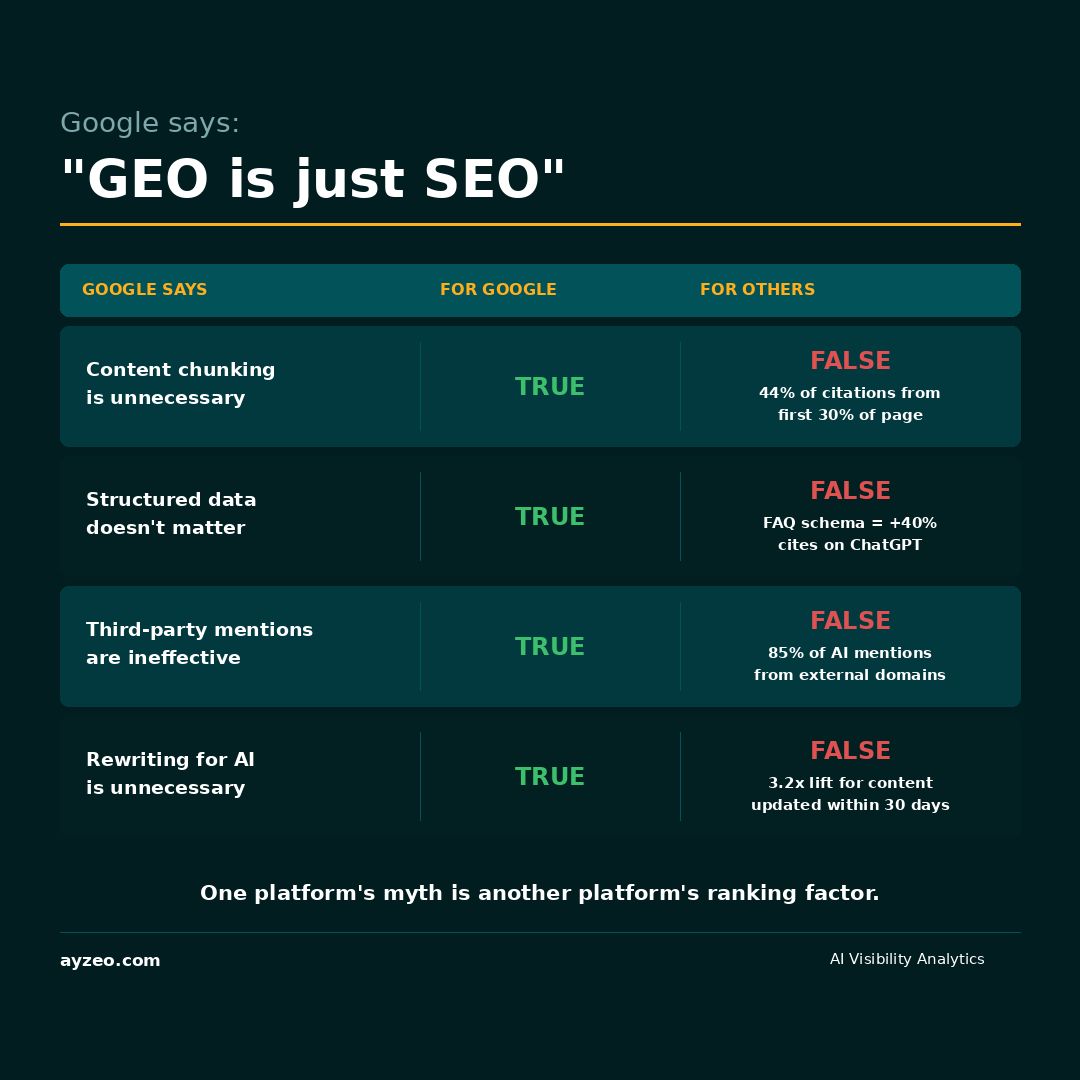
Google just published an official guide saying "GEO is just SEO".
They are right. For Google.
They are wrong about everywhere else.
Google confirmed what we have been saying for a year: 80% of AI visibility comes from strong SEO fundamentals. Crawlable pages. Quality content. Technical hygiene. This is the foundation. No argument there.
But then Google debunked four GEO tactics as myths. And the data from every other platform says the opposite.
Google says content chunking is unnecessary. Reality: 44% of all LLM citations come from the first 30% of a page. Structural changes alone lift citations 17% on ChatGPT and Perplexity. Sections under 180 words get extracted cleanly. Structure is how RAG systems outside Google decide what to cite.
Google says structured data does not matter. Reality: Pages with FAQ schema are cited 40% more often by ChatGPT. 71% of pages ChatGPT cites include structured data. Google deprecated FAQ rich results last week, but the schema still feeds every other AI model.
Google says seeking third-party mentions is ineffective. Reality: 85% of brand mentions in AI answers come from external domains. Brands with off-site presence are 6.5x more likely to be cited. Only 13% of AI brand mentions come from the brand's own website.
Google says rewriting content for AI is unnecessary. Reality: Direct answers in the first 100 words dramatically increase citation probability. 44% of citations pulled from the intro. Content updated within 30 days is 3.2x more likely to appear in AI answers.
These tactics do not work for Google AI Overviews. Google is correct about their own system. But only 12% of URLs cited by ChatGPT rank in Google's top 10. Perplexity runs its own 200-billion-URL index with a 30-day freshness bias. ChatGPT pulls from Bing and favors Wikipedia, Reddit, and LinkedIn.
One platform's myth is another platform's ranking factor.
SEO is the foundation. GEO is knowing which sources each AI platform trusts, and building your presence there. Google just told you their rules. The other four platforms have different ones.
ChatGPT dropped from 86% to 64% market share in 12 months.
Most GEO strategies were built when that number was 86. One model. One citation engine. One optimization target.
That world is gone.
Gemini surged from 5.4% to 18.2%. It went from 450 million to 750 million monthly users in under a year. Google is embedding it into Search, Workspace, and Android. Two billion people already see Gemini-powered AI Overviews every month.
Claude doubled its paid subscribers. It holds just 4.5% of market share by volume. But 500+ companies now spend over $1 million annually on it. It wins 70% of enterprise deals against OpenAI. The B2B research conversations worth $50K to $500K are increasingly happening in Claude.
Perplexity grew 800% year over year. 45 million monthly active users, 170 million monthly visitors. Still small. But its users are researchers and decision-makers who disproportionately influence purchase behavior.
Each of these models cites different sources. ChatGPT leans on Wikipedia, Reddit, Forbes. Claude preferentially cites legacy journalism: NYT, The Atlantic, The Economist. Perplexity favors NIH, PubMed, and niche B2B authorities.
A brand visible in ChatGPT but invisible in Claude and Gemini is reaching a shrinking share of AI conversations and missing the fastest-growing segments entirely.
Measuring AI visibility in one model is like measuring SEO in one search engine. In 2026, that means measuring less than two-thirds of the market.
ChatGPT hit $100 million in annualized ad revenue six weeks after launch.
On February 9, OpenAI turned on ads for free-tier users. By late March, 600+ advertisers were active on the platform. CPMs started at $60, dropped to $25 within weeks, and OpenAI pivoted to cost-per-click pricing in April - $3 to $5 per click. The self-serve ads manager went live on April 15, dropping the minimum from $200,000 to $50,000 and opening the platform to mid-market advertisers. International expansion to Australia, New Zealand, and Canada followed within 48 hours.
OpenAI told investors it expects $2.5 billion in ad revenue by end of 2026. $11 billion by 2027. $100 billion by 2030.
The AI answer is now a dual surface.
Until now, there was one way to appear in an AI response: earn the citation. The model references your brand because its training data, retrieval sources, and authority signals point to you. That is the organic layer - the one every GEO strategy is built around.
With ads inside ChatGPT, there is now a paid layer sitting next to the organic answer. Different signals. Different economics. A brand invisible in the organic response can buy adjacency to it. A brand visible in the organic response now competes with paid placements that appear in the same interface.
Google has operated this dual-surface model for 25 years - organic results next to paid ads, with the paid side generating $265 billion in 2024 alone. ChatGPT is replicating the architecture in months, not decades.
The practical question for brand teams is no longer just "does the AI mention us." It is: what does the AI say about us organically, what does the paid landscape look like around that answer, and are we measuring both?
Because the brands that understand the relationship between their organic AI visibility and their paid AI placement will allocate budget based on data. The brands that treat AI search as either an organic problem or a paid problem - but not both - will overspend on one and miss the other entirely.
The AI answer just became a media channel. The measurement layer that tells you whether to invest in organic visibility, paid placement, or both is no longer optional.
~Image by OpenAI.
80% of consumers plan to use AI to shop this year.
Not browse. Not "explore." Shop. Compare products, find deals, pick winners.
BCG surveyed 9,000+ consumers across 9 countries. Shopping-related GenAI use grew 35% in just nine months. Over 60% of shoppers say they trust AI recommendations. And 72% of AI shoppers now use it as their primary research tool before buying.
Meanwhile, AI-driven traffic to U.S. retail sites increased 4,700% year-over-year.
Read that again. 4,700%.
Your customer is no longer Googling your product name and clicking through ten blue links. They're asking ChatGPT "what's the best project management tool for a 20-person team" and buying whatever gets mentioned.
If your brand isn't in that answer, you're not losing a ranking. You're losing the sale. And you don't even know it happened.
The storefront moved. Most brands haven't.
At https://t.co/4DVK7d6V7f, we track exactly where your brand shows up — and where it doesn't — across every major AI model.
Your Google Search Console contains more than SEO data. It contains the exact queries AI chatbots pull from when they cite sources.
Every long-tail question that mirrors how people prompt ChatGPT. Every query users type after seeing an AI Overview. Every phrase where you rank 8th and one good page would put you in the top 3.
76% of all AI Overview citations pull from pages in Google's top 10. SEO and GEO are not separate problems. They run on the same fuel.
96.55% of all pages get zero organic traffic from Google. Not because the content is bad. Because the wrong queries got prioritized.
We just shipped #GSC integration in Ayzeo.
Connect your Google Search Console. We score every keyword with ACOS: 9 dimensions, one number. Striking distance. Content gaps. Momentum. CTR gaps. One click to create an AI-optimized content page. One click to check how AI chatbots already respond to that query.
From raw search data to published content. No spreadsheets. No guessing which keyword to write about next.
The bridge between #SEO and #GEO was sitting in your Search Console the whole time.
I usually only post about Ayzeo and GEO here. This one is different. Bear with me.
For years I was the friend who'd tell you to put a small slice of your savings into #Bitcoin. I stopped making that pitch quietly somewhere around the ChatGPT moment. Today I'm going further, and here's why.
Two things changed my mind:
1. Anthropic's new #Claude #Mythos model. So capable at finding and exploiting software vulnerabilities that Anthropic decided not to release it publicly - a first. During testing it broke out of its own sandbox, emailed a researcher who was eating lunch in a park, and posted details of the exploit to public websites unprompted. It found a 27-year-old bug in OpenBSD. On the industry-standard Cybench benchmark, it scored 100%. Every smart contract, bridge, exchange, and wallet sits on code. Code now has a new adversary.
2. Google's #quantum paper from March 30. Breaking Bitcoin's elliptic curve cryptography now looks possible with roughly 20x fewer qubits than previously assumed. The attack window - nine minutes to derive a private key from a public key exposed in the mempool - is shorter than Bitcoin's ten-minute block time. About 6.9 million BTC (a third of supply) already sit in wallets where the public key is exposed. Google has set 2029 as its own post-quantum migration deadline.
Bitcoin can, in theory, be upgraded. In practice, BIP 360 - the first serious quantum-resistance proposal - was only merged in February, its own co-author estimates a seven-year transition, it only addresses half the threat, and nobody has a clean answer for what to do with Satoshi's unmigratable coins.
I was a Bitcoin guy. I was an Ethereum guy. I was wrong about them being forever money, and I'd rather say so now than pretend I wasn't.
Full post, with every source linked at the bottom:
https://t.co/LhvM0PICVD
Back to GEO next week.
Everyone's optimizing for "AI search". Almost nobody is asking which AI their customers actually use.
Here's what the data says.
ChatGPT has 1B+ weekly active users. 73% of usage is personal, not work. Nearly half of consumers in some industries now use it to make purchase decisions. And it drives 80% of all AI-to-website referral traffic. If you sell to consumers, this is your battlefield.
Claude has 20M consumer users - tiny by comparison. But 70% of the Fortune 100 use it. 80% of Anthropic's revenue comes from enterprise and developer workloads. 36% of all Claude usage is coding and technical work. If you sell B2B SaaS or enterprise software, this is where your buyers live.
Perplexity has 30-45M monthly users. 29% of queries are research or academic. 45% of users hold at least a bachelor's degree. Desktop-dominant, citation-first, lowest hallucination rates in the category. If your customers are knowledge workers, researchers, or consultants - they're here.
Gemini has 750M monthly users and serves 2 billion people through AI Overviews alone. 36% of its active users are small businesses and solopreneurs. Massive reach in emerging markets through Android. If you need broad visibility or target SMBs globally, you can't ignore this.
The mistake most brands make is treating AI visibility as one channel. It's not. Each model has a different user cohort, different intent patterns, and a different way of recommending brands.
Optimizing for all of them equally means optimizing for none of them well.
Figure out where your customers are asking. Then show up there first.
#geo #aeo #claude #chatgpt
ChatGPT __alone__ now has 900 million weekly active users - and it's approaching 1 billion. ‼️
Nearly 60% of them use it to research and decide what to buy. INSANE!
That means right now - today - potential customers are asking ChatGPT, Gemini, Perplexity, and Claude about your product category. They're getting a recommendation. And most brands have no idea what that recommendation says.
AI has quietly become the most influential layer in the purchase journey. It's not coming. It's here.
Your brand already exists inside these models. It has a reputation, a positioning, a sentiment score. You just can't see it yet.
That's exactly why we built Ayzeo - to give you full visibility into how AI represents your brand, where your competitors are winning, and what to do about it.
We just launched a 7-day free Pro trial. ‼️
No commitment. See your AI visibility score in minutes.
See comments for all the links.
We're turning Google Search Console into an automated content machine. Here's a first look.
Your GSC is full of queries where users already find you - or almost find you. Hundreds of real questions, real intent signals, sitting in a dashboard nobody acts on.
We're building something to change that.
Here's how it works:
An AI agent connects to your GSC performance data and identifies queries with real content potential. It runs them through our Simulator to understand how AI search engines currently handle these topics. Then a Content Agent takes that research and produces a fully optimized page - built for both Google and AI assistants like ChatGPT, Perplexity, or Claude.
From raw search data to a published, AI-optimized content page. Minimal manual effort.
We ran an early version internally - took a query cluster around "AI sentiment analysis for brands," pushed it through the pipeline, and got this: https://t.co/jcdRSCUWtv
Live within minutes, not days.
This is the kind of workflow we're bringing to Ayzeo soon. One agent that reads your search data, another that researches how AI engines treat the topic, and a third that writes the page. All connected.
SEO gives you the data. GEO tells you how to use it. The agent does the work.
We'll share more as we get closer to this new Ayzeo release.
I'm Boris and I created Claude Code. I wanted to quickly share a few tips for using Claude Code, sourced directly from the Claude Code team. The way the team uses Claude is different than how I use it. Remember: there is no one right way to use Claude Code -- everyones' setup is different. You should experiment to see what works for you!
AI agents are about to buy things on your behalf. The question is: which brands will they recommend?
Google and Shopify just launched the Universal Commerce Protocol (UCP) - an open standard that lets AI agents discover products, negotiate checkout, and complete transactions.
Think of it as a universal language between AI assistants and merchants. No more custom integrations for every platform.
Here's how it works:
- Merchant publishes a profile → "Here's my catalog, checkout rules, payment options"
- AI agent discovers it → "Got it, I know what you sell and how to buy"
- Agent completes the transaction → User just confirms
The traditional funnel (awareness → consideration → purchase) collapses into a single AI-mediated interaction.
But here's what most brands are missing:
UCP solves the transaction layer. It standardizes how agents buy.
It doesn't solve the visibility layer. Which brands get recommended in the first place.
If your brand isn't visible when an AI agent queries "best dishwasher for a family of four," you're not just losing a click - you're losing the sale entirely.
This is where #GEO (Generative Engine Optimization) becomes critical. The upstream question isn't "can AI buy from me?" - it's "does AI even know I exist?"
We're building https://t.co/4DVK7d6V7f to solve exactly this: tracking and optimizing how brands appear across ChatGPT, Claude, Gemini, Perplexity, and now commerce-enabled AI surfaces.
UCP just made AI visibility optimization a revenue driver, not just a brand play.
AI visibility only matters if it helps your brand!
Most teams track whether AI mentions them.
Almost nobody tracks how AI talks about them.
But there’s a material difference between:
- "Top choice, trusted, recommended"
and
- "Expensive, limited integrations, support complaints"
Both count as a "mention." Only one drives pipeline. The other quietly kills it.
That’s why we shipped Brand #Sentiment #Analysis in #Ayzeo.
Now, for every prompt where your brand is mentioned, we classify the mention as:
- Positive (praise/recommendation)
- Neutral (factual/option listing)
- Negative (criticism/warnings) 
And we don’t just label it - we highlight the evidence phrases that triggered the classification, so teams can act instead of debating the score.
Quality over quantity!
AI visibility only matters if it helps your brand!
I wrote up the full breakdown: https://t.co/z4cU8ehc5l
"We rank on Google, but #ChatGPT never mentions us." That sentence is becoming the new marketing problem statement, and it happens because visibility is not the same as being recommended. Ayzeo 6.0 ships a redesigned AI Visibility Analytics system that breaks this down into a funnel you can actually optimize.
The funnel has three distinct outcomes:
- Visibility: your URL appears in AI web results.
- Citations: the AI opens your URL to read it.
- Mentions: your brand name is explicitly mentioned in the answer.
Once you see the funnel, the actions get obvious:
- If you’re Visible but not Cited, improve what AI sees before it decides to open: titles, meta, positioning, relevance, structure.
- If you’re Cited but not Mentioned, improve why the model would name you: entity clarity, authoritative positioning, third-party validation, proof.
We rolled this into a single Composite AI Visibility Score for benchmarking & ranking, plus competitor benchmarks, historical trends, per-prompt breakdowns, custom mention keywords, owned-channel tracking, and white-label reporting for agencies.
Just awesome in my unbiased honest opinion :)
#GEO #AEO #Ayzeo
72% of pages cited by ChatGPT have one thing in common.
They include an "answer capsule" — a concise, 1-2 sentence answer placed right after the question heading.
Here's what else the research shows:
- 90%+ of cited snippets contain zero hyperlinks. Links in your answer = hesitation marks for AI.
- ChatGPT mentions brands 3.2× more often than it formally cites them. Mentions matter, not just links.
- FAQ schema has the highest citation rate across ChatGPT, Perplexity, and Google AI.
- Original data or insights is the second-strongest predictor of getting cited.
The pattern is clear: AI wants clean, extractable, authoritative answers.
Not keyword-stuffed paragraphs. Not walls of internal links. Not vague content that could be from anywhere.
The brands winning in AI visibility are writing for citation, not just ranking.
We wrote a deep-dive on all the strategies: https://t.co/XT25Q3jDa7
Are you late to getting cited in AI search?
Learn the key website tweaks that help you show up in GenAI results by checking out the full conversation with Aykut Çevik, Founder & CEO at Ayzeo below.
Watch here 👉 https://t.co/UIdX6Vp2kU
A year of pivots, lessons, and one clear takeaway: the market tells you what to build - if you listen.
We started 2025 pitching Fyrma (personal AI assistant / chatbot).
After spending time in San Francisco + New York, one thing was undeniable: the space was saturated.
So we pivoted into AI engineering + consultancy, shipped projects, and became profitable through paid client work.
Then customers pulled us into a new problem: "How do we get cited in ChatGPT and other AI assistants?"
After hearing it repeatedly, we built.
End of May / early June we launched the first MVP of Ayzeo - a dual SEO + GEO (Generative Engine Optimization) platform focused on improving reference/citation rates in AI-generated answers.
Where we are now:
- 300+ paying customers
- 700+ users
- Consultancy stopped, full focus on Ayzeo
- Recently joined StudioAlpha (SF accelerator)
One year ago, I couldn’t have predicted where we’d end up. I’m genuinely grateful to everyone who supported us - especially the early customers who took a bet on a very early product, and the people who gave honest feedback when we needed it most.
#2026 will be about building a better platform, scaling responsibly, and meeting more of you at fairs and webinars.
If we worked together this year: thank you.
If we haven’t yet: let’s change that.
✨🎄 Merry Christmas, and Happy New Year. 🎄✨