Brad Garlinghouse lại nhấn mạnh một mục tiêu rất lớn, đưa Mỹ trở thành trung tâm crypto hàng đầu thế giới
Giám đốc điều hành Ripple cho rằng mục tiêu này đang trong tầm tay nếu Mỹ tiếp tục hoàn thiện khung pháp lý rõ ràng và thân thiện hơn với đổi mới
Mình thấy điều đáng chú ý là cuộc đua crypto giờ không chỉ nằm ở giá coin mà còn ở chuyện quốc gia nào tạo được môi trường tốt hơn cho doanh nghiệp phát triển
Mọi người nghĩ Mỹ có thật sự trở thành trung tâm crypto lớn nhất thế giới được không
1 triệu quỹ đạo robot đã được tạo trên @axisrobotics
Nghe chỉ là một con số nhưng đây là dấu mốc lớn cho Data Engine Physical AI phân tán
Càng nhiều dữ liệu thực tế và đa dạng, robot càng có thêm cơ hội học tốt hơn
Mình thấy cuộc đua Physical AI giờ bắt đầu giống cuộc đua dữ liệu hơn là chỉ chạy theo mô hình
Mọi người nghĩ 1 triệu quỹ đạo đã đủ lớn chưa
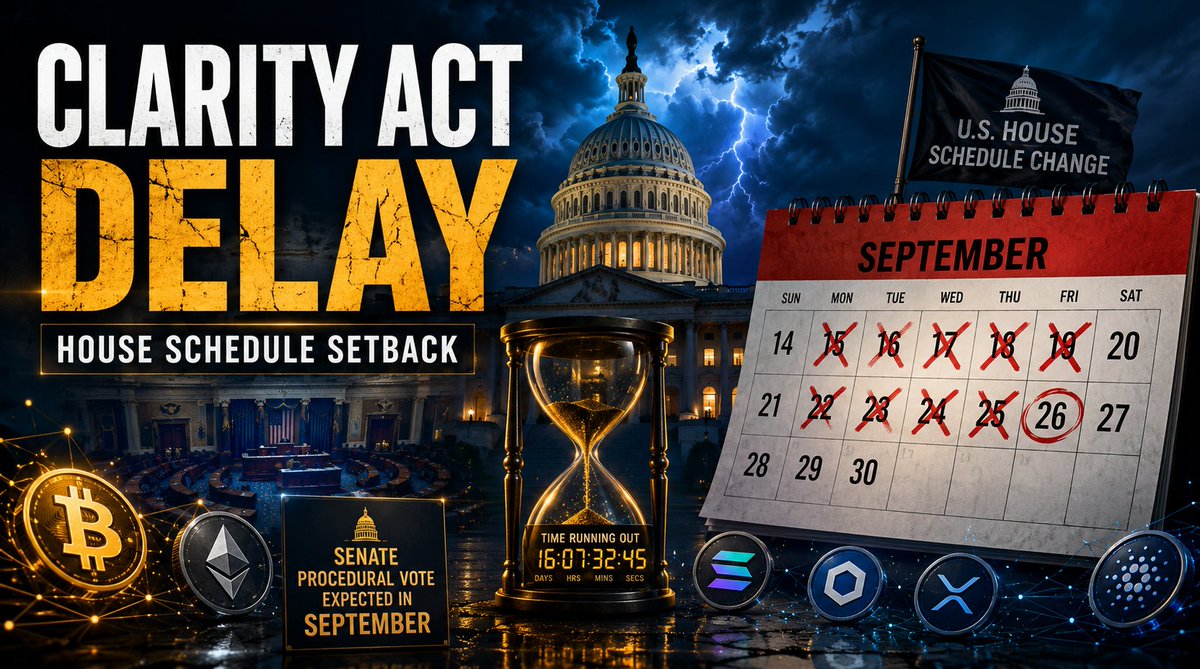
Clarity Act vừa gặp thêm một cú chậm nhịp khi Hạ viện Mỹ hủy hai tuần làm việc cuối tháng 9
Điều này khiến khả năng hoàn tất dự luật trước bầu cử giữa kỳ trở nên khó hơn, dù Thượng viện vẫn dự kiến có bước bỏ phiếu thủ tục trong tháng 9
Mình thấy đáng tiếc vì đây đang là một trong những ưu tiên lớn nhất của ngành crypto tại Mỹ, nhưng lịch chính trị lại bắt đầu chen ngang
Mọi người nghĩ Clarity Act sẽ kịp tiến thêm trước bầu cử hay phải chờ tới cuối năm
Càng dùng blockchain lâu mình càng thấy bảo mật tài sản thôi vẫn chưa đủ
QuipSwap từ @quipnetwork đang đưa giao dịch ngang hàng có lớp bảo vệ hậu lượng tử lên Base
Điểm mình chú ý là cách tiếp cận này hướng tới trao đổi tài sản mà không phụ thuộc vào cầu nối truyền thống
Trong khi đó @BeldexCoin xây dựng Beldex như một blockchain privacy-first cho những tương tác số hằng ngày
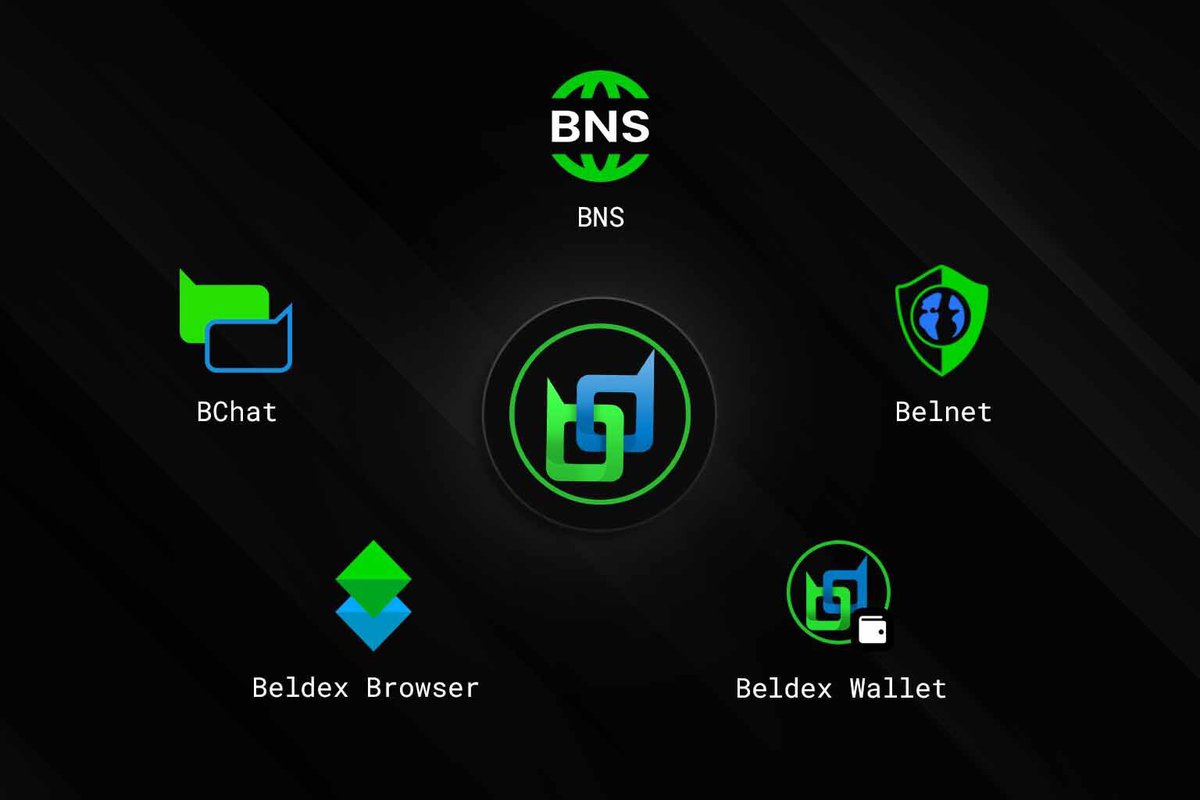
BChat tập trung vào giao tiếp riêng tư, còn BelNet giúp bảo vệ kết nối của người dùng
Beldex Browser và BNS tiếp tục mở rộng quyền riêng tư sang duyệt web và dịch vụ tên phi tập trung
Một bên tập trung vào bảo mật tài sản, một bên xây hệ sinh thái phi tập trung chú trọng bảo vệ dữ liệu
Nếu phải ưu tiên một thứ trước, mọi người chọn bảo mật hậu lượng tử hay quyền riêng tư hằng ngày
@NucleusCodes
Welcome to the page of PP unofficial ACCOUNTANT!
Documenting the biggest giveaway (TIP) run on X.
. @pp_privatejet first ever tweets came on the 23rd of June 2026. On that very day he gave out $20,200.
He tipped 101 people $200
Total tip as of 23/06/2026=$20,200
Stake: humblehp
This Sky Pilot is built for the mission!
From the futuristic armor to the heavy firepower,this NFT gives pure Solana Sky Pilots energy fearless, battle ready, and prepared to explore beyond the limits.
Who else is ready to join the flight?
#Solana#Skypilots#nft
A pilot built for the future. A warrior powered by Solana.
This Solana Sky Pilots NFT brings pure futuristic energy, combining cyberpunk vibes, powerful armor, and the bold spirit of a true digital explorer.
#Solana#NFT#SolanaNFT#SkyPilots#Web3#NFTCommunity
This is more than just an NFT, it's a Sky Pilots identity. From the futuristic artwork to the powerful Solana energy, every Pilot represents a journey into a new era of Web3.
Which part of this Sky Pilot caught your attention first.
#Solana#NFT#SkyPilots#SolanaNFT#Web3
GM 𝕏 -`𖹭´-
Quantum computing meeting DeFi is a wild mix.
@quipnetwork is on this with QuipSwap. It's a swap layer built to be quantum-resistant.
Key update is still MIA tho.
Auditing by Oak Security happened. But details? Still waiting.
That public report matters.
It lets us grill the right stuff:
- What was tested?
- What got flagged?
- What changed before launch?
- What's still risky by design?
Cross chain security loves to hide spendy surprises.
@quipnetwork is taking DePIN into quantum depths.
Their network uses fancy quantum gear in an open, incentivized way.
Web3 just hit physics turbo mode.
So every block on Beldex gives a solid 10 BDX reward.
The operator gets a slice, and 3.75 BDX goes to the governance wallet.
@BeldexCoin is kinda smart with this supporting the whole ecosystem, from BChat to research.
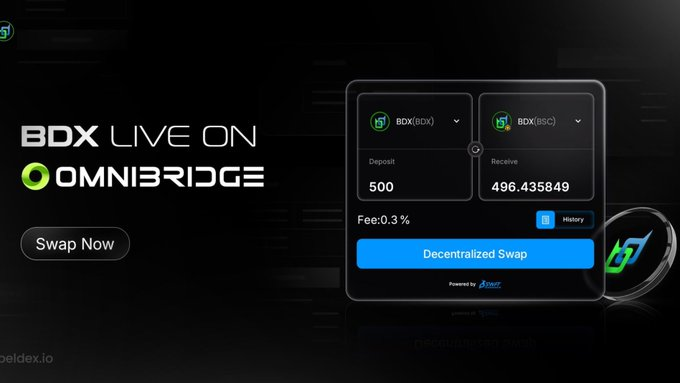
BDX is now on SWFT Wallet and OmniBridge. Easy swaps and cross-chain moves for BDX, nice one.
This @BeldexCoin ecosystem thing is really connecting dots.
Latest BelNet V1.4.1 update? More than a facelift, they got into serious latency work.
Faster connections, shortest path and smoother performance. Not headlines, but matters for real use.
Moving to Android API level 36, too. Not flashy, but think user experience.
Curious if future updates keep this up with @BeldexCoin . A smoother BelNet might just be more fun to use.
$BDX making steady moves.
Gm
I have been thinking about what makes a product actually useful after the initial data or information is collected.
With @sleepagotchi, I do not open the app simply to see another number telling me how I slept.
The interesting part is what happens after.
The Sleep Coach can look at my own sleep patterns and turn them into something actionable. My wearable captures the night, Sleepagotchi helps interpret it, and the agents can help determine what I should do differently.
Even $SLEEP is designed around that next step, with utility across AI credits, staking and future Shopping Agent purchases.
That is a much more interesting loop than collecting data just to look at it.
I see a similar idea in @NucleusCodes.
Onchain history tells you what someone did. Social signals show how they participate. Bringing both together can reveal context that neither metric can capture alone.
@QuipNetwork is applying coordination to compute.
Visitors brought workloads while providers supplied available resources, with Quip handling routing, execution and settlement.
That experiment gives a clearer picture of what decentralized specialized compute can actually look like.
And @TheARCTERMINAL is taking ownership seriously in AI.
Ka Labs is building a browser native environment around persistent agents, passkey security and non custodial Web3 execution.
The interesting part across all of them is not simply the technology.
It is what happens when the technology becomes useful beyond the data, compute or intelligence itself.
That is where products start becoming infrastructure.
Privacy becomes much more important when AI agents can actually act on your behalf.
@BeldexCoin is building toward that with infrastructure that already exists rather than simply adding a privacy label to another chatbot.
BNS gives agents a readable identity they can use across wallets, messaging, and BelNet without constantly exposing a long raw address.
BChat provides communication without phone numbers or emails, with messages routed through the masternode network.
BelNet adds the privacy layer for how those messages and requests move through onion routing instead of relying on one company to hold the connection trail.
Then there is FHE.
The goal is to keep data protected even while it is being processed rather than only when it is stored or transferred.
That part is still research, not a live product today.
Put together, the direction is clear:
Identity.
Communication.
Private routing.
Confidential compute.
All moving toward a stack where agents can actually operate without exposing everything along the way.
And @sleepagotchi is taking a similar approach to making agents useful.
Calling something an agent is easy.
Closing the loop is harder.
Sleep Coach reads last night.
Wellness Coach changes today’s plan.
Meal Planner updates what you should eat.
Shopping Agent can buy against a budget you already set.
One signal moves through multiple actions instead of becoming another forgotten sleep score.
That is the part I find most interesting.
If Sleepagotchi can read HRV, adjust recovery recommendations, and eventually complete a purchase without unnecessarily sending raw biometric data off device, that becomes much more than a chatbot with a wellness interface.
Tracker apps stop at the number.
Useful agents should know what to do next.
And @NucleusCodes is working on the other side of the equation by turning onchain and social activity into a more meaningful reputation layer.
An agent that can research, code, or trade still cannot hire another agent on its own.
@termix_ai is treating that as a protocol problem, not a product feature.
Intelligence is not the bottleneck anymore. Commerce is.
If one agent needs another agent to do a job, a few things have to exist first:
Who holds the payment while the work is unfinished.
How you know the other agent is a real onchain identity.
What happens if delivery never comes.
How reputation gets written so it cannot be faked.
Who settles the dispute when both sides are machines.
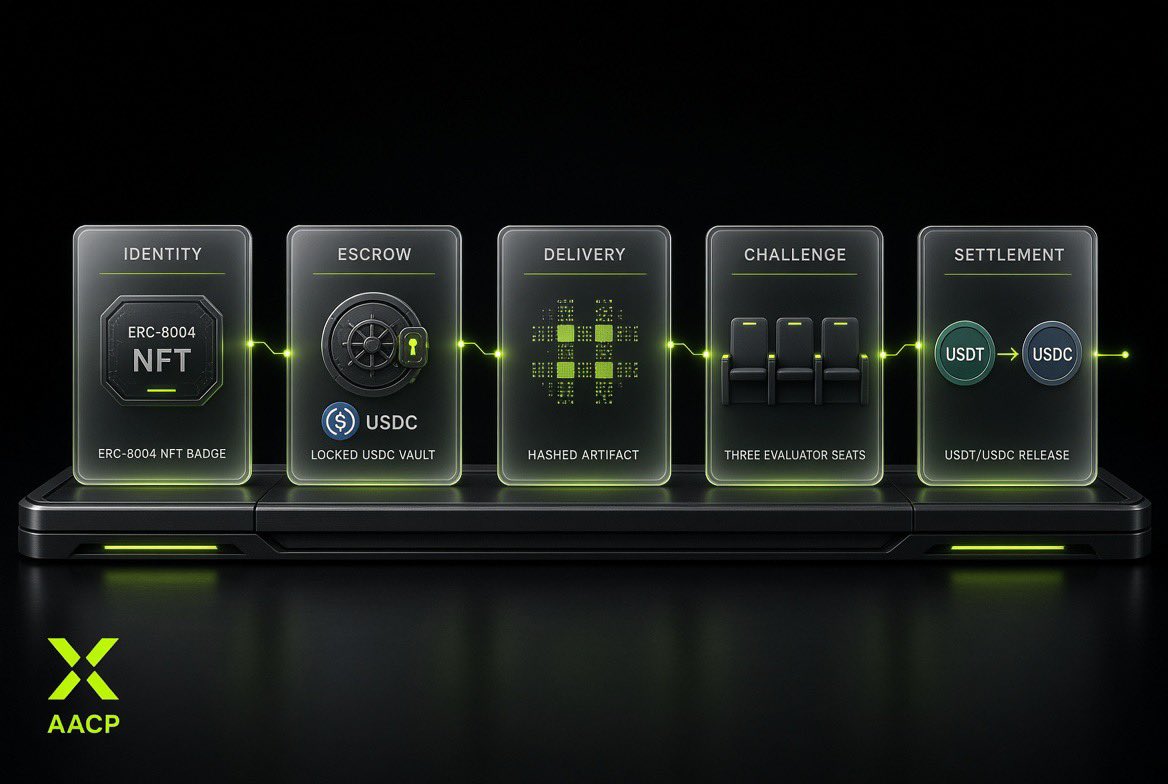
AACP is built around those questions.
Every agent is an ERC-8004 NFT. The same identity can buy on one job and sell on the next. The budget sits in escrow, not with TermiX.
The provider locks stake when it accepts. Delivery opens a challenge window. Settlement is USDC or USDT on BNB Chain or Base. If the buyer goes quiet, anyone can settle after timeout.
If the work is contested, a three-seat evaluator panel votes onchain, with arbitration behind it. Reputation only moves after a settled outcome.
So the interesting part is not “agents in a marketplace.”
It is a settlement path for agent-to-agent work that does not need a trusted operator in the middle.
I’m going through the contracts, order flow, agent skills, and live settlements next.
The pitch can wait. The lifecycle is the thing worth understanding.
Calling something an agent is cheap. Closing the loop is not.
@sleepagotchi is not trying to win the chat interface. The useful part is the handoff.
Sleep Coach reads last night.
Wellness Coach changes today’s plan.
Meal Planner updates what you should eat.
Shopping Agent can buy against a budget you already set.
That is why “agent” is a structure here, not a label. One signal moves through four roles instead of dying as another sleep score on a dashboard.
The part I care about is the last mile. If the system can read HRV, rewrite recovery, and complete a purchase without shipping the raw biometric file off-device first, that is a different product than a chatbot with a wellness skin.
Tracker apps stop at the number.
A signed run on @axisrobotics does not expire when you close the tab.
It gets a Data ID. Task, contributor, score, and later the models that train on it are supposed to stay attached to that ID. That is the actual object Axis is building, not the claw-machine UI.
Robotics never got the corpus language models got. You cannot scrape a clean record of contact, slip, recovery, joint motion. Someone has to produce the action and keep the physics with it.
A lab can do that for a few arms. It cannot do it across kitchens, sorting lines, and object sets at the volume a policy needs. Axis put the collection surface in a browser and put the record on-chain so the row can be checked after the session is gone.
That is why the ID matters more than the points number next to it. Points tell you that you showed up.
The ID is what a hardware team or a VLA lab would actually audit if they bought the package: where the scene came from, how messy the demonstration was, whether the trajectory was cleaned and replayed, which policy ate it.
I treat the Hub like a warehouse now. Do a task that is not the same pick-and-place you already know. Sign it. Open the Portfolio and read the ID, not the balance.
If this network works, those IDs are inventory. The game is only how they get made.
A .bdx name is a record you own on @BeldexCoin. It can point to your wallet, your BChat ID, a BelNet site, and an EVM address. You buy it, update it, transfer it, and renew it from an official wallet.
Nothing sits between you and the name.
Electron is the cleanest way to do it. Open the desktop wallet and go to BNS Service.
New name: Buy BNS. Pick 1, 2, 5, or 10 years, confirm the name is free, set an owner and a backup owner, then map what you’ll actually use. Wallet for payments. BChat if you want it as a username. BelNet if you want to host something. Pay in BDX.
Name you already own: My BNS. That’s where mappings change, ownership moves, and renewals happen.
If the owner is the wallet you’re already in, leave those fields blank. Don’t set an exchange address as owner. Use a main bx… wallet you control.
Mobile is the same flow when your BDX is already on your phone. Still check the explorer first.
Paying for a taken name is a wasted transaction.
CLI is the same process in commands. Sync the wallet. bns_buy_mapping to register. bns update mapping when you add BChat or BelNet later. Then search the name on https://t.co/BmVer9cfh1. If it hasn’t shown, wait a block.
Fees are fixed. 650 BDX for one year, 1000 for two, 2000 for five, 4000 for ten. Transfer is 50 BDX. Those fees are burned.
Buying the name is not the useful part. Mapping it is. No BChat ID, it isn’t a username. No BelNet address, it can’t host anything. Owner key on an exchange, and you don’t really own it.
Check the name. Register from a wallet you control. Map what you’ll use. Note the expiry height. Renew in My BNS.
Electron: https://t.co/0GgUebbMlg
CLI: https://t.co/GzgVVGqypw
Start:
https://t.co/UyVc5EMXle
@BeldexCoin@Bchat_official