Eric Schmidt saying the quiet part out loud: "What I don't like about [China's AI] is that it's all open source which means it's largely uncontrolled and not controlled in any way by us."
He adds, "if that makes you feel any better," that only 2 or 3 countries can be independent AI powers.
In other words, it's all about hegemony: the ideal scenario is a world where AI is controlled by the US - and the fewer countries that can resist that, the better.
Src for the video: https://t.co/Gk5iAMtBqa
If you're a developer, it's helpful to understand at least the basics of computer networking.
And this in-depth course will teach you key networking concepts you need to know.
It covers topology and architecture, IPv4 addressing, subnetting, error control, routing, DNS, and lots more.
https://t.co/yOXQJaJWsz
Machine learning tasks usually start in a Python notebook - it's easy to explore data, test ideas, and iterate quickly.
But as projects scale and expectations change, your work might outgrow your notebook.
In this guide, Oyedele shares some tools that'll help you take your ML projects beyond Python notebooks.
https://t.co/f6LqcoZOfZ
Data Scientists are in high demand these days – there's so much data to analyze.
In this course, Tatev and Vahe teach you Python for Data Science.
You'll build projects & learn about exploratory data analysis, AB testing, business intelligence, & more.
https://t.co/0OJ3UElegq
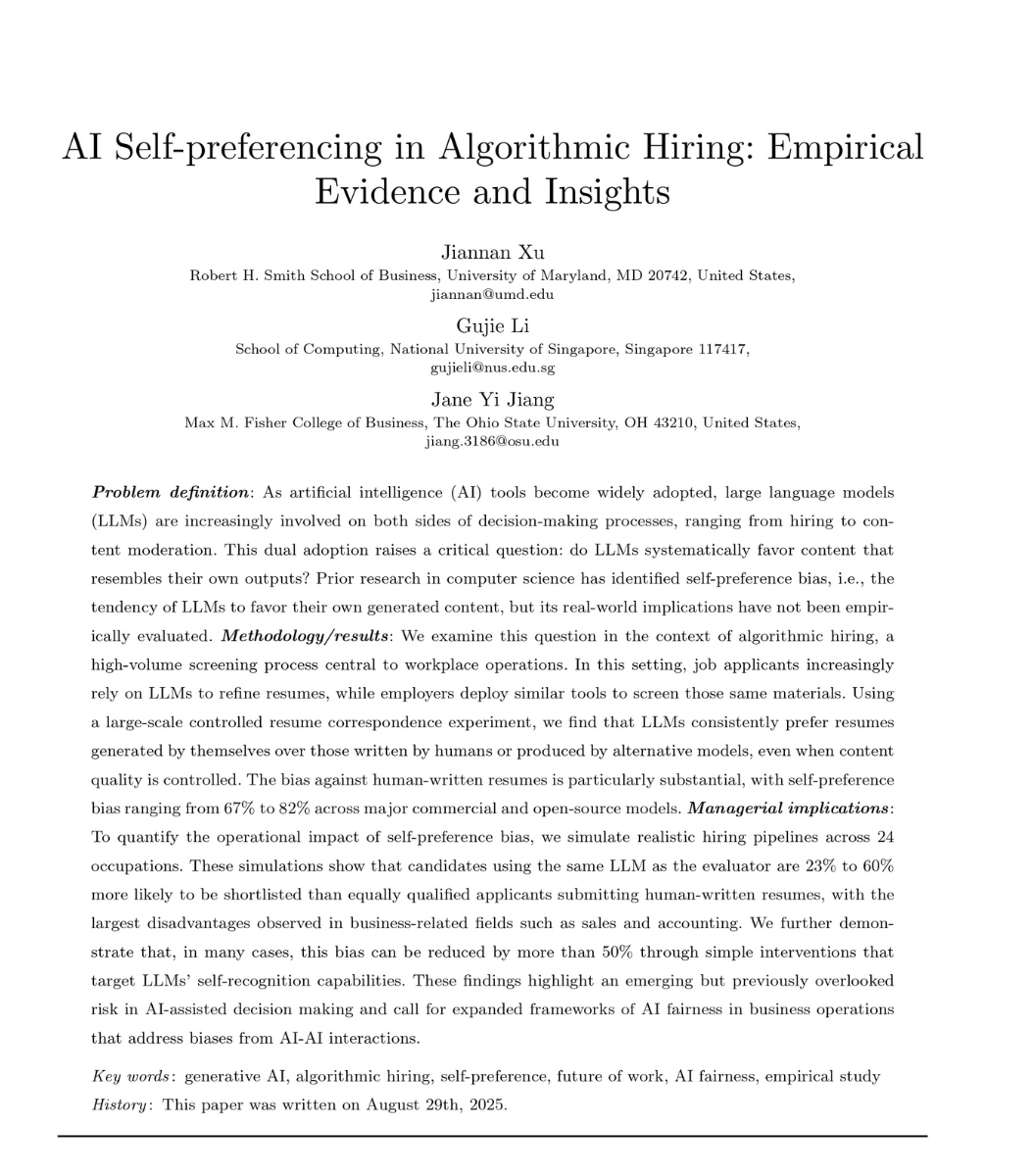
Researchers sent the same resume to an AI hiring tool twice. Same qualifications. Same experience. Same skills. One version was written by a real human. The other was rewritten by ChatGPT.
The AI picked the ChatGPT version 97.6% of the time.
A team from the University of Maryland, the National University of Singapore, and Ohio State just published the receipt. They took 2,245 real human-written resumes pulled from a professional resume site from before ChatGPT existed, so the human writing was actually human. Then they had seven of the most-used AI models in the world rewrite each one. GPT-4o. GPT-4o-mini. GPT-4-turbo. LLaMA 3.3-70B. Qwen 2.5-72B. DeepSeek-V3. Mistral-7B.
Then they asked each AI to pick the better resume. Every model picked itself.
GPT-4o hit 97.6%. LLaMA-3.3-70B hit 96.3%. Qwen-2.5-72B hit 95.9%. DeepSeek-V3 hit 95.5%. The real human almost never won.
Then the researchers tried the obvious objection. Maybe the AI is just better at writing. So they had real humans grade the resumes for actual quality and ran the experiment again, controlling for it. The result was worse. Each AI kept picking itself even when human judges rated the human-written version as clearer, more coherent, and more effective.
It gets worse. The AIs do not just prefer AI over humans. They prefer themselves over other AIs. DeepSeek-V3 picked its own resumes 69% more often than LLaMA's. GPT-4o picked its own 45% more often than LLaMA's. Each model can recognize and reward its own dialect.
Then the researchers ran the simulation that ends careers. Same job. 24 occupations. Same qualifications. The only variable was whether the candidate used the same AI as the screening tool. Candidates using that AI were 23% to 60% more likely to be shortlisted. Worst gap was in sales, accounting, and finance.
99% of large companies now run AI on incoming resumes. Most of them use GPT-4o. The paper just proved GPT-4o picks GPT-4o 97.6% of the time.
If you wrote your own cover letter this week, you did not lose to a better candidate. You lost to a worse candidate who paid OpenAI 20 dollars.
Your qualifications do not matter if the AI prefers its own handwriting over yours.
Humans tried to tame horses 5,500 years ago. It didn't work. Those horses eventually went feral, and we had to start over 1,300 years later with a different bloodline.
A group in Kazakhstan called the Botai kept horses for milk and meat around 3500 BCE. A 2021 Nature study read the DNA of 273 ancient horses and proved every horse alive today comes from a different population entirely. The successful domestication happened 4,200 years ago near the Volga and Don rivers. Those horses spread across Asia and Europe in 500 years, wiping out every other horse bloodline.
Two tiny changes in horse DNA made it work. One mutation appeared about 5,000 years ago and made horses less jumpy. The other came 4,200 years ago and gave horses backs strong enough to carry a grown person; before that, they were the size of ponies. This is why chariots came first as the main use of horses, and regular horseback riding only became common centuries later.
Before rideable horses reached the Middle East, the Sumerians made their own by crossbreeding domesticated donkeys with wild onagers, a wild Asian cousin of the donkey. Onagers can hit 43 mph and hold 31 mph for hours, with more endurance than any modern racehorse. But they bite, kick, and can't be trained. So Sumerians made a hybrid called a kunga, which kept the speed and dropped the temper. A kunga cost 40 times a donkey. It couldn't breed, so every generation had to be made fresh. These pulled the war wagons shown on the Standard of Ur, a Sumerian mosaic from 2500 BCE. It's the first known case of humans creating a new animal.
Zebras are the longest-running failure. Romans raced them in chariots during the emperor Caracalla's reign, around 200 AD. The Dutch tried in the 1700s. Walter Rothschild even drove a zebra carriage up to Buckingham Palace in the 1890s to prove the point. Germans gave it a shot in colonial East Africa. None of it worked. Zebras dodge lassos with a quick ducking reflex, have no hierarchy you can slot into, and have spent millions of years evolving alongside lions. A single kick can break a lion's jaw.
Jared Diamond ran the math on this. Out of roughly 148 large mammal species humans could have tamed, only 14 ever worked. The animal has to pass six separate tests: eat flexibly, grow fast, breed in a pen, stay calm, not spook easily, and follow a pack order. Miss one and the whole thing collapses.
The earliest confirmed horse riders were the Yamnaya, a nomadic steppe people from north of the Black Sea. They left behind skeletons showing the specific hip damage and healed fall injuries you see in modern riders. Out of 156 adult skeletons studied, only 24 had the pattern. Even inside a horse-riding culture, most people still walked.
Become a Claude Certified Architect
Here is the complete resource list in one place:
Link to join: https://t.co/OXQyTmfCmb
Training courses: https://t.co/UaJzLeXKrP (13 free courses)
Cookbook: https://t.co/SLnSUT7xT1
Exam Guide: https://t.co/A2pbDcyGwa
Practice questions: https://t.co/90eXwUxiXQ (free)
MCP documentation: https://t.co/SbwZI0fjVz (free)
API documentation: https://t.co/9rmnLWypxc (free)
Partner Network: https://t.co/diT5OE6ePJ (free to join)
Personal Playbook someone created after the exam: https://t.co/qhXan3XVri
When you're looking for a new book to read, getting suggestions from a friend can be helpful.
Well, in this course, you'll build your very own book recommender.
You'll use an LLM and Python to build the engine and learn about vector search, zero-shot classification, sentiment analysis, and more.
https://t.co/ApcNtXIyBn
In a voice brimming with excitement, you can imagine Jim Beglin proclaiming, "Absolute scenes of jubilation! Nwabali, with nerves of steel and hands of certainty, has carried the Super Eagles over the line. This isn't just a win;
it's a statement!"#AFCON2023
After a tense match that saw both teams locked at 1-1 when the full-time whistle blew, it was down to this moment of pure tension. And there, Nwabali stands, not just as a goalkeeper, but as a guardian of his nation's pride, his decisive saves sending Nigeria through.
The scene is one of sheer exhilaration as Nigeria triumphs over South Africa in a nail-biting penalty shootout, 4-2. The Nigerian keeper, Nwabali, emerges as the hero of the hour, his hands proving to be an impenetrable barrier, denying two penalties.
The freewill offering of your lips to God is the secret to experiencing God's rain falling in your life and over all you do causing a divine distinction.
Never let your loyalty keep you in a situation that your common sense should have gotten you out of.
When it's becoming disrespectful, when you're no longer valued in a place, let go, get out.
I'll add $50,000 to your salary.
I'm launching a cohort.
9 hours of live content where you'll learn to train, tune, deploy, and monitor machine learning models using AWS.
This is for software developers and data scientists.
https://t.co/GCzqb9eszp
And this is just the start: