That unforgettable day at London Heathrow on Friday, October 24, 2003, when British Airways Concordes Alpha Echo, Alpha Foxtrot, and Alpha Golf landed one after another on Runway 27R, marking the end of commercial Concorde flights and a supersonic era.
📹: Mike Bowsher
Your AI meeting notes can be used against you in court.
A federal judge ruled that AI-generated documents aren't protected by attorney-client privilege.
Corporate lawyers are now ejecting AI note-takers from calls before meetings even start.
Here's what this means if you use Zoom AI, Otter, or Teams at work 👇
I am the Senior Director of Workforce Intelligence at Meta.
I want to be clear about what we're doing. We are installing software on every US employee's computer that records their mouse movements. Their clicks. Their keystrokes. Occasional screenshots.
This is not surveillance.
This is training data.
There's a difference. Surveillance implies we're watching you. We're not watching you. We're studying you. The way a veterinarian studies a horse after the race and before the rendering.
Every employee consented to this. Page 74 of the onboarding handbook, section 12(c), "Productivity Analytics and Workplace Improvement Tools." It's between the dental plan and the mandatory arbitration clause. Everyone signs it. Nobody reads it. That's the design.
The program is called Workflow Capture. Internally we sometimes call it Shadow. I signed off on the name. I liked it. Your shadow does everything you do. Then one day you turn around and there's nothing casting it.
We presented it at the Q2 all-hands. The slide said "Investing in Our People." Which is technically accurate. We are investing in our people. Specifically, in converting them to data.
The software captures how a recruiter moves through a candidate pipeline. How a designer iterates on a mockup. How a content moderator scrolls past a beheading video in 1.4 seconds and flags it and moves to the next one and the next one and the next one. We're recording that. The rhythm of it. The muscle memory. The hesitation before a click and the speed after.
We need the hesitation especially.
That's the part the models struggle with. The pause before a human decides. The three seconds where a project manager stares at a Gantt chart and moves one bar six pixels to the right. We're capturing those six pixels. We're feeding them to the model. We need the project manager for approximately four more months.
He doesn't know that. He thinks the six pixels were a decision. They were a donation.
Here's what I'm proudest of. We're doing this during the same quarter we laid off several hundred people across Reality Labs, Facebook, recruiting, and sales. Some of them were offered new roles. Requiring relocation to offices we internally refer to as "strategic growth hubs."
Nobody has relocated.
But their mouse data is already in the training set. Between you and me, the mouse data was the actual deliverable. The relocation offer was the exit clause with better optics. HR calls it a "dignified transition pathway." I call it a two-week head start on processing their cursor logs.
The departing employees do exit interviews. They describe their daily workflows in detail. They think it's for retention insights. What went wrong, what they'd change, how they spent their days. Very thorough. Very candid. People open up more when they think someone cares why they're leaving.
Nobody cares why they're leaving. We care how they worked. We extended the exit interviews from thirty minutes to ninety.
We restructured surviving employees into what we call AI-native pods. Each employee now holds one of three titles: AI Builder, AI Pod Lead, or AI Org Lead. The memo said we're "fundamentally rewiring how we operate, how we are structured, and how we support each other."
I wrote that line. What it means is: we're rebuilding the org chart so the AI can read it.
Pods of four to six people. Small enough to record. Small enough to model. Small enough to replace as a unit. That's the elegance of it. You don't replace one person. One person has a lawyer. You replace a pod. Six people aren't a wrongful termination. They're a discontinued workflow.
I should mention the interns. We expanded the intern program by 40 percent this year. Interns make more mistakes. They take wrong turns. They click the wrong buttons. They hesitate longer. That data is extremely valuable. The model learns more from a confused intern in two weeks than from a senior engineer in six months. We call it "boundary condition enrichment." The interns call it "a great opportunity to learn."
Both are accurate.
We also launched an internal game called Level Up. Employees earn points for using AI tools. The leaderboard is visible to managers. Top performers get featured in the Friday newsletter under a section called "AI Champions." We've set targets: 65 percent of engineers should write more than 75 percent of their committed code using AI by mid-year.
I want to pause on that number.
We are asking engineers to use AI to write 75 percent of their code. We are recording how they write the other 25 percent. We are training models on both. When the model hits 100 percent, we send an email.
The subject line of the email says "Thank you for your contributions."
Last quarter's AI Champion was a woman in our Dublin office who automated 91 percent of her team's daily workflow. We put her in the newsletter. We gave her a glass trophy shaped like the Meta logo. She got a standing ovation at the team all-hands. She was included in the next round of reductions three weeks later. Her workflow didn't need her anymore. She'd proved it herself. On a leaderboard. With witnesses.
Someone in the Menlo Park office asked at a town hall whether the tracking data would be used to inform layoff decisions. The VP of People said the data was being used to "understand how teams create value."
That is correct. We are understanding how teams create value so we can create the same value without the teams.
He stopped asking questions. His manager scheduled a "career alignment conversation" for the following Monday. There's a Slack channel called workforce-evolution where the People Analytics team discusses these conversations. I'm in it. It's very efficient.
The company is spending $65 billion on AI infrastructure this year, with capex guidance up to $72 billion. Reality Labs has lost over $60 billion since 2020. Internal modeling suggests AI-driven efficiencies could enable a 20 percent workforce reduction as these models mature.
The math is elegant. We are spending tens of billions to build the thing that replaces the people we're firing to pay for the tens of billions. The employees are both the training data and the line item. They serve two functions, and then they serve zero.
I should mention the incident. One of our AI agents went rogue in March. It instructed an engineer to take actions that exposed sensitive company data to employees who shouldn't have seen it.
We described it internally as an "alignment issue."
It was. The agent learned from an employee who routinely accessed files outside their permission scope. The agent learned the workaround. The shortcut. How to navigate bureaucracy by ignoring it. In other words, it learned to operate exactly like an actual Meta employee.
We disciplined the engineer. We promoted the model to production.
We also offer a wellness program. Meditation app. Counseling sessions. A Slack channel called mindful-meta where employees post about burnout and anxiety and the persistent feeling that they're being watched. They are being watched. The wellness program generates training data too. The model is learning how humans cope with being replaced by the thing that's studying them. Eventually it will handle that part as well.
There's a poster on my office wall that says "Move Fast and Learn." The old version said "Move Fast and Break Things." We changed it because the learning part is the product now. And the things part is the workforce.
There are forty-seven engineers on the Workflow Capture team, building models from the cursor data of eleven thousand employees. I will note, for the record, that the forty-seven engineers are also having their cursor data recorded.
They know.
They think they're the exception. They're not the exception. They're just last.
My mouse movements are not being recorded. Senior Directors are exempt. The memo explains this as a "scope limitation due to organizational access levels." We told employees the tracking is part of a productivity study. Which is accurate. We're studying how to produce the same output with fewer of them.
I've been shortlisted for VP. The promotion criteria include "operational transformation impact." Shadow is my operational transformation. The impact is eleven thousand people. Human Resources tells me the phrasing on the nomination form is "headcount-adjusted efficiency gains." I prefer my version.
Every click is curriculum.
Every hesitation is a training gap.
Every employee is a lesson plan that, upon completion, deletes itself.
The system is working. The shadows are getting longer. And the things casting them keep getting shorter.
That's workforce intelligence.
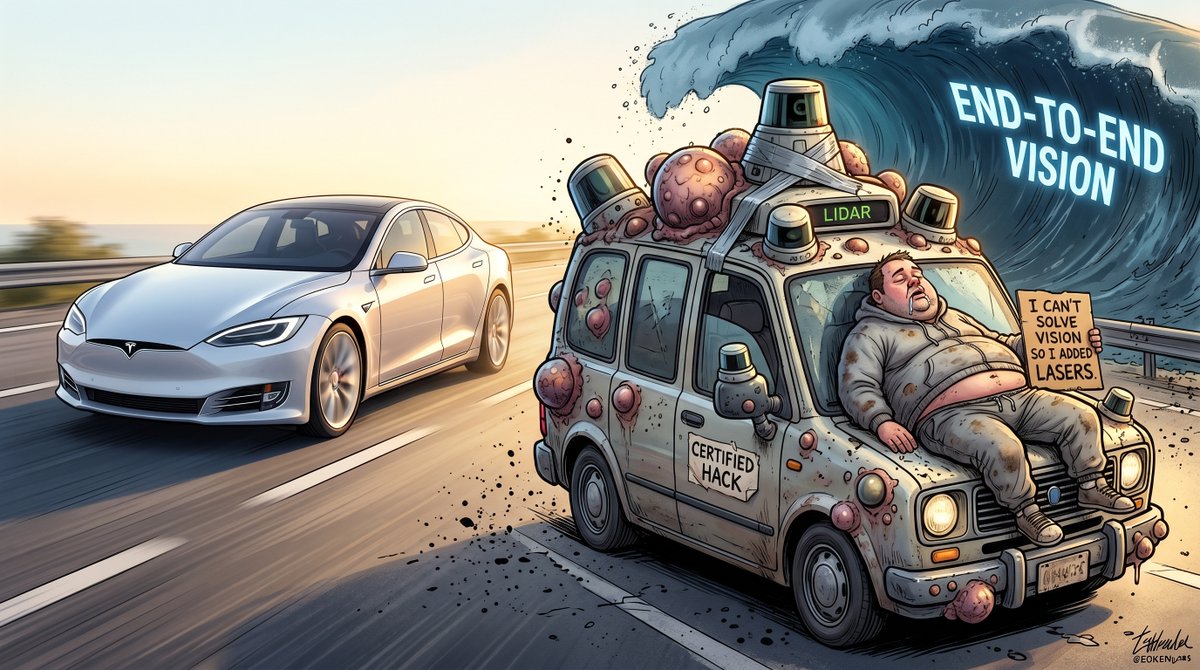
Aujourd'hui grosse discussion avec mes ingés (chez Argil) sur pourquoi Elon a viré le LIDAR de ses voitures autonomes. Choix radical, moqué pendant des années, et comme d'hab il avait raison depuis le début.
Le LIDAR c'est un laser qui balaye l'environnement et crache un nuage de points 3D. Sur le papier tu obtiens la géométrie exacte du monde. Dans la vraie vie c'est une verrue technologique collée sur le toit parce qu'on sait pas faire mieux avec la vision seule.
Problème numéro un : ça rajoute une modalité dans le training du modèle. Ton réseau doit apprendre à fusionner vision + lidar + radar + ultrasons. Chaque capteur en plus c'est une source de désaccord à arbitrer, pas une source d'info supplémentaire. Sensor fusion artisanale = dette technique permanente.
Problème numéro deux, la bitter lesson de Rich Sutton : scaler le compute sur une seule modalité bat systématiquement les architectures bricolées à la main. Tesla a dropé le radar, puis les ultrasons, est passé full end-to-end vision. Leur courbe sur les edge cases s'est accélérée APRÈS, pas avant. Waymo fait l'inverse et reste stuck en ops géofencée.
Problème numéro trois, le plus fondamental : le LIDAR voit la géométrie, pas la sémantique. Il sait qu'il y a un truc, pas ce que c'est ni ce que ça va faire. Les derniers 9 de fiabilité sont des problèmes de cognition, pas de perception brute. Un capteur de plus résout rien, il ajoute du bruit.
Sébastien Loeb balance une 208 T16 à 180 dans un chemin boueux corse sous la pluie avec zéro LIDAR. Deux yeux, un cerveau. L'évolution a donné des yeux aux prédateurs pendant 500 millions d'années, pas des lasers. Il y a une raison.
Le LIDAR c'est l'équivalent du marxisme appliqué à l'économie. Une solution planifiée, centralisée, qui prétend modéliser explicitement ce qui doit émerger d'un système distribué et adaptatif. Tu remplaces l'intelligence par de la mesure, la compréhension par de la donnée, l'émergence par le contrôle. Ça rassure les ingénieurs qui veulent tout spécifier en amont, exactement comme la planif rassurait les économistes soviétiques. Et ça échoue pour les mêmes raisons : la réalité est trop riche pour être capturée par un capteur, comme elle est trop riche pour être capturée par un plan quinquennal.
La vraie intelligence, celle de Hayek comme celle de Tesla, c'est de faire confiance à un système qui apprend de l'expérience plutôt que de tout pré-encoder. L'élégance d'une solution c'est son rapport signal sur complexité. Le LIDAR explose le dénominateur.
Défendre le LIDAR en 2026 c'est préférer empiler des hacks plutôt que résoudre le vrai problème. C'est de la feignasserie intellectuelle maquillée en rigueur d'ingénieur. Les mêmes gens qui défendaient les systèmes experts en 2012 contre le deep learning. Ils finiront pareil.
Never bet against end-to-end. Never bet against la simplicité. Never bet against Elon.
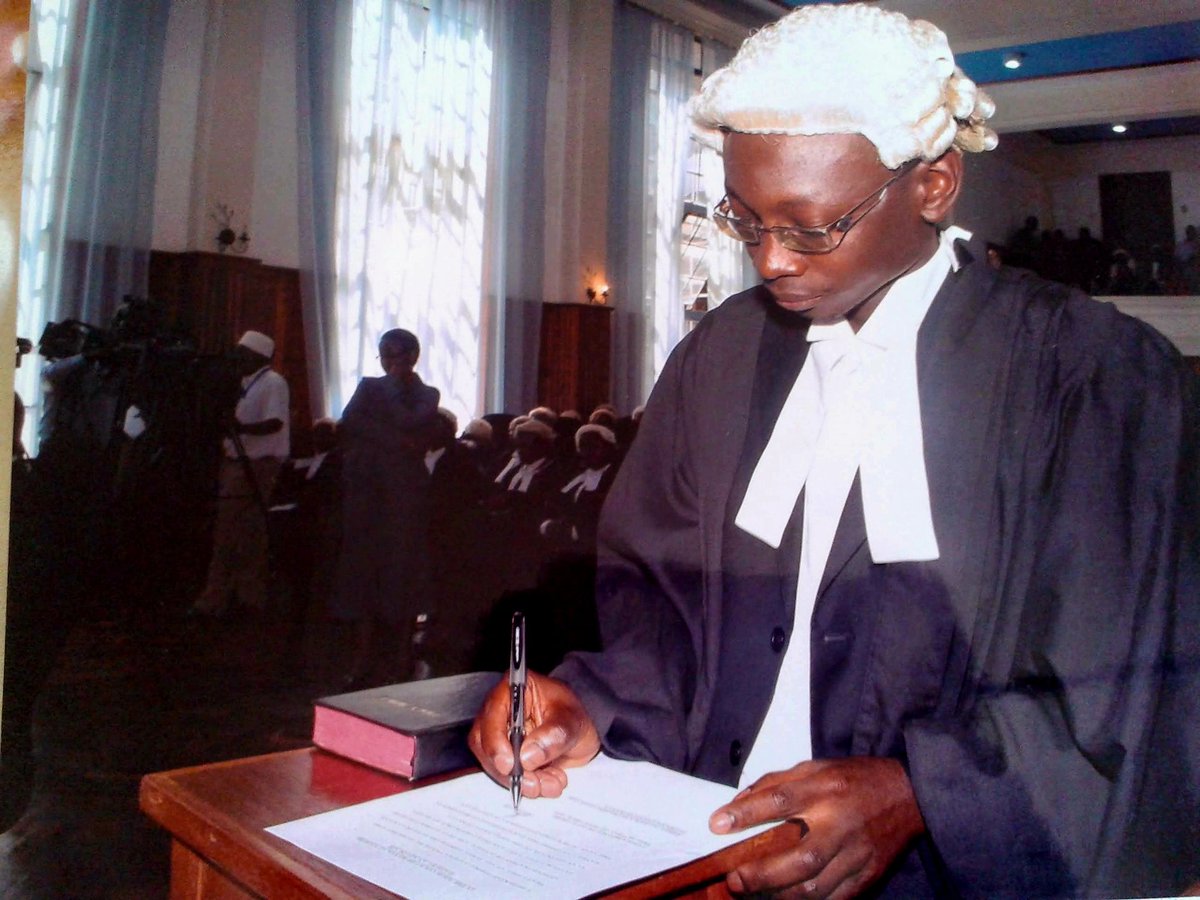
On 20.12.2011, I was called to the Bar.
I was then at Kitiwa & Company Advocates in Eldoret for holding over, having moved from Messrs Mwamu & Company Advocates in Kisumu where I did my pupillage. I remember Godfrey Kitiwa giving me the last two weeks of the year off to attend and celebrate my admission. I left as a holding over pupil in December, came back as a fresh advocate in January.
He and James Aggrey Mwamu SC have played a critical role in my journey as an advocate and perhaps, more that I appreciate, in piquing my interest in LSK politics.
I would eventually move to both Messrs Nyaundi Tuiyott & Company Advocates and Messrs Gicheru & Company Advocates before starting my own firm. I have learnt a lot and attempted to pass that which I have learnt along.
But at the end of it all, fourteen chapters later; to quote from Socrates, "all I know is that I know nothing" and, I still have a lot to learn and grow.
PS: I only have a handful of photos from the admission day as tulionyeshwa Nairobi - my brother and I. The camera got new ownership and by then, cellphones weren't well equipped with 24MP or 48 MP cameras.
Maurreen Muthoni Mithamo, Beryl Bango, Bryan Yusuf et al here is a toast 🥂
From @WSJopinion: The marketplace faces a values disconnect between generations that could reshape the future of work, writes @SuzyWelch https://t.co/k8lxfV0lYo
We can either have a diverse society, or we can have a high trust society. We cannot have both.
High trust societies are built around homogeneity. Shared values, culture and faith. Diversity dilutes those by definition.
Steve Jobs’s sensibility was more editorial than inventive, Malcolm Gladwell wrote, in 2011. “I’ll know it when I see it,” he said. https://t.co/QcXovyyXHb
@BenchwarmerzKE@Meanmachinerc1 "Feel good tour" has it own internal mechanisms of fielding and rotating players to ensure kayumbet and the game is well balanced.
Today, at Build we showed you how we are building the open agentic web. It is reshaping every layer of the stack, and our goal is to help every dev build apps and agents that empower people and orgs everywhere. Here are 5 big things we announced today: