I received a Dark Web Activity Detected alert from @Norton today. Without knowing which account was exposed, what am I supposed to do with this information? 🤷🏻♂️
⚙️What does it take to build web systems for the AI era? Join 50+ deep engineering sessions at Web Engineering Summit on June 11 & 15 in Amsterdam & online.
Topics include: AI development, system design, scalability, performance, full-stack architecture, & more.
Don’t miss out!
Trying to opt-in to FIFA PASS, but it won't show the form and keeps asking for a ticket purchase key. Ticket purchased via the FIFA Resale/Exchange Marketplace. Any help? @FIFAcom@FIFAWorldCup#FIFAWorldCup
For many years, I considered all talk about scale to be irrelevant. If you throw enough money at it, any web stack can scale to handle more traffic.
With an abundance of free investor money, I've always believed that startups should choose the stack that allows them to move faster and further.
As focus shifted to profitability in the recent year or two, cost control has become an important concern.
PHP is my favorite programming language, but it blocks execution threads and network connections (DB, HTTP, Cache, etc.). Should we abandon PHP? NO! is my answer! Why should development speed be sacrificed for cost control? Why not have it both ways?
I placed a bet on PHP and added GoLang to the stack and the results exceeded my expectations.
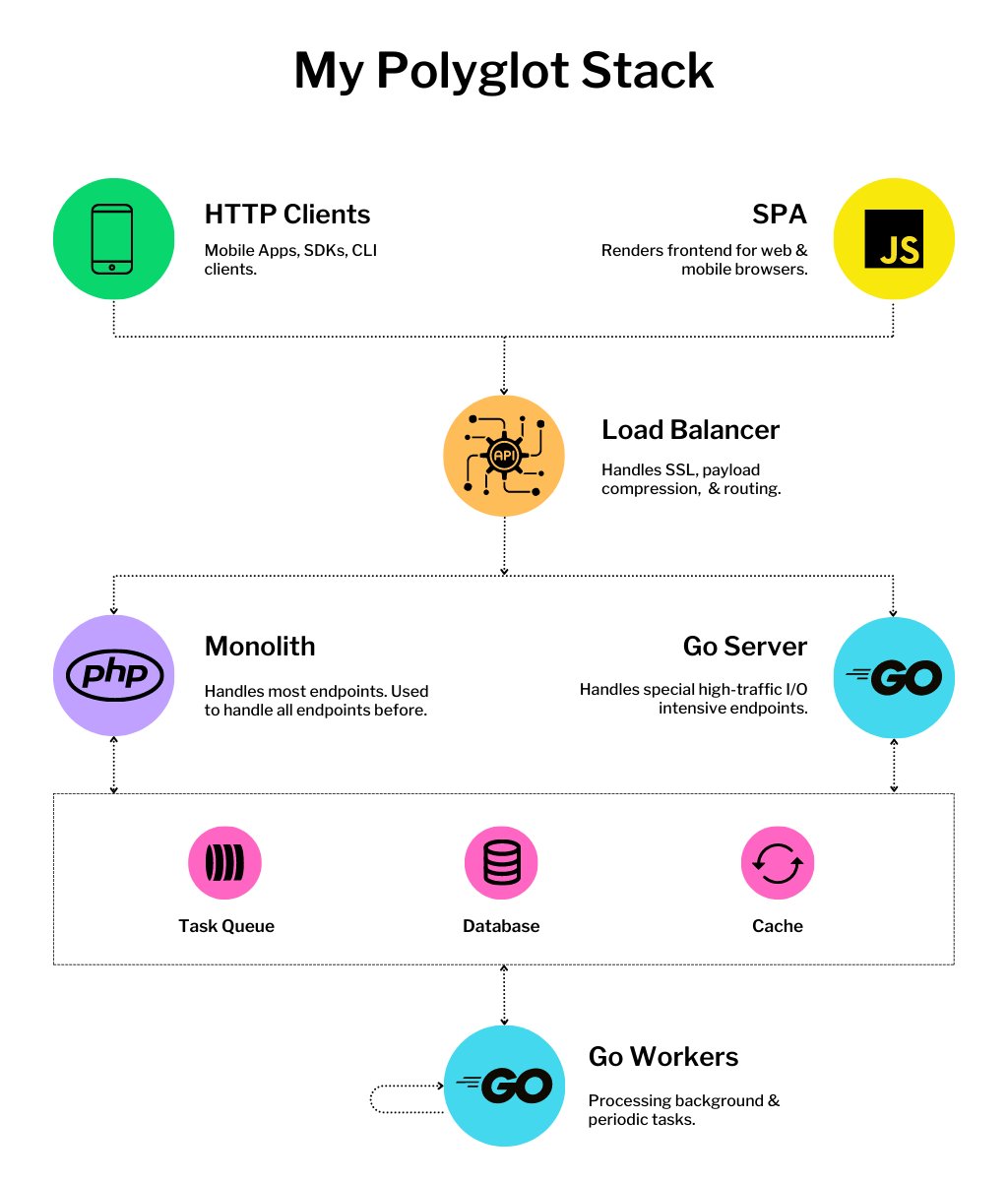
Here's a look at my current stack (for cost control):
1. All web clients talk to a load balancer.
2. The load balancer handles SSL & routes most requests to the PHP monolith.
3. Requests to endpoints that receive high traffic & perform many I/O operations are routed to a Go web server.
4. The PHP monolith & Go server dispatch tasks to the queue & read/write from/to database & cache clusters.
5. A separate Go program handles background jobs (from the queue) and periodic tasks (scheduled).
What do I get from Go?
- Handlers waiting for I/O operations yield to the runtime so others can run.
- I can handle concurrent workloads without having to start new worker processes. Which translates to less memory consumption.
- Network connections are kept alive & re-used.
- Database connections are put back for reuse once the query finishes. They aren't kept hostage until a response is sent.
What do I get by keeping PHP?
The tooling available in the ecosystem (& Laravel in specific) is lightyears ahead. It allows developers to get things done faster by spending their time adding functionality rather than re-inventing the wheel.
Should you switch to this stack?
Are you struggling with compute infrastructure cost at the moment? If the answer is no, stick with PHP. It'll help you move faster, add value, onboard more customers, and hopefully get crazy traffic so you start having infrastructure cost concerns :) That's a nice problem to have, specially that solutions are available.