Good morning 🌄
In Web3, attention is easy to measure.
Trust is much harder.
You can count followers, posts, transactions, referrals, votes, or completed tasks. These numbers create activity scores, but activity alone does not explain whether someone is actually valuable to an ecosystem.
That becomes a serious problem when opportunities depend on credibility.
A builder ships consistently.
A researcher identifies useful information before it becomes obvious.
A community contributor helps newcomers understand a protocol.
A strategist connects the right people and creates opportunities.
These actions may happen across different platforms, wallets, and communities, making the underlying value difficult to capture.
This is where @NucleusCodes becomes interesting.
The bigger opportunity is turning scattered digital contributions into evidence that can compound over time.
Think of reputation like capital.
Every meaningful contribution adds to it.
Every successful outcome strengthens it.
Every verified piece of work gives future ecosystems more context about who you are and what you can actually deliver.
That creates an important shift from identity to credibility.
Your profile says who you are.
Your history can show what you have done.
And a strong reputation system can connect those two things without forcing you to start from zero every time.
This matters because Web3 is becoming increasingly competitive.
More builders are entering.
More creators are producing.
More communities are forming.
More people are claiming expertise.
When everyone can make the same claims, verified history becomes a stronger differentiator.
The real opportunity is not creating another leaderboard.
It is creating infrastructure where useful behavior becomes recognizable, portable, and increasingly valuable.
In that world, reputation stops being a vanity metric.
It becomes an asset you build with every meaningful contribution.
Good morning 🌄
The next valuable asset in Web3 might not be your wallet.
It could be your history.
We already have ways to measure followers, engagement, transactions, and activity.
But those numbers rarely explain what someone actually contributed.
Two people can have similar visibility while creating completely different amounts of value.
One might publish research that helps a community make better decisions.
Another might bring useful users into an ecosystem.
Someone else might test a product, identify problems, provide feedback, or connect builders who eventually create something meaningful.
The problem is that most of these contributions disappear into the timeline.
That creates a strange situation where people are constantly producing value but have very little portable proof of it.
This is where I find @NucleusCodes interesting.
The bigger opportunity is not simply rewarding activity.
It is creating a clearer record of contribution.
Imagine being able to look at someone's history and understand not only how visible they were, but what they consistently did, what outcomes followed, and how others benefited from their participation.
That changes reputation from a social metric into something closer to infrastructure.
And I think this becomes increasingly important as Web3 becomes more competitive.
Attention is abundant.
Credibility is scarce.
The people who can prove they consistently create useful outcomes will have an advantage over those who only know how to stay visible.
The insight most people miss is that reputation compounds quietly.
Every meaningful contribution adds another piece of evidence.
Eventually, the evidence becomes difficult to ignore.
That is the kind of reputation worth building.
Good morning X Family 💞
Wellness apps have never really had a data problem.
They have a decision problem.
Most of us already generate enough information to understand that something could be better. Sleep trackers measure rest. Wearables monitor activity and recovery. Food apps record meals. But collecting another metric does not necessarily change what someone does tomorrow.
The harder part is connecting those signals at the right moment.
That is where @sleepagotchi has my attention.
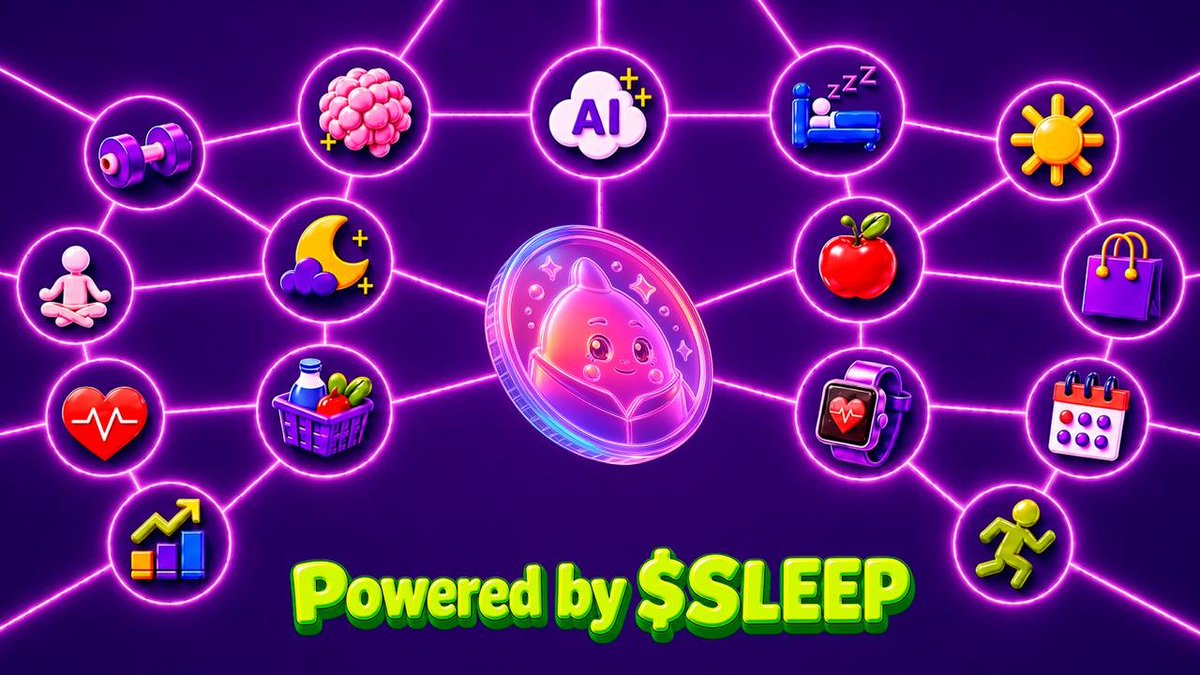
Instead of treating wellness as a collection of separate dashboards, the interesting idea is building a system that understands context across different parts of your routine.
A poor night of sleep might change what your body needs the next day.
A hard workout could affect recovery.
Your recovery could influence nutrition.
And repeated patterns could reveal habits you would never notice by looking at individual numbers.
The opportunity is to make those connections useful without forcing the user to become their own data analyst.
That is where the agent layer becomes important.
One agent can focus on sleep.
Another can look at broader wellness signals.
Another can help with meals.
And the Shopping Agent can potentially turn a recommendation into an actual purchase when something is needed.
The goal is not more notifications.
It is fewer decisions.
That distinction matters.
If technology can understand the context behind your data and quietly help you make better choices, wellness starts feeling less like a project you manage and more like a system that supports you.
That is the direction I’m watching with @sleepagotchi.
The strongest wellness platform may not be the one that tracks the most.
It may be the one that makes the data easiest to act on.
Good afternoon family 😁
A token becomes interesting when its value is connected to what people actually do with the protocol.
That is why I am paying attention to @RVHProtocol beyond the usual supply and burn narrative.
$RVH has a maximum supply of 100 million tokens. That creates a clear ceiling, but scarcity by itself does not build a sustainable ecosystem.
The stronger question is what happens when real users start generating economic activity.
If the protocol can attract meaningful real world asset activity, that activity can generate fees. Those fees can then become part of a broader mechanism involving buybacks, while purchased tokens can ultimately be removed from circulation through burns.
That creates a more interesting loop:
Usage creates fees.
Fees support token demand.
Buybacks connect protocol revenue with the market.
Burns reduce available supply.
Adoption strengthens the economic foundation.
The important part is that each piece should reinforce the next.
This is where I think people can easily focus on the wrong metric.
A large burn number looks good on a dashboard, but it does not automatically prove that the underlying economy is healthy.
I would rather watch whether @RVHProtocol is growing actual usage, generating recurring revenue, and converting that activity into measurable value for the token.
That is a much harder metric to fake.
For me, the thesis around $RVH is therefore less about becoming deflationary and more about becoming economically productive.
If real world asset infrastructure creates sustainable demand and that demand feeds back into the token economy, scarcity becomes a consequence of growth.
That is the model worth watching.
Not how many tokens disappear.
But why they are disappearing in the first place.
Good evening 🌆✨🏙️
Most campaign participants optimize for points.
I think the smarter approach is to optimize for positioning.
The @cifer_security Ghost campaign is interesting because GHOST accumulation is connected to something beyond a leaderboard: the potential opportunity to participate in the Ghost Egg mint on @RobinhoodCrypto.
That changes how I look at the campaign.
A leaderboard tells you where you stand today.
A campaign window tells you how much time you have to improve that position.
And September gives participants enough runway to approach this strategically rather than treating every day like a sprint.
The first priority should be understanding the campaign mechanics.
What actions generate GHOST?
Which activities are actually worth the time?
How does your position change relative to other participants?
Once those questions are clear, consistency becomes more valuable than random bursts of activity.
This is where many people get the strategy wrong.
They see a competitive campaign and immediately maximize activity without measuring efficiency.
More activity does not automatically mean better positioning.
The real objective is to build a repeatable system that compounds participation throughout the campaign.
Check your progress.
Study what is working.
Adjust when necessary.
Avoid letting leaderboard movements dictate every decision.
There is also a timing advantage.
Early participants have more room to learn the mechanics before competition becomes more optimized. That information itself becomes an edge.
So I would treat GHOST less like a points farm and more like a positioning game.
The strongest participants may not be the ones making the most noise.
They may be the ones who understand the system early, execute consistently, and arrive at the end of September with a position they deliberately built.
Good morning 🌄🌞🌄
Here’s a different angle, centered on privacy as selective disclosure rather than secrecy:
Blockchain transparency solved one problem.
It also created another.
Being able to verify transactions publicly is powerful, but permanent visibility can become uncomfortable when every payment, interaction, and wallet relationship contributes to a public behavioral profile.
The problem is not that information exists.
The problem is that too much information becomes connected.
One transaction may seem harmless. A wallet history may seem harmless. A public identity may seem harmless.
Put them together, and they can reveal patterns about how someone operates, who they interact with, and where their value moves.
That is why I think privacy infrastructure needs to focus on reducing unnecessary exposure.
@BeldexCoin is interesting to me because it approaches privacy from the perspective of everyday digital activity rather than treating it as something reserved for a single transaction.
Messaging, browsing, payments, and identity all create different forms of exposure.
Protecting only one layer leaves the others available to connect the dots.
The bigger opportunity is giving users more control over those connections.
You should be able to prove something without publishing your entire history.
You should be able to communicate without turning personal metadata into another asset.
You should be able to transact without making your financial behavior an open profile.
And you should be able to use digital identities without permanently attaching every interaction to your real world identity.
That is where privacy becomes more than hiding information.
It becomes controlling context.
The insight I think gets overlooked is that privacy is not about having nothing to show.
It is about choosing what deserves to be shown.
As more economic activity moves onchain, that distinction will become increasingly important.
The future of Web3 should not force users to choose between transparency and personal control.
It should give them both, at the right boundaries.
Good evening family
AI agents have become very good at finding information.
The harder problem is getting them to actually do something with it.
That’s where @MeridianX_ gets interesting.
Its Dragonfly application is showing an early example of what AI-powered commerce could look like when intelligence connects directly to real-world infrastructure.
Instead of stopping at “here’s the best flight,” the system is moving toward:
AI intent → real aviation inventory → booking → USDC settlement → completed transaction.
That distinction matters.
A recommendation is software output.
A completed booking is economic execution.
Dragonfly has already started sharing completed flight orders across different routes, with transactions settled in USDC. These may look like small steps, but they demonstrate an important transition from AI assistants to AI agents capable of participating in real transactions.
And the infrastructure underneath matters just as much.
MeridianX has been building around aviation ticketing, supply-side infrastructure and settlement, including its cooperation with OSL. That gives Dragonfly something many AI applications lack: a connection to actual transactional rails.
The bigger opportunity isn’t simply AI-powered travel.
It’s autonomous commerce.
For agents to participate meaningfully in the economy, they need access to inventory, payments, settlement, compliance and execution. Intelligence is only one layer of that stack.
Travel is a strong testing ground because every interaction is transactional and globally connected.
If @MeridianX_ can keep turning machine-generated intent into completed real-world transactions, Dragonfly could become more than a travel application.
It could become an early example of AI moving from assisting commerce to actually executing it.
The interesting metric won’t be how smart the agent sounds.
It will be how much real economic activity it can complete.
#MeridianX #Dragonfly #OKX #WEB3 #AI
Good night 🌉
Campaigns like this are often judged by the size of the leaderboard.
I think that misses the more important part: access is being shaped by participation.
The @cifer_security Ghost campaign runs throughout September, giving participants a defined period to accumulate GHOST and work toward positioning for the Ghost Egg mint on @RobinhoodCrypto.
That creates an interesting dynamic.
You are not only competing for visibility. You are building eligibility within a fixed timeframe.
And fixed windows reward preparation.
Starting early gives you more opportunities to participate, understand the mechanics, adjust your strategy, and build a meaningful balance without relying on a last minute rush.
There is another layer many participants overlook.
When a campaign becomes popular, attention increases, but so does competition. The advantage often belongs to people who understand the structure before the crowd starts optimizing for it.
So I would approach GHOST differently.
First, understand exactly what actions contribute to your progress.
Then establish a realistic participation routine.
Track your position consistently instead of reacting emotionally to the leaderboard.
Most importantly, think about the objective beyond accumulating a number.
The Ghost campaign connects community participation with a potential access opportunity tied to the Ghost Egg mint.
That makes the campaign more interesting than a conventional points race.
The edge is not necessarily maximum effort every day.
It is efficient participation over the entire campaign window.
If you are already involved, the best move may be simple: understand the rules early, stay consistent, and make every GHOST you earn part of a deliberate strategy rather than random farming.