This is an unbelievable piece of work by Sarthak and something that requires amplification.
Let me explain what he found, in simple terms.
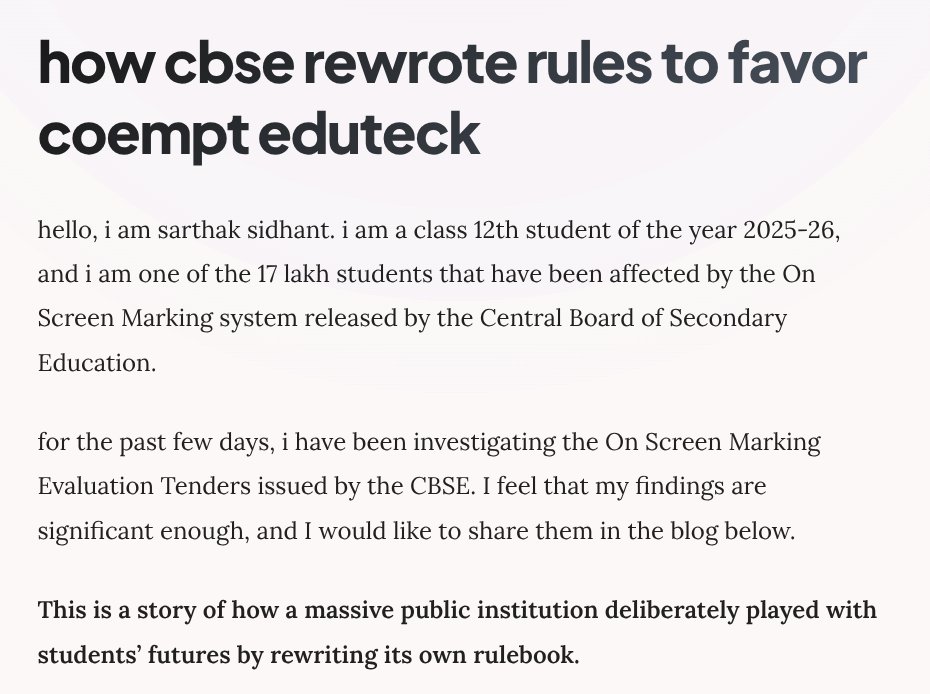
Sarthak is a Class 12 student from the 2025-26 batch, one of the 17 lakh students whose answer sheets went through CBSE's new On-Screen Marking system.
He spent days reading through CBSE's evaluation tenders, scraped all 576 tenders CBSE has issued, and tracked how the rules changed across three versions of the same tender.
The core finding is that the company that won the contract to scan and grade 17 lakh students' answer sheets is Coempt Eduteck.
Coempt used to be called Globarena Technologies. Globarena was the company behind the 2019 Telangana intermediate exam disaster, where software failures led to 3.8 lakh students getting wrong or missing marks, and 23 students died by suicide.
A government committee found systemic failure and negligence. Six months later, Globarena rebranded to Coempt Eduteck.
So a company with that track record won a contract to handle 17 lakh CBSE students. Sarthak's investigation is about how the rules were rewritten to let that happen.
The tender was issued three times.
> First tender, February 2025. It existed, then disappeared from the public GeM portal. Sarthak scraped all 576 CBSE tenders and this one was missing from the archive entirely.
> Second tender, May 2025. Four companies applied including TCS and Coempt. All four failed the technical evaluation. Cancelled.
> Third tender, August 2025. Coempt won. Between the second and third tender, a series of rule changes happened, and every single one made it easier for Coempt to qualify.
Here is what changed, one by one.
01. The old rules disqualified any company with a history of abandoning work, failing to complete contracts, or financial weakness. The new rules deleted this clause entirely. Coempt's Telangana history stopped being a barrier.
02. The old rules disqualified any company that was "blacklisted earlier." The new rules changed this to "currently blacklisted." Because Globarena rebranded after Telangana, removing the word "earlier" effectively erased their past.
03. The rules required Rs 50 crore average turnover over three years. Coempt's exact average came to Rs 50.86 crore. They cleared the bar by less than 1%. Earlier, a smaller company had asked CBSE to lower the bar to Rs 30 crore for fairer competition. CBSE refused. So the bar was kept high enough to block small players, but sat exactly low enough for Coempt to scrape through.
04. Software maturity is measured on the CMMI scale, 1 to 5. The old rules required Level 5. The new rules dropped it to Level 3. Coempt is a Level 3 company.
05. The cooling-off period for engaging retired CBSE officials was cut from two years to one. This makes it easier to use recently retired insiders to influence the process.
06. The old rules required experience with large projects of at least 5 lakh students each. The new rules removed the student count and counted cumulative answer-book volume across small projects instead. Coempt has many small fragmented university contracts. This helped Coempt and hurt TCS.
07. The old rules required bidders to own their own data centre and disaster recovery centre on Indian soil. The new rules allowed third-party MeitY-empanelled cloud hosting. Coempt runs on AWS and Azure. This helped Coempt and hurt TCS, which owns its own data centres. It also means student data is no longer on sovereign, Indian infrastructure.
08. The old rules required the bidder to own or control the complete source code of its software. The new rules deleted this. Coempt's platform runs on Microsoft's proprietary IIS, which they don't own.
09. A last-minute corrigendum, issued right before bid submission, removed CBSE's own power to blacklist the firm if its software failed catastrophically. So even a Telangana-scale failure couldn't get Coempt banned from future government tenders.
10. The penalty structure shifted from punishing mistakes to punishing delays. The old rules fined the vendor for wrong scanning, merged pages, and unscanned books. The new rules dropped those and instead levied Rs 50,000 per day for delays. This incentivises rushed scanning over accurate scanning.
11. The old rules had a hard accuracy threshold, error rate not to exceed 0.5%. The new rules removed this number entirely.
12. The old rules specified proper book and robotics scanners. The new rules just say "sufficient scanners." The definition was vague enough that, as Sarthak notes, the scanning could be done with a phone on a stand.
13. On the security side, the contract required a VAPT (vulnerability and penetration test) certified by CERT-In before go-live, and a restricted beta phase before launch. The system clearly wasn't restricted, because the other researcher, Nisarga, was able to access it and find vulnerabilities four days before go-live. So the mandatory security audit appears to have been bypassed.
These are more than a dozen rule changes, all between the failed tender and the winning tender, all pushing in the same direction, all benefiting the one company with the worst track record in the field.
The security holes Nisarga found last week now have an explanation. The system was built by a vendor that was specifically allowed to skip the security certification, the source code ownership, the data sovereignty, and the quality thresholds the original rules demanded.
Following things need to happen immediately;
1. An immediate CAG audit of the tender process.
2. A parliamentary debate on the topic.
3. An independent investigation into
> Why the first tender vanished?
> Why the disqualification clauses were deleted?
> Why the turnover bar was held exactly where it was?
> Why the security level was dropped?
> Why the blacklisting power was removed at the last moment?
Sarthak, this is genuinely exceptional investigative work. Far better than most journalists with full resources ever manage. Take a bow. :)
India’s “standard city package” now includes:
> 45°C heatwaves 🌡️
> AQI competing with gas chambers 🚬
> Corruption at every step 💸
> Roads designed like obstacle courses 🕳️
> Water purifier mandatory, not optional 🚰
> Packaged food with surprise ingredients 📦
> Fruits & veggies on chemical steroids 🍎
Bonus features:
> Traffic that eats 2–3 hours daily 🚗
> Honking = background music 🔊
> Random power cuts ⚡
> Sewage smell in the name of “development” 🤢
> Illegal constructions everywhere 🏗️
> Illegal Immigrants living as freeloaders
> Stray animals + garbage combo 🐄🗑️
> Floods after 30 mins of rain 🌧️
> Dust = free skincare layer 😷
And somehow… highest taxes + zero accountability 🙂
In 2014, Modi promised you 100 smart cities.
Today, 100 of the hottest cities in the world are in India.
100 of the most polluted cities in the world are in India.
This was not the case a decade ago. There were consistent efforts to fight pollution and rising temperatures.
Today, the BJP's agenda is only one thing, win elections. Not by governance, but by creating social divisions and manipulating the electoral system. That’s where their focus is, not on improving your quality of life.
Today, ask yourself honestly: has your quality of life improved?
Is the air cleaner?
Are cities more liveable?
Are summers more bearable?
Because "smart city" was never meant to change how you live. It was always a slogan.
You, your whole life, your future has always been reduced to a slogan.
And all of you who continue to support Modi and BJP must understand, you are destroying the future of your children and the future of this nation.
It's never too late.
Wake up.
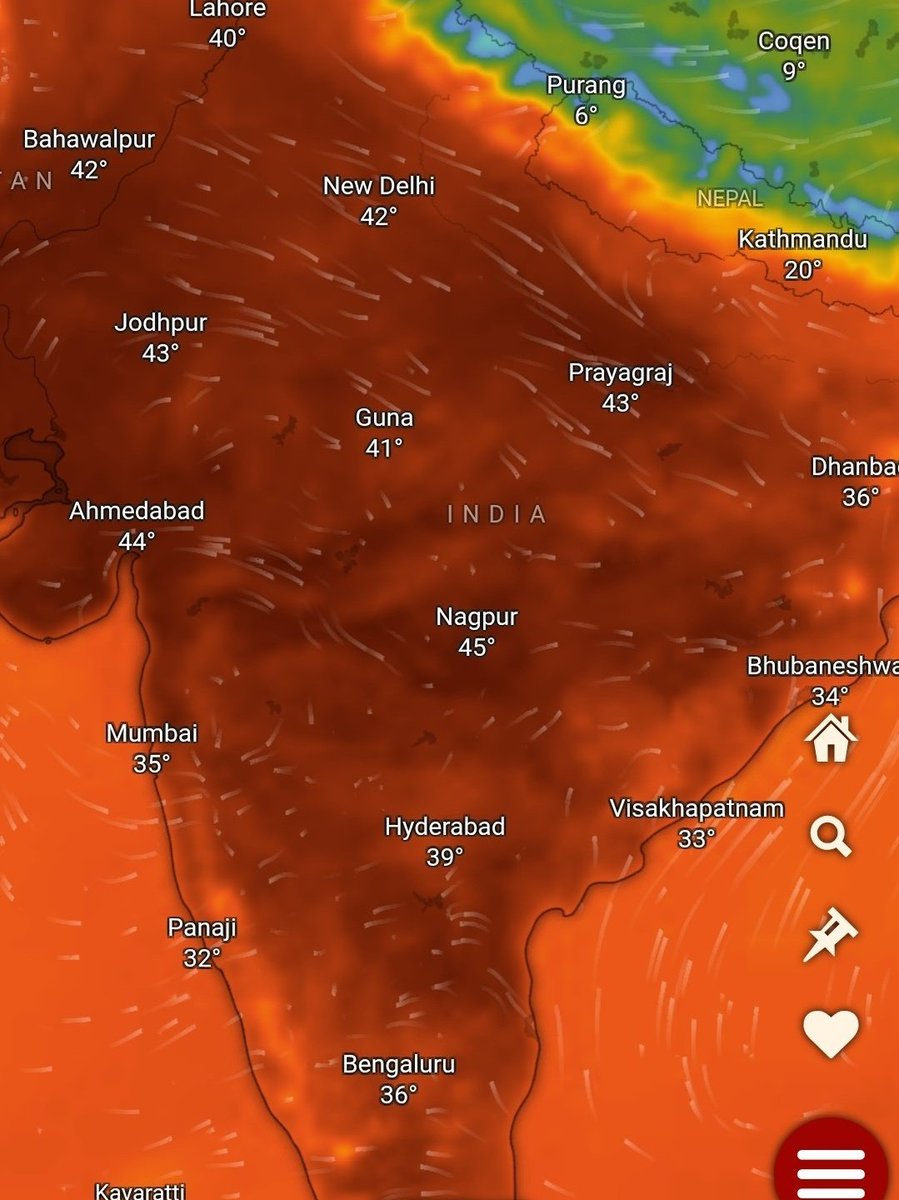
Look at this map.
Nagpur 45°. Ahmedabad 44°. Prayagraj 43°. Delhi 42°. The entire country is a single dark red mass. This is not a heatwave. This is a country that was told its forests were fine.
And this is April. Not May. Not June. The hottest months have not even arrived yet.
The past few days have been hell. So I did what I always do when something bothers me. I went looking for answers.
What I found was a policy con job that has been running for over two decades.
But before I explain what happened, let's clear some definitions.
A garden is not a forest. An orchard is not a forest. A plantation is not a forest.
A forest is a living system. Soil, water, fungi, insects, birds, mammals, decades of accumulated complexity, specific to its land and climate. It cannot be designed. It cannot be harvested. It regulates water, cools land, shelters hundreds of species. It takes decades to become what it is.
You can plant a forest. But it will take decades to become one.
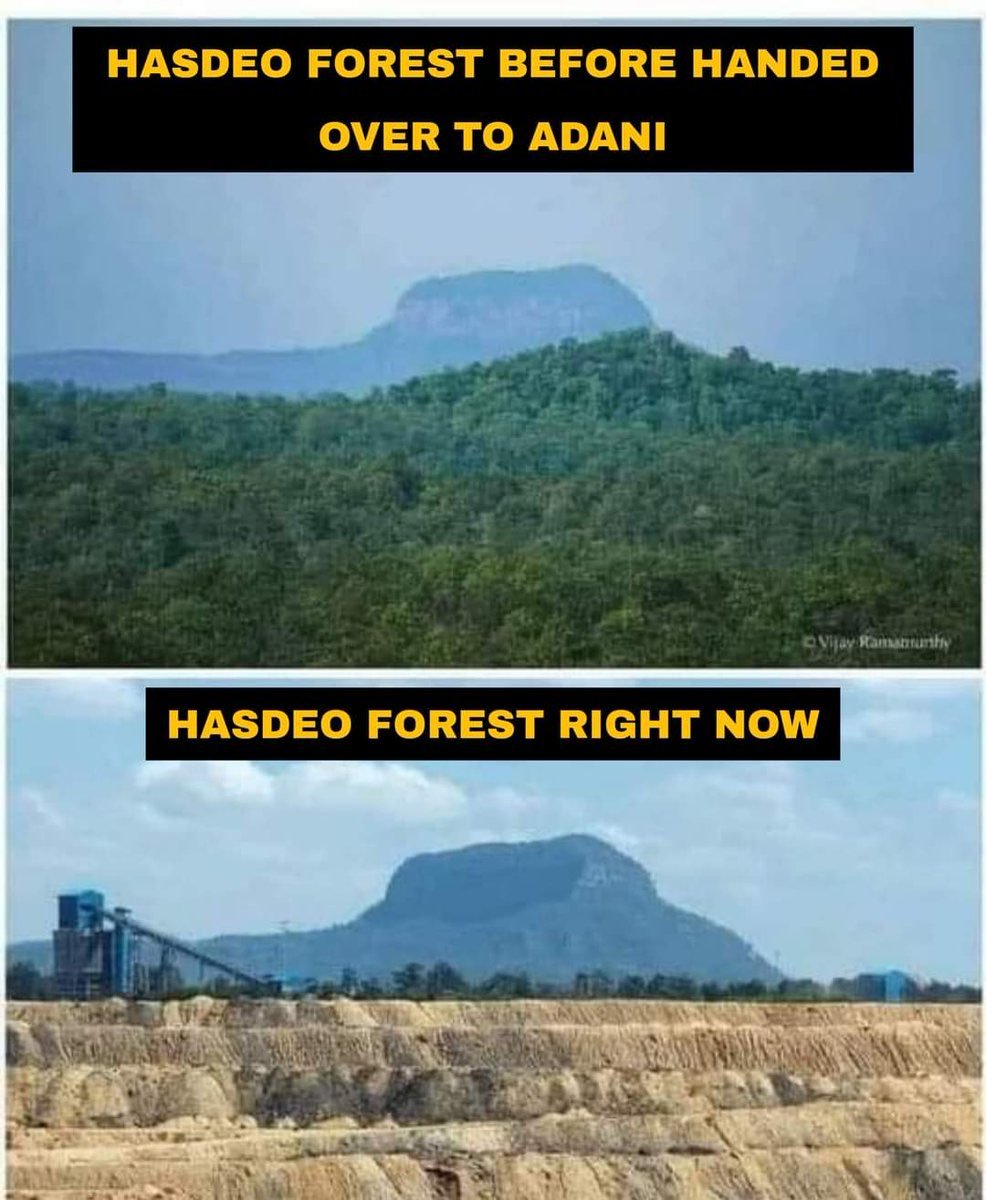
In 2001, India's forests were disappearing. The Indian state, led by the Vajpayee government, faced a choice. Protect what remained, or change what the numbers said.
It chose the numbers.
The Forest Survey of India quietly changed the definition of what a forest means. Any land with 10% tree canopy cover and more than one hectare in area was now a forest. Your mango orchard. A coconut plantation in Tamil Nadu. A tea garden in Assam. Lodhi Garden in Delhi.
All forests, on paper.
The FSI will tell you that 10% canopy cover follows international norms. The FAO also uses 10% as its threshold. But the FAO's definition comes with a crucial exclusion that India's FSI quietly dropped.
The FAO explicitly states that fruit tree plantations, oil palm plantations, olive orchards, and agroforestry systems are not forests. The World Bank says the same. India adopted the number but discarded the exclusion.
It took the cover of international legitimacy while gutting the standard that gave it meaning.
The government will also tell you this was never hidden. That it was publicly stated in every report, disclosed in Parliament. That is technically true. But a disclosure buried in a technical government document is not transparency. It is the appearance of transparency.
I did not know any of this until I went looking. Neither do most Indians whose forests, whose land, whose air this directly concerns. The con is not in what was hidden from experts. It is in what was never explained to the people it was done to.
This is not a technicality. This is the con.
It was a trick as old as power itself. If you cannot fix the problem, fix the measurement.
For ten years after 2001, Congress governed India. Two terms, two environment ministers, including Jairam Ramesh, one of the more serious ones. They saw the numbers. They knew what the numbers meant.
They did nothing.
Because the lie was convenient. India looked good in international climate negotiations. The fiction of a greening India served everyone in power, so everyone in power kept it. Congress did not create this lie. It simply chose, year after year, to live inside it.
The BJP is different.
When they returned to power in 2014, they came with something Congress never had. An absolute majority, and no coalition compulsions. They did not merely inherit the lie. They built on it. And in 2023, they legislated it.
The Forest Conservation Amendment Act of 2023 removed legal protection from "deemed forests." Forests that existed outside the official definition but were ecologically real.
Forests that Adivasi communities had lived in and depended on for generations. Forests that cooled land, held water, sheltered species. They were not on the right list. Since the amendment, forest destruction on Adivasi land has accelerated.
The people who knew these forests best, who had protected them longest, now watch them being cleared. Legally.
CONT++
Traffic has turned our metro cities into giant parking lots with people trapped inside them.
In Bengaluru, Pune, Mumbai, Kolkata, Delhi and Chennai, on average a commuter spends 100 to 168 hours a year stuck in traffic . Not commuting. Just sitting.
Every hour lost is an hour India cannot get back. Productivity lost, fuel wasted, air polluted, quality of life damaged.
I stood up in Parliament and demanded a National Urban Decongestion Mission for our big metro cities with better public transport, smarter traffic management and a scientific parking policy.
We are not stuck in traffic. We are stuck because of it. And if India wants its economy in the fast lane, our cities need to start moving.
This proves that the issue is neither budget nor competency. They just don't care about you.
They value a gora’s oneday impression more than your everyday quality of life.
11 lakh crore income tax collected from individuals.
9.8 lakh crore income tax collected from corporates.
Personal income tax more than corporate one.
What a disaster!
Bless this economy, save this nation.
Salaried Middle Class is doomed again.
For the 1st time in the post-independence era,
Personal income tax (PIT) collections surpassed corporate tax (CIT) in FY 2023-24.
In FY24-25, PIT collections stood at ~₹11.82 lakh crore, while CIT was ~₹9.86 lakh crore.
The top 1% owns 40% of the wealth.
Yet earners above ₹10 crore contribute less than 5% to total PIT collections, while the salaried class contributes more than 90%.
The middle class & the poor are affected the most due to taxes, suffering under GST and heavy personal taxes.
And it shows in data:
India’s household savings slipped to a new low for the 3rd consecutive year, falling to 18.1% of GDP in FY24.
On the other hand, household debt rose to 6.2% of GDP – almost twice as much as ten years ago.
More middle-class Indians are borrowing to meet their everyday needs.
If this is not a curse of being middle class, I don't know what it is.
This is called socialising institutional problems to individuals.
The air is a govt issue. The streets are, unfortunately, a govt issue. The aesthetics are…you guessed it right, a govt issue.
People lack civic sense, but they have no incentive to learn civic sense, because no laws are really enforced.
The taxes we pay disappear into a hell hole of 0 accountability, and now we must pay a moral tax too. First I pay in money to have my city look half decent, now I must also pay in guilt because the money disappeared somewhere.
#AirEmergency: *HAZARDOUS* air this morning in Delhi! Woke up at 7 AM and saw an apocalyptic view outside. Within five minutes of leaving the purified room had a mild headache. A thick blanket of smog engulfs the city.
The MOST DANGEROUS PM2.5 levels is 30 TIMES the WHO safe limits! Where are the GRAP measures!? Where are the strict measures!? How is this okay? How are WE, THE PEOPLE okay with our own mass slow poisoning!?
#LetUsBreathe #WeDeserveAQI50