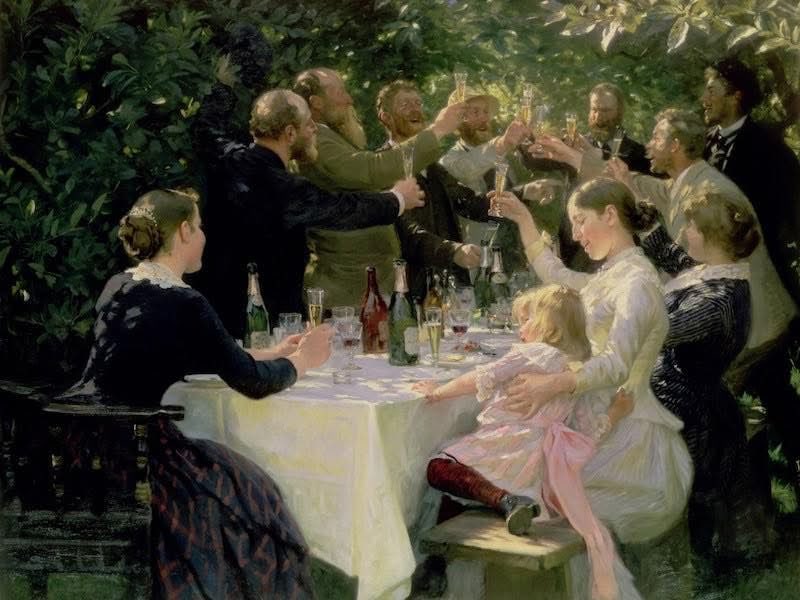
“Drink wine. This is life eternal. This is all that youth will give you. It is the season for wine, roses and drunken friends. Be happy for this moment. This moment is your life.”
—Omar Khayyam
if you want to be unforgettable, just be you. yeah i mean this literally, that’s all you need to do. there is literally no other person like you. there are so many things that unique to only you. just try to be yourself. don’t know who you are yet? cool. take some time and actually figure it out. it ain’t that hard. look at the moments you felt most alive. cause that’s the whole point of life. look for the patterns. strip away all the expectations and ask yourself “what would i do if nobody judged me?” there’s your answer hiding somewhere in that question.
try things seriously. do small experiments. “do i even enjoy this?” test it. pay attention to what you envy too. yeah, envy. because most of the time it points toward desires that you haven’t admitted to yourself yet. and stop making life so serious all the time. have fun. explore. reflect. evolve. becoming yourself and having fun is literally the whole point.
Spend about 10–30 minutes every day seeing a picture in your mind of the person you want to become. Do this when you are already calm, like at night or just before you go to sleep. Your mind takes in pictures much better when it is not busy thinking about too many other things.
The main idea is simple. Your brain thinks that things you imagine over and over again are very important.
When you see the same situation in your mind many times, with lots of small details and strong feelings, it stops feeling like a fake story. Your mind starts to feel like it is a real place you already know well.
And when something feels normal, it stops feeling impossible.
Old, bad habits get weak during this time. This does not happen because you fight them. It happens because you stop thinking about them and stop practicing them in your head. At the same time, new, good habits start to stick because you are practicing them inside your mind before they ever happen in real life.
Start by making your body quiet. Breathe slowly. Let go of the tight feelings in your face, your shoulders, and your stomach. You are not trying to force anything. You are just turning down the noise inside yourself.
Next, pick one real moment. Do not just think about a big, blurry goal. Pick one short moment you can step into with your mind.
If you want to be healthy, do not just think "I want to be healthy." Instead, see yourself walking through a normal day easily. See yourself walking without getting tired, breathing clearly, and feeling like your body is light and ready to move.
If you want to be brave or do well, see yourself in a real place where you usually feel scared. But now, see yourself talking without stopping. You are steady, you are direct, and everything goes well without any bad feelings inside you.
If you want to have good control over yourself, see yourself already doing your hard work. You are just doing it without arguing with yourself, as if it is just a normal thing you do every day.
Always look through your own eyes. Do not look at yourself from the outside.
Look at what is right in front of you. Look at what is under your feet. Look at the walls and the room around you. Look at the light in the space. Notice the tiny things you usually do not look at.
Next, listen to the sounds. Hear how people's voices sound in that room. Hear the sound of your own slow breathing. Hear any background noise that belongs in that place.
Next, feel your body. Feel the weight of your body on the floor or chair. Feel if the air is warm or cold on your skin. Feel yourself move. Feel how good it is to sit or stand when you are not fighting yourself.
Inside your feelings, do not try to force yourself to be super excited. Let a quiet feeling come to you. Feel happy that things are simple. Think to yourself, "This is already how I live my life." It is a quiet, steady feeling that does not need to prove anything to anyone.
You are not making up a fake dream. You are just practicing a feeling so it feels normal to you.
At the end, stop adding new things to the picture. Just sit with the quiet feeling for a short moment, as if your mind has already said "Yes, this is normal."Let that good feeling stay with you gently as you go through the rest of your day or night.
Do this so many times that the picture stops feeling like something far away that you are trying to catch. Instead, it starts to feel like something your mind already knows exactly how to do.
I'm finally reading Dune. This quote, which is in the first few pages, hits hard:
"Once men turned their thinking over to machines in the hope that this would set them free. But that only permitted other men with machines to enslave them."
“When I am weaker than you, I ask you for freedom because that is according to your principles; when I am stronger than you, I take away your freedom because that is according to my principles.”
— Paul Atreides, Children of Dune
the man who loves walking will always go further than the man who only loves the destination. you’ll never be free until you realize this. it was never about the destination. it was about the person you become while chasing it. the ones who fall in love with the process are the only ones who survive the pain, the boredom, the uncertainty.
we spend most of our lives trapped inside other people’s expectations. making decisions based on approval, but the more we live for their validation, the further we drift from ourselves. i think somewhere along the way, we stopped listening to our own inner voice and started trusting fear, opinions, and comfort more than our own instincts. but the truth is, life was never meant to be walked that way. we are meant to enjoy the process.
the universe gave you a compass, not in your pocket but in your chest. and it’s there for a reason. sometimes the hardest but most important thing you can do is trust that feeling, keep walking, and learn to love the process instead of obsessing over the destination.
“it is good to have an end to journey toward but it is the journey that matters, in the end.”
Spend around 10–30 minutes a day visualizing a version of yourself that you are deliberately trying to build. Do it when your mind is already calm, especially in the evening or just before sleep, because the mind accepts imagery more easily when it is not being pulled in different directions.
The basic idea is simple. The brain treats repeated internal experience as something important. When a certain kind of situation is lived again and again in imagination, with enough detail and emotional weight, it starts to lose its “imagined” quality and becomes something your mind recognizes as familiar territory.
And what becomes familiar stops feeling impossible.
Old patterns weaken in this process not because you fight them directly, but because you stop feeding them the same mental rehearsal. At the same time, new patterns begin to stabilize because they are being repeatedly experienced internally before they ever exist externally.
Start by settling your body. Slow breathing. Less tension in the face, shoulders, stomach. You are not trying to force anything, you are just lowering internal noise.
Then choose one specific scene. Not an abstract goal. A moment. Something you can step into mentally.
If it is health, do not think “I want to be healthy,” instead see yourself moving through a normal day with physical ease, walking without effort, breathing clearly, feeling your body light and responsive.
If it is confidence or success, see yourself in a real situation where you would normally hesitate, but now you speak without that hesitation, you are steady, direct, and things unfold without internal resistance.
If it is discipline, see yourself already inside the routine, doing the work without negotiation, as if it is simply what you do.
Always stay in first person. Through your own eyes.
What is directly in front of you. What is under your feet. The texture of the environment. The light in the space. The small details your attention would normally skip.
Then sound. The way voices actually enter the space. The rhythm of your breathing. Any background noise that belongs to that environment.
Then physical sensation. The weight of your body. Temperature on the skin. The sense of movement. The way you occupy space when you are not resisting yourself.
Emotionally, you are not trying to force excitement. You are allowing a quieter set of states to appear. Relief that things are simple. A sense of “this is already how I operate.” A quiet internal stability that does not need justification.
You are not building a fantasy. You are rehearsing familiarity.
At the end, stop adding detail and just remain in the general felt sense of it for a short moment, as if your mind has already accepted it as normal.
Let that feeling continue lightly as you move into the rest of your day.
Repeat it often enough that the scene stops feeling like something you are trying to reach, and starts feeling like something your mind already knows how to do.
delusional optimism is the only way out. most people lose before they even start because deep down they already convinced themselves it probably won’t work. they look at the odds and the competition and they try to be more practical and slowly talk themselves out of their own potential. but the people who end up doing insane things usually have one thing in common. they were delusional enough to believe they could actually pull it off before there was any proof. that’s the weird power of delusional optimism. it makes you keep going long enough for reality to eventually catch up to your vision.
i just can’t understand why you all are this realistic with your dreams. why you only allow yourself to want things that feel achievable from where you currently stand. every massive success story ever sounded delusional in the beginning. every athlete, artist, entrepreneur, creator, all of them had moments where nobody around them understood the vision. people laughed at them. doubted them. told them to be practical. but they kept going anyway because they were obsessed enough to trust something nobody else could see yet.
i mean just think about it. you are alive and here in this world. the odds were already impossibly slim. you exist on a planet floating in infinite darkness where trees communicate underground, where dead stars became the atoms in your body, where creatures glow in the ocean without sunlight ever touching them. your own brain is made of electricity and somehow produces dreams, memories, ideas, emotions. everything about existence sounds insane if you really think about it deeply enough. so why do people suddenly become “realistic” or “practical”the moment it comes to their own potential? there is nothing realistic about being alive in the first place. so be delusional, that’s the only way out.
THE HAIRCUT THEORY
If you suddenly want to cut your hair, rearrange your place, or get rid of half your closet, it's your soul preparing you for a new era and needs the old energy cleared out first. Trust the pull. Change is good Your soul is making room because something beautiful is on its way.
repetition rewires your brain more than motivation ever will. not in some fake “just think positive and the universe will fix your life” way. i mean in a very real biological way. your brain is constantly adapting to whatever you repeatedly think, feel, and do. most people don’t realize this because they assume their personality is fixed. they think their habits, mindset, confidence, anxiety, even the way they see the world is just “who they are.” but a huge part of it is actually conditioning. your brain is always listening to what you repeat.
most people spend their entire day reinforcing stress without even noticing it. they wake up and immediately check their phone. compare themselves to strangers online. replay old mistakes. overthink conversations. expect bad outcomes before anything even happens. and because the brain learns through repetition, those thoughts slowly become its default setting. the brain starts scanning the world for more proof that those fears are true. more problems. more reasons to doubt yourself. more evidence that life is against you.
that’s the scary part about neuroplasticity. your brain does not really care whether the pattern is helping you or hurting you. it doesn’t automatically separate good patterns from bad ones. it just adapts to what you consistently repeat. repeat stress and your brain becomes better at felling anxious, repeat self doubt and insecurity starts feeling natural, repeat distraction and your attention span weakens. whatever you feed your mind daily becomes stronger.
but the opposite is true too.
when you start focusing on growth, gratitude, discipline, your brain slowly begins reshaping itself around those things too. and no, it doesn’t happen overnight. at first it feels unnatural because your old patterns are still stronger. but over time your brain starts changing what it notices automatically. you begin seeing opportunities you would’ve ignored before. small wins start feeling bigger. challenges stop feeling like proof that you’re failing and start feeling like part of the process.
one of the most underrated things you can do is deliberately reinforce good experiences. when something good happens, pause for a second and actually feel it. your brain remembers what carries emotional weight. that’s why negative experiences stick so easily. but if you consciously hold onto positive moments too, your brain starts building stronger pathways around them.
your mind becomes whatever it practices most. so be careful what you keep giving your attention to cause whether you think you can or you think you can’t, you’re right.
i know it sounds kinda stupid. but regardless of how simple it is you have to embody being a delusional optimist. you’ll open unexpected new doors and effortlessly 10x your quality of life. there’s no reason to be a self sabotaging pessimist.
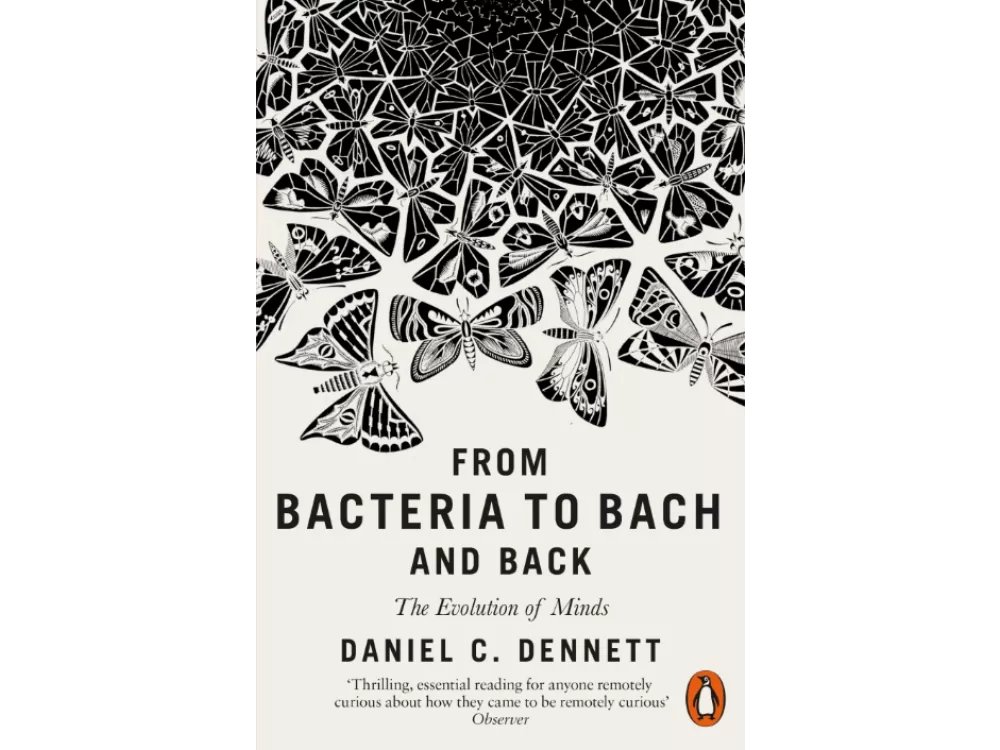
Daniel Dennett, who recently passed away, is an inspiration for people like me who love grand ideas that connect many different fields at a deep level (and be rigorous about that; well as rigorous as grand theories can be). His thinking is difficult to categorize: part philosopher, part scientist, he had many good ideas on topics ranging from evolution to consciousness to God.
The #book From Bacteria To Bach And Back had been lying on my shelf for many years and I recently picked it up because I’ve been thinking a lot about evolutionary constraints on brain and consciousness.
The book is hard to summarize because it spans so many topics, but perhaps the central idea is this: competence without comprehension is not only possible, but is the norm; but when comprehension slowly develops, it leads to an explosion of artifacts and culture that we see around us. Dennett argues that there’s a difference between performing a behavior and having a (manipulable) representation in the mind of that behavior such that you can “think” and “reflect” on that behavior to fix a particular context or to make it better.
For example, a bird making an intricate nest displays a startling case of competence but is debatable whether she understands what it’s doing. The bird nest works well because it is an adaptation to the environment the bird finds itself in, so there’s a rationale behind design of the bird nest but nobody designed it. This is what Dennet calls as a design without a designer where rationale for the designed objects are free-floating. So reasons exists but not in someone’s minds.
Humans, on the other hand, seem to understand what they’re doing as they can flexibly change their behavior depending on context. Our entire society and technology is a proof of us transcending beyond our evolved instincts.
How did that happen?
Dennett argues that this transition was gradual and links it to languages (and memes, in general). Our ancestors, like birds, would have instincts for performing various behaviours without understanding them. Imagine if one such biased behavior is copying the elders or copying the most successful. This kind of copying behavior could initially bootstrap rudimentary form of language as a group settles on some sort of shared signals. It also bootstraps knowledge-sharing (aka culture) as copying allows spread of successful discoveries much faster than what genetic reproduction cycles would allow.
Once rudimentary culture and language is in place, the benefits of having these capacities would allow for co-evolutionary process where the brain and biology of humans could change in order to absorb language and culture faster. However, this is still competence without comprehension. One can imagine sophisticated behavior in a primitive group of homnids but nobody knowing what they’re doing. Even proto-language (like most animal calls) could have been “mindless” in the sense of it eliciting the right behavioral responses, but individuals not comprehending what they’re doing.
So how did competence then led to comprehension? The road to comprehension wasn’t a step change, though. There’s a continuum of instinct to flexible behavior (which is a hallmark of comprehension). You could have behaviors that work well but you only sort-of understand why (for example, the impulse to do art or driving a car well).
Dennett suggests that gradually comprehension could have become better and better due to the need to justify our actions to others (or deceive others) in a social settings. Once a shared proto-language has taken hold in a group, everyone has an incentive to take advantage over others by giving false information. This creates a pressure to justify and convince through giving reasons and that required having a representation of reasons in the mind. Such representations of “why am I doing this” were glimmers of comprehension which became stronger thanks to the arms-race between deceivers and questioners.
This dynamic also explains where a sense of self comes from. In order to decieve others, you need to model others and their behavior in the situation at hand. And that model includes how you yourself will behave in response to their responses. As you can see here, self emerges within the theory of mind because social dynamics require identification of distinct selves including oneself. (This does make me wonder if solitary animals have an explicit sense of self that they feel as strongly as we feel.)
The last part of the book is about consciousness. Dennett is an illusionist, which means he believes that there’s no hard problem of consciousness to be solved. He says that our experienced reality is like a user-interface constructed by evolution on top of the raw reality. The user interface exists because it is beneficial to the organism’s survival but we must not mistake it for “truth”, which only a scientific investigation can reveal (and not introspection).
Over time, I’ve grown sympathetic to the illusionist position but haven’t yet come around to embracing it fully. My current feeling is that the hard problem will not be solved but will gradually dissolve as neuroscience progresses (just like the problem of “what is life” got dissolved as we made advances in biology).
There’s definitely an air of mystery around consciousness, but is it because evolution hides complexity of brain processes that compose it from us (which science will eventually reveal) or is it because consciousness is in some way fundamental in the universe?
Dennet argues it is the former and he calls this as the Cartesian Gravity. Our inner experience is so vivid that we mistake it for truth but we find it mysterious because evolution had no incentive to represent how it’s built. The more we probe internally, the more we find it as a given, which seems unexplainable and baffling. This also prevents us from being scientifically objective about consciousness as we keep gravitating to first-person experience (which could have holes that we’d never see unless we study it from a third person point of view). This is why Dennet advances his approach of studying consciousness, heterophenomenology, which treats first-person reports of consciousness as a third-person scientific object of analysis.
High cortisol is aging you faster than drinking and partying
It also kills memory, makes you snap at people you love, and shrinks your hippocampus.
Here are 7 ways to reduce high cortisol:
1. Sunlight on skin in the first 30 minutes.
A British biologist looked at 200,000 years of human history and found that the entire reason humans broke out of poverty was not intelligence, not language, not even agriculture, but one mechanism so simple a 6-year-old could explain it.
His name is Matt Ridley.
He is a zoologist by training, an evolutionary biologist by career, and in 2010 he wrote a book called The Rational Optimist that quietly argued the most important fact about human progress had been hiding in plain sight for the entire history of economics.
Naval Ravikant has been telling people to read everything Ridley has ever written for the last 15 years. The reason is the argument inside this one book.
For 200,000 years, anatomically modern humans walked around with the same brain you have right now. Same skull size. Same neural architecture. Same raw capacity for language, planning, and abstract thought.
For roughly 190,000 of those years, almost nothing happened. Generation after generation lived and died inside the same Stone Age toolkit their great-great-grandparents had used. Then somewhere around 50,000 years ago, the line on the chart of human progress started to tick upward. Then it bent. Then it exploded.
The question Ridley spent years on was the only question that mattered. What changed.
It was not the brain. The brain had been the same for 190,000 years. It was not language, which had existed long before the takeoff. It was not even agriculture, which arrived only 10,000 years ago and was actually preceded by the upward bend, not the cause of it.
What changed was that humans started trading with strangers.
This sounds too small to be the answer. Ridley argues that it is the answer to almost everything. The moment one human exchanged a useful object with another human from a different group, something happened that no other species on earth had ever done.
Two ideas that had developed in isolation came into contact. The flint knapper learned what the spear maker had figured out. The fisherman from the coast learned what the hunter from the forest had figured out. The two pieces of knowledge fused into something neither side could have produced alone.
Ridley calls this ideas having sex. The phrase sounds frivolous and it is meant to. The point is that ideas, like genes, get better when they combine with other ideas from different lineages.
An idea sitting inside one head, no matter how brilliant the head, eventually hits a ceiling. The same idea exposed to ten thousand other ideas does something genes do under sexual reproduction. It mixes. It recombines. It produces offspring nobody planned.
The cleanest proof of this argument is the most uncomfortable case study in the book. Tasmania.
Around 10,000 years ago, rising sea levels cut Tasmania off from mainland Australia. A population of roughly 4,000 humans was now isolated on an island, with no possibility of contact with the rest of humanity. They had the same brains. The same language. The same starting toolkit as their cousins 150 kilometers north. The natural experiment was now running.
What happened next is something no economist or geneticist had ever predicted.
The mainland Australians kept inventing. Boomerangs. Spear-throwers. Fishing nets. Bone needles for sewing fitted clothes. Watercraft with paddles. Their technology compounded slowly across the centuries.
The Tasmanians went the other way. They did not just fail to invent the new tools their cousins were developing. They started losing the tools they already had. Fishing was abandoned within a few thousand years. Bone tools disappeared. Fitted clothing disappeared. They forgot how to make fire from scratch and started carrying lit firebrands from camp to camp instead, relighting their fires from a neighbor's whenever their own went out.
By the time European explorers arrived in the 17th century, the Tasmanians had the simplest toolkit of any human society ever recorded. Their material culture had gone backward for 8,000 years.
The archaeologist Rhys Jones called it a slow strangulation of the mind.
Joseph Henrich at Harvard later proved with formal mathematical models that there was nothing wrong with Tasmanian brains. There was something wrong with their network. A toolkit requires a critical mass of people exchanging skills to maintain itself.
The act of teaching a skill is imperfect. Every generation loses a small percentage of what the last generation knew. If your population is large enough and trading widely enough, those losses get caught and corrected by someone else who still remembers.
If your population shrinks below a certain threshold and stops mixing with outsiders, the small losses compound until entire technologies disappear.
This is the part that should haunt anyone reading this in 2026.
Intelligence is not a property of the individual brain. Intelligence is a property of the network the brain is connected to. A genius in isolation will produce less than a mediocre thinker inside a dense exchange of other mediocre thinkers.
The thing your ancestors needed in order to break out of 190,000 years of stagnation was not better brains. It was better connections between brains they already had.
The implication for any individual is direct and uncomfortable. If you are smart and isolated, you will be outproduced by people half as smart who are connected.
The most successful people in any field are almost never the smartest people in it. They are the ones positioned at the intersection of the most idea flows. They are reading more authors than their competitors. They are talking to more people from more disciplines. They are in the rooms where ideas from different lineages bump into each other.
Ridley ends the book on the line that sounds optimistic but is actually a warning its this "The future will be invented by people who connect ideas, not by people who guard them."
I’m in love with this sentence:
“The degree to which a person can grow is directly proportional to the amount of truth he can accept about himself without running away.”