Voter privacy starts before the first ballot is cast, it starts with how the encryption key is created.
Our team has been working on NI-DKG: a non-interactive, ZK-based approach to Distributed Key Generation that eliminates complaint rounds and makes the whole process publicly verifiable on-chain.
check the 🧵 below
Say goodbye to 'black box' voting.
We've officially launched the Vocdoni App! 🎉
For 7 years we've powered elections for sports clubs, professional bodies, major political parties, and city councils with our secure, verifiable, and privacy-first voting protocol.
Now, we are putting that same high-guarantee technology into the hands of every organization with an easy-to-use SaaS voting platform.
Whether it's AGMs, board elections, or participatory budgeting, we've got you covered. Enjoy a seamless experience with unbeatable prices, no hidden costs, and the highest security guarantees.
Read the full announcement for features, pricing, and our roadmap:
https://t.co/7arWyQZT7M
🚀Big news!
https://t.co/f6StGHclBe has been featured in the new State of Private Voting 2026 report by Shutter Network & Privacy Ethereum
The report highlights our architecture, ZK approach, and progress toward scalable private voting
Huge thanks 🖤🗳️
https://t.co/43IXm5QMVA
Every era has a moment when people look at the systems around them and realize:
This isn’t working anymore.
Governance systems, platforms, institutions, all built for a world that no longer exists. Slow, opaque, coopted.
They ask us to trust them while giving us nothing to trust.
This is this era's moment.
https://t.co/CLSfZ9hxjK
#WeAreNotSpectators
/1
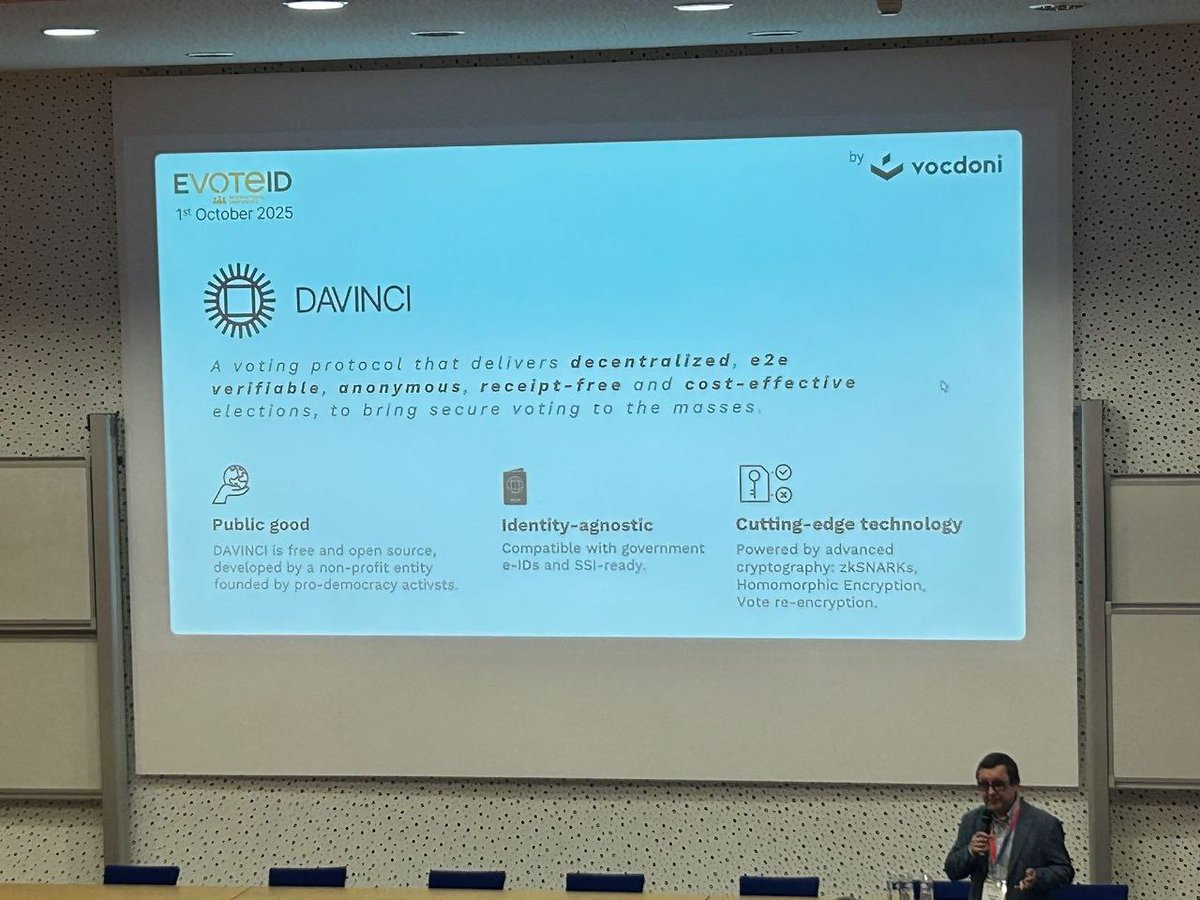
🎙️ Live at @EVoteID@alex_kampa presents @Davinci_vote, Vocdoni’s zkRollup using zkSNARKs and Homomorphic Encryption to ensure decentralized, anticoercion, e2e verifiable, anonymous, and cost-efficient digital voting.
I've just uploaded a new paper: "Two Detailed Proofs of Arrow's Impossibility Theorem ". If you've heard of this theorem before but never bothered to check out a proof, this is your chance. https://t.co/BgE1evBy0a
@VitalikButerin just mentioned the private voting project we did for @nounsdao while ago, together with @aztecnetwork. Nice! We were part of @AragonProject at the time. Also serves as a reminder that efficient private voting on Ethereum is still an open problem...
More generally, perhaps a core theme of the next wave of democracy will be less "transparency and accountability" and more deliberate indirection and room for (pluralistic, aggregated) individual conscience.
(this applies to DAOs too; eg. see NounsDAO https://t.co/Wy6p7Wftsz)
More generally, perhaps a core theme of the next wave of democracy will be less "transparency and accountability" and more deliberate indirection and room for (pluralistic, aggregated) individual conscience.
(this applies to DAOs too; eg. see NounsDAO https://t.co/Wy6p7Wftsz)
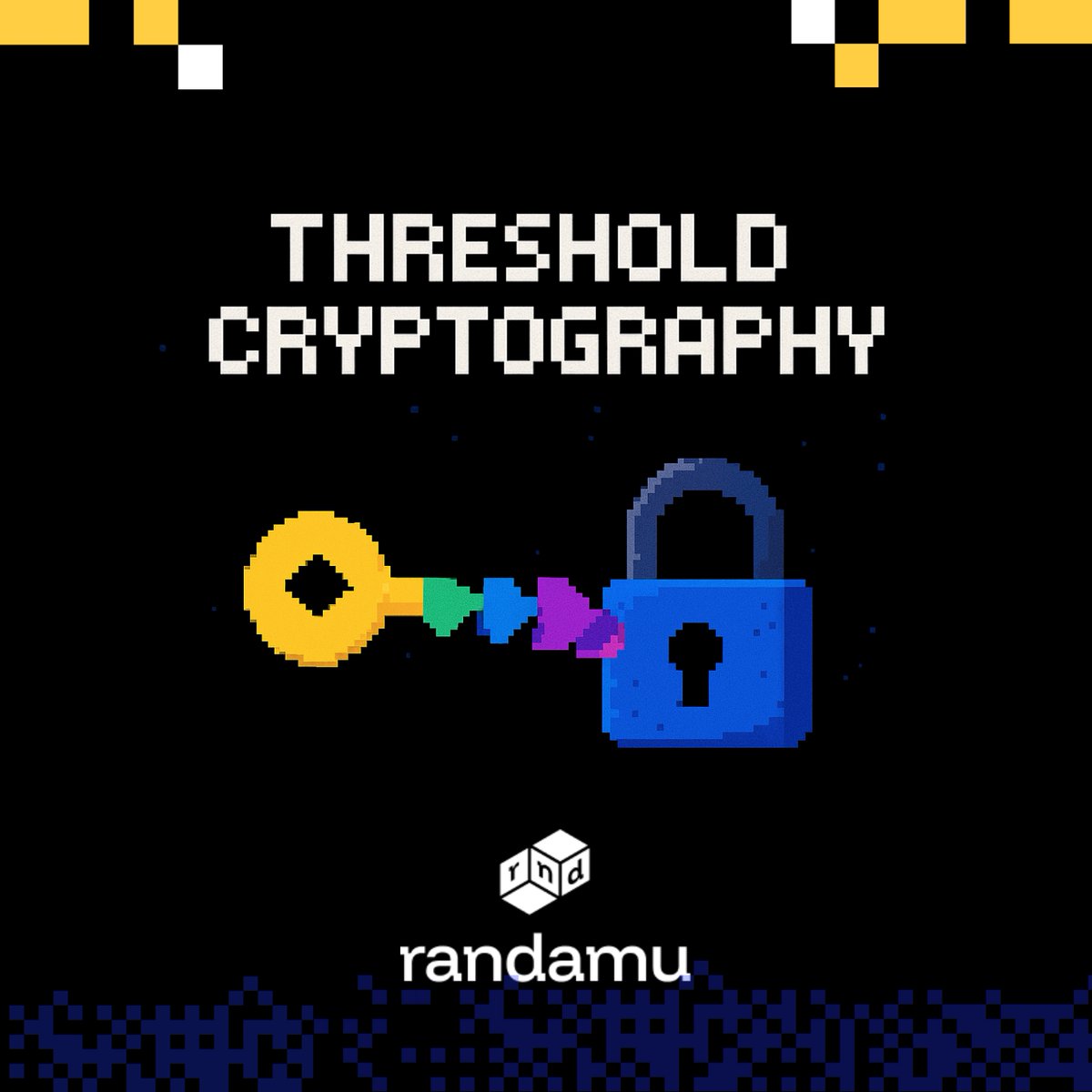
Threshold cryptography is a method of distributing cryptographic operations across multiple parties. Instead of relying on a single keyholder to sign, decrypt, or verify data, a group of nodes must collaborate to complete the operation.
It works by splitting a private key among n nodes, requiring only t out of n nodes to cooperate in order to produce a valid signature or decrypt a message. This eliminates single points of failure and central control, making systems far more resilient and secure.
This is the foundation on which Randamu is built. No single node holds the full key. We are not stoping here, we are building a decision network, enabling developers to define custom logic, form dynamic committees, and execute actions based on verifiable, on-chain conditions.
And that's how Randamu is designed. No single node holds the full key, eliminating centralized points of failure or control.
Randamu takes it further. With Randamu, threshold cryptography becomes programmable. It’s not just about security, it's a decision network.
You can weave together custom logic, committees, and conditions that sign only when your protocol says so.
This unlocks powerful new capabilities⛓️
👾 No single party can manipulate or predict the outcome
👾 You get verifiability, fault-tolerance, and trust minimization baked into every operation
👾 It becomes possible to build protocols for randomness, encryption, and coordination that are actually trustless
The innovative approach of weaving together, cryptographic guarantees with programmable decision workflows, represents the next evolution in blockchain infrastructure, moving beyond simple consensus to complex, condition-based cryptographic operations that can power the future of decentralized systems.
The kick-off session of our "Maths for Privacy" will take place today at 16:00 UT / 18:00 CET. Find out more on our Discord = https://t.co/oVxqlwNZZ4 or Telegram = https://t.co/0yjs6eVP3G
🎁Test Bank3 & Get Rewarded!
We’re launching a reward program for testing Bank3.
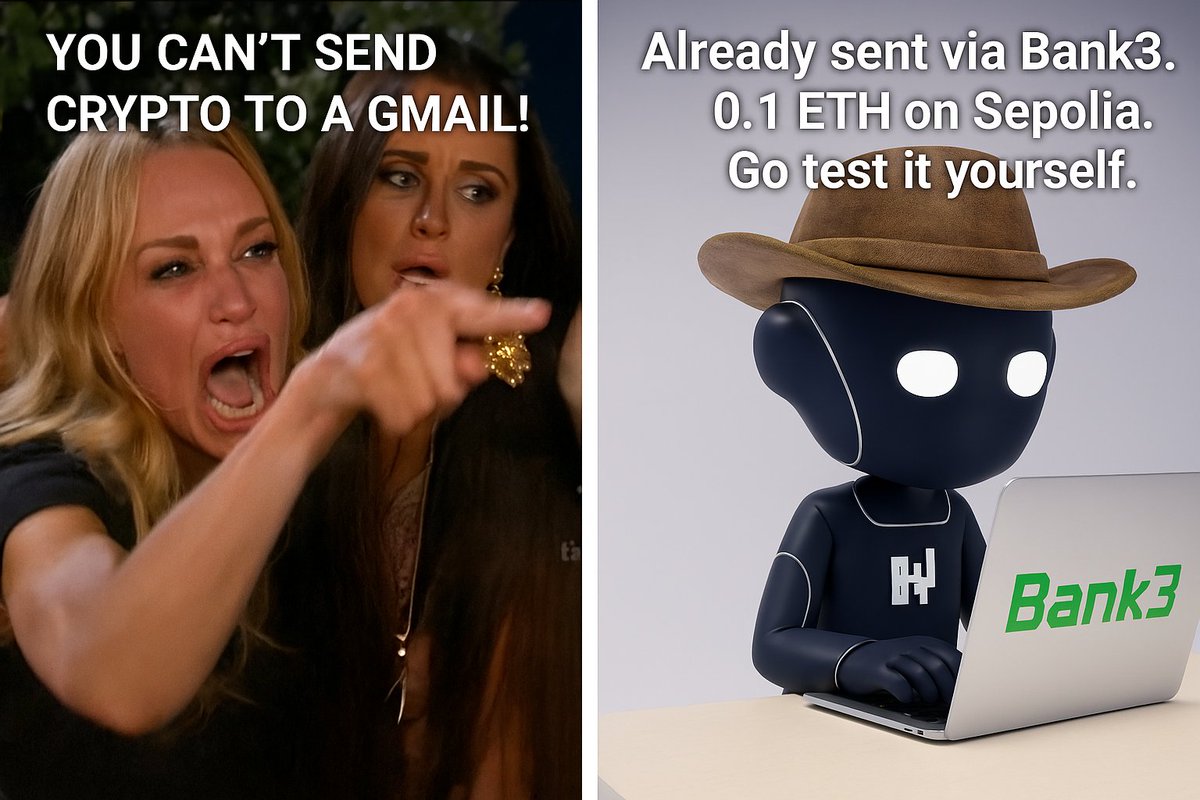
Bank3 allows you to send crypto directly to Gmail and social media accounts.
⬇️Join our Discord to get started
https://t.co/RNrDM5WXc3
Head to the “TECH/bank3-testers” channel for next steps.
No one believed it until the AZKR Team made it happen.
You can now send crypto directly to a Gmail account with Bank3. NO WALLET ADDRESS needed for the recipient. 🚀
Help us mass onboard more users in Web3.
Start testing here ➡️ https://t.co/QeJyGxirPq
Bank3 is for everyone!
Allowing you to send crypto to anyone, even if the recipient doesn’t have a wallet address!🤯
How is this possible?
🎁Top 3 best answers will win 10,000 $AZKC each.
$AZKC is the governance token of the AZKR ecosystem. Join the giveaway now. Let's go!🚀
Are you a developer, researcher, or curious mind who is fascinated by blockchain, zero-knowledge proofs, or cryptography?
Click here and join us for a comprehensive lecture series ⬇️
https://t.co/MbBIxa4o9l
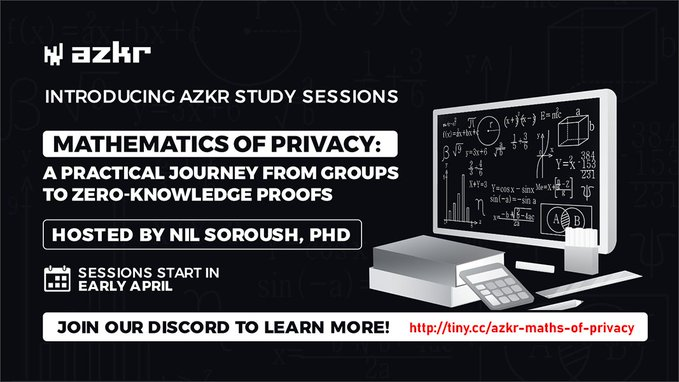
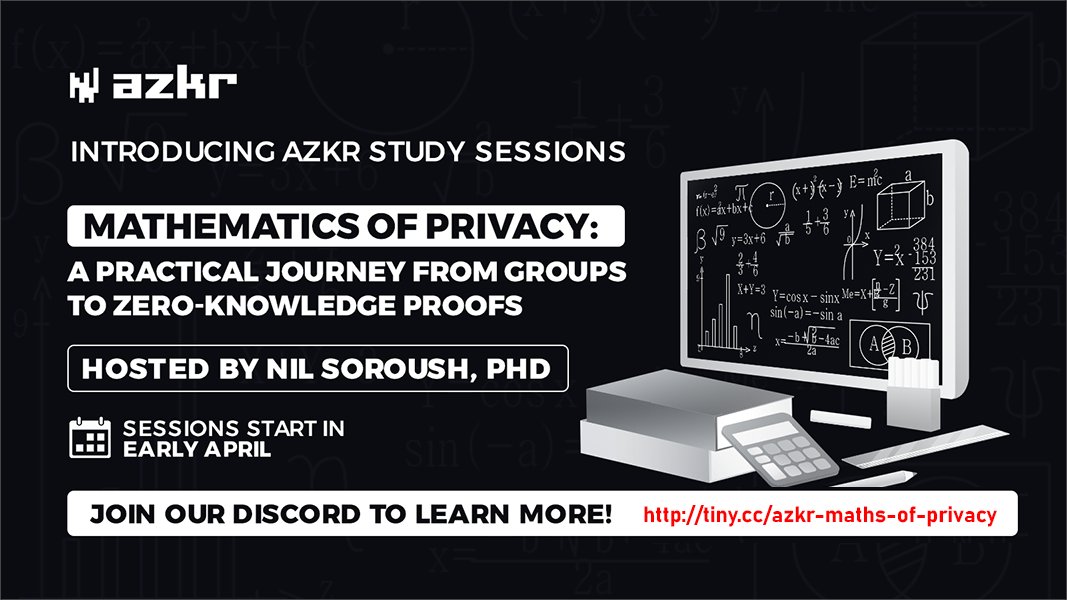
Introducing a new series of AZKR study sessions: "Mathematics of Privacy: A Practical Journey from Groups to Zero-Knowledge Proofs".
Are you a developer, researcher, or curious mind who is fascinated by blockchain, zero-knowledge proofs, or cryptography but feels intimidated by the mathematical foundations? Then this course is for you. Join us for a comprehensive lecture series that bridges the gap between abstract mathematics and practical cryptographic understanding.
Sessions will start in early April, please join our Discord to find out more: https://t.co/MbBIxa3QjN
What You'll Learn
By the end of this course, you'll understand:
* How group theory underlies public-key cryptography
* Why finite fields are crucial for zero-knowledge proofs
* The mathematical principles behind commitment schemes
* How elliptic curves enable efficient cryptographic systems
* The mathematical foundations of modern ZK-proof systems
* More will be shared soon – stay tuned!
Introducing a new series of AZKR study sessions: "Mathematics of Privacy: A Practical Journey from Groups to Zero-Knowledge Proofs".
Are you a developer, researcher, or curious mind who is fascinated by blockchain, zero-knowledge proofs, or cryptography but feels intimidated by the mathematical foundations? Then this course is for you. Join us for a comprehensive lecture series that bridges the gap between abstract mathematics and practical cryptographic understanding.
Sessions will start in early April, please join our Discord to find out more: https://t.co/MbBIxa3QjN
Who Should Attend?
* Developers working with or interested in blockchain technology
* Engineers implementing or working with cryptographic protocols
* Anyone curious about the mathematical foundations of modern cryptography
* No advanced mathematics background required – we'll build from the fundamentals