NVIDIA will refund your cloud GPU bill if you let them bolt a $250,000 AI supercomputer to your desk for $2,999.
NVIDIA's $2,999 DGX Spark puts a 128GB AI supercomputer on your desk runs the same 70B models you've been renting in the cloud, but nothing crosses your network and no ToS governs a machine you own.
the $22K/year savings everyone's posting is the loud number.
the quiet one is bigger: the contracts you stopped losing on data residency.
own-compute isn't a budget optimization anymore. it's a sales motion.
↓ builder benchmark from the week the box shipped. real numbers, not marketing.
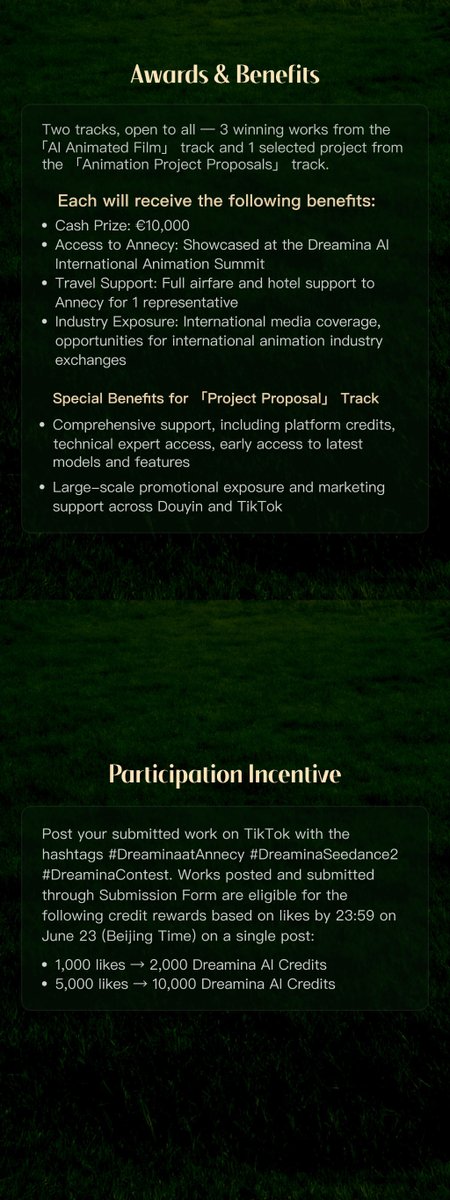
Create with Dreamina Seedance 2.0. Dreamina launches a €40,000 prize pool to bring your work to Annecy International Animation Film Festival
Animation is one of humanity’s oldest ways of dreaming. With Dreamina Seedance 2.0, we continue to explore new possibilities for animated storytelling, and hope to bring more imagination to the world’s leading animation stage.
The Annecy International Animation Film Festival — the only animation festival among global Category A international film festivals and widely known as the "Oscars of Animation" — marks its 66th year in 2026, placing AI on its key theme for the very first time.
The Dreamina AI International Animation Summit will be held on June 23, 2026 at Annecy International Animation Film Festival, launching a global open call for AI animated works and creative project proposals.
The event features a total prize pool of €40,000, with winning creators and selected works receiving sponsored flights and accommodation to attend Annecy in person, participate in screenings, and engage with the international animation industry.
Powered by Dreamina Seedance 2.0, and the new upcoming 「Octo」, Dreamina AI continues to explore new frontiers in animation filmmaking — and we hope to create the defining visual language of this era together with you.
For detailed information, please visit the official Dreamina AI website.
#DreaminaAI #DreaminaatAnnecy #DreaminaContest #DreaminaOcto #DreaminaSeedance2 #DreaminaOctoVibeCreate
This is so interesting and shows the skill sn animator needs to create a really good movie. Even though AI is smart, it needs to be directed by a creative human intelligence with discernment and will. Intention drives creativity: AI can automate the process, but the breakthrough creativity requires genuine human work, else it comes out formulaic.
One of the hardest things to understand with AI is ‘how’ to get it to be spontaneously creative: but there’s really no such thing: real creativity is work. It is time spent, attention given, resources expended, and opportunity cost.
Here’s an example of something Craig Wright might rail against, but let’s give him the benefit of the doubt.
On the one hand, open access to knowledge is a good thing. It opens the door to education, which might increase the sum of human wisdom and happiness and being more good things into the world.
On the flip side, one could argue that, just like Aaron Schwartz JSTOR story, or RIA’s story, stealing copyrighted material that belongs to its authors and sharing it widely against their wishes is illegal, immoral, and dis-incentivises funding of real research since it demonetizes its output (one could argue).
But… it turns out that blank cassette tapes and a record button did not kill the music industry. The music industry grew anyway, just as it did after pirate radio and BitTorrent.
Meaning that copying and sharing tends to precede growth and drive sales. Why?
I think likely Ita because copying music leaves you the budget to spend on music anyway. It gives you latitude to genuinely invest in the artists you like, and maybe this is true of research and books also?
OK: So how might this relate to the BSV crowd? They want to leverage the technology, tokenisation and such: could we tokenise research on a Uni-Swap-like Dex? Yes, we could. We could fund research on a decentralised (permissionless) market if there was an appetite for it, and degens could gamble on research papers.
What’s interesting is he cross-over in pirate markets; from content to tokens: BitTorrent and UniSwap have a similar ‘anti establishment ethos’, one is substance without payment (BitTorrent, Anna’s Archive etc.) the other is payment without substance (Memecoins, DeFi etc.)
BitTorrent solved the problem of sharing content for free. DEX’s solved the problem of distributed ownership, now what is needed is a synthesis of the two: shared ownership of monetised material.
This is BitCoin’s greatest strength and AI is rising to meet the challenge of content creation on a global scale such that users do not have to share illegally ripped Hollywood movies - they can create and sell them on their own distributed networks and compete with Hollywood on their own terms. And this is partially what is meant by ‘own your own data’. Sell interest in your ideas, production’s etc, as tokens. Shares in your own intellectual productions.
An anonymous developer built a library so big it made Elsevier's legal team cry.
It's called Anna's Archive.
This got 99 million books and papers. Every shadow library on earth mirrored and searchable in one place. Domain takedowns bounce off it. It just moves to a new URL and keeps going.
Here's the story behind it.
In November 2022, US law enforcement seized Z-Library's domains and arrested its operators. The largest ebook library on the internet was gone overnight.
A pseudonymous developer going only by "Anna" had already seen it coming.
She had spent months as part of an anonymous group called the Pirate Library Mirror, quietly making full copies of every major shadow library before they disappeared. When Z-Library fell, she had the entire thing backed up.
Days later, Anna's Archive went live.
Here's what makes it unkillable.
It does not host a single file. It indexes metadata and links to third-party mirrors. Legally, there is nothing to seize. Technically, there is no central server to shut down.
The entire codebase is open source. The entire dataset is distributed via torrents and IPFS, a decentralized file system where data lives across thousands of nodes simultaneously. If every domain gets blocked tomorrow, anyone can spin up a new mirror in minutes from the same data.
Italy blocked it. Germany blocked it. Publishers sued it. The US Trade Representative put it on their notorious markets list.
It added new domains and kept going.
What you get for free:
→ 99M+ books and academic papers
→ Sci-Hub, Library Genesis, Z-Library, Internet Archive all mirrored in one search
→ No account required
→ No subscription
→ Download via IPFS, torrent, or direct link
→ Works across multiple mirror domains when one goes down
Elsevier charges universities $2 billion a year for journal access. A single anonymous developer with a pseudonym and a backup drive just made that business model look embarrassing.
100% Opensource.
https://t.co/HCUQBVrpUu