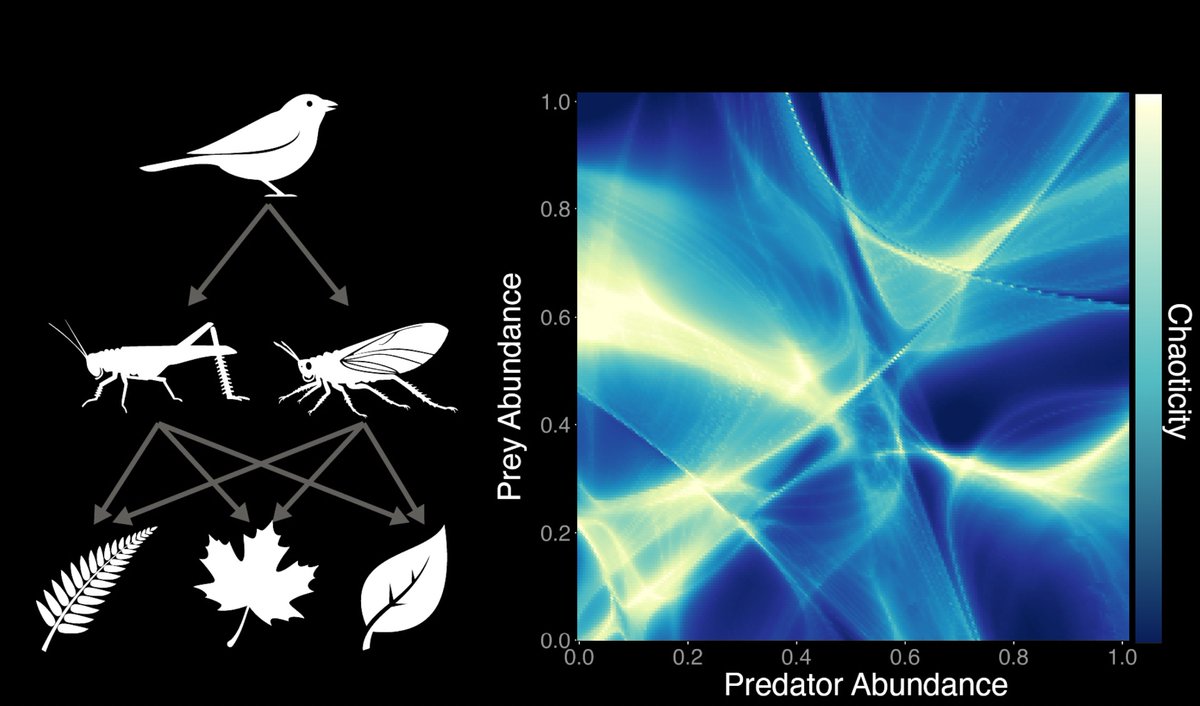
Does stability matter in biology? My article on the cover of this month’s @PLOSCompBiol explores how large ecosystems develop supertransients, a manifestation of computational hardness (1/N)
https://t.co/iqt8h2DVz0
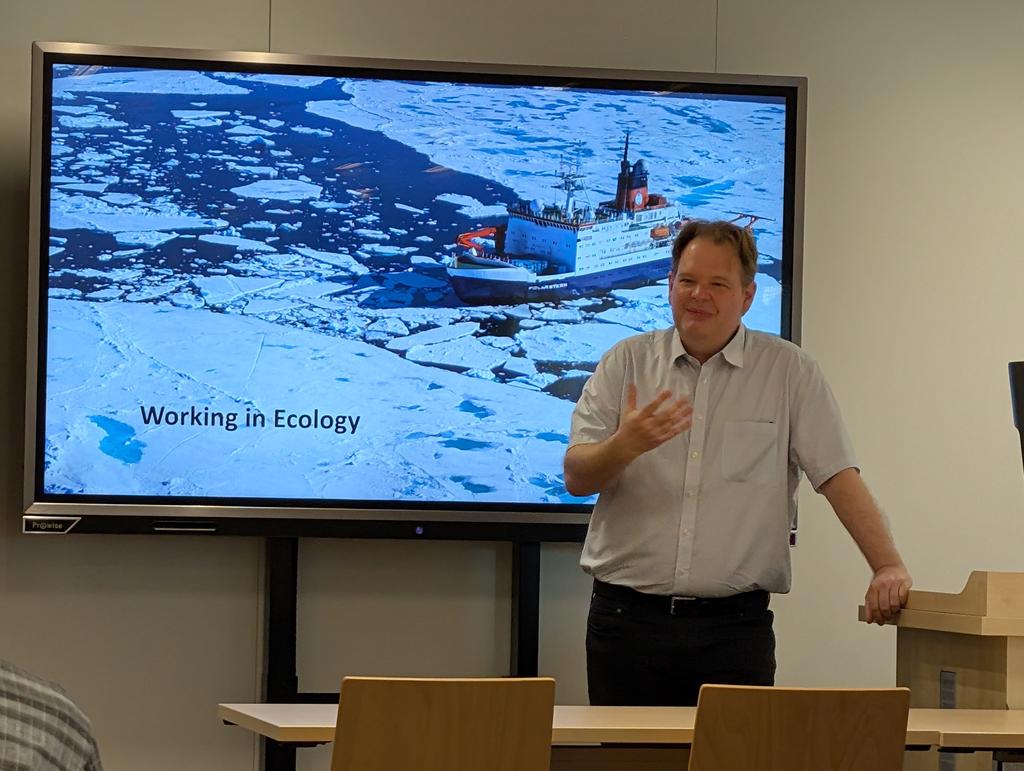
Complex systems often exhibit bi-directional, cross-scale causation. External Professor John Harte's recent seminar explored work on combining top-down statistical approaches with bottom-up process modeling for a new theory of complex systems dynamics. https://t.co/n0gnD00o0t
.@DavidDeutschOxf: “I spoke to [Richard] Feynman—a great highlight of my life, I only spoke to him once—for a few hours. And we had a wide ranging conversation, mostly about quantum theory and computation, but we deviated a bit to talk about physics generally.
And I said that physics seems to have slowed down, and he said, “There will be no more great physicists.” And I was like, “Oh, what makes you say that?” Because I wasn’t thinking like that at all, because I was lucky enough to be among several of them and learning from them.
And he said, there will be no more of them. So I said, why? And he said, “Well, because of physics education.” He didn’t put it in exactly the way that I would today, but it was that it was very narrow, and everybody was taught to do the same thing.
I don’t think he had any objection to this concept of being taught a thing or to have a curriculum, but he thought it was becoming narrower and narrower. And the reason it’s becoming narrower is because that’s the only way you can base it on exams. And if you want to have a world in which most people go to university, let’s say, then you need to have standards for going to university. And these standards have to be determined by exams, otherwise it’s unfair. And if they’re determined by exams, they have to be determined by a uniform curriculum.
When I was in school, there was no national curriculum. Every school had its own curriculum. There were dozens of different examination boards that set exams, and each school could choose: we’ll have this board for physics, and we’ll have this board for history, according to what the teachers in the school thought was a good idea to force their pupils to learn.
So that part of it wasn’t the way I would have it. But the state didn’t take a view, and most importantly, it didn’t take a uniform view that everybody in the country had to learn this thing. And that was the thing that Feynman was objecting to—that everybody in the country learning the same thing. And by the time they get to university and by the time they’ve done an undergraduate degree, they’ve learned to become proficient. I mean, those that pass through the sieve and eventually get to become physicists or something, they have all learned how to do the same thing in the same way. And that’s going to put a damper on doing things a different way, a new way.
Of course, Feynman, in his life and in his research career, was constantly doing things in a new way, in ways that people didn’t approve of. And I think, well, I’m not a pessimist, so I don’t think there aren’t going to be any more great physicists. I’m expecting that there are, because I’m expecting that the Enlightenment will spread to educational theory as it has spread to many other aspects of life.”
PhD position on Antarctic Climate Causality
Join us in unraveling links between the components of the Antarctic climate system and their variability
Joint PhD of UCLouvain and KU Leuven
https://t.co/eBAXZ5pvtM
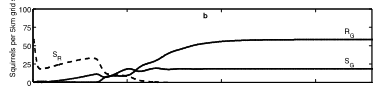
@DrAlexBest@BlindMath@visualPDE@bj_w95@img_oxford Thanks! For anyone else who is interested, here a graph from a double SIR model (with an S, I and R population for each), taken from one of the papers on that page.
@BlindMath@visualPDE@bj_w95@img_oxford@DrAlexBest So the grey squirrels were carrying a disease to which the reds didn't have any immunity? If disease spread and its effects were fast, that would require the extinction wave of red squirrels to have preceded the colonisation wave of grey squirrels. Was this observed?
"Theoretical tools for understanding the climate crisis from Hasselmann’s programme and beyond" (by Valerio Lucarini & Mickaël D. Chekroun, in Nature Reviews Physics): https://t.co/ICYcEyS3lb
What spatial structure and dynamics emerge in tropical forests affected by fires at their edges? We explored this question theoretically by modelling fire and forest spread as contagion processes on grass patches. 1/n https://t.co/SU7rPwdPDp
Persistence can lead to success! Roeland van der Vijsel, former NIOZ PhD student, publishes one of the nicest papers from his thesis in Nature Communications!
https://t.co/3lIxv6ckui