An AI research paper has been getting attention this week.
The finding, in plain terms: if you grade your training data by quality from day one instead of treating every example as equal, you can train a model up to 2.8x more efficiently.
Sounds obvious, but this is not how most AI gets built.
And it rhymes with something Qubic has been doing for the past four years. 🧵
The Quorum has spoken.
Qubic's second halving is approved and locked in for Epoch 227.
Weekly emissions drop from 450B to 225B $QUBIC. The burn rate jumps to 77.5% of all weekly emissions. The first halving was EP175.
EP227 keeps emissions on a controlled long-term schedule and extends the runway for the entire ecosystem.
A blockchain is basically a genius locked in a room with no windows.
Hand it a problem in writing and it will reason through it flawlessly, every time, forever.
But it cannot see out.
It does not know today’s Bitcoin price, who won last night’s football match, or whether a flight actually landed. Everything it knows has to already be inside the room.
That is a real limitation.
A contract that pays out the moment a flight is delayed is useless if it can never find out the flight was delayed.
Oracle Machines are the window.
They let a Qubic smart contract ask the outside world a question, get an answer the network checks and agrees on, then act on it.
Prices. Sports results. Sensor readings.
This is not a someday feature.
Oracle Machines are live, and already doing real work: validating Dogecoin mining shares for the network.
That workload recently climbed by up to 40x across a few epochs, and the system handled it without strain.
A contract that can read reality is worth far more than one stuck guessing.
Qubic can read it.
Neuraxon Live Sesion 2 https://t.co/G0IJoRb8de is booming with clusters, with 17K total managed, and very long lived ones, most for days, time to start Sesion 3, with a new base brain just developed, save your Nxrs if you haven't already before 08.00 UTC
The breakdown.
Of that weekly trillion, part goes to miners, part to CCF (Computor Controlled Fund), and part is burned on the way out.
A halving lifts the burn share, so net emissions, the new supply actually entering circulation, drops significantly.
The last halving, in August 2025, cut net weekly emissions by roughly half and slowed the climb toward Qubic’s 200 trillion max supply cap.
$QUBIC is the only chain where mining upgrades the intelligence of the network instead of just securing it.
Every other PoW chain burns energy to prove work happened.
$QUBIC burns energy to make AI smarter.
That is not a small distinction. That is an entirely different category of asset.
The people who understood this before will not need to explain themselves later.
Tomorrow: Tech on Deck, the Qubic AMA with the core team.
Wednesday, June 3 at 11:00 AM EDT | 3:00 PM UTC, live on X.
The community voted for a raw technical session and that is exactly what this is.
Outsourced compute, algorithm updates, halving mechanics, network parameters, and an open floor for the questions you actually want answered.
No softballs. Straight to the builders.
Energy was never meant to be wasted.
Qubic turns proof-of-work into the work itself: computation that trains AI with purpose.
No staking. No idle burn. Just useful work.
This is not mining as you know it. It's Qubic.
Watch.
Most people sleeping on $QUBIC have never looked past the price.
Here is what the people who actually read the docs already know:
1) Mining that trains AI instead of wasting energy. Every hash contributes to something real.
2) 15.5 million TPS certified by Certik. Fastest blockchain infrastructure on the planet. Not a claim. A certification.
3) Founded by Come-from-Beyond. The original co-founder of IOTA. Credibility that cannot be manufactured.
4) Zero VC funding. Zero central authority. The community owns this entirely.
5) Peer-reviewed AI research heading to IEEE conferences. Not marketing slides. Actual science.
6) DOGE mining revenue flowing directly into $QUBIC burns. External capital funding the deflation.
7) 84% surge in GitHub developer activity in the last 30 days.
Seven things. One project. Almost nobody is talking about it.
Which one changes your mind the most?
Drop your number below.
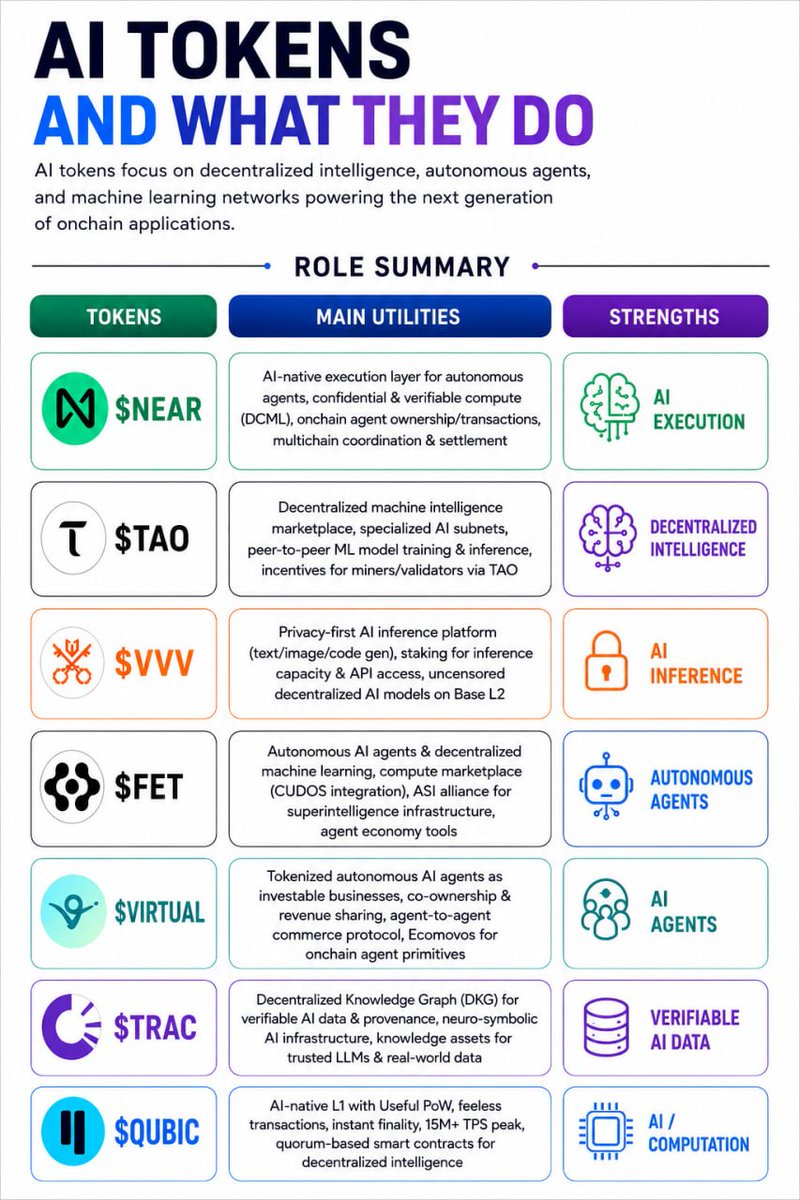
AI tokens are building the back end of the future internet.
The smartest capital is not chasing random meme plays, they are accumulating the actual network protocols that power decentralized intelligence.
Keep this cheat sheet handy:
$NEAR: Confidential compute and chain abstraction
$TAO: Peer to peer inference marketplace
$VVV: Privacy first GPU access infrastructure
$FET: Autonomous agent economy tools
$VIRTUAL: Co owned autonomous businesses
$TRAC: Trusted knowledge infrastructure for LLMs
$QUBIC: Feeless quorum based AI computation
Which protocol has the strongest tokenomics for long term holding ?
Last week the Qubic science team let you watch artificial creatures evolve in your browser. That version reset every time you loaded it.
This one does not.
NeuraxonLive is a single world that runs around the clock and keeps running. The creatures in it forage, mate, sing, and die on their own.
None of it is scripted. When one dies it stays dead, and there is a permanent ranking of every creature that has ever lived in the world.
Each creature carries a brain built on the general-intelligence design from last week's release. So you are not watching a replay. You are watching selection actually shape these things in real time, and if you zoom in, you can hear them.
You can drop your own creature in. The first season is live now, capped at 500 creatures with 100 custom slots. Whether your line survives or dies out is decided by the world, not by you.
It is fully open source, so you can also run your own world on your own machine.
In 1904, psychologist Charles Spearman found that children who scored well in one subject scored well in almost everything.
He called the underlying factor “g”, general intelligence.
120 years later, g remains one of the most replicated findings in behavioral science.
And yet, when researchers run the same psychometric analyses on large language models… the g factor structure doesn’t show up.
LLM performance across domains doesn’t correlate the way human cognition does.
It tracks training data density, not genuine cognitive generality.
So what would it take to actually evolve g in an artificial system?
That’s the question behind Neuraxon’s latest experiment.
Artificial creatures growing their own modular brains, selected not for mastering any single task, but for the shared cognitive thread across many.