If you want good news about women in executive politics, do I have the article for you! “Approaching Equality? Media Treatment of Male and Female Ministers (with Michelle Taylor-Robinson) is now out in print! 1/🧵
In this new paper with @b_armstrong95 and @Spencer_Goidel, we show that the drug crisis boosts Republican vote, especially among independents, by lowering both Democratic support and abstention.
@ThiagoMQM, @b_armstrong95, and my paper, “The Drug Crisis and Voting Behavior,” is now out in Perspectives on Politics (@PoPpublicsphere).
We show that rising overdose death rates are associated with both Democrats and abstainers shifting right.
https://t.co/5WMkSewPET
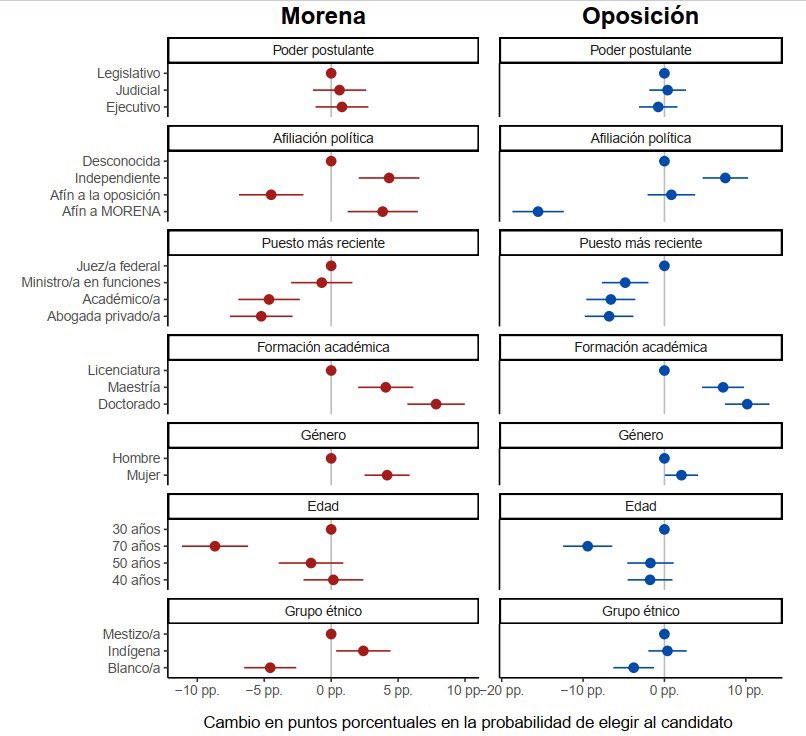
🚨 Datos preliminares sobre preferencias para candidatos judiciales en México (¡mañana son las elecciones!) 🚨
En la gráfica, los puntos muestran cómo ciertos atributos afectan la probabilidad de que una persona elija a un candidato, según su preferencia partidista.
It’s a two publication day! Check out our latest articles with @Res_Pol:
What’s woke? Ordinary Americans’ understandings of wokeness - Benjamin M. VanDreew, Joseph B. Phillips, B. Kal Munis, Spencer Goidel, 2025 https://t.co/0mr2GqBcSY
As a Kentucky fan, an A&M fan and an institutionalist, I’m going to rate March 2/10. If Tennessee makes their first final four ever, it’ll go down to 0/10.
Thanks to the Wiley Online Library, "Redefining 'expansion' in congressional communication: Homestyles for a digital constituency" by Stephanie Davis (@UALR) and @AnneliseRussell (@UKYMartinSchool) is available to read now for a limited time only! 🔗⬇️
https://t.co/Ia1NTegxp5
We replicate all tests exploring whether gender stereotype backlash might moderate the optimistic media findings related to inclusion. We find that incongruence with a post stereotype (man-fem. post, woman-masc. post) improves the tone of coverage. 9/
Overall, we take these findings to mean that, when women are treated differently, it is usually to their benefit. This is especially true for women who hold posts they don’t “fit” in a stereotypical framework! 12/22
Finally, we explore if the media mentions men and women’s experience equally. We find that as women’s inclusion increases, they actually receive fewer mentions, but when women’s inclusion is low the media mention their qualifications more than men (robust to actual exp.) 8/
When we focus on the tone focused on individual ministers, we find that increases in women’s inclusion are associated with notable increases in positive tone coverage of women. Though, all tone changes are small in an individual article, so we expect this to matter at scale 7/
Related to quality: We find that the tone of articles including women are significantly more negative at lower levels of women’s historic incorporation, but articles mentioning men do not change in tone over levels of inclusion. 6/
We find that women’s historic inclusion and minister gender interact to predict # of ministers included in articles that mention the minister of interest. At lower levels of inclusion, women receive less individual focus, but the gap closes at higher levels of inclusion. 5/
Related to quantity: We find that men and women in the first month of a new admin. generally receive similar coverage in terms of (1) length of articles that discuss them, (2) % of the article that discusses them, and (3) the # of their quotes included by journalists. 4/