One sincere dua can change your entire life. Today is the day to ask Allah for everything.
Ya Allah, on this Day of Arafah, grant us halal rizq, good health, peace of mind, and Jannah.
Good morning my dear mutuals 🌞❤️
Let’s boost each other today like, repost, reply and engage.
May the algorithm favor us all and may our hustle pay big this week 📈✨
One Demon Slayer theory is making fans rewatch Muzan Kibutsuji’s entrance with completely different eyes.
In Season 4 Episode 7, some viewers noticed the fog-like effect surrounding Muzan as he approached Kagaya Ubuyashiki’s estate, leading to new discussions online.
According to the fan theory, the effect may represent Muzan’s body constantly burning and regenerating at the same time while moving through the area.
The idea comes from the heavy presence of wisteria around the Demon Slayer headquarters, a plant known in the series for harming and repelling demons.
While some fans believe this detail makes the scene feel even colder and more intense, others think the effect was simply added for dramatic visuals rather than literal regeneration.
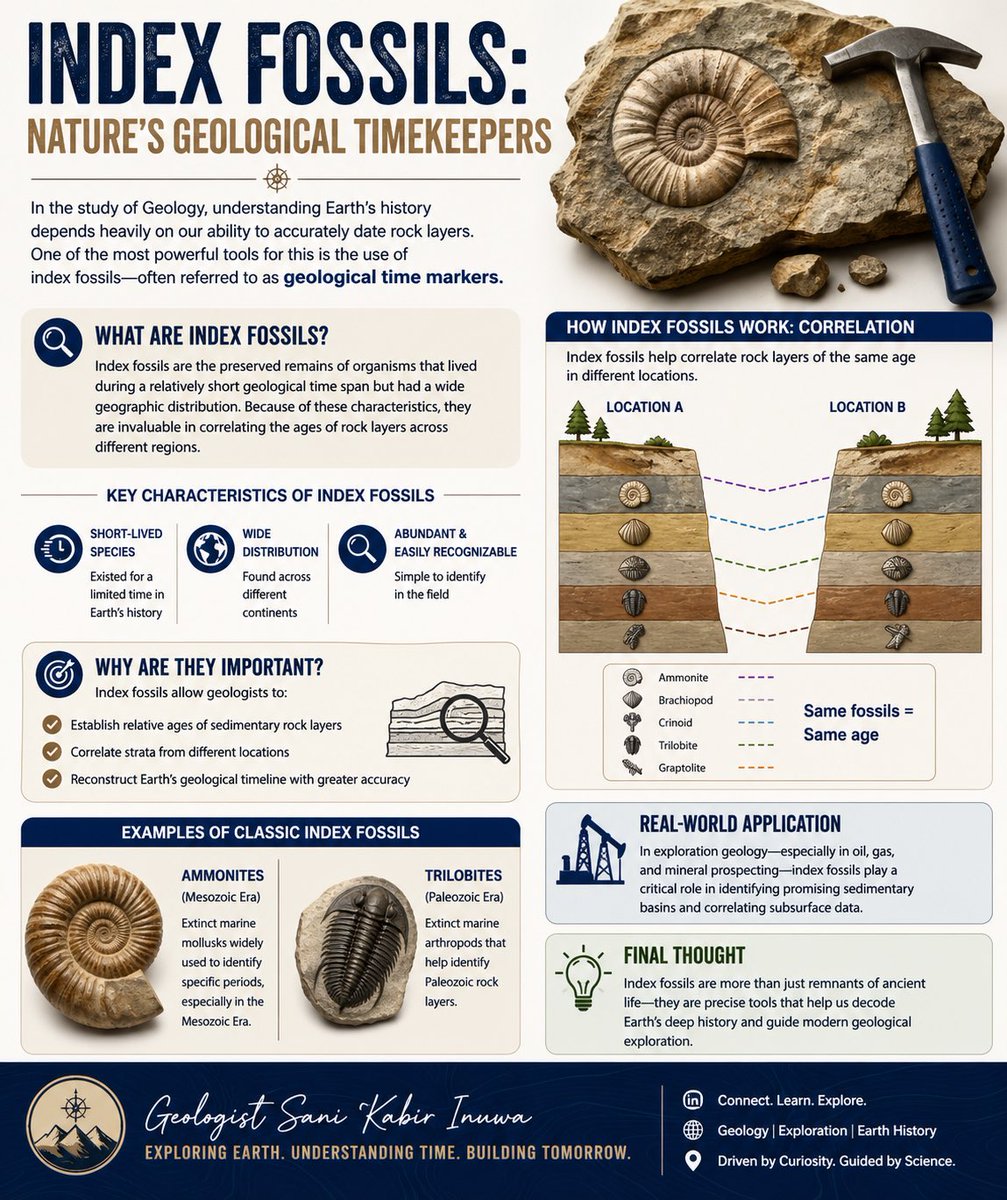
🔍 Index Fossils: Nature’s Geological Timekeepers
In the study of Geology, understanding Earth’s history depends heavily on our ability to accurately date rock layers. One of the most powerful tools for this is the use of index fossils often referred to as geological time markers.
📌 What are Index Fossils?
Index fossils are the preserved remains of organisms that lived during a relatively short geological time span but had a wide geographic distribution. Because of these characteristics, they are invaluable in correlating the ages of rock layers across different regions.
🧭 Key Characteristics of Index Fossils:
•Short-lived species → existed for a limited time in Earth’s history
•Wide distribution → found across different continents
•Abundant and easily recognizable → simple to identify in the field
⏳ Why are they important?
Index fossils allow geologists to:
•Establish relative ages of sedimentary rock layers
•Correlate strata from different locations
•Reconstruct Earth’s geological timeline with greater accuracy
For example, fossils like Ammonites and Trilobites are classic index fossils used to identify specific periods within the Paleozoic and Mesozoic eras.
🌍 Real-World Application
In exploration geology especially in oil, gas, and mineral prospecting index fossils play a critical role in identifying promising sedimentary basins and correlating subsurface data.
💡 Final Thought
Index fossils are more than just remnants of ancient life they are precise tools that help us decode Earth’s deep history and guide modern geological exploration.
✍️ Geologist Sani Kabir Inuwa
🌍 Continental Drift: The Earth in Motion
The surface of our planet is not fixed it is constantly moving and evolving. The concept of continental drift, introduced by Alfred Wegener in 1912, explains how continents have shifted over geological time.
Millions of years ago, all continents were joined together as a supercontinent called Pangaea. Over time, this massive landmass broke apart and gradually drifted to form the continents we recognize today.
🔍 Evidence of Continental Drift:
• The jigsaw-like fit of continents (e.g., Africa and South America)
• Similar fossils found across widely separated continents
• Matching rock formations and mountain belts
• Evidence of past climates (glacial deposits in unexpected regions)
Today, continental drift is explained through the theory of plate tectonics, which describes how lithospheric plates move and interact.
📌 Simple Illustration Idea:
[ PANGAEA ] → [ BREAKUP ] → [ PRESENT-DAY CONTINENTS ]
(Africa + South America fit like puzzle pieces)
💡 Understanding these movements helps geologists predict natural hazards and locate valuable mineral resources.
✍️ Geologist Sani Kabir Inuwa
#Geology #ContinentalDrift #EarthScience #PlateTectonics #Geologist