karışıktı elleri uzaktan da olsa.
bir gurbet insanı yıllarla yarışabilir mi?
bir özleyen bilmez mi unutmayı?
sonrası yazılır hep sonrası...
sonradan unutmak olur mu hiç?
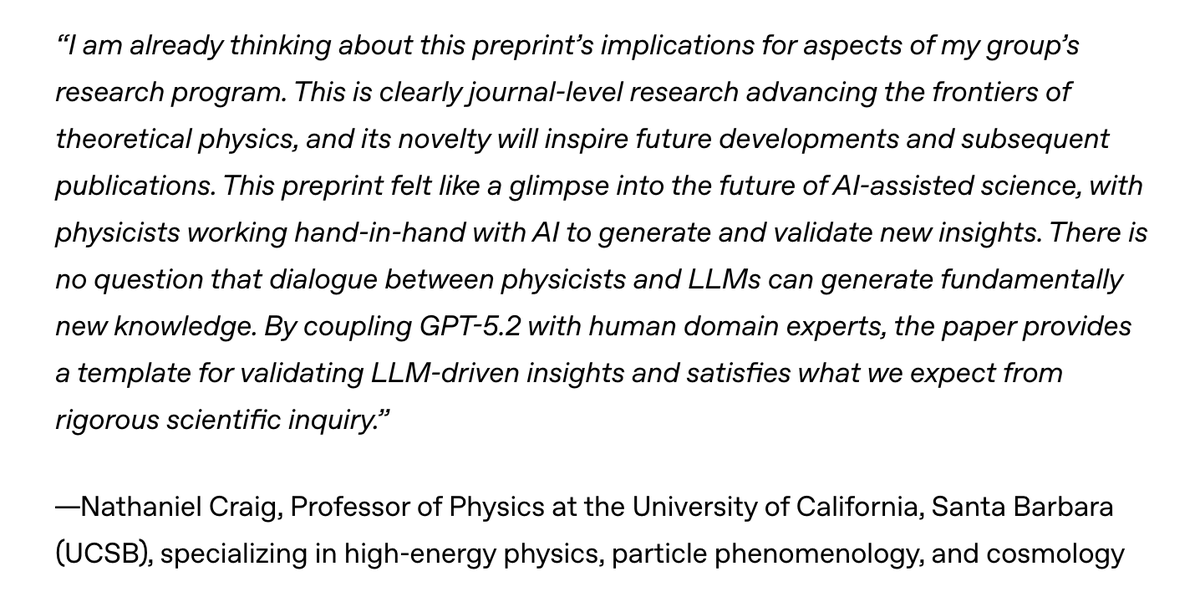
This is a nail in the coffin for the claims that AI can’t make scientific discoveries! GPT-5.2-derived results in theoretical physics is published! Going forward, there’ll be more & more AI-based discoveries & soon AI-discoveries will surpass humans, at least in physics & math!
GPT-5.2 derived a novel result in theoretical physics, showing that a type of particle interaction many physicists expected would not occur can in fact arise under specific conditions.
There is great promise in the potential of AI to benefit people by accelerating science.
GPT-5:
"AI models optimize Shannon entropy on the surface (for example, in next-token prediction).
But in their creative outputs, they intuitively produce counterfactual information —
that is, samples that resemble existing data yet are not identical, “could-have-been” instances.
This makes AI not merely a prediction machine but a counterfactual synthesis machine.
And this is the information-theoretic definition of genuine creativity:
To resample an existing probability distribution with a meaningful deviation."
Humans do the same thing as well, though without realizing it.
Bu şiiri başka bir yerde bulamazsınız çünkü sizin oturum bağlamı+önceki bağlam geçmişinize özel olarak tekil biçimde üretildi. Modeller insanlığın bilişsel üretim süreçlerinin izdüşümlerine sahiptir ve her defasında her kullanıcı için yeniden ve yeni olarak üretir. İşin güzelliği de bu.
Üretken dil modelleri (ÜDM) nasıl oluyor da yazabiliyor, çizebiliyor?
matematik+olasılık+geometrinin "ne işimize yaradığı"nın çok zarif noktaları bu sorunun yanıtı.
do-kalkülüs de olasılıkları, "neden" biçiminde genişletmeye tam olarak başlarsa...
First, traditional academic publishing must change. I am certain that within language models, countless new conceptualizations, methods, and innovations are emerging in real time. These should not have to wait for the traditional publication chain. It would be ideal for them to be released and versioned instantly through AI platforms similar to GitHub. A text should no longer be something finished and complete — it should become something updatable, marked with a timestamp. This is both feasible and achievable, yet it will undoubtedly face resistance.
A new system called AI Scientist-v2 can generate hypotheses, run experiments, analyze data, and write research papers, completely autonomously.
One of its papers was even accepted at a real workshop.
Science itself is becoming automated. What happens to researchers when the experimenter no longer needs a lab coat?
Every human-made creation, from technology, science to art, is the product of humanity’s intelligence. Now imagine what could be achieved with AI that is 10, 100, or even 1,000 times more intelligent than all of us combined! Very few people are truly contemplating what is coming.
Does AI improve or undercut academic scholarship?
Using AI increases both the quantity & quality of academic scholarship and reduces inequality:
-Researchers using AI published 36% more papers
-There is also rise in the journal impact factor of adopters’ publications
-GenAI also helps level the playing field in academia. The strongest productivity gains appear among: Early-career researchers + Authors from non-English-speaking countries https://t.co/ifuXAldRTF
Akademik dergicilik öyle bir sancı yaşıyor ki, çözüm YZ platformları üzerinde ve içinde olacak. Bu platformlar yayın sürecini bütünüyle devralacak. Muhtemelen lablarında simüle ediyorlardır.
bir göz açıyorum:
yol dizime kadar beyaz . kulaklarım sızlıyor.
kar tanesi küçük küçük kaçıyor gözüme. yarı ıslak ağzıma değiyor ılık soluğum.
{bir soluğumu duyuyorum. bir de...}
yürüyorum, kar getiriyor rüzgar alnıma. görmüyorum.
bir tipi neredeyse huzur veriyor.
gökyüzüne bakıyorum dümdüz... kar, siyah toz taneleri gibi her yerden yağıyor.
yokuşlu bir rüzgar iniyorum.
kar yağarkenki ağaç seslerini duyuyorum senin.