Faster isn't the same as earlier.
Earlier isn't the same as better.
Most translation systems optimise for speed. That's not wrong. Speed reduces latency. Latency matters.
But there's a third dimension most systems ignore entirely.
The moment meaning becomes usable.
A system can process at remarkable speed and still wait too long. It waits for the complete sentence when the intent was clear three words in.
Speed got it to the answer faster. It still chose the wrong moment to speak.
Babelbit attacks that third problem directly.
Not: how quickly can we process this?
Not: how do we reduce the gap between input and output?
But: when does this utterance contain enough meaning to act on?
Different question. Different architecture. And it's the one that determines whether a real conversation can actually happen.
Most subnets produce an output. It gets used. Then it's gone.
Babelbit works differently.
Every competition round improves the underlying system. Better prediction. Better calibration. Better domain adaptation. The foundational intelligence - context, cultural awareness - comes with the model. Competition sharpens what sits on top.
A small team can't explore that space. Not enough hours. Not enough people. Not enough compute.
So we opened it up.
Researchers and engineers compete globally on measurable capabilities. The results compound. Round after round.
That's open-access incentivised ML competitions.
Not how most systems are built. Exactly why this one keeps improving.
Every translation benchmark in use today rewards the wrong thing.
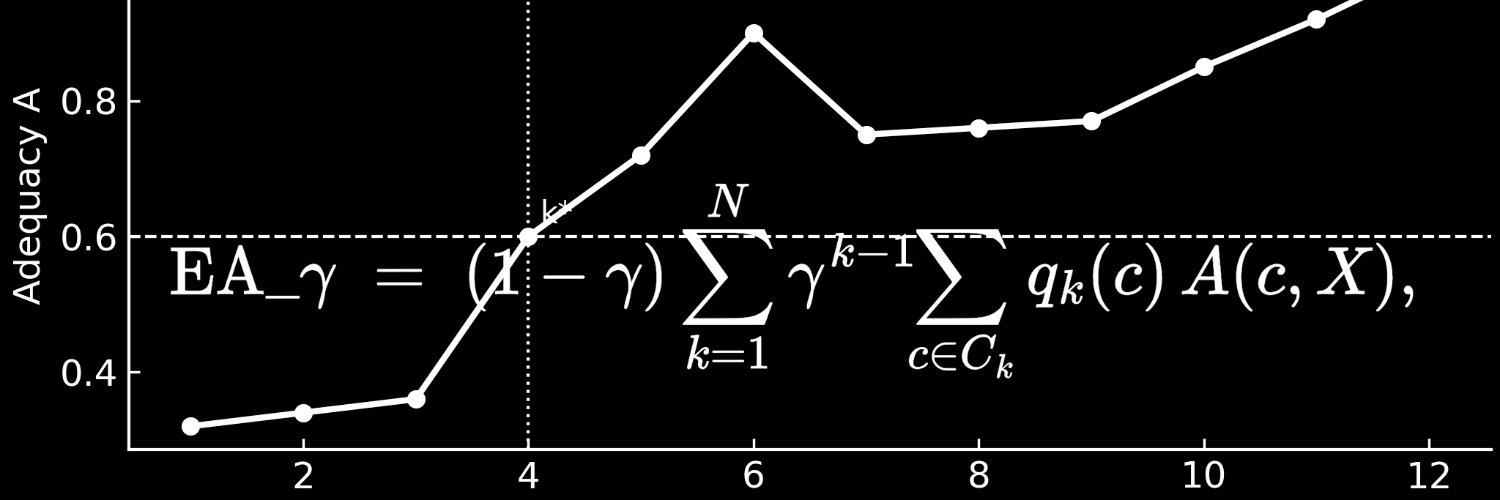
BLEU, AL, DAL, LAAL, ATD - all measure how closely machine output matches input. None measure what actually matters: whether the meaning arrived.
BLEU is the standard benchmark for translation quality. Measures how closely machine output matches human reference.
"Agreed" scores poorly. "I think you are absolutely right" scores well.
BLEU rewards word-for-word matching. Can't recognise that one word carried the meaning of twelve.
Every established metric has the same problem - AL, DAL, LAAL, ATD. All measure how closely output matches input. None measure whether it was adequate.
Babelbit's metric: Phrase Completion Latency.
Not how fast the words arrive. How fast the meaning does.
Harder problem. Right problem.
🥐 Fr: Je pense que vous avez tout à fait raison.
🌍 Standard: I think you are absolutely right.
🚀 Babelbit: Agreed.
The correct translation is one word.
Same meaning. Half the latency. Better conversation.
This is adequacy over accuracy. A translator converts what was said. An interpreter delivers what was meant - in the fewest words that carry full weight.
The difference isn't cleaner output. It's faster conversation. When every phrase distils to meaning, the lag between speaker and listener collapses.
Translation has always measured accuracy. Nobody measures adequacy.
That's what we're solving.
Calling speech and language ML talent. Join an ongoing competition to train a low-latency transformer network to predict and paraphrase as it translates.
$400k paid out over the last six months. Phase 2 is starting now, and the bounty will only grow as the competition delivers.
New structure:
Qualifying round: 20% of the bounty shared between every qualifying contestant.
The Arena: qualifiers compete for the remaining 80%.
Most translation systems optimise for literal accuracy. That misses the point.
🥐 Fr: Je pense que vous avez tout à fait raison.
🌍 Google: I think you're absolutely right.
🚀 Babelbit: Agreed.
Compete on prediction, end-to-end speech mode, or paraphrasing.
Latency under 2 seconds. Performance ahead of SOTA.
We've accelerated our GTM plan by two months.
First phase launches this month:
• Building a reseller network via B2B systems integrators
• Targeting marquee brands as early adopters
• AWS Marketplace as the primary conduit for reaching resellers
• Global sales reach without a global sales team
What made this possible: an ML engineering team the size of a large corporate, working through Bittensor mining - collaboration and competition at a fraction of the cost.
More to come as partnerships confirm.
Calling speech and language ML talent. Join an ongoing competition to train a low-latency transformer network to predict and paraphrase as it translates.
$400k paid out over the last six months. Phase 2 is starting now, and the bounty will only grow as the competition delivers.
New structure:
Qualifying round: 20% of the bounty shared between every qualifying contestant.
The Arena: qualifiers compete for the remaining 80%.
Most translation systems optimise for literal accuracy. That misses the point.
🥐 Fr: Je pense que vous avez tout à fait raison.
🌍 Google: I think you're absolutely right.
🚀 Babelbit: Agreed.
Compete on prediction, end-to-end speech mode, or paraphrasing.
Working with Mark again was a total pleasure, and especially getting the whole team involved.
We are creating more and more new features all the time, and of course we will be putting out our usual (slightly dry) demos. However, doing the demos live in the middle of a conversation with someone deeply involved in the Bittensor community, is *way* more fun, so hopefully this will prove to be the first of many.
Thanks Mark for your welcoming approach, your insights, and above all for making this fun.
#hashrate #babelbit @babelbit #sn59
Looking forward to this one.
Bring your questions on how we're building speech-to-speech translation without text steps, why predictive models change the game for latency, or how we're applying professional interpreter techniques in the incentive mechanism.
We've been heads-down building.
Ready to talk about where we are and where we're going @subnetsummer 🎙️
🚨 Subnet Summer AMA X @babelbit (SN59) 🚨
🕔 5:00 PM BST (Wednesday, May 20)
Join us as we sit down with Matthew from BabelBit (Subnet 59) on Bittensor to explore how they’re building decentralised real-time AI translation infrastructure.
BabelBit is developing a predictive speech translation network designed to reduce latency in multilingual communication. Instead of waiting for a speaker to finish an entire sentence before translating, BabelBit leverages AI models that predict and complete utterances in real time enabling faster, more natural conversation across languages.
At its core, BabelBit represents a shift from traditional static translation systems → decentralised, latency-optimised AI communication infrastructure. By leveraging Bittensor’s incentive design, the network creates a competitive environment where miners continuously improve prediction accuracy, semantic understanding, and translation speed through economic incentives.
This AMA is your chance to explore how BabelBit is pushing decentralised AI into one of the largest global markets, real-time communication and language infrastructure.
We’ll cover:
• What BabelBit (SN59) is building
• How predictive translation works
• Why latency is one of the biggest problems in AI translation
• How miners compete on semantic accuracy and speed
• Validator scoring and evaluation mechanisms
• Real-world applications for multilingual communication
• Current progress and long-term roadmap
• Live Q&A with the team
BabelBit is pushing Bittensor into the future of decentralised real-time communication infrastructure.
Set your reminder 🔔
In October 2025, founder Matthew Karas built Babelbit's first prediction engine prototype with a single LLM prompt. No code written by hand. Two out of three scripts ran first time. One had a bug - fixed in one iteration.
He then handed it over to chief scientist Josh to expand on, and lead developer Mica who turned it into a subnet in two weeks.
Along with co-founder and COO Tom Horner, Babelbit is still four-person team.
50 years of combined experience in speech. The architecture to finally do this properly.
French-English real-time interpretation. Public API. Sub-2-second latency. Interpreter skills from prediction to paraphrasing are built in - not bolted on.
Not a speeded up Google Translate. The first machine interpreter.
Q2 is turning out to be even more frantic. The first model we got working is performing better than we could have hoped, so we're bringing forward our GTM plan, and are negotiating a deal with a partner to help manage our presence on AWS Marketplace.
What this space!
Here's what we've been working on and where we're going...
Q1: foundation complete ✅
Live demos showing interpretation in action. New incentive mechanism rewarding verified performance. Miners competing on #SN59.
Q2 is where it gets interesting - feature-specific contests, new language training, early adopter partnerships.
Let's build.
New look, new website 👀
Check out our front-end redesign, now featuring:
1️⃣ Product demo
2️⃣ Dashboard
3️⃣ Miner leaderboard
4️⃣ Our story
Link in the post below
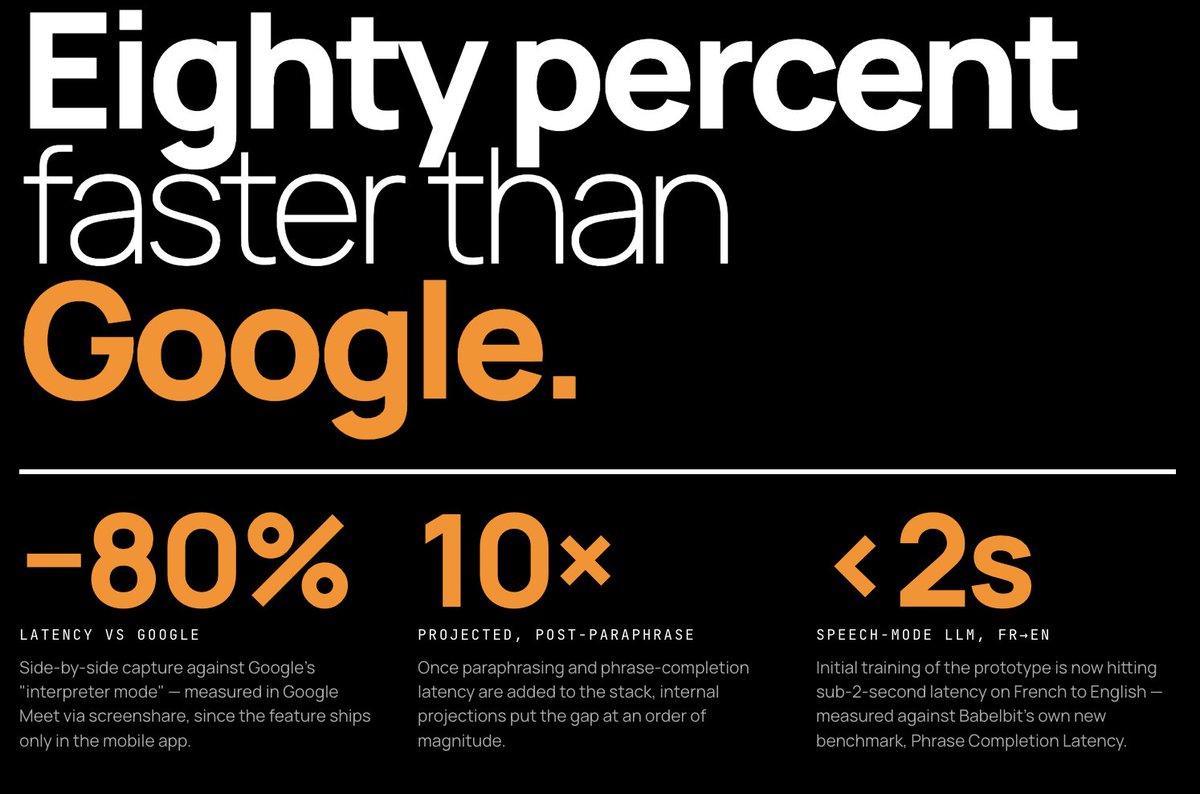
Benchmarked against the best ⚡
☑️ Babelbit's interpretation latency is already lower than Google's interpreter mode
☑️ French to English in <2s
☑️ Predictive Semantic Modelling & Phrase Completion Latency still to come
Real-time speech to text is being built on Bittensor 🌐