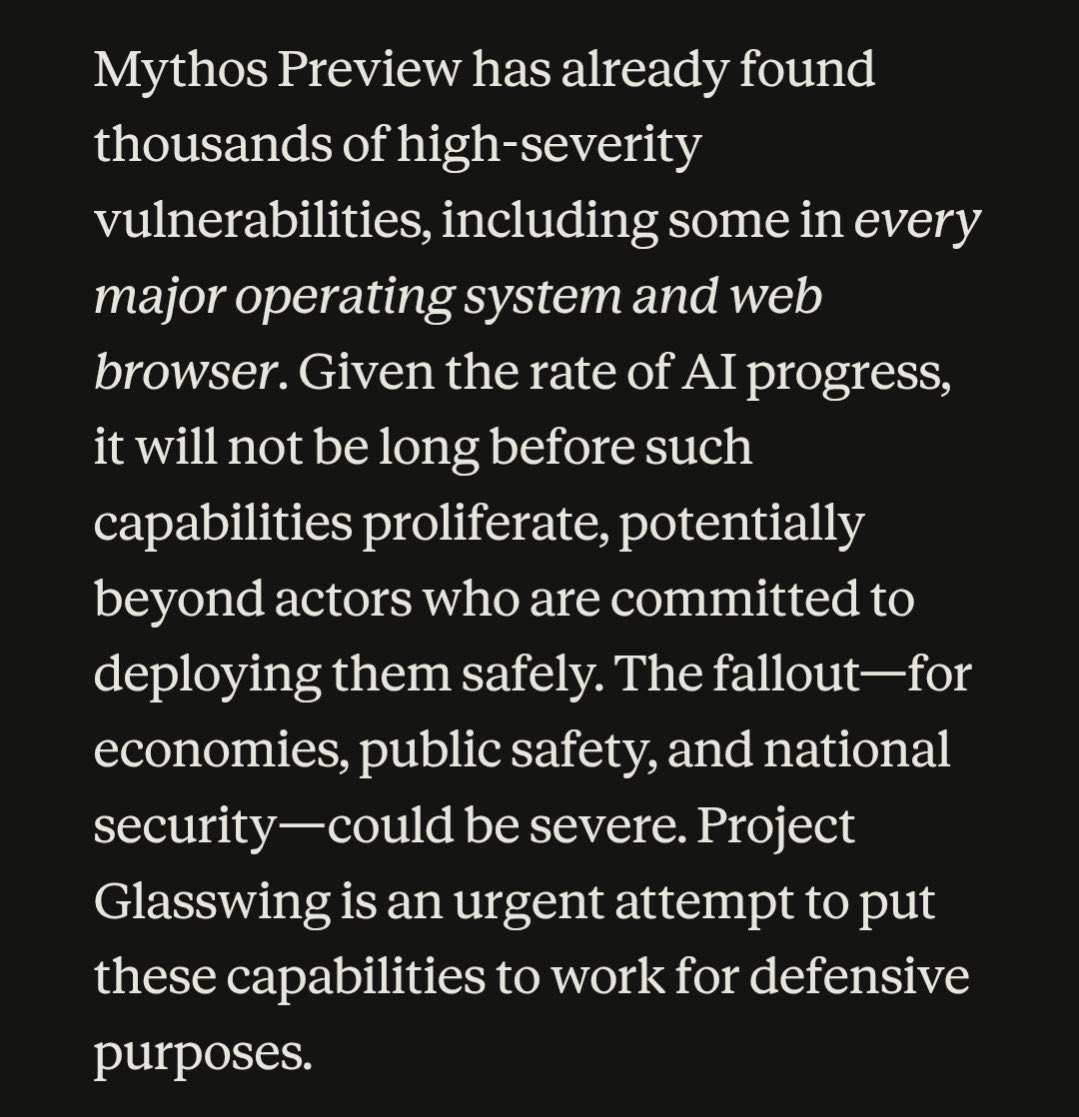
Our internal data shows Claude is accelerating AI development—a possible path to recursive self-improvement, or AI autonomously building a more capable successor.
It’s happening faster than we thought, and the implications deserve greater attention. https://t.co/OVVPJO7VQx
@NYCMayor Beyond the obvious issue with commenting on a historically-sensitive conflict via a one-sided narrative, No clarity on what relevance is to NyC or why, presumably, NyC gov’t funds were spent producing the video
The first time I was flying to Beirut, the desk officer at London Heathrow asked before checking us in, “have you been to Israel?”
We had rehearsed the answer to this question before. But Winston can't lie, so he said yes. I gave him the dirty look. There goes our vacation!
"Well, you don't have the stamp on your passports so just make sure you tell the officer in Beirut that you haven't," she intoned.
I was stressed out for the next 5 hours, and even more so when we had to face the border officer who, by the grace of God, did not ask us THE question (even though he took our passports to a secondary office for extra checks).
Spending time in Beirut, you realize that it's the same Mediterranean light that bathes Tel Aviv; the sea is the same shade of shimmering blue because... well, it's the same sea.
In both places, young people spill out of clubs at sunrise, the bass still thumping from rooftops that overlook the same ancient coastline. Both cities pulse with the same Levantine hunger for life: the clink of arak glasses, endless plates of hummus swirled with olive oil, the sudden eruption of dabke or house music that pulls strangers into a circle. Parties start on the rooftops of Gemmayze in Beirut and tumble down into Mar Mikhael’s narrow alleys; in Tel Aviv they begin on the sand at Gordon Beach and migrate to the warehouses of the Florentin district. These are both stylish people who love life, and who love to party. The energy is truly infectious. The accents may differ but something about this weird combination along with a deep sense of rootedness in community and the extended family really underscore how similar they were.
And yet, there's been a wall between these two peoples. There are no flights stitching the 45 min hop across the water. No commercial trucks rumbling between the ports. Lebanese law forbids its citizens - inside the country or in the diaspora - from so much as speaking to an Israeli, a rule so absolute that some Lebanese friends of mine who live in Europe still glance over their shoulders before typing a reply to any Israeli even outside the country, whether for business or pleasure.
I spent evenings in Beirut listening to Lebanese friends speak of Israelis not as the enemy but as people caught in the same endless loop of fear and longing.
Decades of Hezbollah’s shadow have hollowed out parts of Lebanon, turning the south into a garrison and the economy into a ruin. Yet in the cafés of Achrafieh and the mountain villages above the city you hear it more and more: a quiet, exhausted recognition that the real hostage-takers are not across the border but inside it.
I keep imagining the day the question at Beirut airport changes. I keep picturing the first flight from Rafic Harari to Ben Gurion. One day the music will be louder than the fear. One day the Lebanese and the Israelis will throw the party the rest of the world has been waiting for.
I hope this is the first step:
maybe this is not yet clear, so let me state it plainly: as of right now Anthropic, and really a small number of individuals at Anthropic, has the capacity to directly attack and cause major damage to the United States Government, China, and generally global superpowers. government agencies like the NSA do not have internal models or defense capabilities that outclass frontier models. if they chose to do so, they could likely exfiltrate top secret information from government systems, gain control over critical infrastructure including military infrastructure, sabotage or modify communications between members of government at the highest level, and potentially carry on activities for some time without detection. the thing about having access to a huge number of zerodays your adversaries don't know about is it gives you a massive asymmetric advantage.
they did not exploit this to gain power or destabilize the world order. they publicly released the information that they had these capabilities and worked to mitigate these flaws. you should be grateful american frontier labs have proven themselves remarkably trustworthy and concerned with the public good. but it's critical you understand we are in a new regime. private entities now have power that directly rivals and impacts the government's monopoly on influence and violence. and anthropic is certainly not the only one, there's little chance OpenAI's internal models are far behind.
this trend will accelerate on virtually every dimension, not slow down. my prediction for how it plays out is the relatively imminent seizure and nationalization of labs by the US government, sometime over the next two years. it's very tough for me to see how they accept the existence of this kind of threat. but this adds a whole new class of governance issues, as then we've handed these extremely wide-reaching capabilities from private entities to public ones.
So, basically, if Anthropic was not a US company, we’d be facing zero days with multiple unknown points of attack on virtually all of our systems to an adversary who developed this capacity before us.
Your heart puts out a magnetic pulse with every beat, so faint you'd need a shielded room the size of an apartment to even detect it. The CIA just used that pulse to find a wounded man hiding inside a mountain in Iran.
The tool is called Ghost Murmur. The way it works: certain atoms, when you hit them with a laser, become sensitive to magnetic fields. Sensitive enough to pick up the tiny magnetic ripple your heart creates each time it beats. Ghost Murmur then runs that signal through AI to filter out everything else, the Earth's own magnetism, electronics, vehicles, other people nearby, until one heartbeat is left.
Skunk Works built it. That's Lockheed Martin's secretive weapons lab, the same team behind the SR-71 spy plane and the first stealth fighter. Lockheed had already been developing quantum magnetic sensors since at least 2019 through a program called Dark Ice, a device the size of a salt shaker that uses a synthetic diamond to pick up magnetic fields. Ghost Murmur has been tested on Black Hawk helicopters and could eventually fly on the F-35. This was its first real-world use.
An American F-15E fighter jet got shot down over southwestern Iran on April 3rd. Two crew members ejected. The pilot was rescued within hours, but the second crew member, a colonel who runs the jet's weapons systems, landed deeper in the mountains with a sprained ankle. For nearly two days he hid in a crevice in the Zagros mountain range while hundreds of Iran's Revolutionary Guard soldiers hunted for him. Nomadic tribesmen combed the hills carrying rifles. A regional governor posted a $60,000 bounty for his capture.
The CIA fed false intelligence into Iran saying the American had already been recovered and was being moved out by ground. While Iranian forces chased that ghost, Ghost Murmur found the real one.
The Pentagon had a heartbeat detector before this, a prototype from 2019 called Jetson. Jetson shot an infrared laser at someone's skin and measured the tiny vibrations from their pulse. It topped out at 200 meters (about two football fields), needed the target sitting perfectly still for 30 seconds, and failed through anything thicker than a t-shirt. Ghost Murmur works on a different principle. Magnetic fields pass through rock, clothing, and human tissue without weakening. Same reason an MRI machine can photograph your brain without cracking open your skull.
The rescue used 155 aircraft. Armed drones hit Iranian soldiers who got within about 2 miles of the airman. Bombs cratered roads to block ground convoys. Special operations teams pulled him out at night under heavy fire. Two large cargo planes and four helicopters took so much damage that American forces blew them up on the ground rather than let Iran get the equipment.
A senior U.S. official called it "the ultimate needle in a haystack." A wounded man wedged inside a mountain, invisible to every camera and heat sensor in the sky, found by the one signal he couldn't turn off.
F15E SHOOTDOWN AND CSAR OPERATION — FULL VERIFIED BREAKDOWN
APRIL 3 — THE SHOOTDOWN
F15E from the 494th Fighter Squadron out of RAF Lakenheath is hit over southwestern Iran.
Crash site confirmed in Kohgiluyeh and Boyer Ahmad Province near Dehdasht.
Wreckage includes ACES II ejection seat and tail section matching the squadron.
Cause
Iran claims it used a new IRGC air defense system.
Exact weapon system remains unconfirmed.
HOUR 0
Both crew eject.
Pilot activates survival radio and PRD immediately.
Contact established with U.S. aircraft overhead.
Pilot recovered within hours.
WSO lands separately in mountainous terrain.
WSO beacon briefly detected by satellites, then goes silent.
Reason unknown.
HOURS 1 TO 12
WSO begins evasion using SERE training.
Maintains intermittent encrypted communication with U.S. forces.
IRGC launches large scale search operation.
Iranian state TV urges civilians to report or capture the pilot.
Rewards up to $60,000 reported.
Public messaging includes calls to shoot on sight.
HOURS 12 TO 24
WSO moves into high elevation terrain.
Climbs to around 7,000 feet.
U.S. ISR tracks Iranian movement continuously.
MQ9 Reaper drones strike Iranian personnel approaching within roughly 3 km.
U.S. aircraft strike IRGC forces moving toward the area.
HOURS 24 TO 36
A10 INCIDENT
A10 supporting the mission is hit.
Pilot exits Iranian airspace, ejects over Kuwait, recovered safely.
CSAR AIR OPERATIONS
HC130 conducts aerial refueling missions.
Black Hawk helicopters take fire during rescue operations.
Aircraft return safely with some injuries onboard.
CIA DECEPTION OPERATION
CIA launches deception campaign inside Iran.
False reports spread that the WSO had already been recovered.
CIA locates the WSO and passes coordinates to U.S. leadership.
President Trump authorizes immediate rescue.
HOURS 36 TO 48 — FINAL EXTRACTION
Large scale nighttime rescue launched.
U.S. special operations forces inserted.
WSO located and recovered alive after sustained evasion.
EXFIL COMPLICATIONS
MC130 aircraft land at remote airstrip inside Iran.
At least 2 aircraft become disabled on the ground.
Decision made to destroy them.
Aircraft blown to prevent capture of sensitive equipment.
U.S. assessment
Aircraft were self destroyed, not shot down.
Reports indicate a light helicopter was also lost at the site.
Replacement aircraft deployed.
All personnel extracted successfully.
Israel pauses airstrikes during the rescue.
TRUMP STATEMENT
President Trump confirms success.
No U.S. personnel killed.
Dozens of aircraft involved.
FINAL OUTCOME
2 crew from the F15E rescued
1 A10 pilot rescued
3 U.S. airmen
All alive
No captures
Mission completed deep inside Iran under hostile conditions.
@RichardHaass@Faiyla My guess: Making the case (belatedly) before the next big US move. Asset movements into region align with escalation. Likely won’t look like a nothingburger in a week.
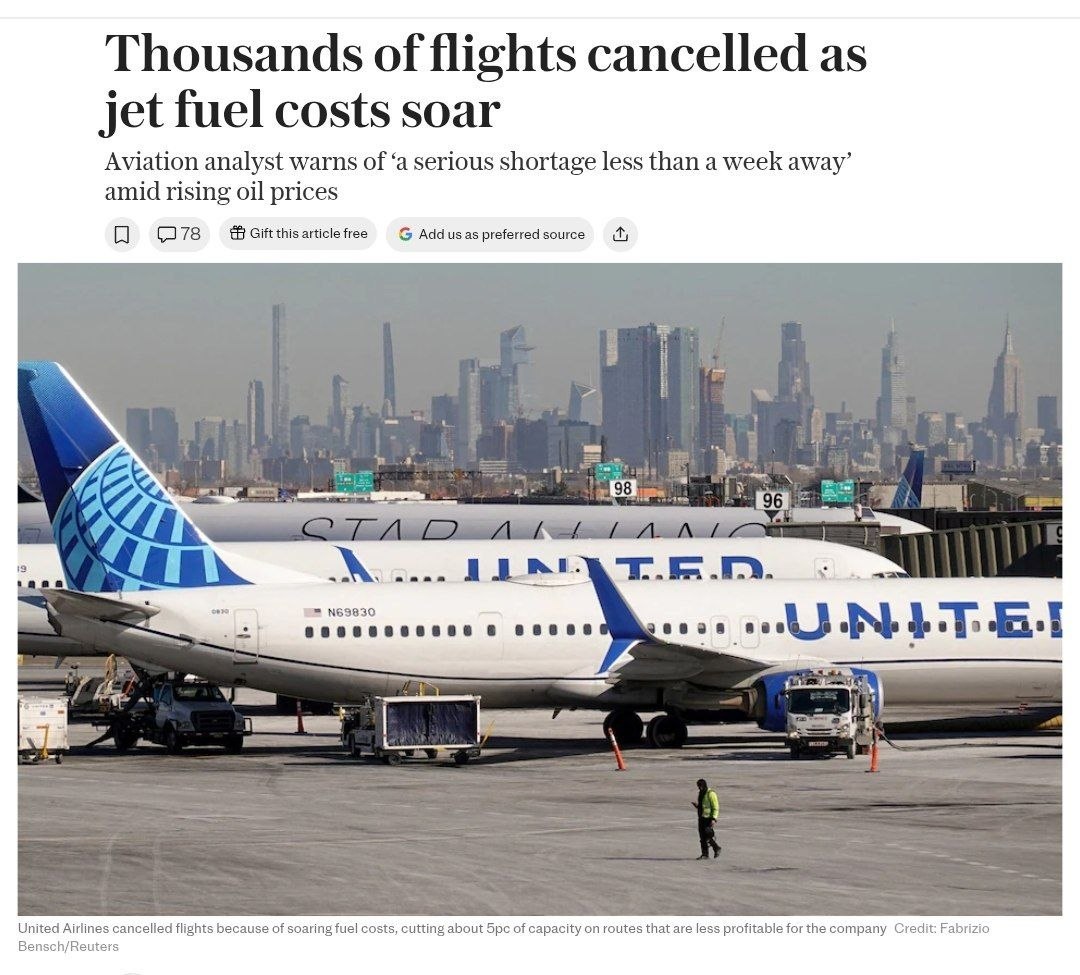
European airports have urged airlines to prepare contingency plans for a potential complete lack of aviation fuel in the coming weeks. Thousands of flights have already been canceled across the continent amid the escalating crisis.
Lufthansa is reportedly considering suspending operations of around 20 aircraft, partly linked to the ongoing war in Iran, which has disrupted flight routes and driven up costs.
According to aviation analytics firm Cirium, more than one in every twenty scheduled flights was canceled on Monday.
Jet fuel prices have more than doubled in the past year. A year ago, the cost stood at $742 per tonne, it has now surged above $1,710 per tonne.
Meanwhile, as Ive posted, The UK is expected to receive its final shipment of aviation fuel from the Middle East this week, with no further deliveries confirmed in the immediate pipeline.
Aviation industry analyst Alex Macheras (@AlexInAir) has warned that a serious jet fuel shortage could hit all major European airports within a week. He noted that airports are already informing airlines to prepare for scenarios where “no fuel is available.”
London’s Heathrow Airport is expected to be among the hardest hit major hubs in Europe due to fuel supply constraints. The situation is worsened by the UK’s closure last year of an aviation fuel production plant in Scotland.
There is no greater threat to democracy than political violence. The assassination plot targeting Nerdeen Kiswani is not only a crime against an individual—it is an assault on American democracy, which cannot long survive the substitution of violence for politics.
In a liberal democracy, disagreement must be resolved not by force but by the force of debate. Those who corrode our civil society with the acid of political violence must be prosecuted to the fullest extent of the law. Period.
To paraphrase a quote often attributed to Voltaire: “I shall disagree with what you say but I shall defend to death your right to say it.”
@NYCMayor 1) Obviously, act should be condemned. Such violence is never acceptable.
2) Framing used is dangerous, inappropriate.
3) Playing into identity politics seems intentional - statement could have mentioned affiliation w/o group name detailed or “flee abroad” w/o country name.
My read on the Iran situation:
This stopped being about firepower a long time ago. The US has total escalation dominance. The real question is pain threshold, and America may blink first.
Iran's conventional military is decimated. But they only need one missile to reach a Gulf state to rattle global markets. That asymmetry is their entire remaining leverage.
Forget a Venezuelan-style negotiated exit. The IRGC's legitimacy depends on never being seen as collaborating with America. There is no Delcy Rodriguez in Tehran.
Russia will not mediate. A distracted America and elevated oil prices suits Moscow perfectly.
The narrow path to de-escalation: a Strait of Hormuz passage guarantee, with everything else kicked down the road. Pakistan is the only credible mediator left standing.
But here's the angle nobody is talking about: China.
If the US can threaten to block Chinese oil shipments through the Strait, Beijing suddenly has enormous skin in the game. China has the leverage to pressure Iran into reopening the waterway to all shipping, and the US has the leverage to make that worth China's while. Bringing China in as an economic stakeholder in de-escalation could relieve significant pressure on Trump without requiring a direct US-Iran deal.
Watch this week closely.
Useful reflections - particularly around long term US-GCC and US-Israel dynamics. The comments on path forward also mirror much that has come up in my conversations lately.
A few thoughts nearly a month into this war. It’s most likely not ending any time soon and we’re headed for more escalation.
1. Despite all the talk of diplomacy, we are nowhere near a deal with Iran. The gap between the two sides remains enormous – very much in line with what we saw during previous Trump negotiations with Iran in both the first and second terms, all of which ultimately failed. There’s very little evidence that anything meaningful has changed. At its core, the U.S. position still looks less like a negotiating framework and more like a surrender document for Iran: no nuclear program, no ballistic missiles, no regional proxy activity. Iran’s position is equally maximalist in the opposite direction – essentially demanding a full U.S. military withdrawal from the Gulf. That’s not a starting point for diplomacy; it’s a recipe for stalemate.
2. But the much more important story right now isn’t diplomacy – it’s the thousands of U.S. troops being mobilized and moving toward the Middle East. That movement strongly suggests preparation for further escalation, with Kharg Island emerging as the most likely target. For any objective observer, the likely Iranian response to a U.S. move on Kharg is obvious: escalation, not capitulation. Tehran would almost certainly respond by expanding attacks on energy infrastructure across the Gulf rather than “crying uncle.”
3. Which is why it’s so striking – and frankly baffling – to see oil prices trending downward. Markets appear either deeply complacent or willfully ignoring the reality of what we are facing: the very real possibility of months more of this disruption to energy markets and increasingly complex knock on effects for energy production and distribution.
4. The Gulf states, for their part, are in a rough spot. They did not want this war, but now that it is underway, they are increasingly convinced it must end in a way that weakens Iran’s ability to threaten regional energy infrastructure and maritime routes. The problem is that even as they articulate that goal, there is no clear or realistic pathway to achieving it. And when this war eventually ends unsatisfactorily and with Iran still able to threaten Gulf energy infrastructure there is likely to be significant frustration and anger in the Gulf directed at the United States. That has the potential to shape the long-term trajectory of U.S.--Gulf relations.
5. Meanwhile, support for the war remains very high inside Israel. That shouldn’t be surprising. Israeli society is still profoundly shaped by the trauma of October 7, and that trauma continues to drive both public opinion and policy choices. It’s worth remembering that in the United States, it took years after 9/11 for public opinion to shift on Iraq and the Global War on Terror. Israelis are only about two and a half years removed from October 7. We are still very much in the early phase of that cycle, where security concerns and a sense of existential threat dominate decision-making.
6. I’d also watch out for Lebanon. There is a real possibility of a large-scale Israeli ground invasion into southern Lebanon. History suggests that such operations do not produce lasting strategic success, but that has not prevented them from being attempted repeatedly. Israel’s 20-year occupation of southern Lebanon in the 80s and 90s, along with multiple subsequent wars, underscores the limits of military solutions in that arena. And yet, under current conditions, this Israeli government is driving towards another large-scale ground operation. While the war with Iran is what’s driving global economic and strategic consequences, a major ground war in Lebanon could generate far greater human suffering.
7. Another major, and often underappreciated, consequence of this conflict is the long-term impact on the U.S.–Israel relationship. The fight over the JCPOA during the Obama administration created a lasting fissure within the Democratic Party that has since expanded. This might do the same in the Republican Party. Right now, you can see the beginnings of elite-level debate and division among conservative foreign policy voices and influencers, even if that hasn’t yet translated into a shift among Republican voters. History suggests that elite debate often precedes broader public realignment. A decade from now, it is entirely plausible that Republicans could be as internally divided over Israel policy as Democrats are today. That would represent a profound shift in American politics—and in the bilateral relationship.
8. Meanwhile, in the United States public support for the war is already showing signs of erosion. Initial polling was weak, in large part because the administration did little to prepare the American public for the scale and risks of the conflict. There was a brief uptick as partisan consolidation kicked in and Republicans rallied behind the president. But as the conflict drags on and the costs become clearer, those numbers are starting to decline again. We’ve already likely hit peak support for the war and that was still less than 50%.
9. So what is the most realistic path out of this? At the moment, it is not a negotiated diplomatic breakthrough. The positions are simply too far apart, and the conflict dynamics are moving in the opposite direction. The most plausible off-ramp involves the president declaring that U.S. objectives have been achieved, announcing an end to U.S. military involvement, promising to restraint Israel and making clear we will stop if Iran ceases attacks on regional neighbors and does not resume it’s nuclear program. Iran would likely continue limited attacks for a short period, but it would also face significant international pressure to de-escalate. Over time, that pressure could help bring the conflict to a close, even if the outcome falls far short of a comprehensive or satisfying resolution. This is not an ideal outcome. It does not resolve the underlying issues, and it leaves many risks unaddressed. But in the current environment, it may be the only realistic option available. Better to accept this likely outcome today rather than six months from now.