I don't think people real understand the scale of healthcare collapse in Zimbabwe. I spoke to an old classmate of mine and she has kidney stones. It will cost her $1500. She has used all the little she had. When I asked her about the plan, she said she is now going to Makandiwa's church for prayers because she can't afford it. It broke my heart.
Huge congratulations to Prof Vukosi Marivate!
At this year's National Orders ceremony, President Ramaphosa awarded Prof Marivate the Order of Mapungubwe in Silver, one of South Africa's highest honours, for his contributions to artificial intelligence and computer science. Prof Marivate has been a leading voice in advancing African language technologies and inclusive AI, with a firm belief that "AI in Africa should not be something that just happens to us from the outside."
As SADiLaR, we're proud to have worked with him and look forward to continuing this journey together.
In a canteen back in the 1980s, three employees at drug giant Pfizer decided to break away to start what became Zimbabwe’s first privately held black pharmaceutical firm.
Tobias Dzangare, Celestine Gadzikwa and Glory Zata founded Varichem in 1985. Its first product, Prazosin, launched in 1988. But they faced resistance.
“Most wholesalers and pharmacists were not interested in our product because of prejudice from our former employer.”
Today, Varichem Pharmaceuticals is one of Zimbabwe’s biggest manufacturers and exporters of medicines.
The more you learn about Chinese culture, the more you understand why their historical explorers traveled around the world, decided to call it quits, and returned home unimpressed.
“To me, it feels like working in your own grave, while you make your own casket.”
Every morning before his shift at a textile factory in #Nagpur, 30-year old Ashish Narayan, a machine technician, straps a small recording device to his forehead.
For the next several hours, the #camera tracks and records everything he does.
From stitching workers to technicians and machine operators, workers across factories are being asked to wear such devices.
Often, they do not know exactly what is being recorded, where the #footage is going, or how it may eventually be used.
But in many cases, they are rarely in a position to refuse or reduce participation, especially in sectors where jobs are insecure.
They are paid anywhere between Rs 200 and Rs 350 per hour.
This whole exercise is part of a growing global push by AI and #robotics companies to gather what is being called “egocentric data”.
That means 1st-person recordings of human activity that can teach #machines how people perform physical tasks.
Reported by: @imsoumyarendra
Produced and edited by: @NotAboutPrachi
Script and voiceover: @shameenalauddin
So much attention has been paid to the Musk v. Altman trial. But real accountability for the AI industry will not come from a billionaire mudfight.
It will come from the movements around the world resisting the empires of AI.
My op-ed for @guardian.
https://t.co/MsHC9UsXgh
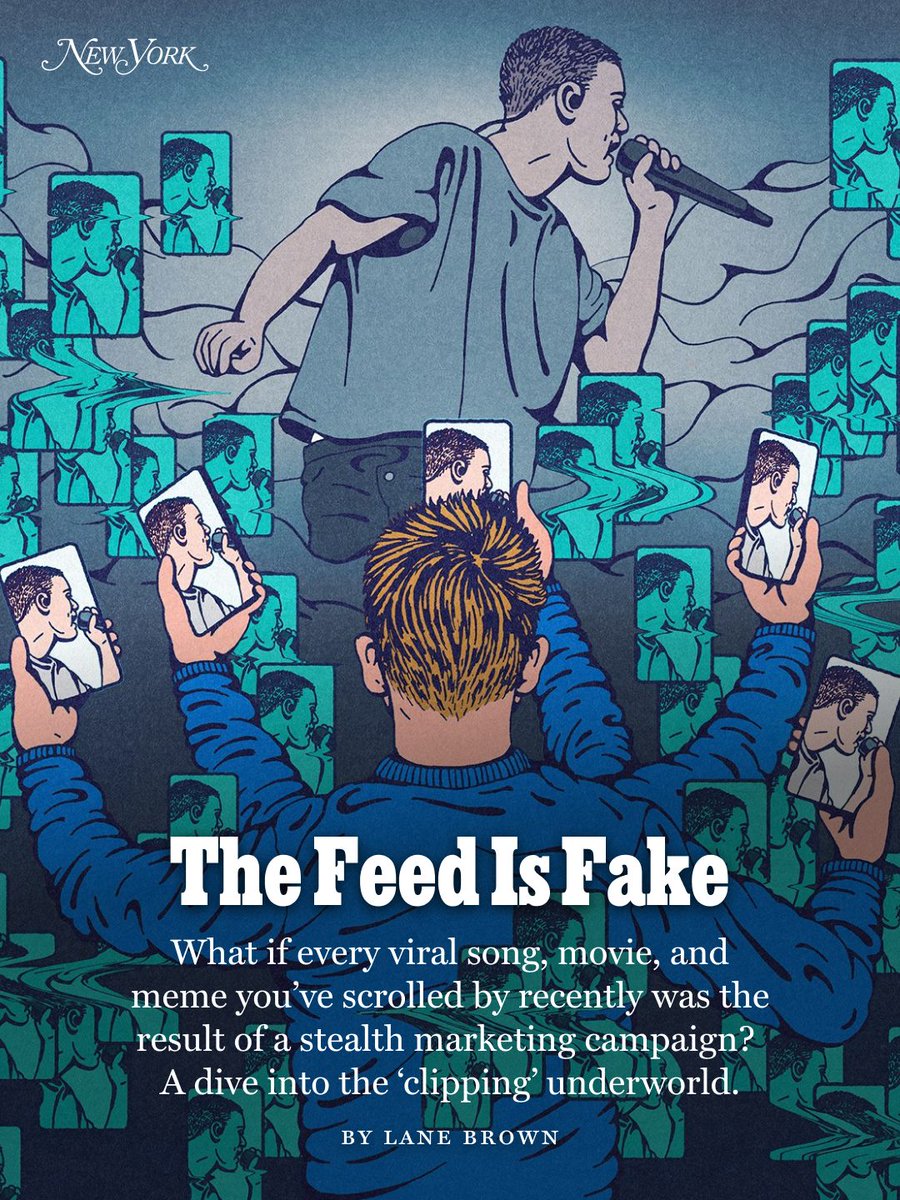
Joe Lim estimates that 90 percent of what you see on the internet is advertising in disguise, and he should know. For three years, Lim ran a company called Floodify, which at its peak operated 65,000 dummy social-media accounts used to drum up attention on behalf of paying clients.
The point of this kind of marketing is that nobody is supposed to notice it. But lately, the machinery has started to show.
In April, Justin Bieber headlined two consecutive weekends at Coachella. Coachella is the biggest stage in pop music save only for the Super Bowl, the kind of event that in theory generates its own attention. And yet on both weekends, a Discord server writer Lane Brown had been monitoring hosted paid campaigns for Bieber’s Coachella performances, offering clippers — people who are hired to turn a song, trailer, interview, stump speech, or whatever into short, social-media-friendly fragments — as much as a dollar per thousand views.
“On social media, popular opinion is being formed, measured, and manipulated all at once, and every signal the platforms produce — a trending song, a backlash, a talking point, the feeling that ‘everybody’ is suddenly talking about the same thing — can now be fabricated by unseen actors with hidden agendas,” writes Brown.
“Everybody is doing this now,” Lim says. “And if you’re not, you’re behind.”
Brown reports on how the same techniques are now being used to fool people on every app they go to in order to find out what other people think, not just in music but across entertainment, politics, consumer products, and celebrity gossip: https://t.co/hlcdfSmzPc