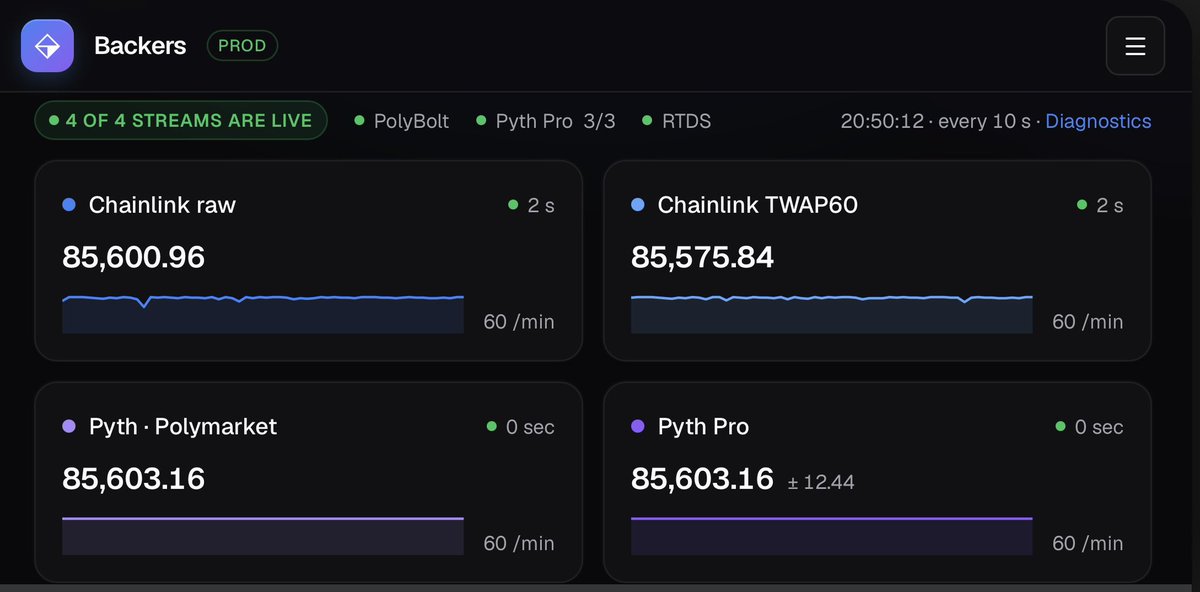
Would free Polymarket data help you build a better backtest?
I’ve collected the data for my own trading research: L2 order books, trades, market outcomes, Pyth Pro, Chainlink raw and TWAP60.
Think bid/ask prices and sizes, trade price and size, and event and receive timestamps—the details you need to reconstruct what the market looked like at the time.
I want to make a backtest-ready dataset available for free, with a schema and honest coverage notes.
If this reaches 100 likes and 500 replies, I’ll prioritize the first public release of the data I can share.
What market, time range and fields would you test? I’d appreciate your help getting this in front of other builders.
$40K/month from a game built in just 8 hours with Claude.
No dev team. No massive budget. Just an idea and AI.
Meet Frank Michael Smith (@frankmikesmith), a sports content creator who built GeoSports (https://t.co/5bLd5CMWlF) — a ridiculously simple browser game.
The concept?
🌍 Answer sports trivia by tapping locations on a globe.
No country names. No city labels.
The closer your guess, the higher your score.
5 free questions every day. Want more? Subscribe.
Five days after launching, Frank casually dropped the link in a reply to his own NBA tweet.
What happened next was insane:
→ 40,000 players on day one
→ 150,000 players the next day
→ 700,000 monthly active users
→ ~$40,000 in monthly revenue
→ 53% of players share their results
Here’s the crazy part:
Frank already had 4 MILLION followers.
Yet his existing audience reportedly drove just 2% of traffic.
The other 98% came from organic discovery and viral distribution.
The real lesson isn’t that AI can build a game in 8 hours.
It’s that distribution can be built INTO the product.
GeoSports gives users something worth sharing: their own scores.
Every shared result becomes free marketing.
And every new player can bring in more players.
The 2026 playbook:
Find a proven concept.
Remix it for a specific niche.
Build an MVP with AI.
Make the experience inherently shareable.
Let users become your distribution channel.
AI makes building cheaper.
Virality makes distribution cheaper.
And the combination is incredibly powerful.
Would you rather spend 8 hours building a product or 8 weeks perfecting an idea nobody wants?
I’m mainly testing Polymarket’s 5-minute crypto Up/Down markets, especially BTC.
The current TWAP60 resolution mechanism was introduced on August 14, 2026, so we only have about 2 months of relevant history.
Ideally, I’d want at least 1–2 years of data to properly validate strategies across different market regimes.
I’m already collecting L2 order book snapshots. The problem is that you can’t collect historical data that doesn’t exist yet.
That’s the real bottleneck for my research.
5 things that stopped me from making my first money on Polymarket’s 5-minute markets.
I’ve been trading Forex for 6 years.
I thought making money on Polymarket would be easy.
I was wrong.
Here are 5 mistakes and traps that cost me time, money, and a lot of frustration 🧵👇
I use OpenAI for backend development and research, and Opus for frontend.
OpenAI handles complex logic and large codebases better in my experience. Claude tends to get lost in the details and struggles more as projects grow.
But for frontend? OpenAI is terrible.
Opus is on another level when it comes to UI/UX.
The bigger gap for me is historical depth.
I’m already collecting L2 order book snapshots, so I can analyze executable liquidity, spreads, and slippage.
The real limitation is the short historical window. Polymarket switched to Chainlink TWAP60 relatively recently, and the oracle itself doesn’t have a long history either.
That makes it difficult to backtest strategies across different market regimes and assess their long-term robustness.
More historical data under the current resolution mechanism would be far more valuable to me.
The biggest lesson?
Polymarket isn’t easy money.
Forget the overnight millionaire stories.
Build your own data.
Test your own ideas.
Find your own edge.
I’m now running my own strategies live and sharing the results — including the drawdowns.
What was your biggest mistake trading Polymarket?
5. The historical data problem
Finding reliable, free historical data for 5-minute Polymarket markets is surprisingly difficult.
Want to backtest a strategy properly?
You either:
• Build your own dataset
• Pay for historical data
• Work with incomplete information
Without good data, you’re mostly guessing.
My new Polymarket trading strategy has been running live for a week now.
What do you think? Is this okay?
If you trust your backtests, don’t let drawdowns shake you out of your strategy.
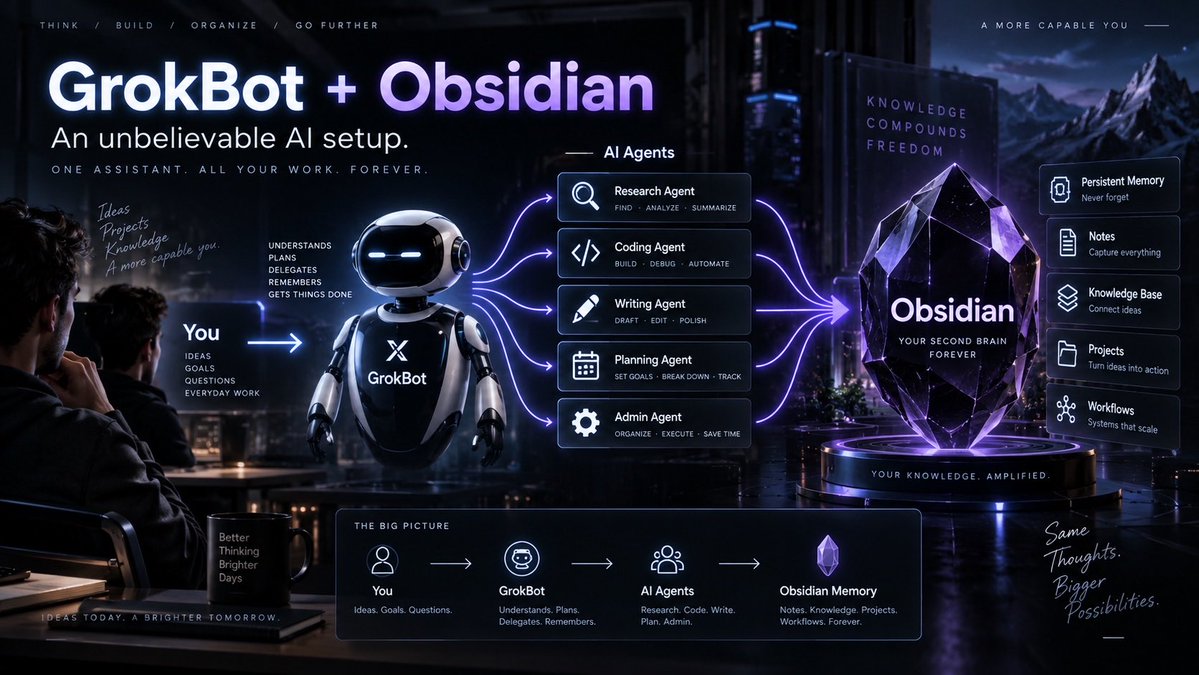
GrokBot + Obsidian is unbelievable.
This might be one of the most interesting AI setups I’ve seen in a while.
Most AI assistants still have the same fundamental problem:
You have to explain your context again and again.
But connect GrokBot to Obsidian and suddenly your vault becomes persistent memory for the agent.
Your projects.
Your notes.
Your research.
Your decisions.
Your workflows.
Your personal knowledge base.
Now imagine GrokBot sitting on top of all of that.
Not just answering questions — but actually acting like a persistent AI operator that understands what you’re working on.
And it gets even better.
GrokBot can delegate tasks to specialized agents:
• research
• coding
• writing
• planning
• admin work
All of them working from the same Obsidian knowledge base.
So the architecture becomes:
You → GrokBot → AI agents → Obsidian memory
That is a completely different experience from a normal chatbot.
You stop “prompting AI”.
You start building an AI system that already knows your context.
And honestly, GrokBot + Obsidian feels like an early version of a real personal AI operating system.
@0xPascual Hi! I have a proposal for a mutual partnership that could be beneficial for both of us — completely free, no paid promotion involved.
If you’re interested, send me a DM.