The Backseat Linguist comments on current research in language acquisition and language education. Aka Jeff McQuillan. Author: The Literacy Crisis (1998)
@natwexler Side note:
One of the fiercest critics of the "critical thinking" movement in schools was none other than "progressive" Frank Smith—see his To Think (1990).
Thinking "is not some abstract set of rules that can be applied in any situation...thinking depends on knowledge." p. 103
@ChristianL14405 Excited to see CI for ancient languages. I'll let Steve K. know about this when I see him next. He'll be thrilled.
Will the Zoom recordings be available to registrants?
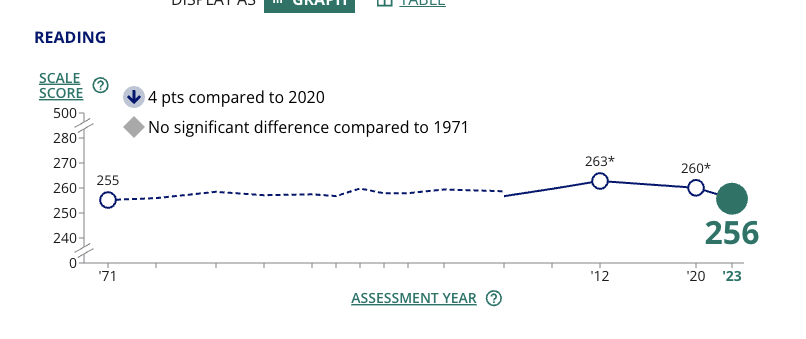
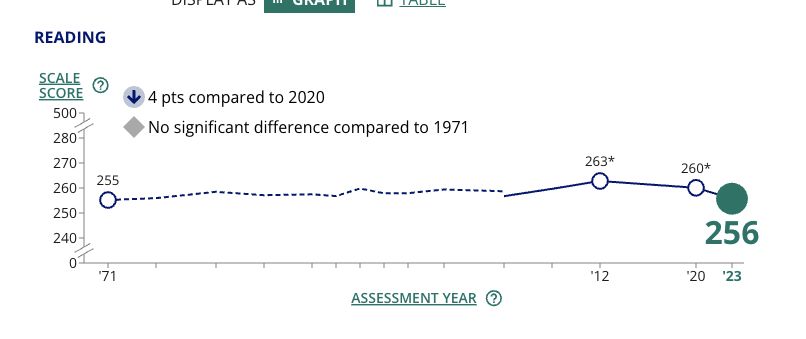
.@imkahloon reports that we are sliding back to the level of literacy when he himself was in 8th grade.
Even back to that well-known "Age of Illiteracy" also known as the 1970s.
The horror.
My latest piece for The Atlantic looks at how American education peaked in 2013—and has been sliding to 25-year, sometimes 50-year, lows in math and reading.
Why? I don't think it's the pandemic, and I don't think it's too little spending.
https://t.co/EhoCEnQem6
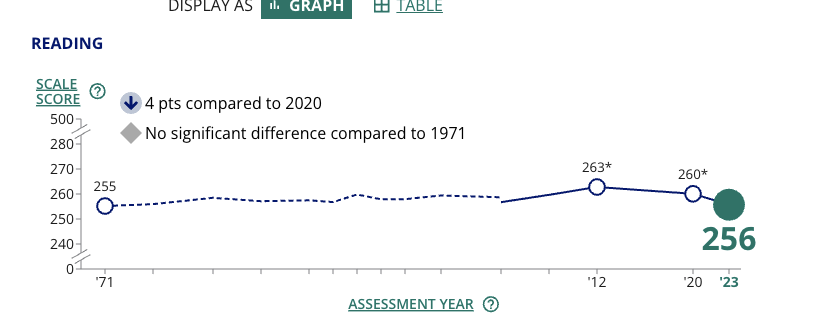
@imkahloon Note these sharp declines. We're back to when you were in 8th grade.
On previous ominous "declines" in American education, see work by Gerald Bracey and Berliner & Biddle.
Harvard profs complained about the poor writing of incoming students...in the 1890s (Stewart, 1982).
@alexanderrusso We are sliding back to the level of literacy when the author of this article was himself in 8th grade.
Back to that well-known "Age of Illiteracy" also known as the 1970s.
The horror.
@karenvaites@DTWillingham@natwexler@ehanford@ReadingShanahan@WSJ Tim also penned a letter riddled with errors and half-truths.
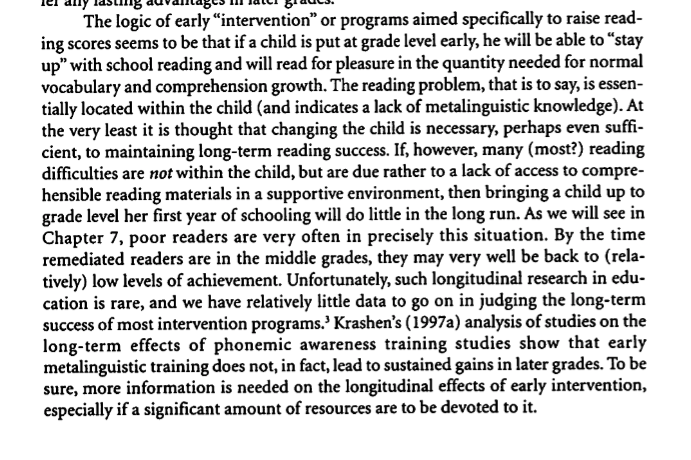
Some are too young to remember the '90s, but many of us warned of the silliness of focusing on "reading by 9" back then. I devoted an entire chapter to it in The Literacy Crisis (1998).
https://t.co/K1VeDjB0DA
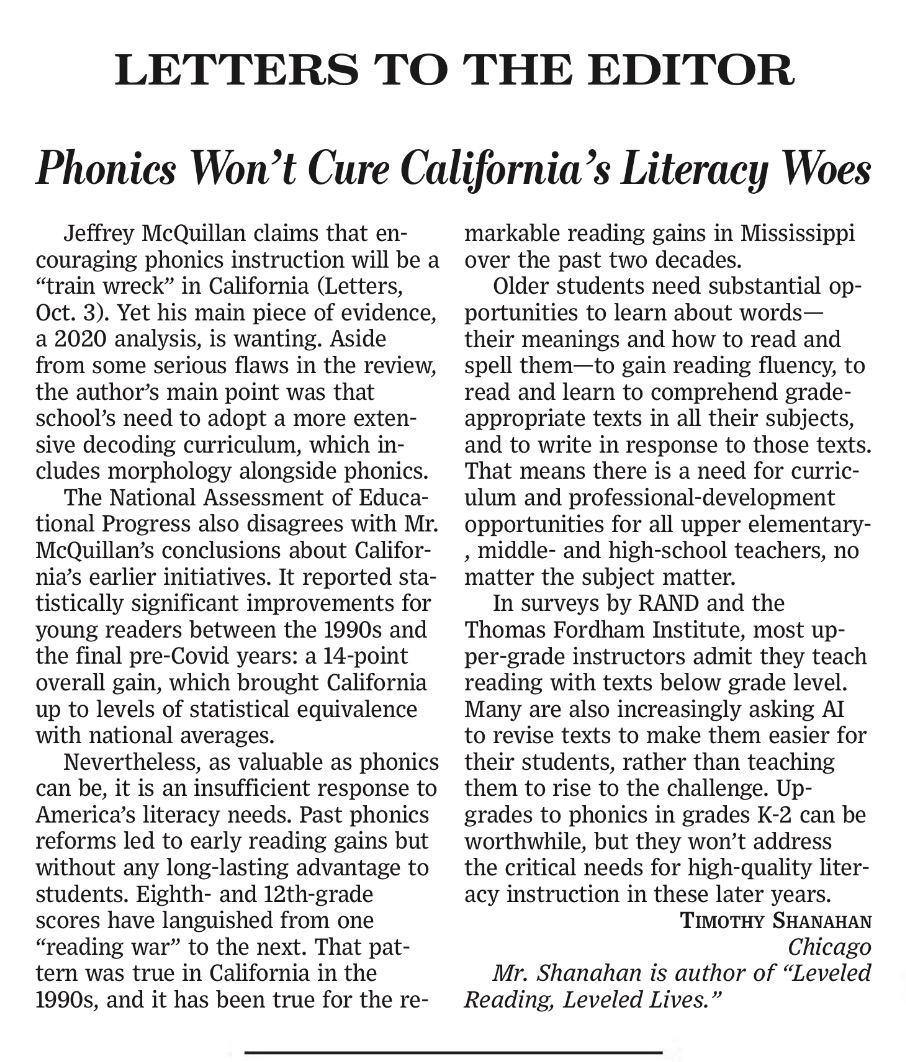
Shanahan Responds to My WSJ Letter, and Now I’ve Got Whiplash 🧵1/16
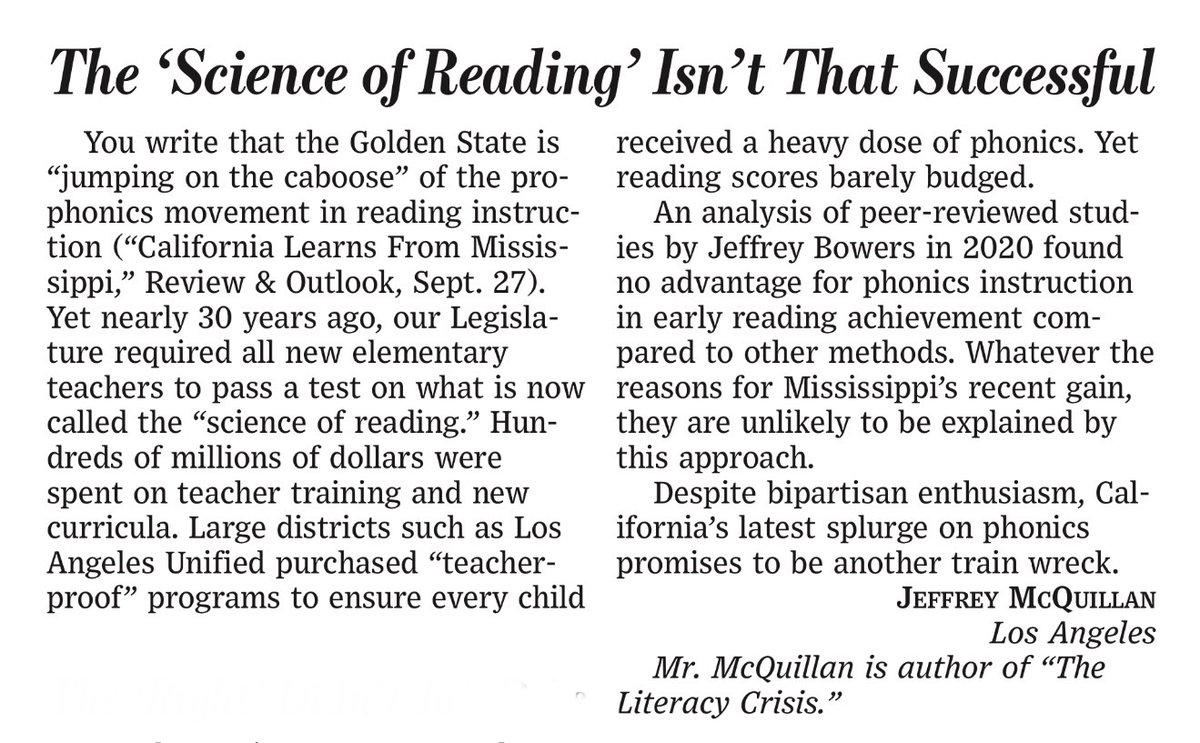
The WSJ just ran a longish rebuttal by .@ReadingShanahan to my short letter on phonics in California. I find his piece hard to respond to—mostly because I’m not quite sure what points he’s trying to make.
Shanahan Responds to My WSJ Letter, and Now I’ve Got Whiplash 🧵1/16
The WSJ just ran a longish rebuttal by .@ReadingShanahan to my short letter on phonics in California. I find his piece hard to respond to—mostly because I’m not quite sure what points he’s trying to make.
@jeffrey_bowers Update 2: .
@jeffrey_bowers clarifies that what he advocates for beginning reading is not even another form of phonics. My apologies—I stand corrected.
(Note this is still *not* the "main point" of Bowers (2020), as Shanahan claimed.)
https://t.co/sGfuwKUHsV
@BackSeatLing Note, I am not advocating another type of phonics. The highlighted text does not suggest this, and indeed, proponents of phonics have been critical of the alternative approach I consider (SWI). Check out my illustrated book that describes it: https://t.co/dy1m0ZAyrG
Shanahan Responds to My WSJ Letter, and Now I’ve Got Whiplash 🧵1/16
The WSJ just ran a longish rebuttal by .@ReadingShanahan to my short letter on phonics in California. I find his piece hard to respond to—mostly because I’m not quite sure what points he’s trying to make.
The Wall Street Journal recently applauded California for adopting phonics. Small problem: CA already went all in on phonics back in the 1990s—with predictably disappointing results. It's not our first phonics rodeo. 1/6
#phonics#scienceofreading
Update 1:
.@jeffrey_bowers's article had a 3rd critique I missed, Fletcher et al. (2020), to which he *was* allowed to publish a response (unlike Buckingham (2020) and Brooks (2023)).
See his rebuttal here:
https://t.co/xQBbgcBste
Update 2: .@jeffrey_bowers clarifies that what he advocates for beginning reading is not even another form of phonics.
My apologies—I stand corrected.
(Note this is still *not* the "main point" of Bowers (2020) by any stretch of the imagination, as Shanahan claimed.)
@BackSeatLing Note, I am not advocating another type of phonics. The highlighted text does not suggest this, and indeed, proponents of phonics have been critical of the alternative approach I consider (SWI). Check out my illustrated book that describes it: https://t.co/dy1m0ZAyrG
Update: .
.@jeffrey_bowers's article had a 3rd critique I missed, Fletcher et al. (2020), to which he *was* allowed to publish a response (unlike Buckingham (2020) and Brooks (2023)). See his rebuttal here:
https://t.co/xQBbgcBste
So is Bowers's article in fact flawed?
Two critiques of it appeared—but breaking normal academic protocol, neither journal let him respond(!).
What were the editors afraid of?
Perhaps B's devastating rebuttals:
https://t.co/Vo72jdkmnG
https://t.co/cAPIlLHpuY 5/16
@karenvaites Single-state NAEP scores are the worst-quality data you can appeal to for your cause. It's a fool's errand.
Why not use to actual well-controlled experiments on these issues?
Why are many #scienceofreading advocates allergic to actual science?
https://t.co/VoxvIXptuF
You can’t credit phonics when 10 other reforms happened simultaneously.
That’s why state-level NAEP data are the lowest-quality evidence we have. We should stop using them completely.
We should look instead at actual scientific experiments—the kind Bowers reviewed. 13/16