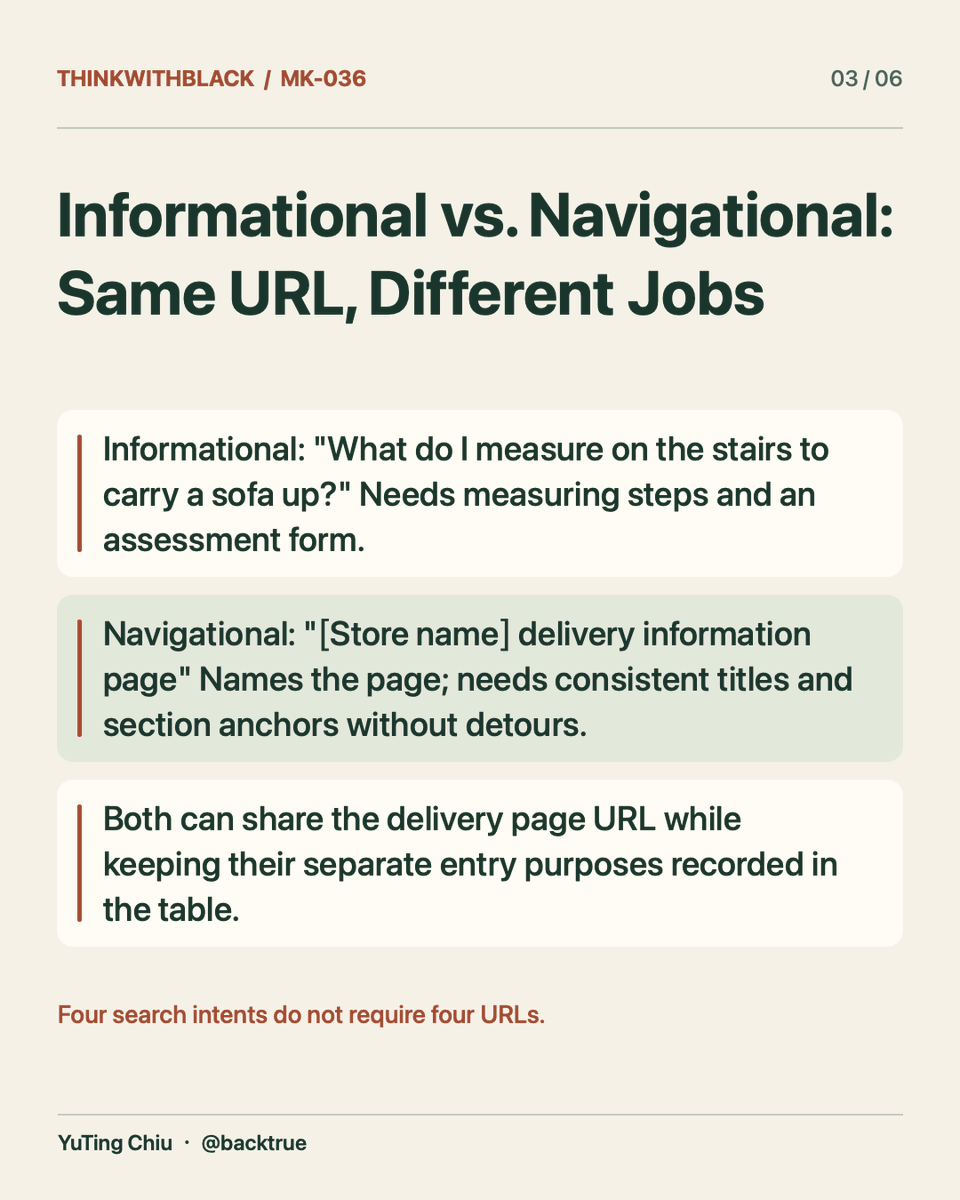
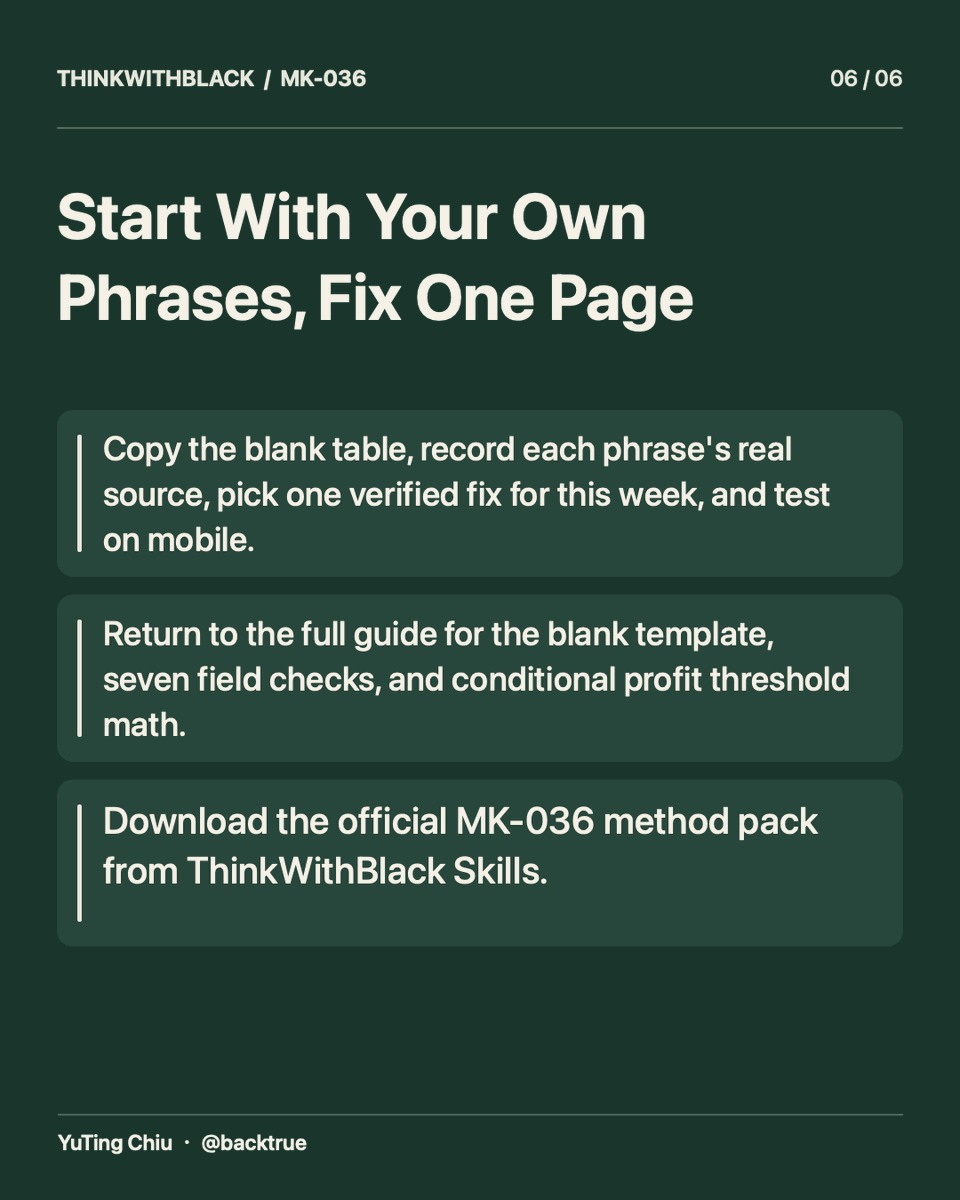
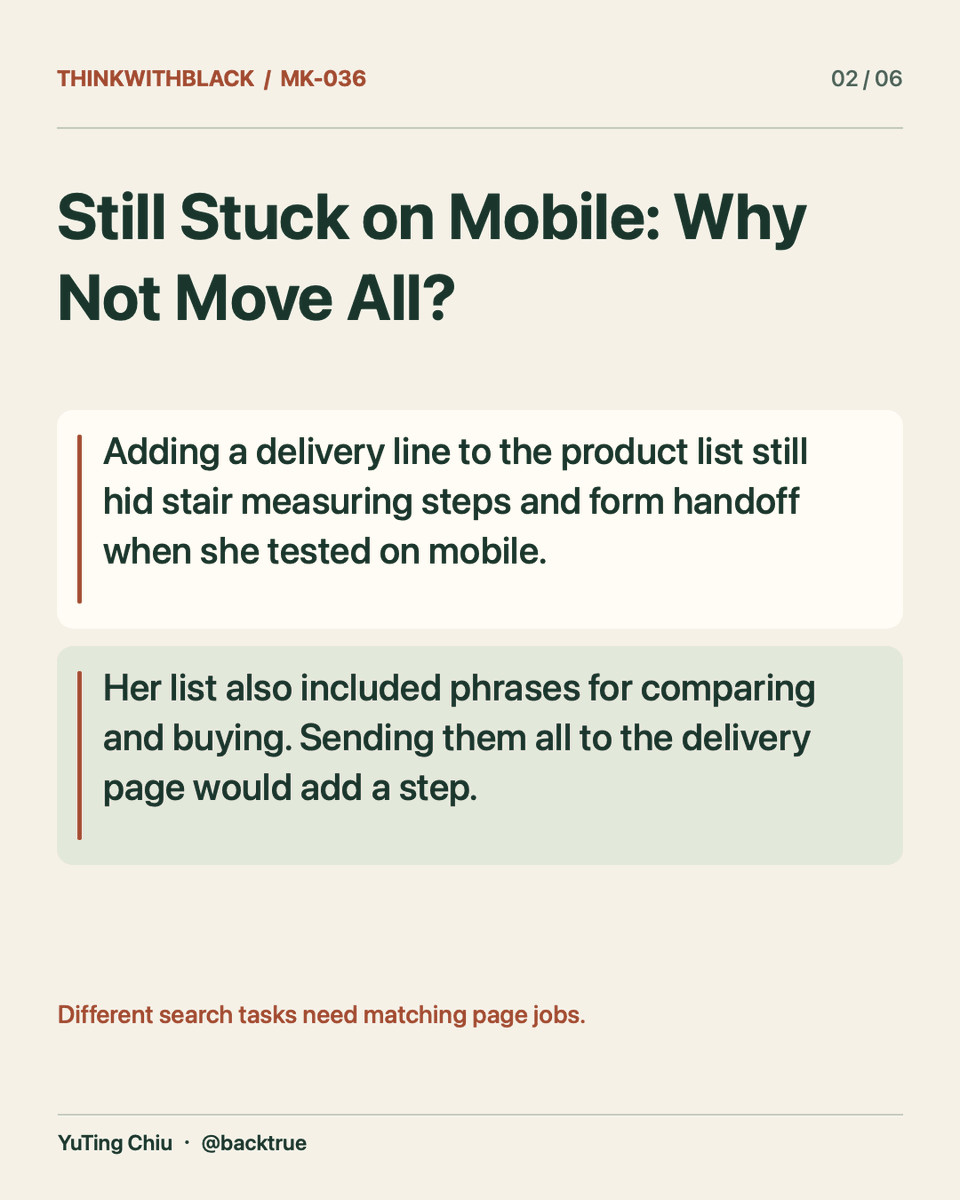
Cards 5–6. Add the stairs guide and the assessment form to the delivery page, then try sending the measurements from your phone. Use the seven-column worksheet to pick the first page to fix.
YuTing Chiu · @backtrue · ThinkWithBlack
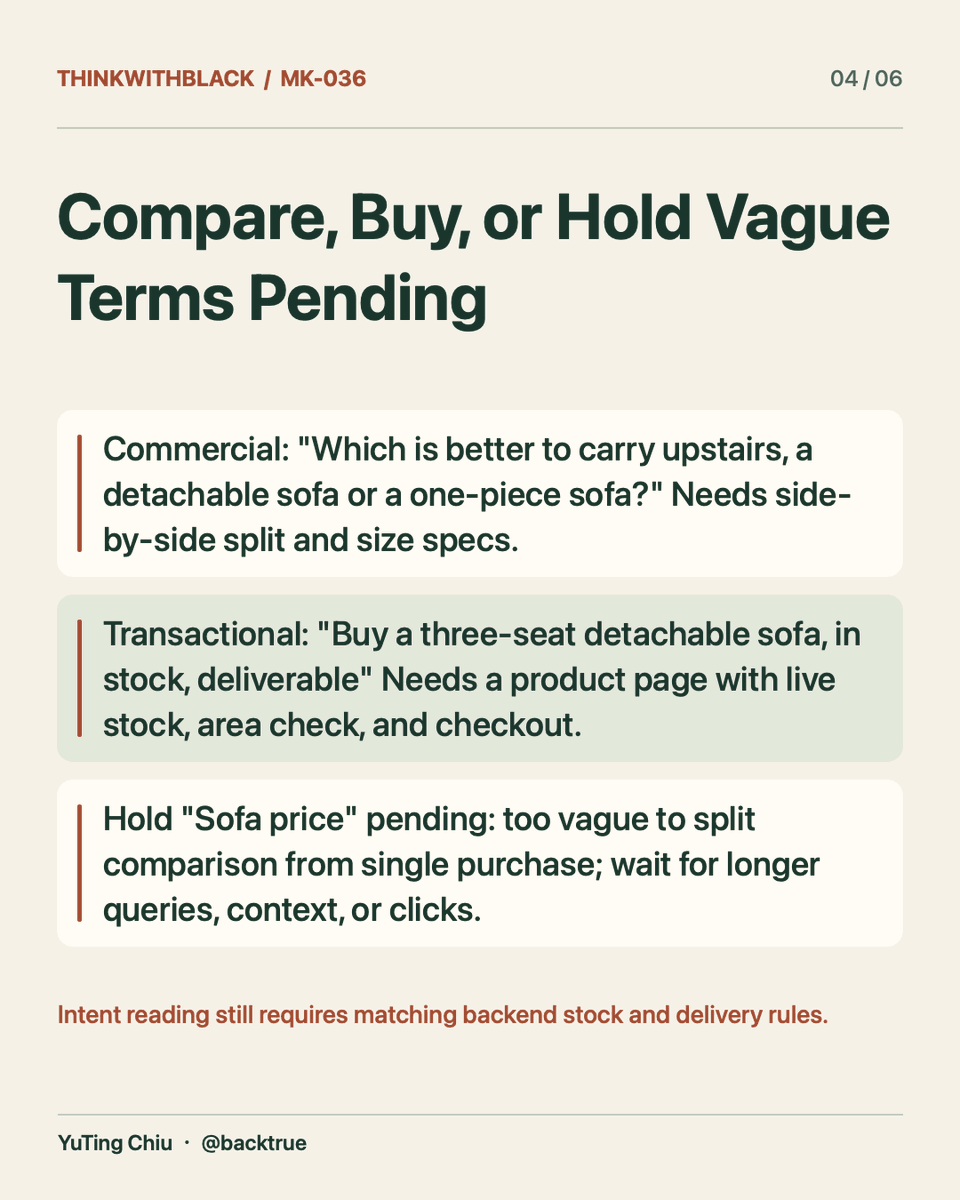
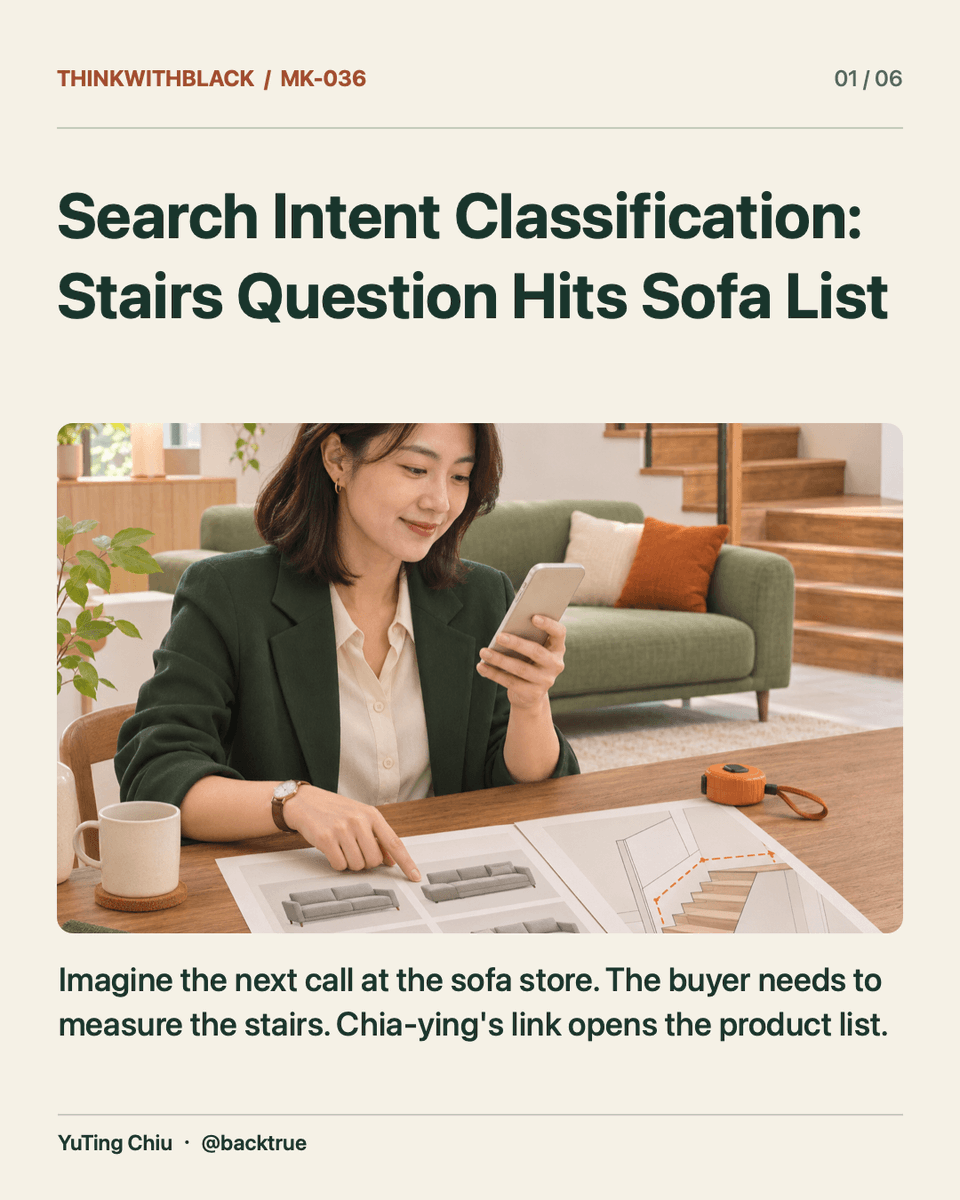
A shopper asks how to measure the stairs for a sofa. Your ad opens a product list, so they go back to customer service.
MK-036 matches each query to a page where the shopper can finish the task. Cards 1–4 of 6.
https://t.co/tPwqY5AGCX
YuTing Chiu · @backtrue · ThinkWithBlack
Keep running the bundle ad if actual sales reach 5 at NT$1,000 in ads per offer, or 6 if bundle spend rises to NT$1,500 and single-pack spend stays at NT$1,000.
https://t.co/AorAFTZCV2
MK-174
https://t.co/0Pzl2xPmWL
YuTing Chiu · @backtrue · ThinkWithBlack
At checkout, a NT$360 pack adds NT$100 in shipping. Check that payment works and read the buyer's feedback on that same checkout. If the fee made them leave, ask the brand for a NT$1,080 three-pack to clear the NT$1,000 free-shipping threshold.
Use ThinkWithBlack Skills’ MK-174 with AI. Give it both prices, the free-shipping threshold, shipping charged and paid, product costs, ad spend per offer and your single-pack order count. Ask how many bundles you need to beat the single-pack offer.
Want to test a winning Meta ad on a new audience? Find its Post ID, choose Use existing post in the new ad set, and judge that set on its own purchases.
https://t.co/fIohQ2aSEl
365 free Skills: https://t.co/x1iXNfsgfa
YuTing Chiu · @backtrue · ThinkWithBlack
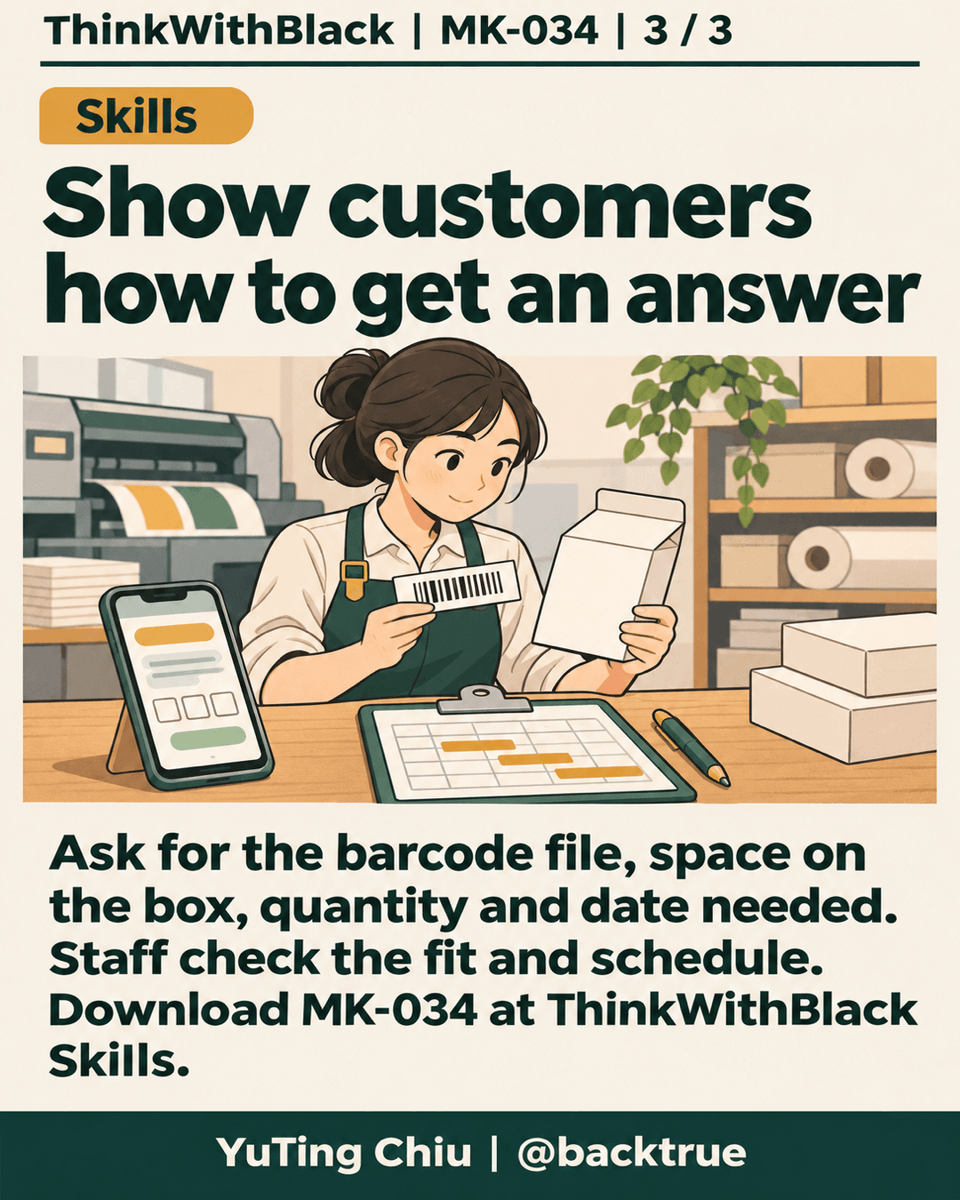
Say a food maker receives its first wholesale order. The retailer asks for a barcode on every box, and the first delivery is due Thursday. A print shop advertises small runs. The service page lists materials and quantities, so the person packing the order asks support if the label will fit and when it can be ready.
MK-034, Turning events into problem awareness, comes from my first Google Ads lesson. Write down what happened, then ask what the person now needs to work out. The new packaging requirement raises two questions here. Will the label fit the space on the box? Can it be printed in time?
Put those questions next to the existing page. If production can check each order, the page can tell people to send the barcode file, packaging dimensions, quantity and date needed. Staff can then confirm what the shop can deliver.
https://t.co/vqud7NiFjg
YuTing Chiu · @backtrue · ThinkWithBlack
Say a sofa shopper finds out the freight lift is being serviced this week. They ask the furniture shop whether a sofa can go up the stairs and what they should measure. The marketing team’s list starts with “premium sofas” and “home delivery.” Those phrases leave out the job the shopper is trying to do.
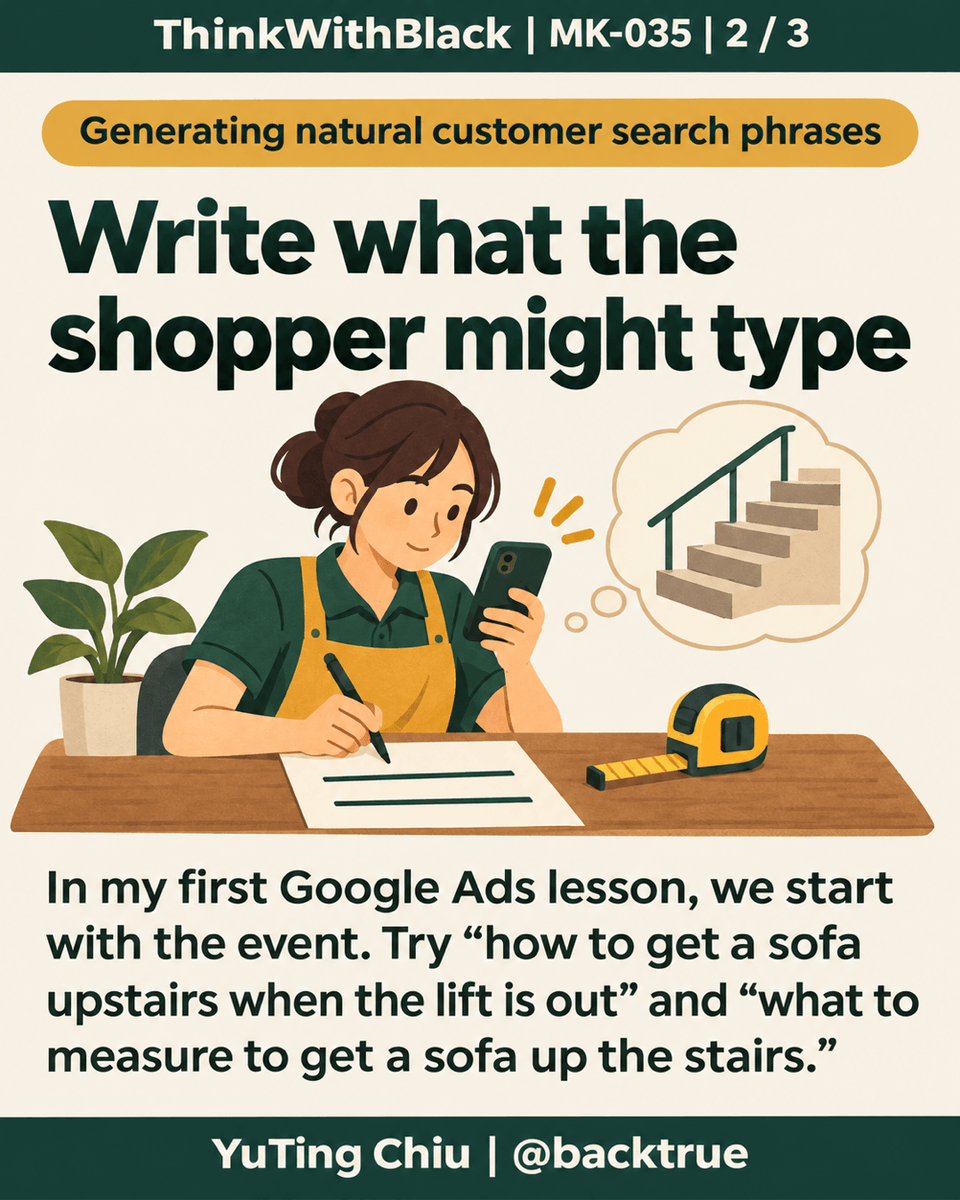
MK-035, Generating natural customer search phrases, comes from an exercise in my first Google Ads lesson. Start with the shopper’s words. Try “how to get a sofa upstairs when the lift is out” and “what to measure to get a sofa up the stairs.” Both keep the question open while the shopper considers what will fit.
Save the two phrases as candidates. Check them against search terms and support messages, then see whether the delivery page tells people what to measure. If the delivery team can review photos and dimensions, tell shoppers where to send them.
https://t.co/V9TJtRvXlM
YuTing Chiu · @backtrue · ThinkWithBlack
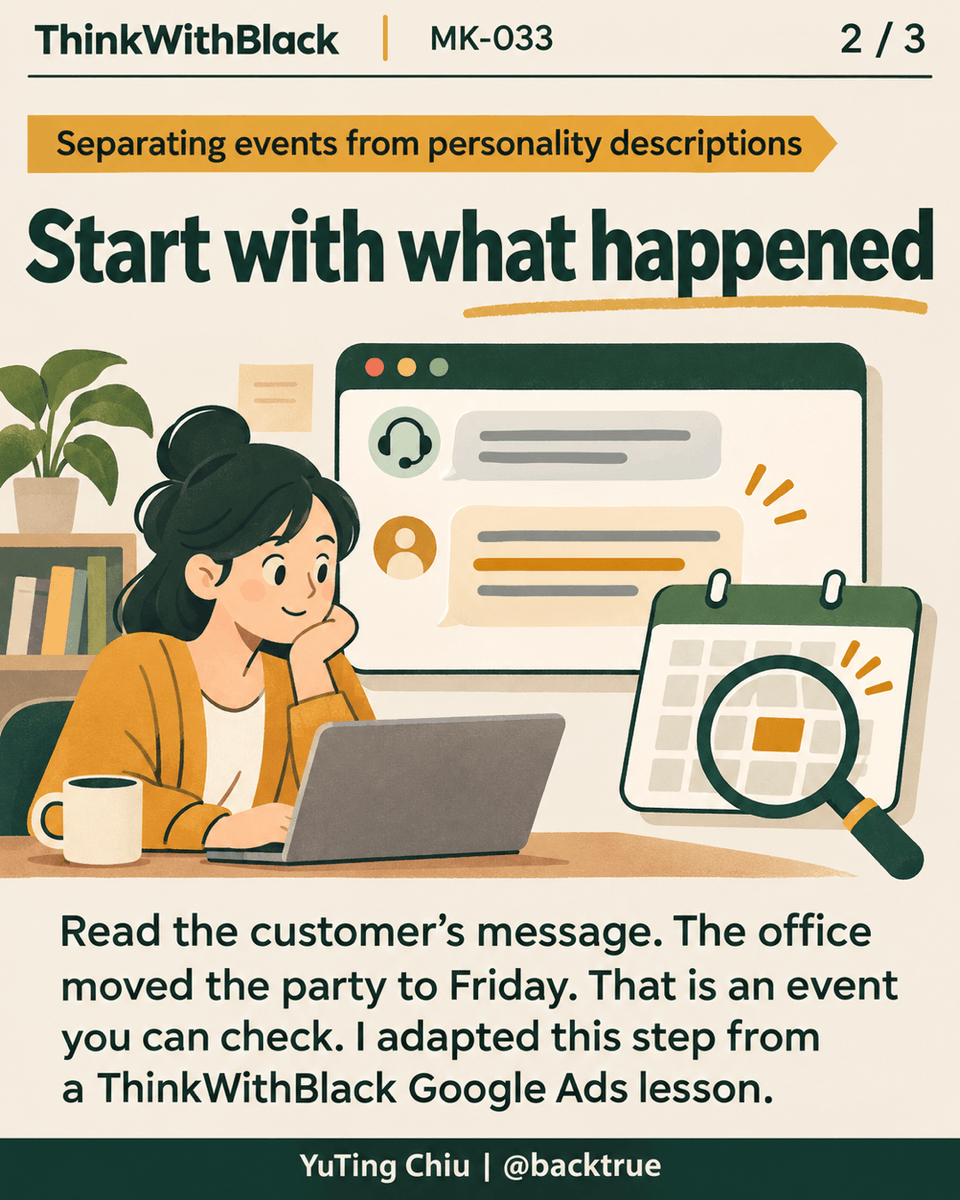
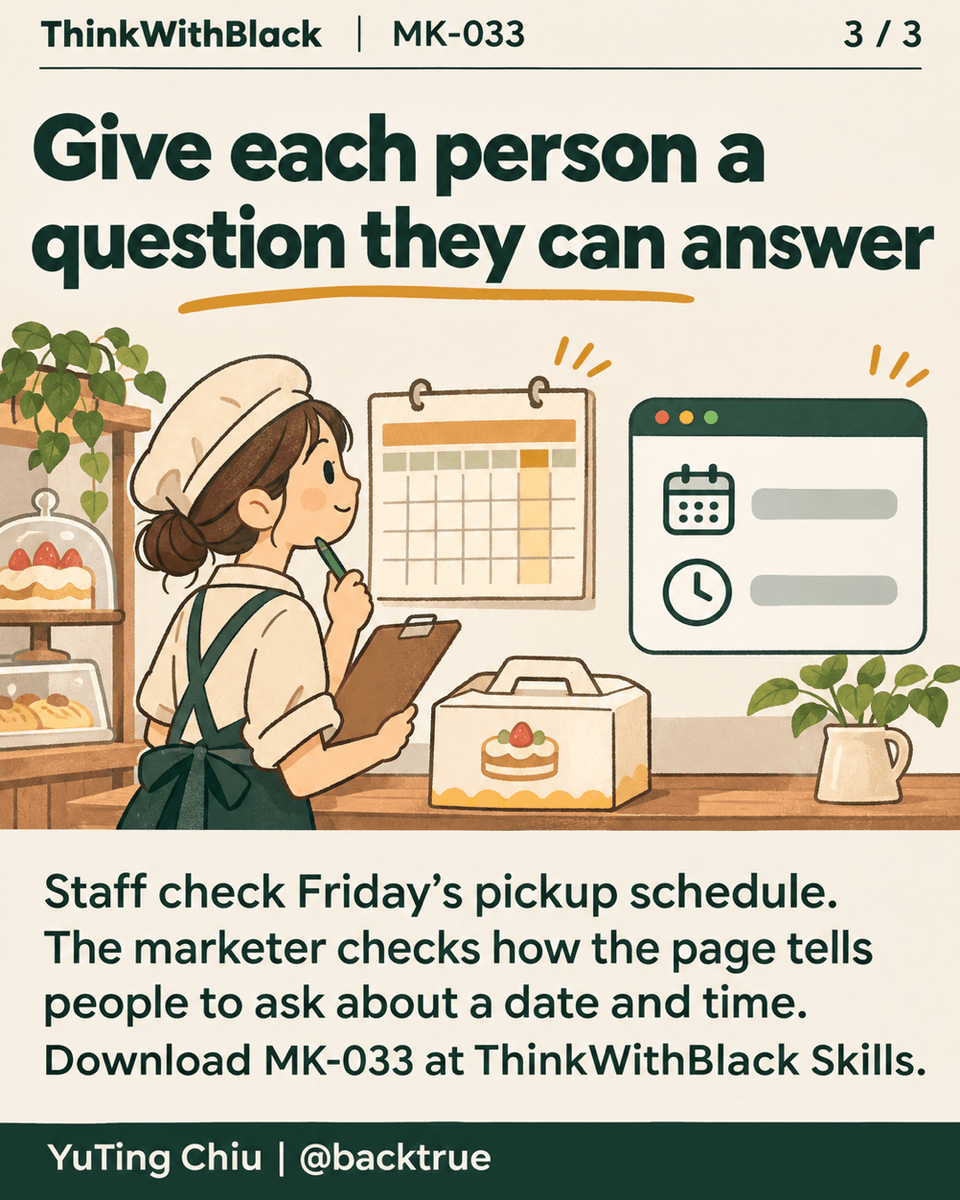
Picture an office that moves a birthday celebration to Friday. The organizer needs to collect a cake before 3 p.m. The bakery’s ad mentions pickup, but the product page leaves the customer looking for a way to check the time.
MK-033, Separating events from personality descriptions, comes from an exercise in my first Google Ads lesson. Use the customer’s message to write down what happened. In this example, the celebration moved to Friday. That gives staff a specific date to check and marketing a specific question to test on the page.
Bring one support message, the ad and its landing page to your next meeting. Keep the pickup time open until staff confirm it. If they can answer date requests individually, tell customers what to provide and how they’ll hear back.
https://t.co/RBW2edvHQ6
YuTing Chiu · @backtrue · ThinkWithBlack
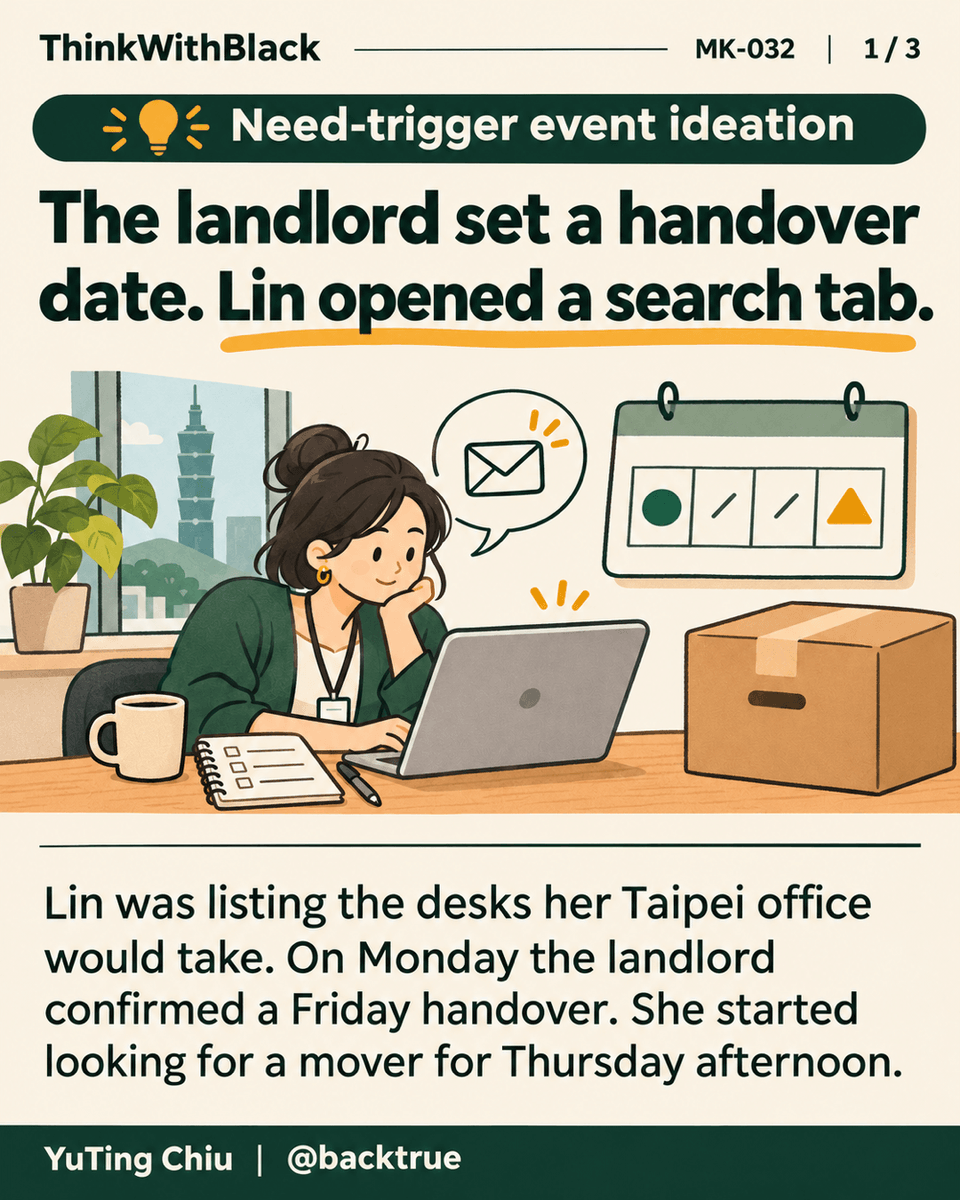
Picture a small office in Taipei. On Monday, Lin was still listing the desks her team would take to its new space. Then the landlord emailed to confirm a Friday handover. She opened a search tab to find a mover for Thursday afternoon. A page that says “fast service” still leaves her with a call to make: is a truck available that day?
MK-032, Need-trigger event ideation, comes from an exercise in my first Google Ads lesson. Write down what the customer was doing, what changed and when they started looking. Then check the timing and likely search words against customer messages and actual search terms.
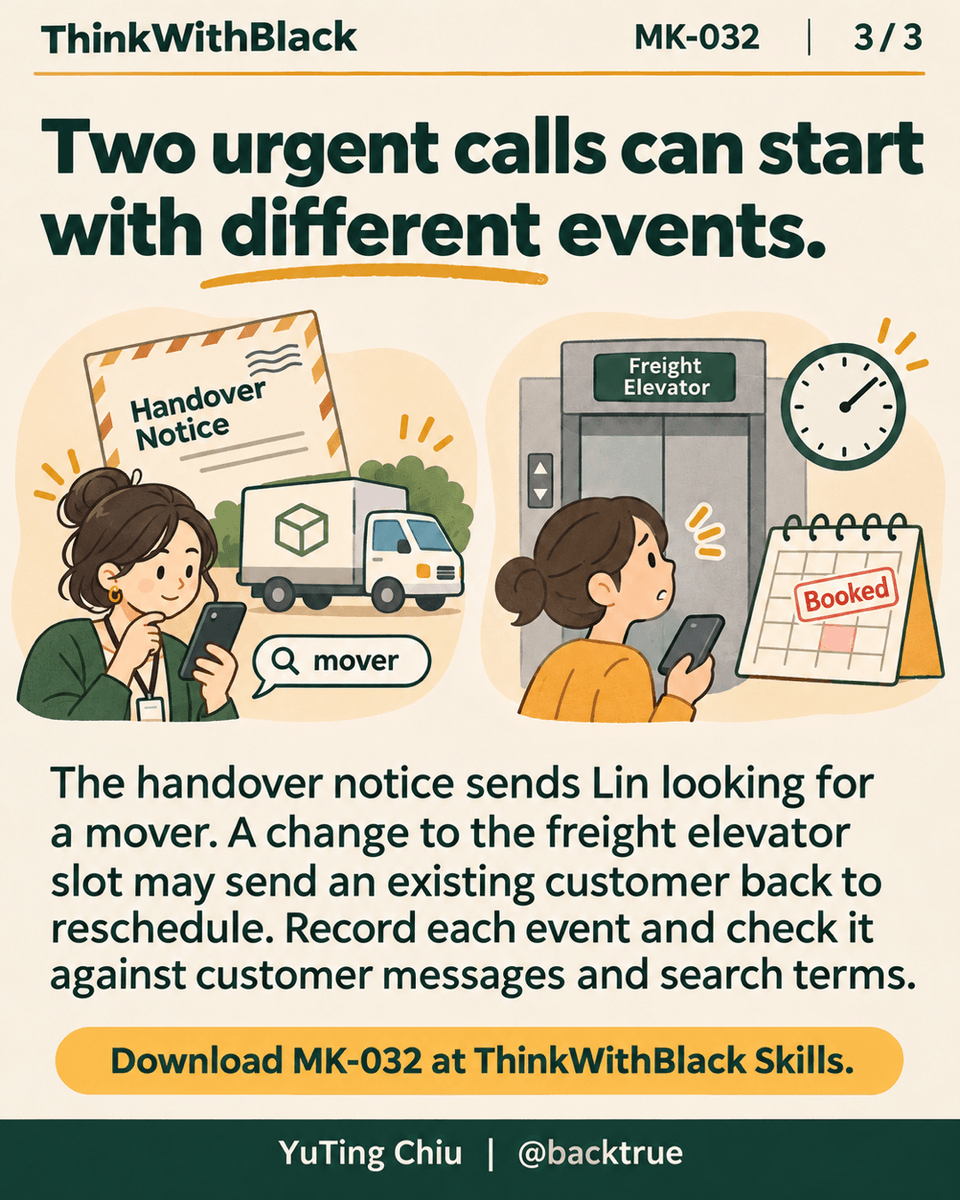
Two calls can sound equally urgent. One customer starts looking when they get a handover date. Another already has a mover and needs to reschedule after the building changes the freight elevator slot. Put those events on separate rows so sales can see which customer needs availability and which needs help with a booking.
https://t.co/WF4ZifZ4CI
YuTing Chiu · @backtrue · ThinkWithBlack
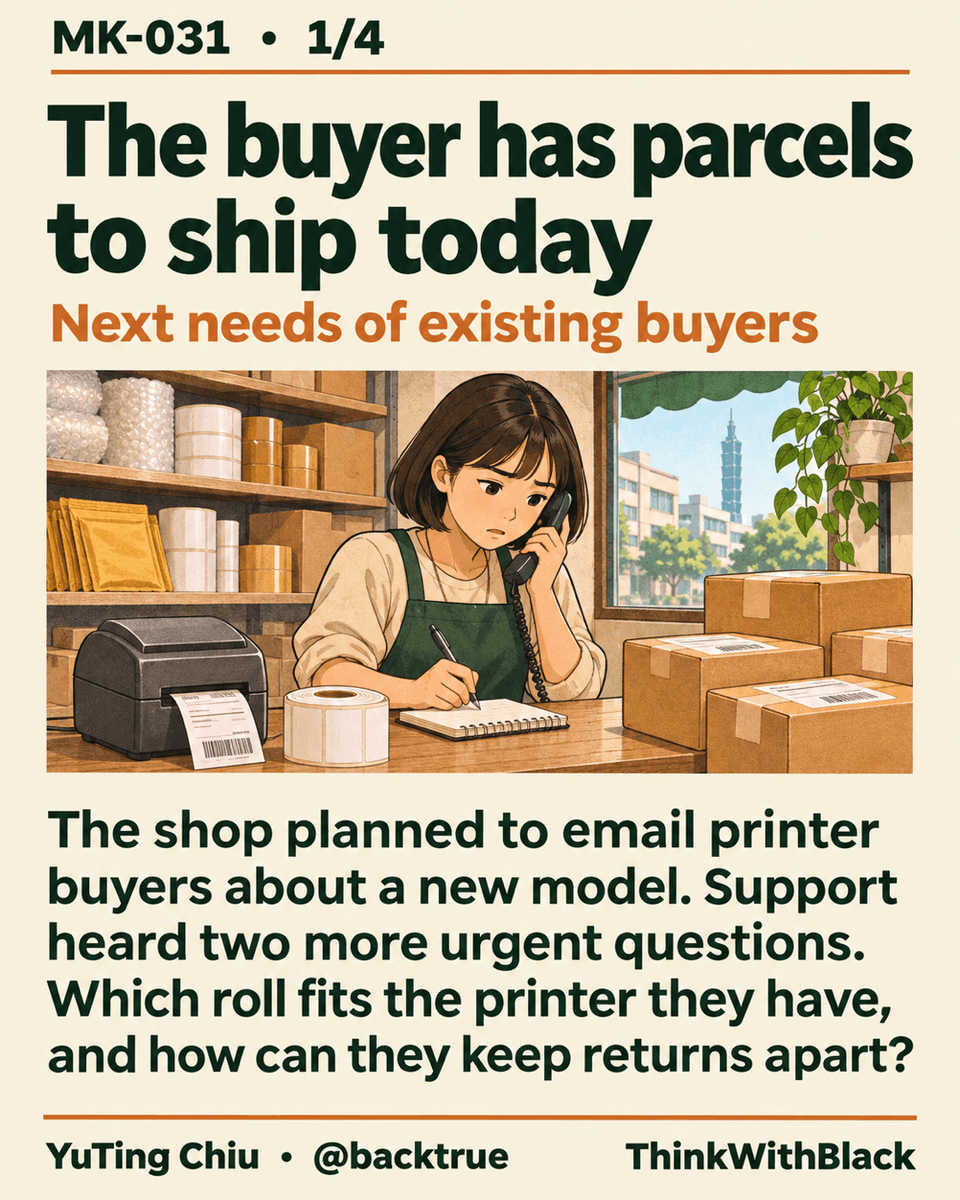
A shipping supplies shop is about to email label printer buyers about a new model. One buyer has parcels to send that afternoon and asks which roll fits the printer they bought last month. Returns are also piling up by the packing table.
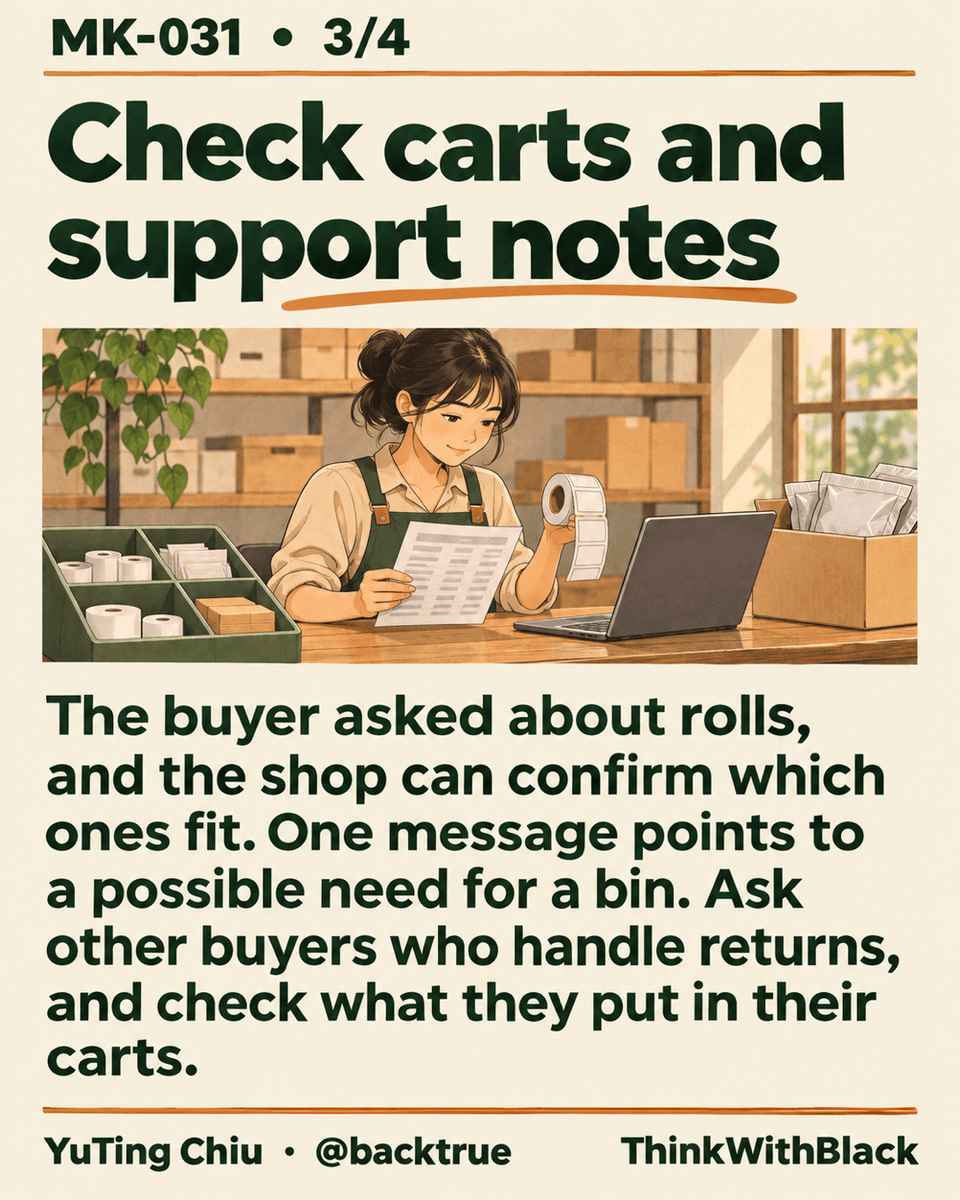
I use MK-031, Next needs of existing buyers, to explore both leads. Look up the original printer model and check which rolls fit. Then follow the buyer's work. A divided bin may help someone sort returns, so ask how they separate items today.
The shop can answer the question about the roll once it checks the model. One conversation gives it a reason to investigate the bin. Check carts and ask others who handle returns before including the bin in a broader email. The article shows what to put in the eight-field record for each lead.
https://t.co/b0C04Slrgc
YuTing Chiu · @backtrue · ThinkWithBlack
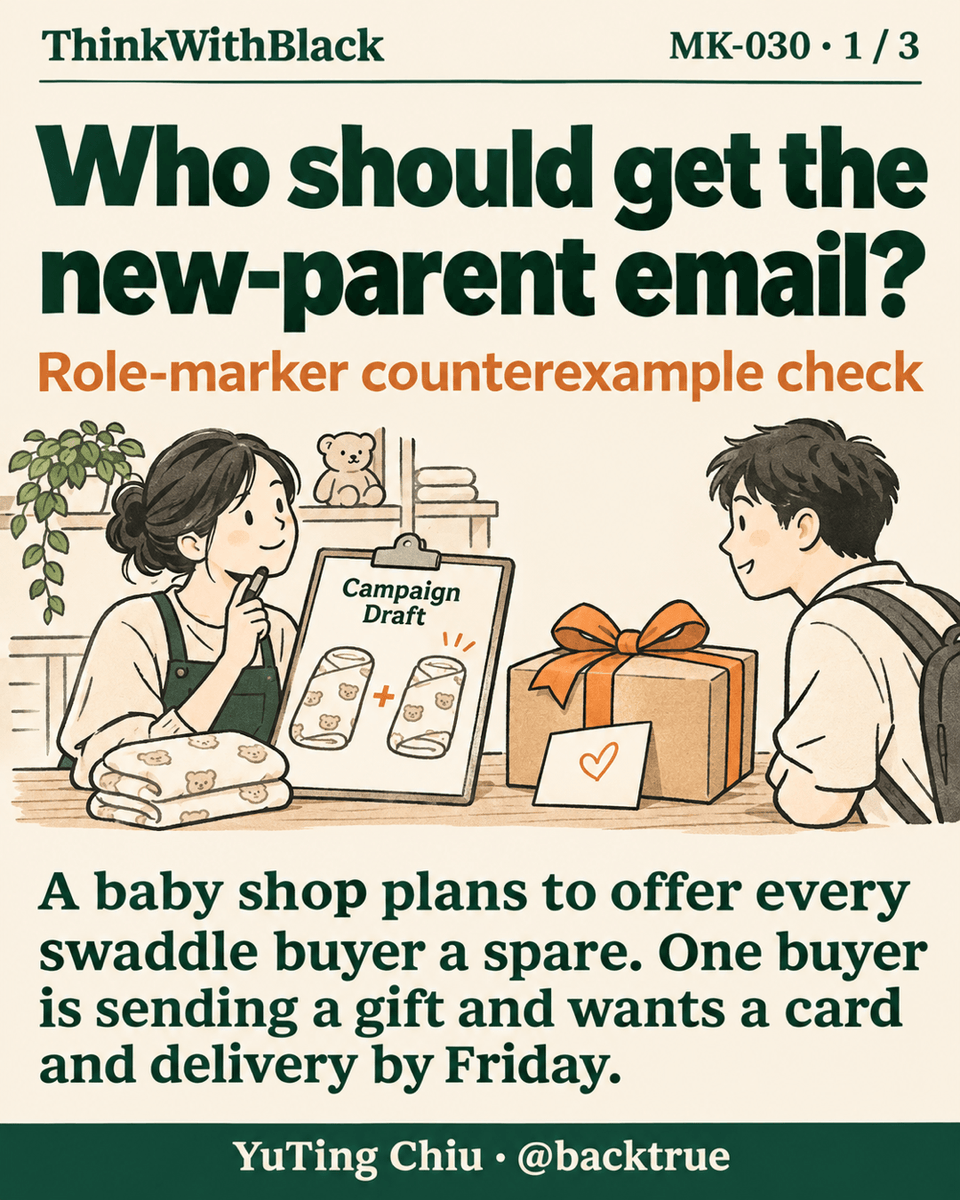
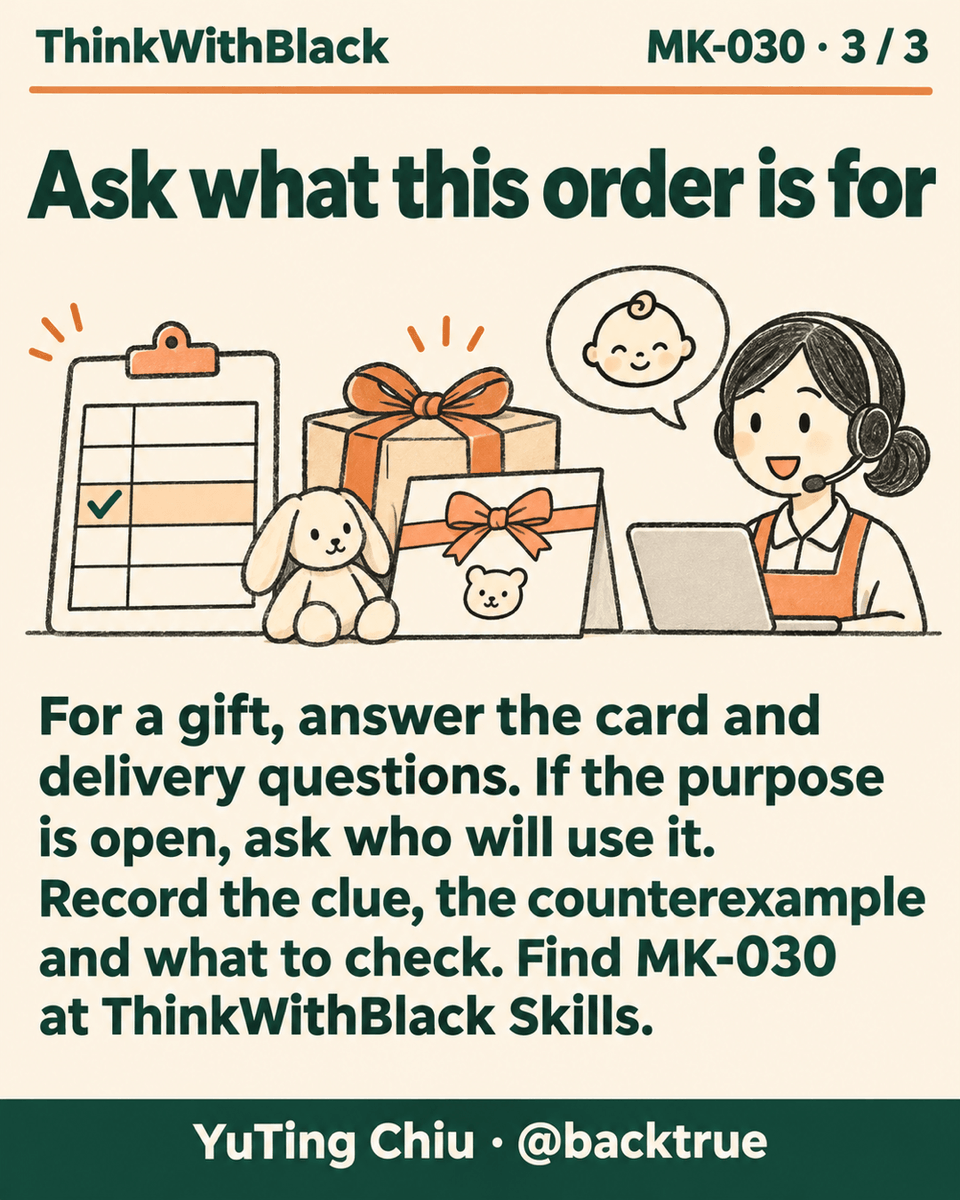
Say a baby goods shop is about to email everyone who bought a swaddle and suggest buying a spare. Then one buyer asks support if they can add a note to the gift and have the parcel delivered to a friend by Friday. The team now has a reason to review its “new parents” list before hitting send.
I adapted MK-030, the Role-marker counterexample check, from the section on customer roles in my Meta Ads course. For each order, consider who might be buying for their own household, sending a gift, or ordering for someone else. Then check what the buyer actually said or selected.
For the gift buyer, answer the card and delivery questions. When the purpose is unclear, ask who the item is for. The article includes an eight-field table for recording the clues, the alternative explanations, and the next question.
https://t.co/ZlObhqFHJl
YuTing Chiu · @backtrue · ThinkWithBlack
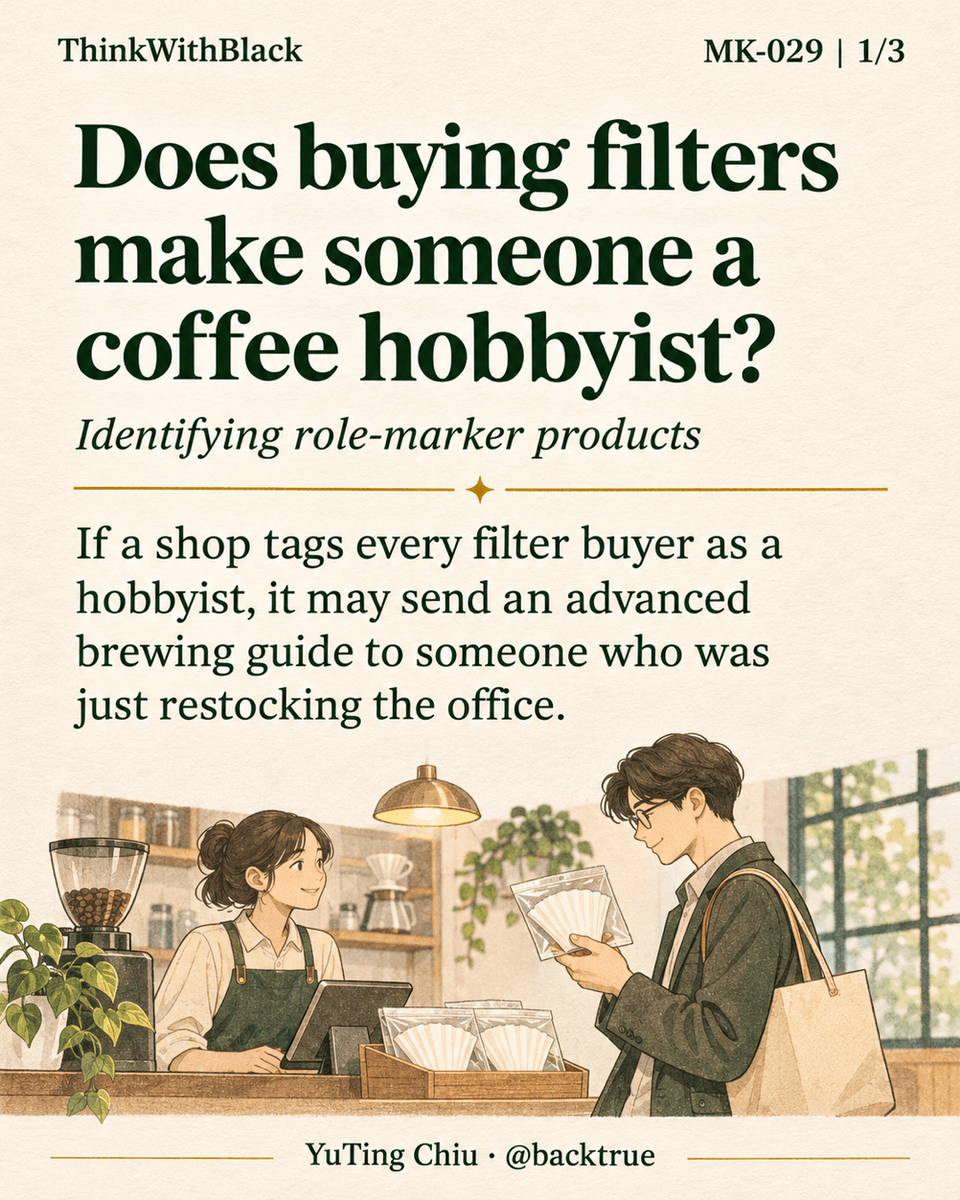
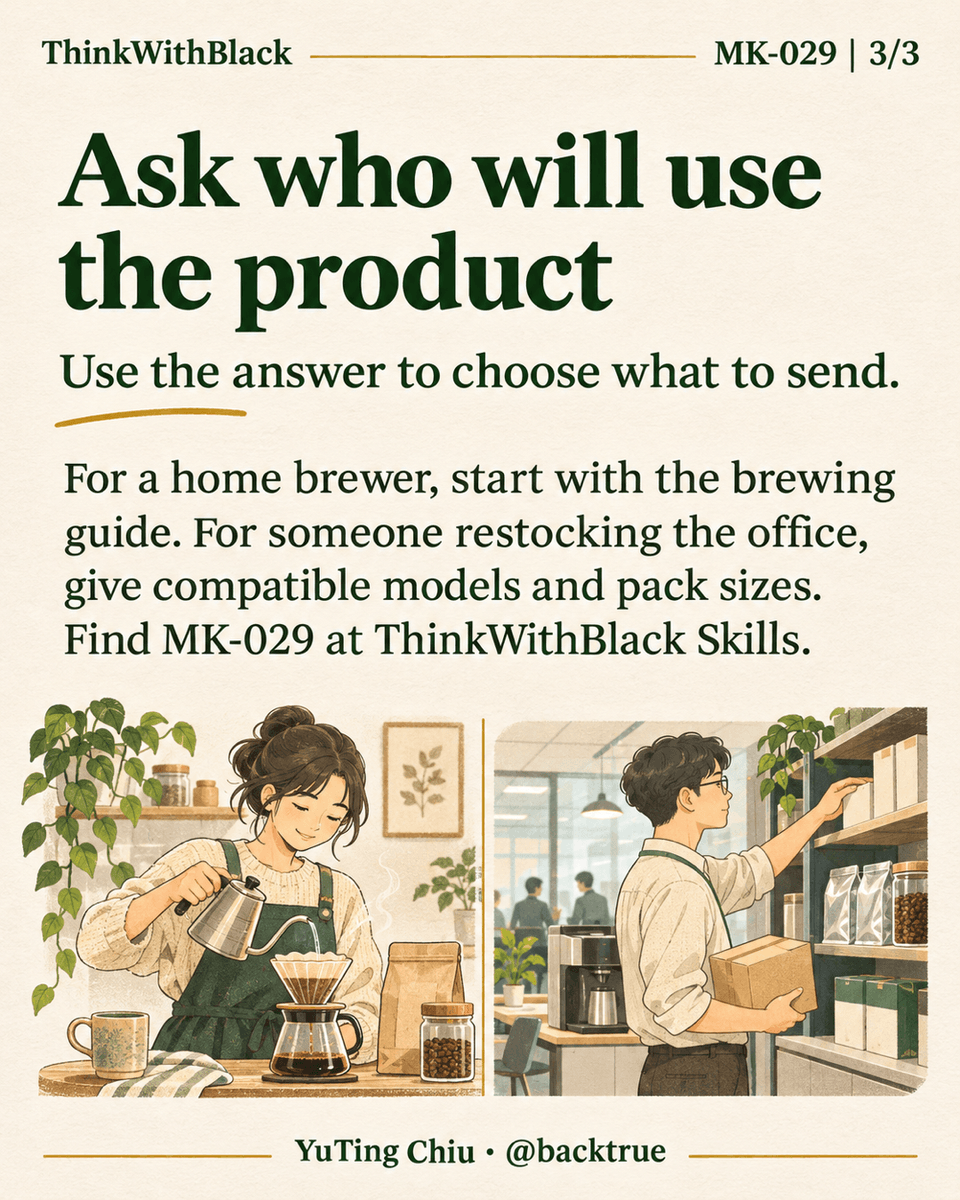
A coffee shop tags all filter buyers as hobbyists and sends them an advanced brewing guide. Someone who was restocking the office still has to ask which filters fit the dripper and how many come in a pack.
I use MK-029, Identifying role-marker products, to separate three clues. A dripper suggests what someone might do, repeat orders suggest restocking, and a question about a folding dripper can point to a trip. I adapted the method from the section on customer roles in my Meta Ads course.
Ask who will use the product. For someone who brews at home, offer the guide for that model. For an office buyer, lead with fit and pack size. The article shows how to keep both possibilities, the evidence for each, and the question that will help you choose.
https://t.co/H6u844CAqY
YuTing Chiu · @backtrue · ThinkWithBlack
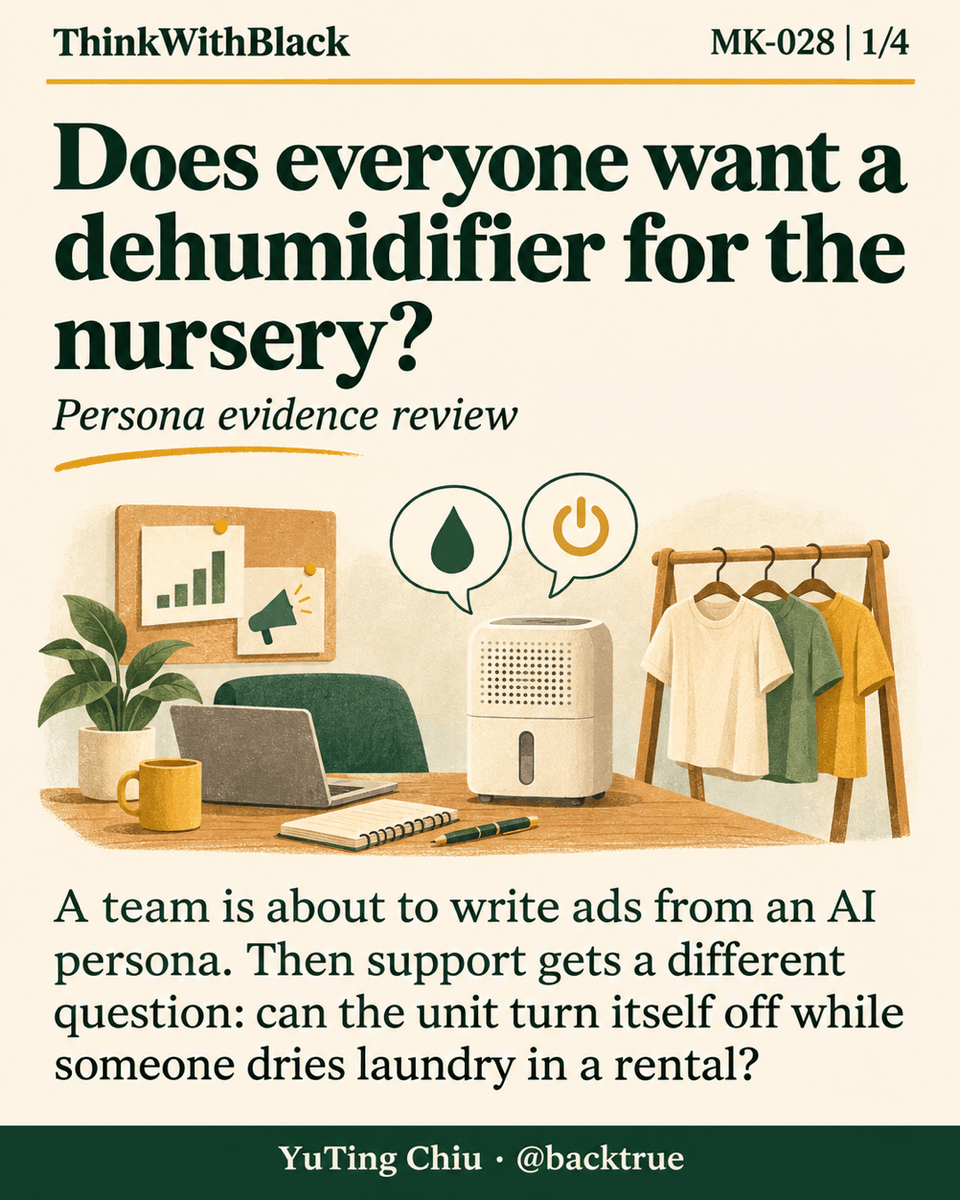
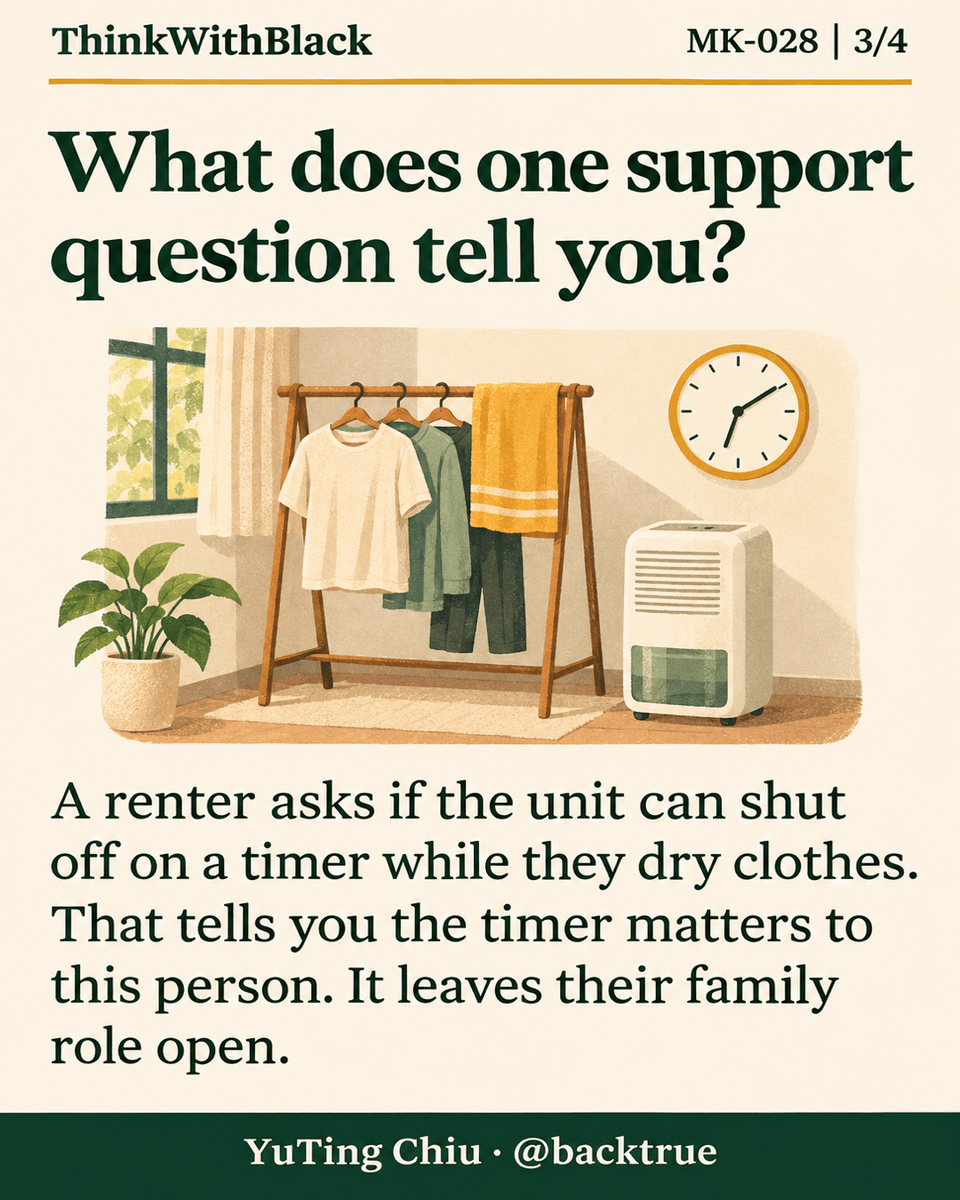
The AI persona says everyone wants a dehumidifier for the nursery. Support hears from someone who dries laundry in a rental and wants to know whether the unit can switch off on a timer.
The team is about to redesign the product page and spend money on ads. I’d check each claim first. MK-028, Persona evidence review, comes from a dehumidifier example in my Google Ads course. The idea is to check what happened, what someone actually asked or searched for, and whether your business can give them the answer they need.
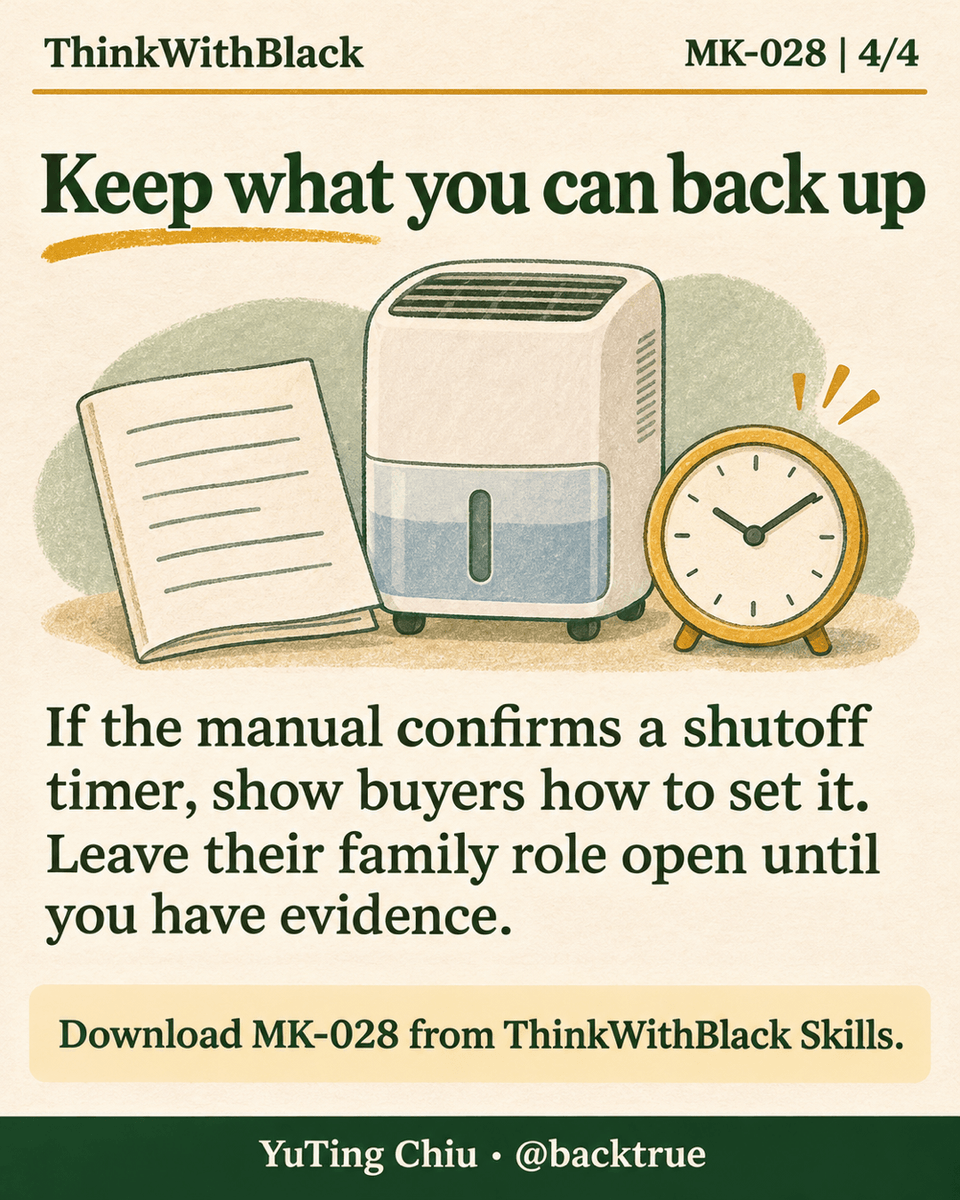
The support note gives you one person’s reason to ask about a timer. Check the manual for that model, then add the settings to your product FAQ. Leave the person’s family role open. Before you build a nursery campaign, look for enquiries that mention that use.
In the article I’ve put three claims side by side: one supported by the notes, one contradicted by them, and one still unknown. Take a sentence from your own persona and see which column it belongs in.
https://t.co/6f83e1FDD8
YuTing Chiu · @backtrue · ThinkWithBlack
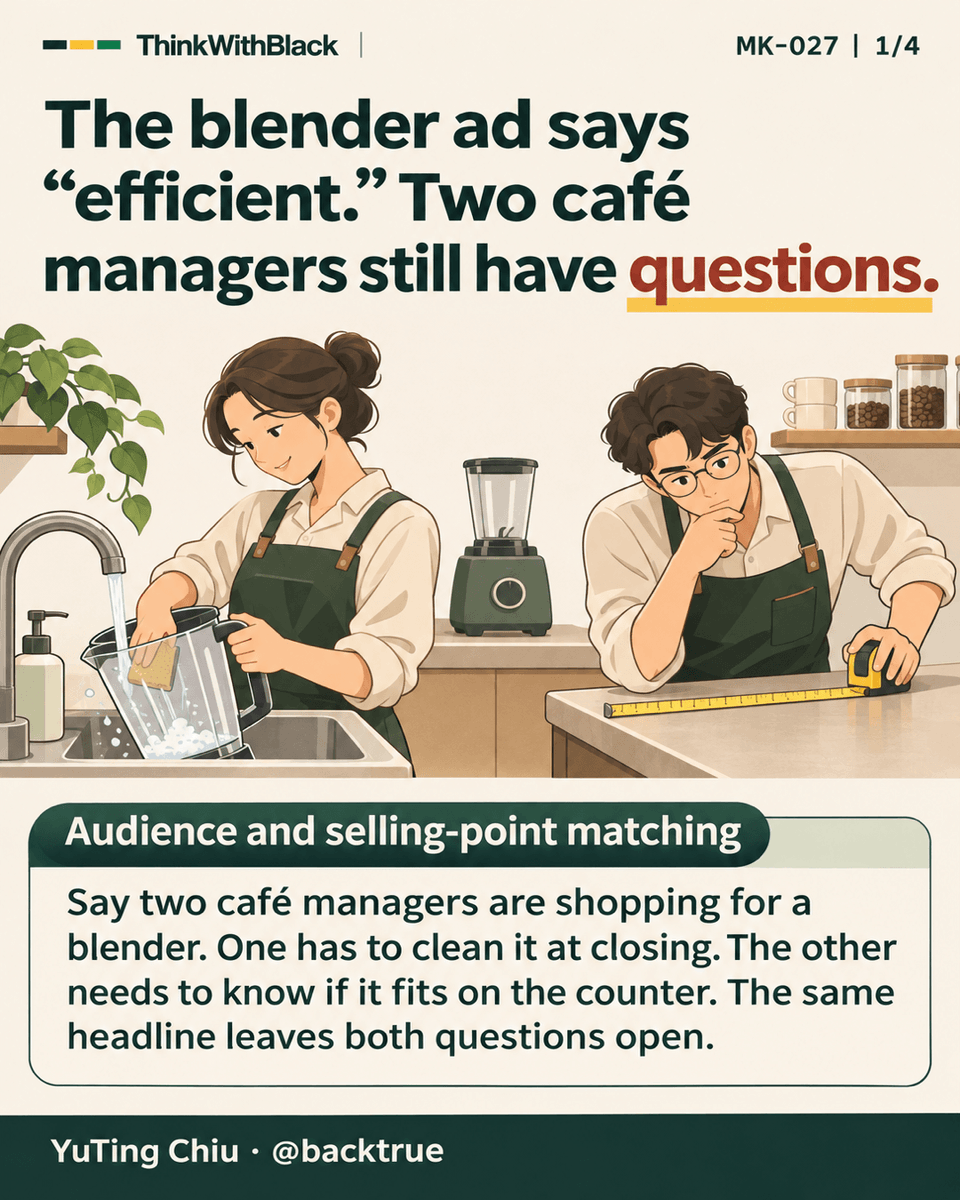
The blender ad says “efficient.” Two café managers still have questions.
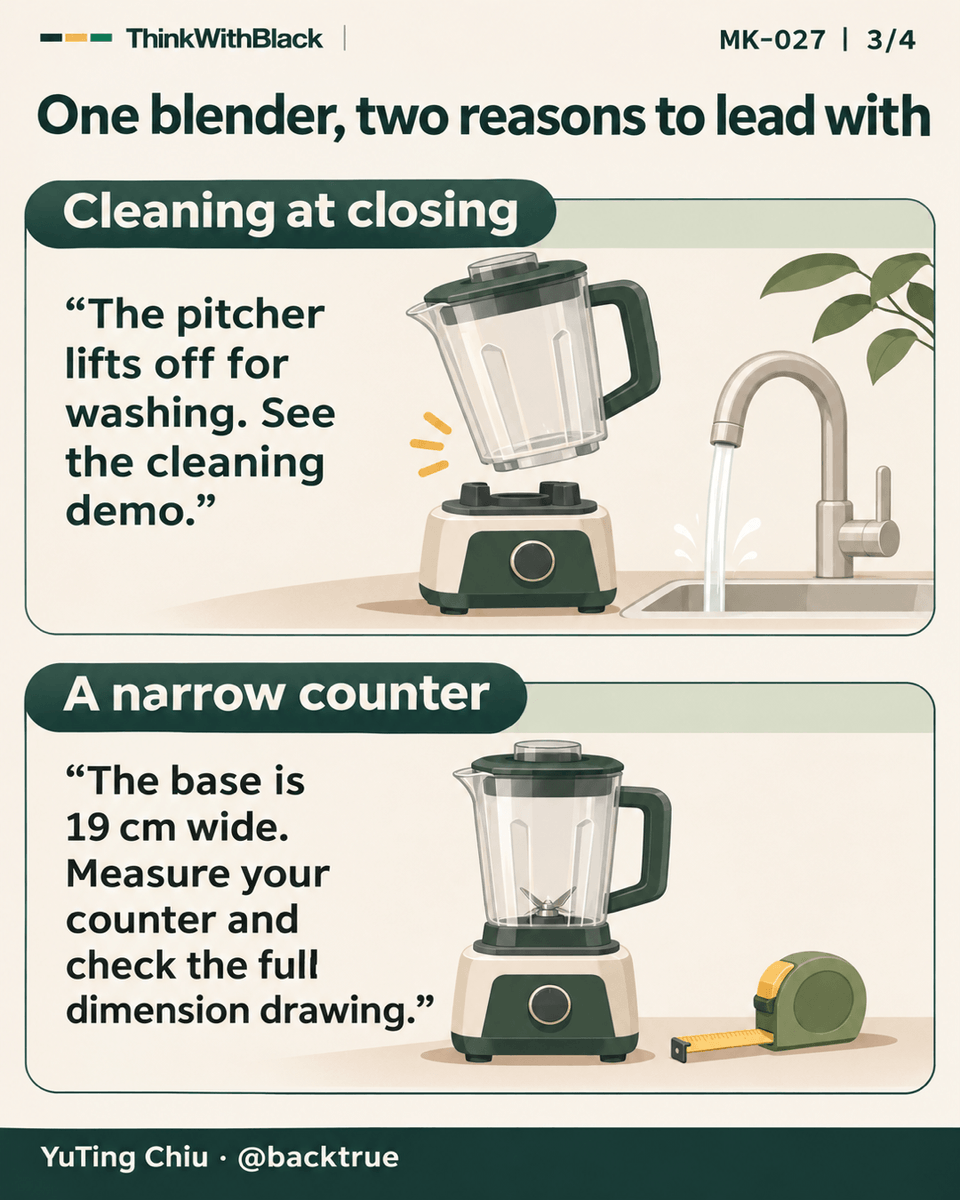
Say an equipment supplier has one ad for the same blender. One café manager wants to see how the pitcher comes off for washing at closing. The other needs to check the counter space. Both have to contact support before they can decide.
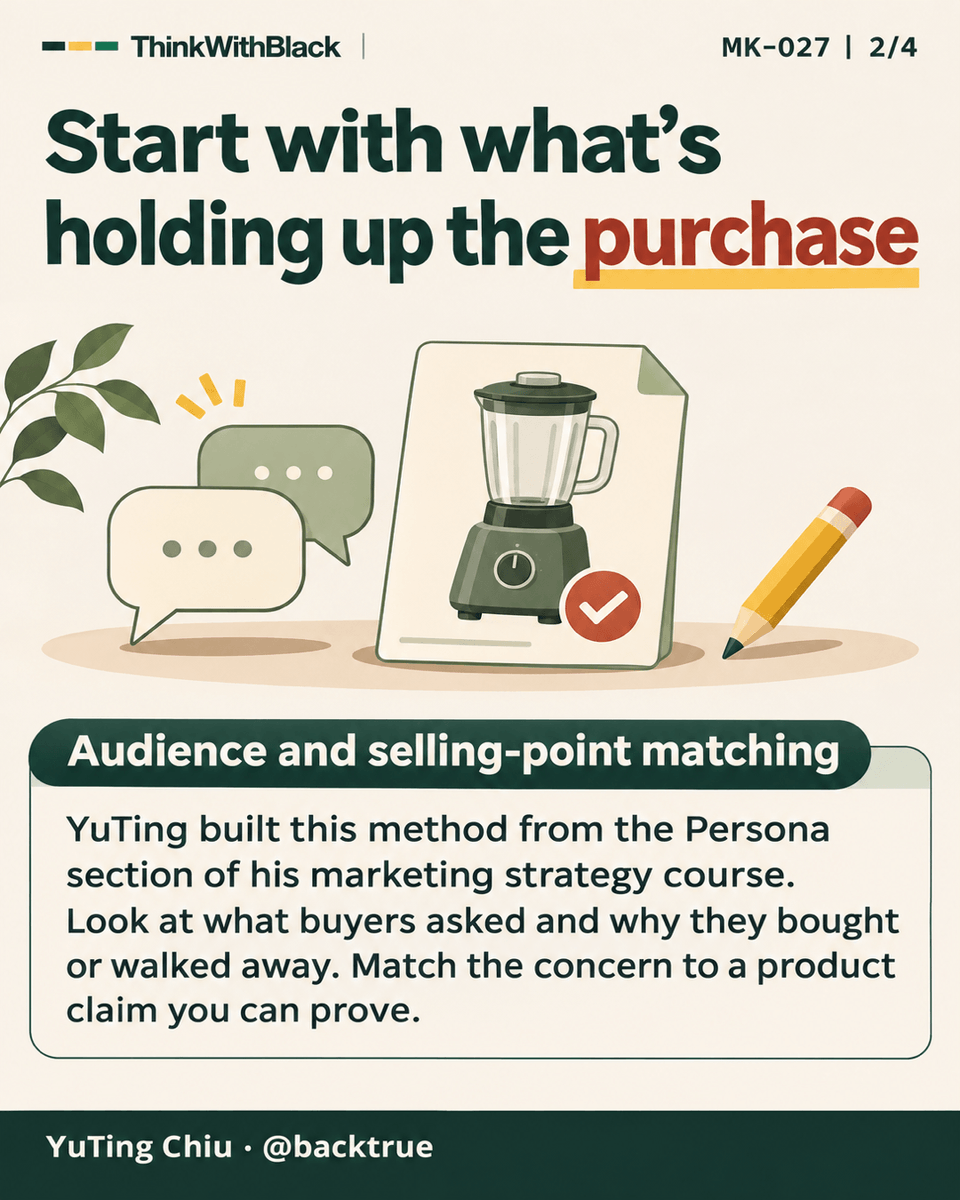
I use MK-027, Audience and selling-point matching, to find the concern holding up each purchase. I developed the method from the Persona section of my marketing strategy course. Pull one customer question or lost-sale note, then match it to a claim you can prove for that model.
For the manager who needs to wash the blender, lead with the cleaning demo. For the manager with a narrow counter, show the full dimensions. In this example the base is 19 cm wide, and the buyer still needs to measure depth, height and working clearance.
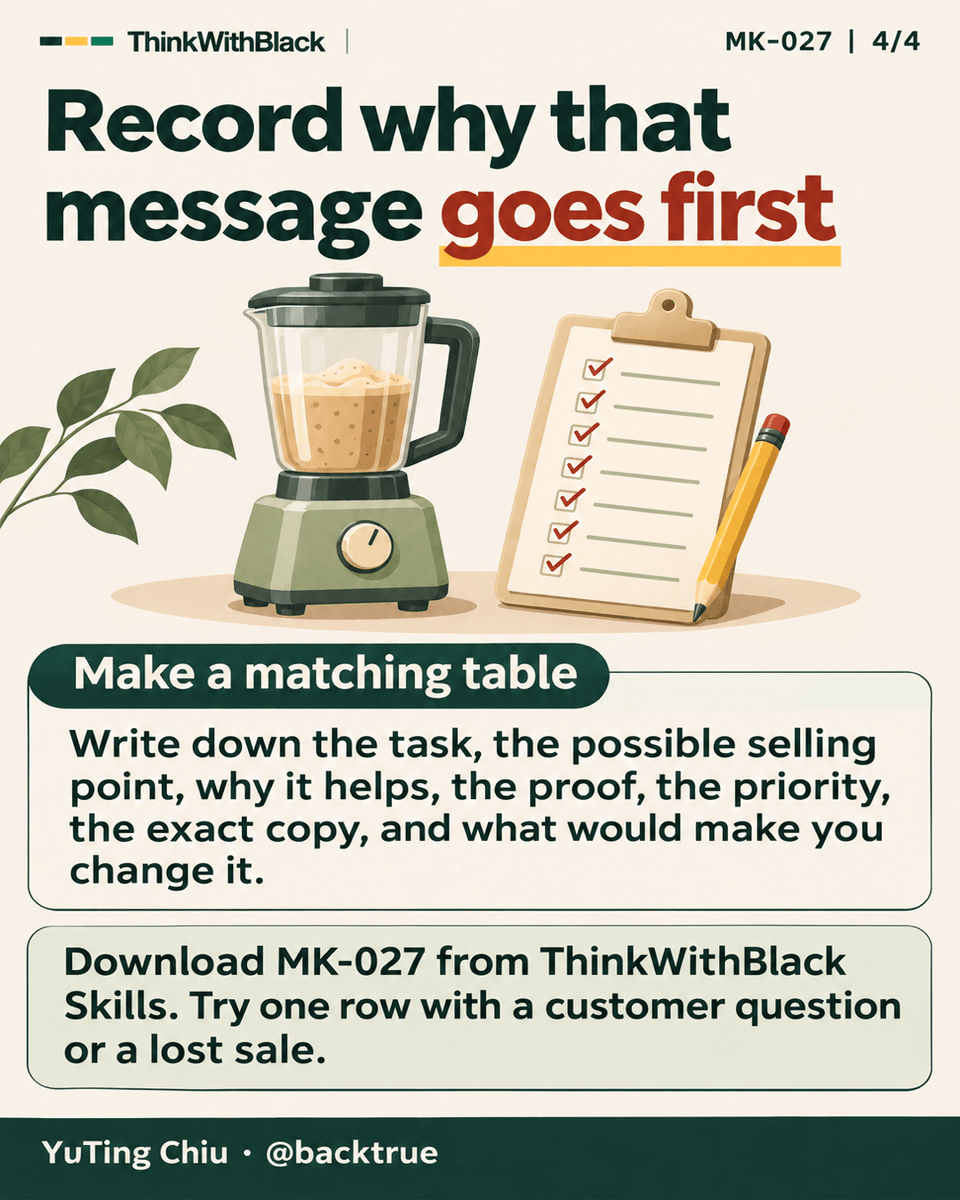
Put the task, candidate selling point, usefulness, proof, priority, actual copy and conditions for changing it in the same table. The next person on the team can see what to show first and what would make them change the message.
Download MK-027 from ThinkWithBlack Skills and try one row with a customer question or a lost sale.
https://t.co/K1YOawNX32
YuTing Chiu · @backtrue · ThinkWithBlack
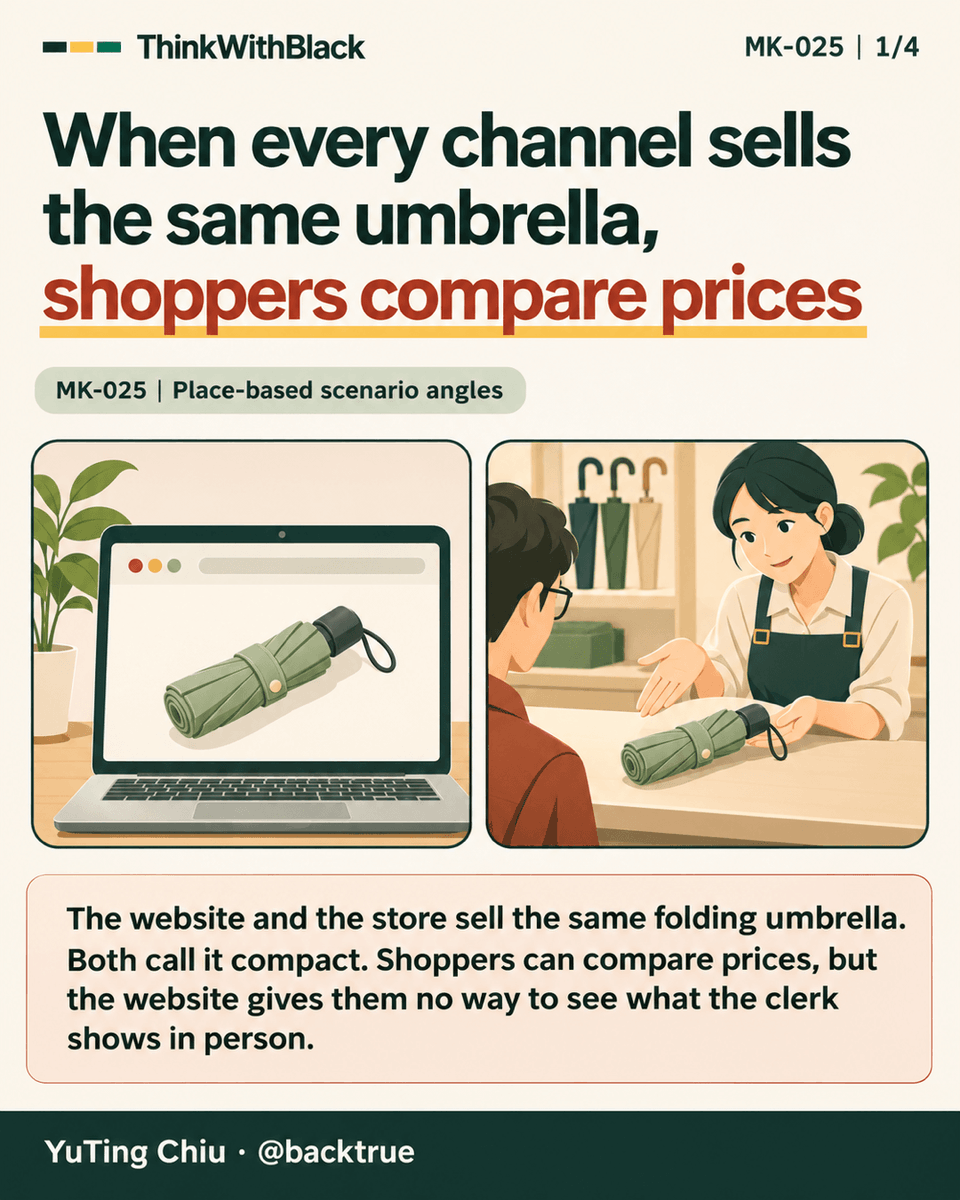
When the website and the store sell the same umbrella, what can shoppers compare besides price?
Say both channels call a folding umbrella compact. A shopper tries it in their bag at the store, checks the website, and sees the same umbrella with a different price. The page gives them no way to see what the clerk showed them in person.
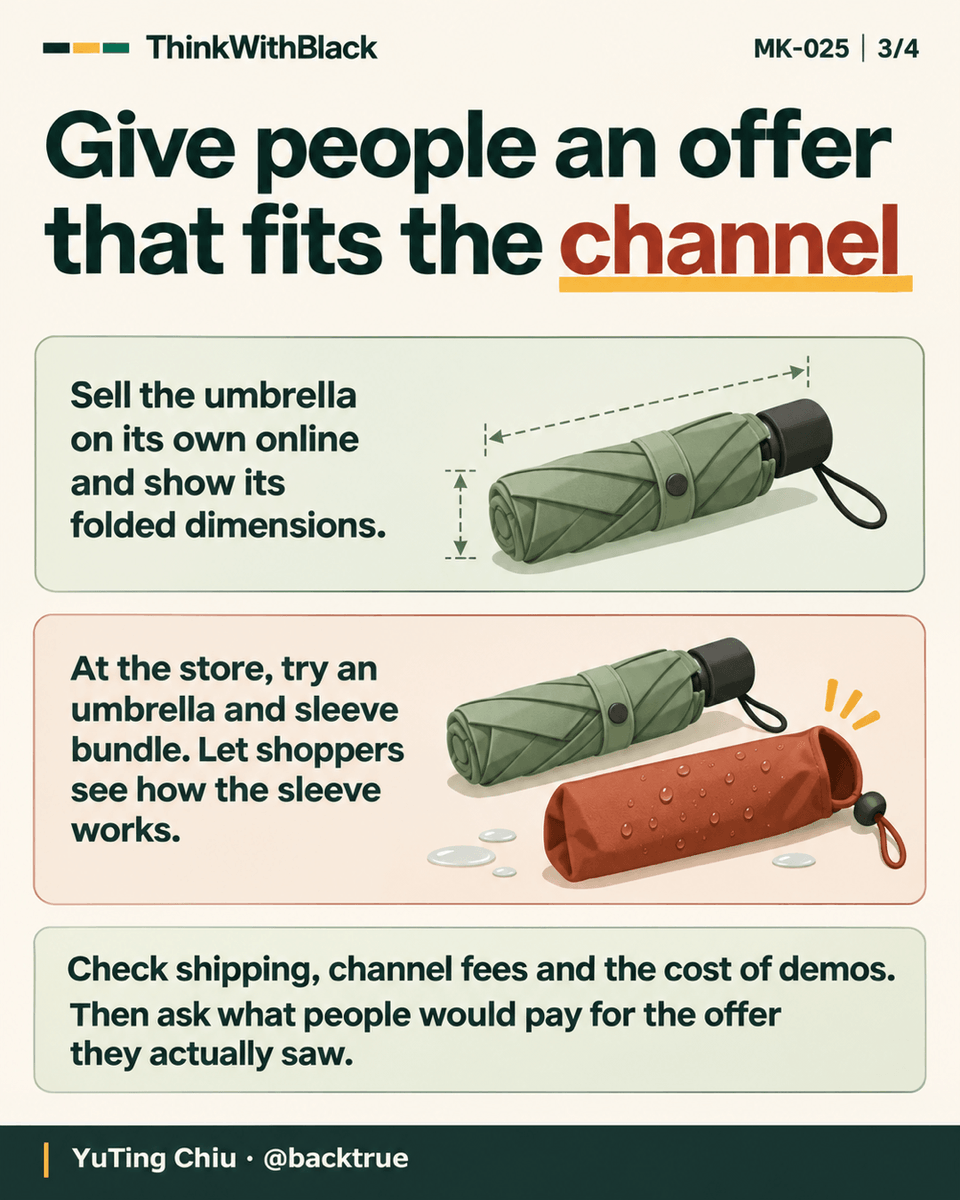
I use MK-025, Place-based scenario angles, to keep the clues from each channel separate. The method comes from the section on Place in my course materials on product-line planning. One website shopper might ask for the folded length. At the counter, someone tries the umbrella in their bag and asks where to put it when it's wet. Record what each person said or did. They may be buying for someone else, so keep the buying and using roles open until you know.
Put the folded dimensions on the product page and try selling the umbrella on its own. At the store, offer a sleeve bundle alongside the standalone umbrella and let people try it. If website shoppers ask about the sleeve too, keep that clue. You may want to test the bundle online as well.
Check shipping, fees, and demo costs by channel. When you ask what someone would pay, record the offer they actually saw. The eight fields help your team keep the evidence with the proposed offer and decide what to check next.
Download MK-025 from ThinkWithBlack Skills and try it with one product and records from two channels.
https://t.co/EpQdJESiZy
YuTing Chiu · @backtrue · ThinkWithBlack
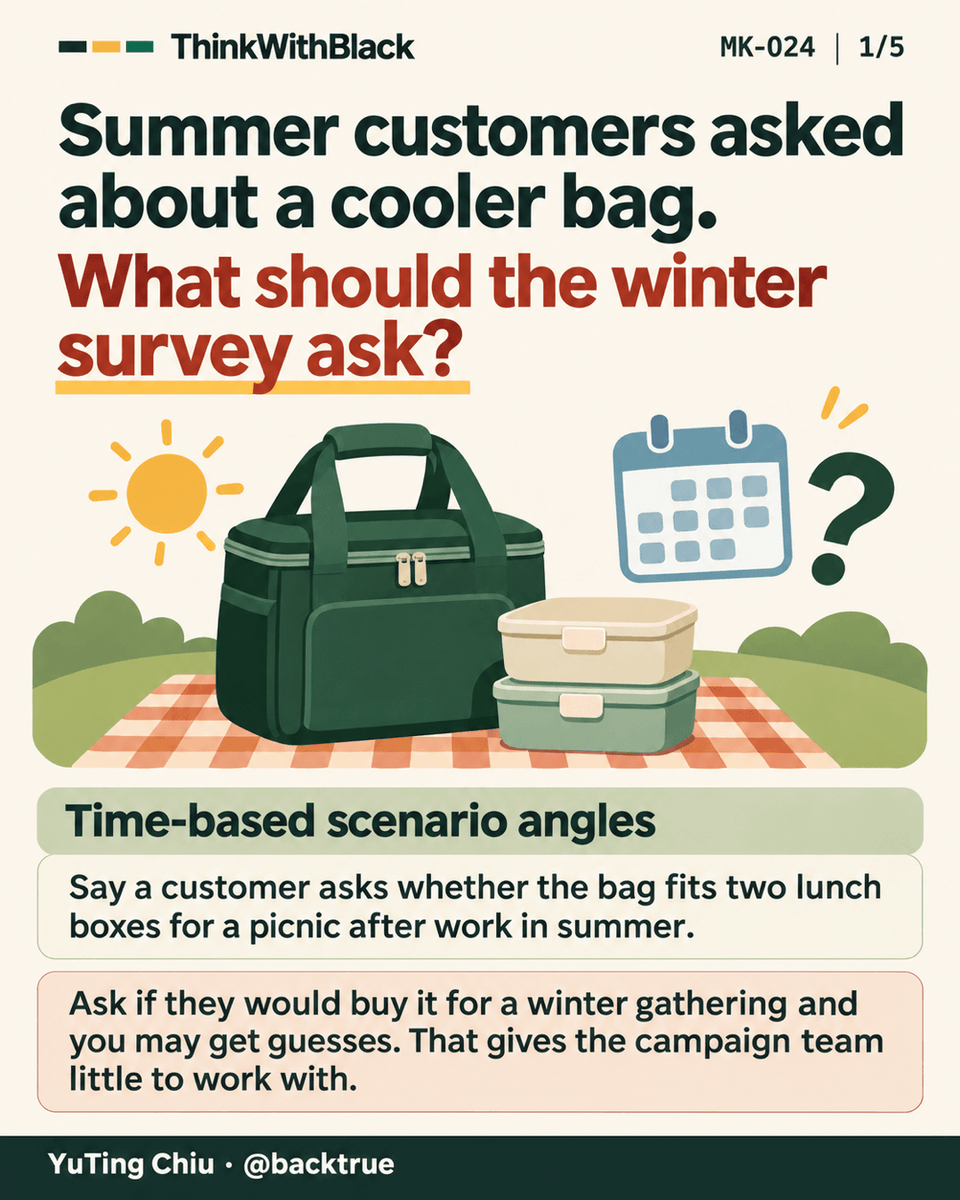
Summer customers asked about a cooler bag. What should the winter survey ask?
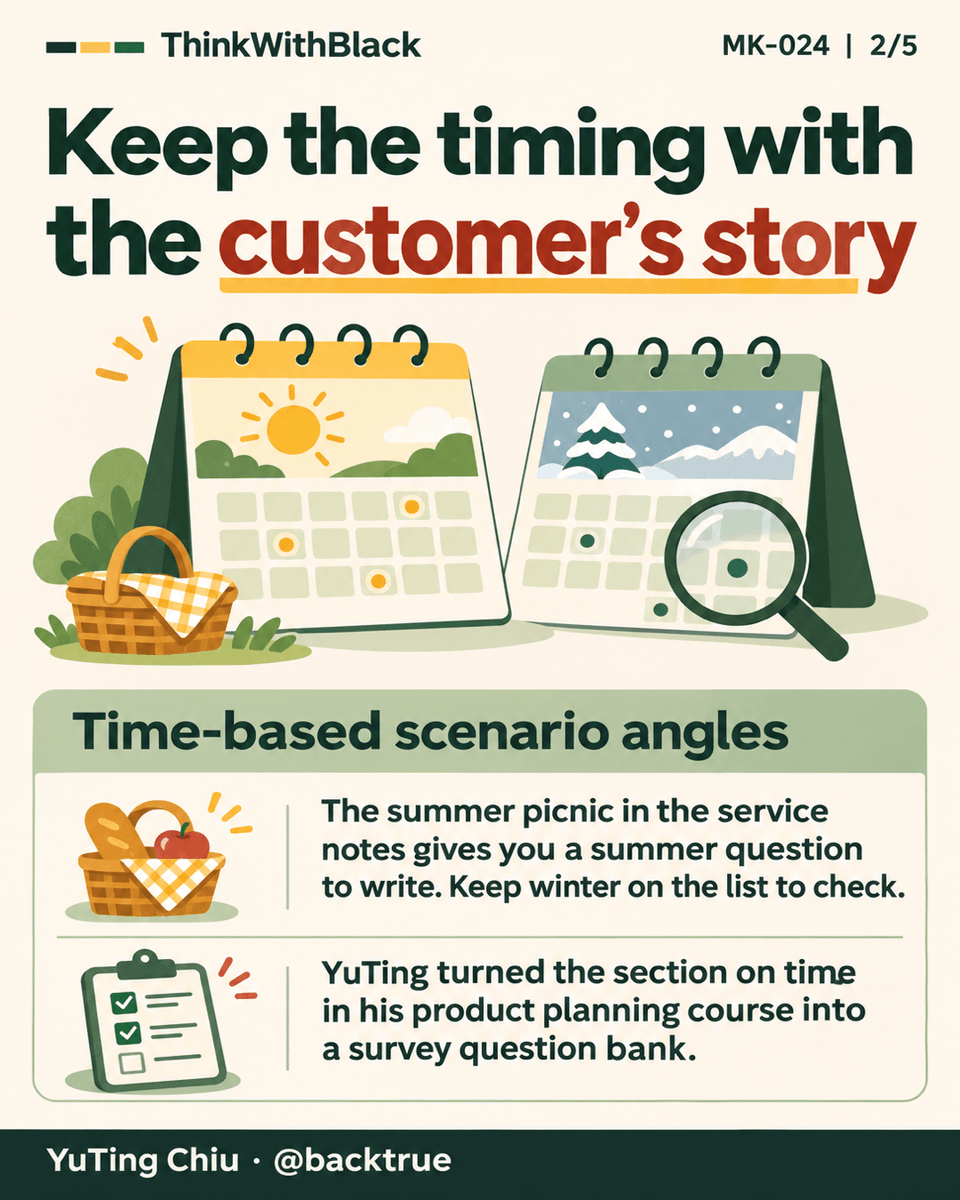
Say a customer tells support they took two lunch boxes to a picnic after work in summer. They ask whether your cooler bag will fit both boxes next time. When the team plans its winter campaign, it uses that note to ask, “Would you need a cooler bag for a winter gathering?” Then it asks what people would pay.
The survey comes back with choices and prices. You cannot tell who has had that need and who was picturing the scene you gave them. That makes it hard to decide what the winter campaign should say.
I use MK-024, Time-based scenario angles, to keep the time and the activity with the service note. The method comes from the section on time in my course materials on planning products and product lines. Use the summer record to write a summer question. Put winter on the list to investigate.
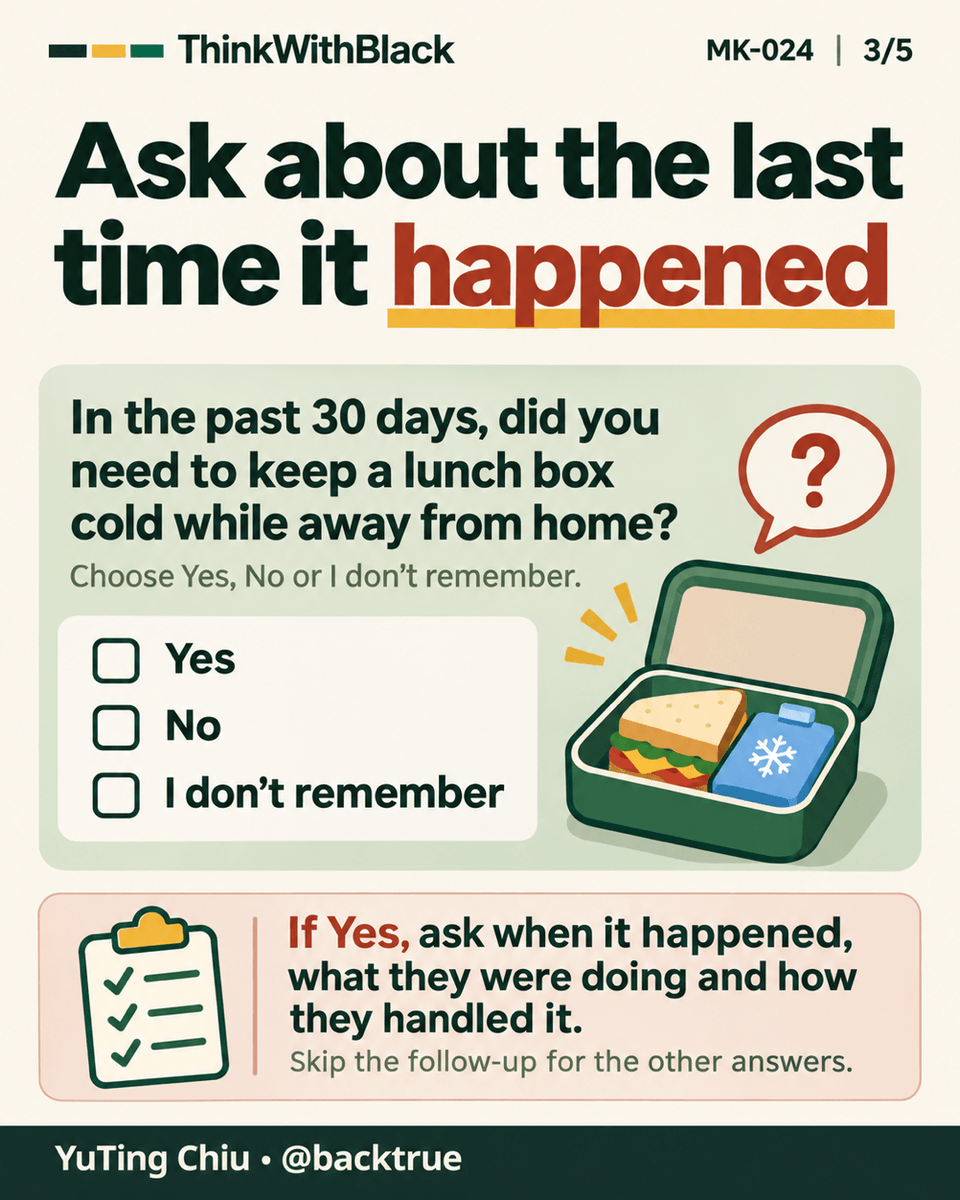
Start with “In the past 30 days, did you need to keep a lunch box cold while away from home?” Give people Yes, No and I don't remember. After Yes, ask when it happened, what they were doing and how they handled it. Skip the follow-up for the other answers.
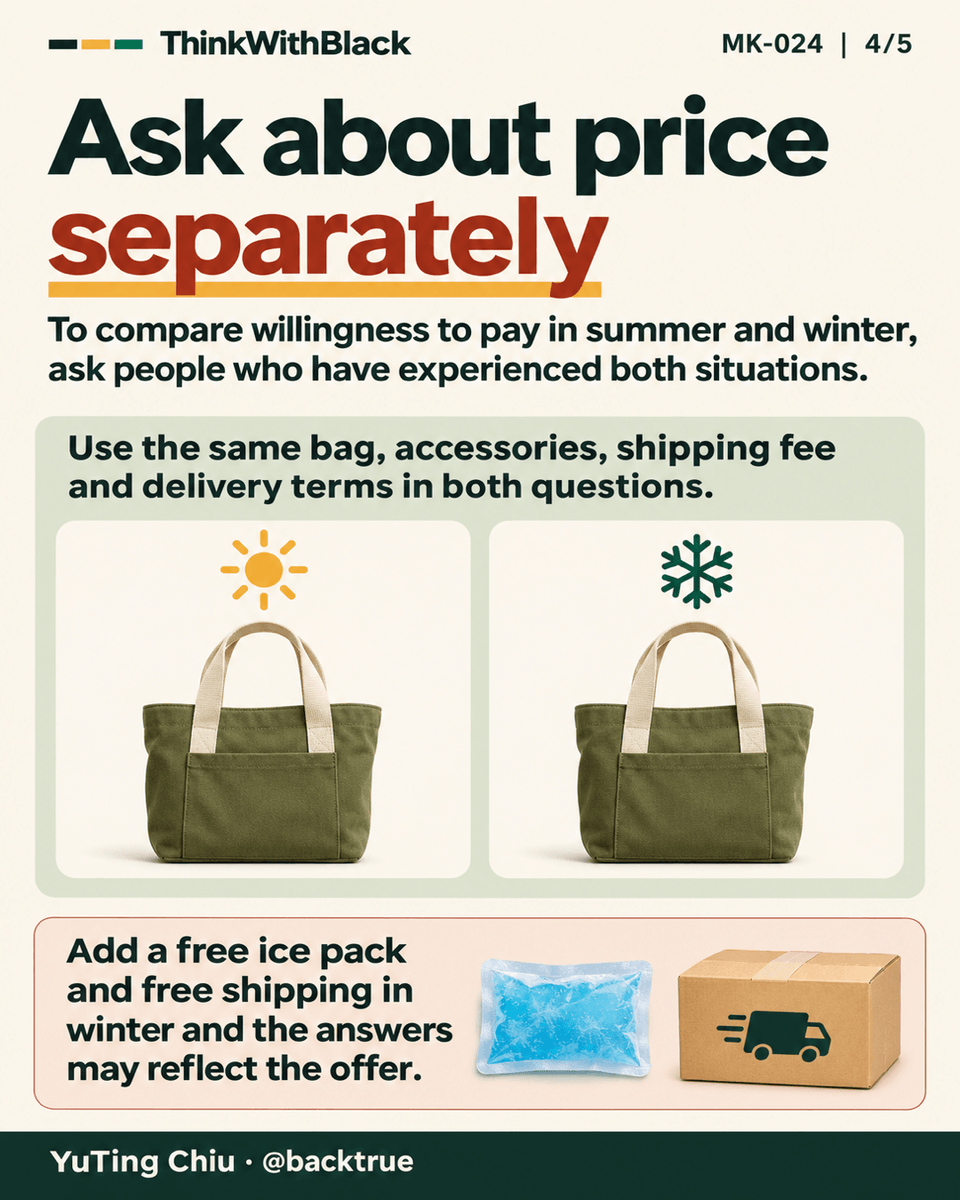
If you compare willingness to pay in summer and winter, ask people who experienced both. Show the same bag, accessories, shipping fee and delivery conditions. Add a free ice pack and free shipping in winter and the answers may reflect the offer.
The seven fields give your team the question, the people to ask, the recall period, the response format, the source, the separate price question and the skip logic. They can collect accounts of summer use and see what they still need to find out about winter.
Download MK-024 from ThinkWithBlack Skills and try one question with a product and service notes with personal details removed.
https://t.co/ZS8mssBa27
YuTing Chiu · @backtrue · ThinkWithBlack