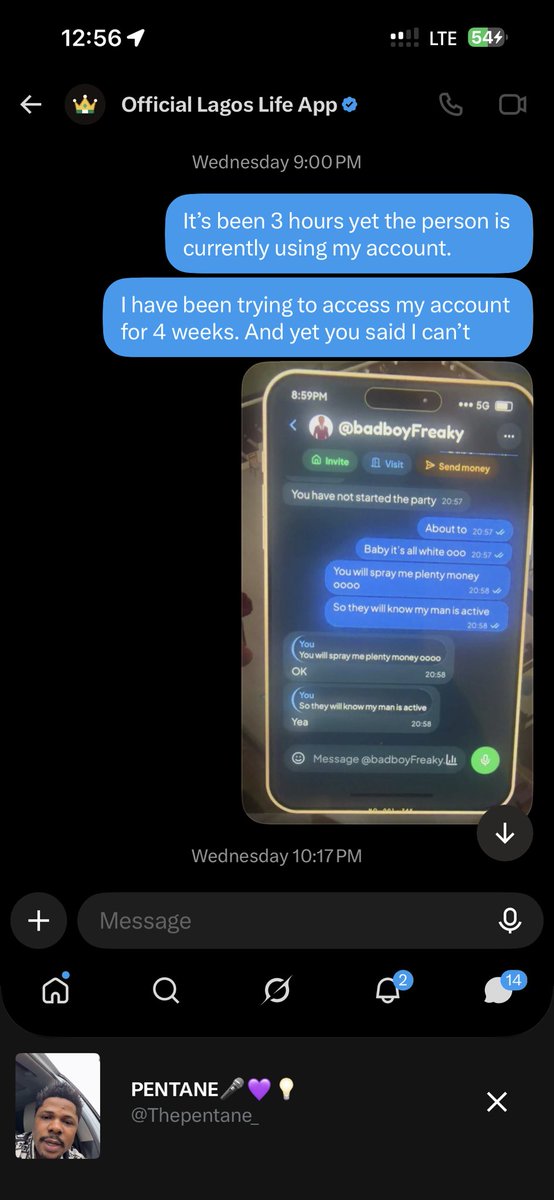
@LagosLifeApp it’s been one month since my account has been hacked and yall will do anything but give me access back to my account. I have answered all question to proof I own this account yet nothing has been done. My wife and 9 kids all my cars gone. Yall can enjoy your game
@ibcityannouncer Olubadan is no more different from Oluwo. First it was Mecca , partisan politics. Now going to greet President at the airport. It use to be presidents visiting traditional rulers in their palace. Everything is wrong with this sets of traditional rulers WTF !!!
If you’re a patriot of our great nation you will agree the country need a total overhaul of the current status quo and YES Peter/Tboy/Atiku are not the answer !!
19th November, 2026.
PRESS STATEMENT
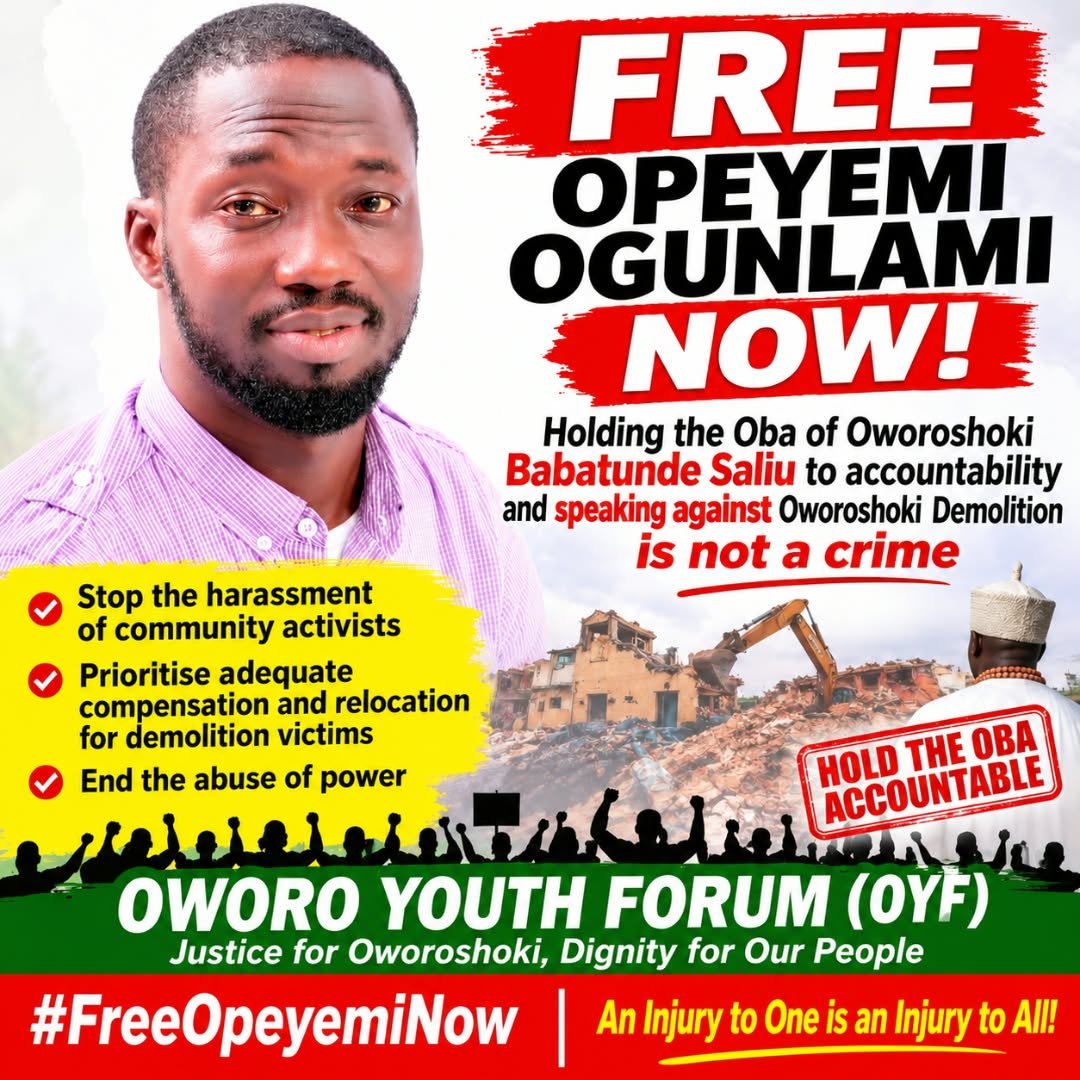
OWORO YOUTH FORUM CONDEMNS ARREST OF COMRADE OPEYEMI OGUNLAMI, DEMANDS HIS IMMEDIATE AND UNCONDITIONAL RELEASE
The Oworo Youth Forum strongly condemns the arrest of Comrade Opeyemi Ogunlami, one of the leaders of our organisation and a longstanding community rights activist, who was arrested today and taken to the Police Zone 2 Command in Onikan, Lagos, over an allegation of cyberstalking the Oba of Oworonshoki, Oba Babatunde Saliu.
According to information received from Comrade Ogunlami, about three hours before this statement, some police officers stormed his office in Oworonshoki and asked him to accompany them to Zone 2, initially claiming that a stolen phone had been tracked to him. However, upon arriving at the command, he communicated to us indicating that his arrest was connected to an allegation of cyberstalking the Oba of Oworonshoki.
We find the circumstances surrounding his arrest deeply troubling. The manner in which the police officers stormed his office, the initial explanation given for taking him away, and the subsequent revelation of a different allegation raise serious questions about the motive and procedure behind his arrest.
We have strong reasons to suspect that this arrest may not be unconnected to Comrade Ogunlami's longstanding activism and his consistent defence of the rights of Oworonshoki residents, particularly victims of forced eviction and demolition. His courage in speaking out against injustice, challenging abuses of power and standing in solidarity with displaced residents has made him a prominent voice in the struggle for justice in Oworonshoki.
Comrade Opeyemi Ogunlami is a transparent, courageous and committed activist and community leader who has dedicated over two decades to defending the rights, dignity and interests of Oworonshoki people. His record of community service and activism is well known. He is not a criminal whose voice should be silenced through intimidation, harassment or the abuse of state institutions.
We are particularly concerned that this matter is being handled by Zone 2 Command, given the controversies surrounding the role of the current head of the command, DIG Moshood Jimoh, during his tenure as Commissioner of Police in Lagos State, particularly in relation to the forced eviction crisis in Oworonshoki. These circumstances reinforce our concerns about the possibility of the police being deployed to settle personal scores or intimidate those demanding accountability.
We condemn in the strongest terms the Gestapo-style manner of Comrade Ogunlami's arrest. If the police had any genuine questions or allegations against him, they could have extended a formal invitation, which we are confident he would have honoured. There was absolutely no justification for the manner in which officers reportedly stormed his office and took him away.
Meanwhile, the humanitarian consequences of the Oworonshoki demolition remain devastating. Victims are yet to receive adequate compensation or proper relocation, and many displaced families are still sleeping in the open, exposed to cold, harsh weather conditions and the risk of various diseases. More than 30 people have reportedly died as a consequence of the demolition crisis. Yet, instead of prioritising justice, adequate compensation and decent relocation for thousands of displaced residents, there appears to be a growing atmosphere of intimidation and harassment against those demanding accountability.
We insist that the priority of the authorities and traditional institutions should be addressing the suffering of displaced residents, ensuring adequate compensation, providing decent and permanent relocation, and investigating the deaths and human rights abuses associated with the demolition. Harassing community activists will neither resolve the humanitarian crisis nor erase the demand for justice.
Igbos are essential to Nigeria’s configuration. About 17 million live in the North, 10 million in Lagos alone. A tolerant group cannot afford intolerance, you must reach out. Peter Obi cannot be more popular than Buhari, who ran in 2003, 2007 and 2011 until a handshake across Niger delivered victory in 2015.
- VP Kashim Shettima
What you are raising is a real historiographical debate (the critique of "Nagô-centrism" in Bahian ethnography), but explaining Yoruba prominence in Brazil as an invention of "20th-century white, racist academics" is a complete denial of Black agency in this process of cultural change.
First, the idea that early white scholars invented Nagô prestige ex nihilo is an anti-essentialist ethnographic narrative championed by scholars like Roberto Motta and Beatriz Góis Dantas, and it has already been refuted by historians like Luis Nicolau Parés and J. Lorand Matory. In Black Atlantic Religion, Matory shows that as early as the late 1800s, freed Afro-Brazilian returnees (Agudás) and Black Lagosian elites ran a thriving transatlantic circuit between Lagos and Bahia, actively cultivating ties to West Africa and championing Yoruba traditionalism decades before 1930s anthropologists showed up. This circuit produced a number of influential Black leaders. A prime example is Martiniano Eliseu do Bonfim, born in Bahia in 1859 to freed African parents. In 1875, his father took him to Lagos, where he attended the Presbyterian Faji School and underwent initiation as a babal��wo (Ifá diviner) during an eleven-year stay ending in 1886. Another key figure in this Brazilian-Lagosian circuit was the babaláwo Felisberto Sowzer (anglicized as "Souza"), grandson of the Oyo diviner Manoel Rodolfo Bamgbose,the progenitor of many important Ifa-Babalawo families in Lagos, Bahia, and Rio.
Second, nobody in serious scholarship claims Bahian Candomblé is "100% pure" Yoruba. Even the most traditional "pure Nagô" terreiros still use Jeje (Gbe) terms for their core ritual functions: dofona (initiate), peji (shrine room), hunco (initiation room), and hun (drums). It was an internal African synthesis, not a white intellectual sorting exercise.
Third, the modern "re-Africanization" and "purity" push did not come from racist white professors. As Parés documents, Black Brazilian activists (Movimento Negro Unificado, SECNEB) drove it in the 1970s and 1980s, inspired by Pan-Africanism and the US Civil Rights movement as an anti-colonial strategy.
Fourth, within Bahia, "Nagô" functioned as an initiatory religious identity rather than biological bloodline gatekeeping. As Parés notes, Mãe Aninha, the fiercest champion of "pure Nagô" orthodoxy at Axé Opô Afonjá, was the daughter of Grunci, parents from Ghana with zero Yoruba ancestry.
Finally, Bantu-Kongo heritage is hardly in the shadows in Brazil. Because West-Central Africans arrived earlier and dispersed widely across the country, they provided Brazil's foundational cultural bedrock, with Kimbundu and Kikongo dominating Portuguese loanwords while producing Brazil's most globally famous cultural exports, such Samba, Capoeira, and Congada.
So, yes, early ethnographers like Nina Rodrigues and Arthur Ramos did construct an artificial hierarchy of "purity" that favored Yoruba (Nagô) traditions over Bantu-Kongo ones. And yes, West-Central Africans made up roughly 70% of captives brought to Brazil across the entire trade. But calling modern diaspora reverence "Yoruba ancestral supremacy politics" casts Afro-Brazilians as passive participants in culture-making while erasing how Nagô priestesses (Iyalorixás like Mãe Aninha, Mãe Menininha, and Mãe Senhora) strategically leveraged alliances with intellectuals, artists, and politicians from the 1930s to 1950s to shield their communities from brutal police repression and state persecution.
I honestly think Nigerians need to engage in some serious introspection over this South African fiasco. Having to constantly remind South Africans of Nigeria’s magnanimity and sacrifices 35–45 years ago is beginning to sound like glorified emotional blackmail, particularly when many of the South Africans we are appealing to were not even born when those events took place.
We must also be honest about the conduct of some Nigerians in South Africa. Drug trafficking, armed robbery, theft, prostitution and other criminal activities have undoubtedly contributed to the negative perception of Nigerians and fuelled resentment among sections of the South African population.
None of this justifies xenophobia or violence against innocent Nigerians. But we cannot keep demanding tolerance and goodwill without confronting the behaviour of some of our own. A people must be willing to look inward, acknowledge their shortcomings and take responsibility. Nigerians need to fix up.
Ekiti is truly an ancient town (Otu Ife).
Egun (Masquerade) remains an integral part of our culture.
Ekiti masquerades are covered in Mariwo.
As civilization spread down the river to Lagos, some adopted cloths & Mariwo but Ijebu, Oyo & Lagos all wear cloths.
@AKakanfo “I hope, however, it will be a long time before any other supercedes the musical Yoruban tongue.” (Stone, 1850s, pg 280)
“A Yoruba goes so far as to consider that his language is sufficiently musical to be easily imitated instrumentally” - Milson, 1891
https://t.co/ijaCBVkuKo