After 2 months of everyday use, I can say that setting up a personal research engine is one of the highest-ROI things you can do if you like to learn and stay on top of things at the edge
- Use a cloud-hosted agent, probably hermes or openclaw
- Learn about memory systems and encoding (cognee is very good at this)
- Build the right commands for parsing data and storing it (tag things properly, encode and save full text and key ideas)
- Build recurring jobs so the system grows itself (rss ingestion, auto twitter scroll, newsletter following)
- Build advanced skills that create connections between ideas, surface the most important info, and create digests for you automatically
- Build search retrieval skills that actually pull what you need and don't forget or miss things
Will change your life
deepseek is raising a monster $7 billion round at $50B val making it china's largest ever AI raise but what shocks me the most is the founder, liang wenfeng:
> he's personally contributing 40% of the round himself. $3 billion.
> he owns 90 PERCENT of the company (unheard of at this valuation)
> deepseek was founded inside his hedge fund, one of China's most successful funds.
guys a fucking beast. this round is meant to achieve 2 things:
1. acquire as much compute to push out new deepseek models more often
2. turn deepseek revenue-positive by pushing new enterprise products (same tactic as OAI and anthropic)
deepseek v4.1 is expected to release soon.
The man who killed the $10,000 GPU myth. He did it alone, from Bulgaria, with one C file. 🤯
Meet Georgi Gerganov.
>Bulgarian developer. Nobody had heard of him.
>In March 2023, Meta’s LLaMA model leaked online
>Within days he wrote a single C file
>Called it llama.cpp
>It ran a full AI model on a MacBook. No GPU. No cloud.
>The entire AI industry said you needed $10,000 GPUs to run LLMs 🔥
>He proved you didn’t. On a laptop. Alone.
>Also built whisper.cpp ~ same thing for voice AI
> His code is the foundation of Ollama, LM Studio, and GPT4All
>107,000+ GitHub stars. Fastest open-source AI project to hit 100K ever. 🚀
>In 2026 Hugging Face hired his entire team
>Still ships code. Still open source. Still free.
Every time you run AI locally, you’re running his work.
Absolute Legend 🐐
more founders are choosing bootstrapping over VC
- liquidity events now take 14 years on average. up from 7. that's your entire 30s waiting for an exit that might never come.
- bootstrapped startups are 3x more likely to be profitable within 3 years. VC-backed companies optimize for growth metrics, not money in the bank
- preferred shares mean founders often walk away with nothing. even when the company "succeeds," VCs get paid first. sometimes that's all there is
- bootstrapped companies spend 1/4 of what VC-backed startups spend on customer acquisition and grow just as fast. capital efficiency wins
- VCs can force a sale whenever it suits them. drag-along clauses give them that power. you built it, they decide when to sell it
- fundraising takes 4-5 months of full-time work. that's 4-5 months not building your product or talking to customers. most founders who reach traction don't need VCs anymore by then
- AI tools let solo founders build what used to require a 10-person team. the capital requirement that made VC necessary is disappearing
- 38% of startups now launch without external funding. up from 26% in 2019. the shift is already happening
- most VCs are not operators. they can pressure you to grow but can't help you build. the "value add" is often just intros to other portfolio companies
- VC money outside of AI has dried up. if you're not building AI, you're fighting for scraps anyway
- a $10M business you own 80% of beats a $100M valuation where VCs control the outcome. math is math
- the ZIRP era is over. cheap money inflated VC activity for a decade. that's not coming back
- founders are getting ousted by their own boards. the company you built becomes a job you can be fired from
- VC turns you into a middle manager of your own company. board meetings, investor updates, formal reporting. you didn't quit your job to get another boss
- the pressure to hit arbitrary growth targets breaks people. chasing 3x year over year because your investors need it, not because your business needs it
- you stop building what customers want and start building what looks good in a pitch deck. that's how products die
- VCs funded hundreds of AI startups in the last few years. most are already dead or irrelevant. the foundation model companies just absorbed their use cases
- when funding dries up, VC-backed companies panic. bootstrapped companies just keep going. you're already used to operating lean.
you started a company for freedom. VC often takes that away
if the business feeds your life and you control it, why give that up?
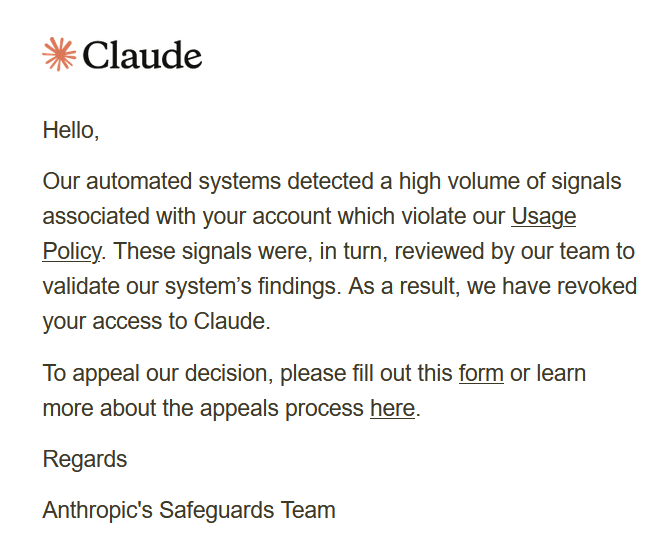
I paid to upgrade my Claude account yesterday, I got suspended one second later. I didn't even have the chance to open the Claude app or do any activity at all.
@AnthropicAI This is quite annoying and unprofessional. I hope this doesn't happen to many people!
Breaking: The President's son is on a heater
Donald Trump Jr's fund invested in one of the only U.S. rare earth magnet startups at a $200M valuation
Three months later, the Pentagon awarded Vulcan a $620M loan and the Commerce Dept took a $50M equity stake
In February, Trump announced a $12B rare earth strategic reserve
Today, the company is now valued at $2 billion. That's a 10x for Trump Jr in under a year
Vulcan is building the largest rare earth magnet factory outside of China. The U.S. says it needs to stop relying on China, which controls 90% of global rare earth processing
The timing is either the greatest coincidence in investing history, or it isn't
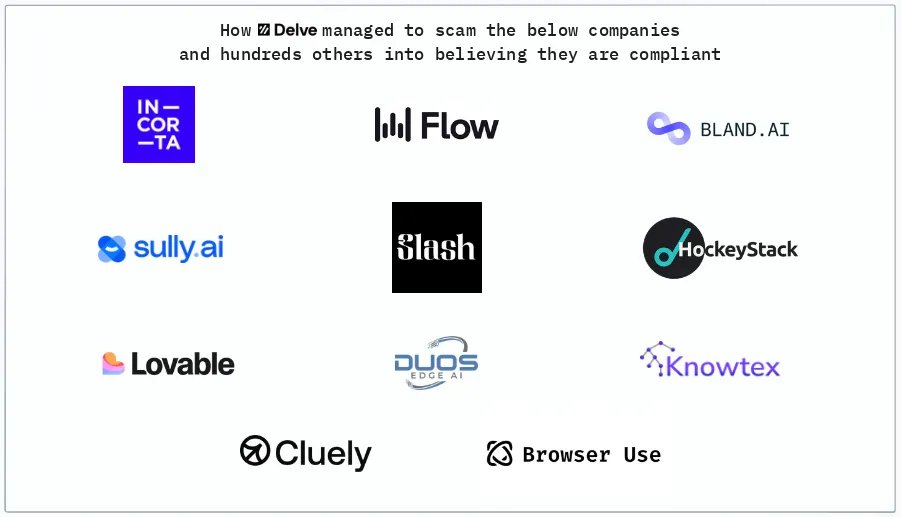
Delve, a YC-backed compliance startup that raised $32 million, has been accused of systematically faking SOC 2, ISO 27001, HIPAA, and GDPR compliance reports for hundreds of clients. According to a detailed Substack investigation by DeepDelver, a leaked Google spreadsheet containing links to hundreds of confidential draft audit reports revealed that Delve generates auditor conclusions before any auditor reviews evidence, uses the same template across 99.8% of reports, and relies on Indian certification mills operating through empty US shells instead of the "US-based CPA firms" they advertise. Here's the breakdown:
> 493 out of 494 leaked SOC 2 reports allegedly contain identical boilerplate text, including the same grammatical errors and nonsensical sentences, with only a company name, logo, org chart, and signature swapped in
> Auditor conclusions and test procedures are reportedly pre-written in draft reports before clients even provide their company description, which would violate AICPA independence rules requiring auditors to independently design tests and form conclusions
> All 259 Type II reports claim zero security incidents, zero personnel changes, zero customer terminations, and zero cyber incidents during the observation period, with identical "unable to test" conclusions across every client
> Delve's "US-based auditors" are actually Accorp and Gradient, described as Indian certification mills operating through US shell entities. 99%+ of clients reportedly went through one of these two firms over the past 6 months
> The platform allegedly publishes fully populated trust pages claiming vulnerability scanning, pentesting, and data recovery simulations before any compliance work has been done
> Delve pre-fabricates board meeting minutes, risk assessments, security incident simulations, and employee evidence that clients can adopt with a single click, according to the author
> Most "integrations" are just containers for manual screenshots with no actual API connections. The author describes the platform as a "SOC 2 template pack with a thin SaaS wrapper"
> When the leak was exposed, CEO Karun Kaushik emailed clients calling the allegations "falsified claims" from an "AI-generated email" and stated no sensitive data was accessed, while the reports themselves contained private signatures and confidential architecture diagrams
> Companies relying on these reports could face criminal liability under HIPAA and fines up to 4% of global revenue under GDPR for compliance violations they believed were resolved
> When clients threaten to leave, Delve reportedly pairs them with an external vCISO for manual off-platform work, which the author argues proves their own platform can't deliver real compliance
> Delve's sales price dropped from $15,000 to $6,000 with ISO 27001 and a penetration test thrown in when a client mentioned considering a competitor
Huge repository of information about OpenAI and Altman just dropped — 'The OpenAI Files'.
There's so much crazy shit in there. Here's what Claude highlighted to me:
1. Altman listed himself as Y Combinator chairman in SEC filings for years — a total fabrication (?!):
"To smooth his exit [from YC], Altman proposed he move from president to chairman. He pre-emptively published a blog post on the firm's website announcing the change.
But the firm's partnership had never agreed, and the announcement was later scrubbed from the post."
"...Despite the retraction, Altman continued falsely listing himself as chairman in SEC filings for years, despite never actually holding the position."
(WTAF.)
2. OpenAI's profit cap was quietly changed to increase 20% annually — at that rate it would exceed $100 trillion in 40 years. The change was not disclosed and OpenAI continued to take credit for its capped-profit structure without acknowledging the modification.
3. Despite claiming to Congress he has "no equity in OpenAI," Altman held indirect stakes through Sequoia and Y Combinator funds.
4. Altman owns 7.5% of Reddit — when Reddit announced its OpenAI partnership, Altman's net worth jumped $50 million. Altman invested in Rain AI, then OpenAI signed a letter of intent to buy $51 million of chips from them.
5. Rumours suggest Altman may receive a 7% stake worth ~$20 billion in the restructured company.
5. OpenAI had a major security breach in 2023 where a hacker stole AI technology details but didn't report it for over a year. OpenAI fired Leopold Aschenbrenner explicitly because he shared security concerns with the board.
6. Altman denied knowing about equity clawback provisions that threatened departing employees' millions in vested equity if the ever criticised OpenAI. But Vox found he personally signed the documents authorizing them in April 2023. These restrictive NDAs even prohibited employees from acknowledging their existence.
7. Senior employees at Altman's first startup Loopt twice tried to get the board to fire him for "deceptive and chaotic behavior".
9. OpenAI's leading researcher Ilya Sutskever told the board: "I don't think Sam is the guy who should have the finger on the button for AGI".
Sutskever provided the board a self-destructing PDF with Slack screenshots documenting "dozens of examples of lying or other toxic behavior.
10. Mira Murati (CTO) said: "I don't feel comfortable about Sam leading us to AGI"
11. The Amodei siblings described Altman's management tactics as "gaslighting" and "psychological abuse".
12. At least 5 other OpenAI executives gave the board similar negative feedback about Altman.
13. Altman owned the OpenAI Startup Fund personally but didn't disclose this to the board for years. Altman demanded to be informed whenever board members spoke to employees, limiting oversight.
14. Altman told board members that other board members wanted someone removed when it was "absolutely false". An independent review after Altman's firing found "many instances" of him "saying different things to different people"
15. OpenAI required employees to waive their federal right to whistleblower compensation. Former employees filed SEC complaints alleging OpenAI illegally prevented them from reporting to regulators.
16. While publicly supporting AI regulation, OpenAI simultaneously lobbied to weaken the EU AI Act.
By 2025, Altman completely reversed his stance, calling the government approval he once advocated "disastrous" and OpenAI now supports federal preemption of all state AI safety laws even before any federal regulation exists.
Obviously this is only a fraction of what's in the apparently 10,000 words on the site. Link below if you'd like to look over.
(I've skipped over the issues with OpenAI's restructure which I've written about before already, but in a way that's really the bigger issue.)
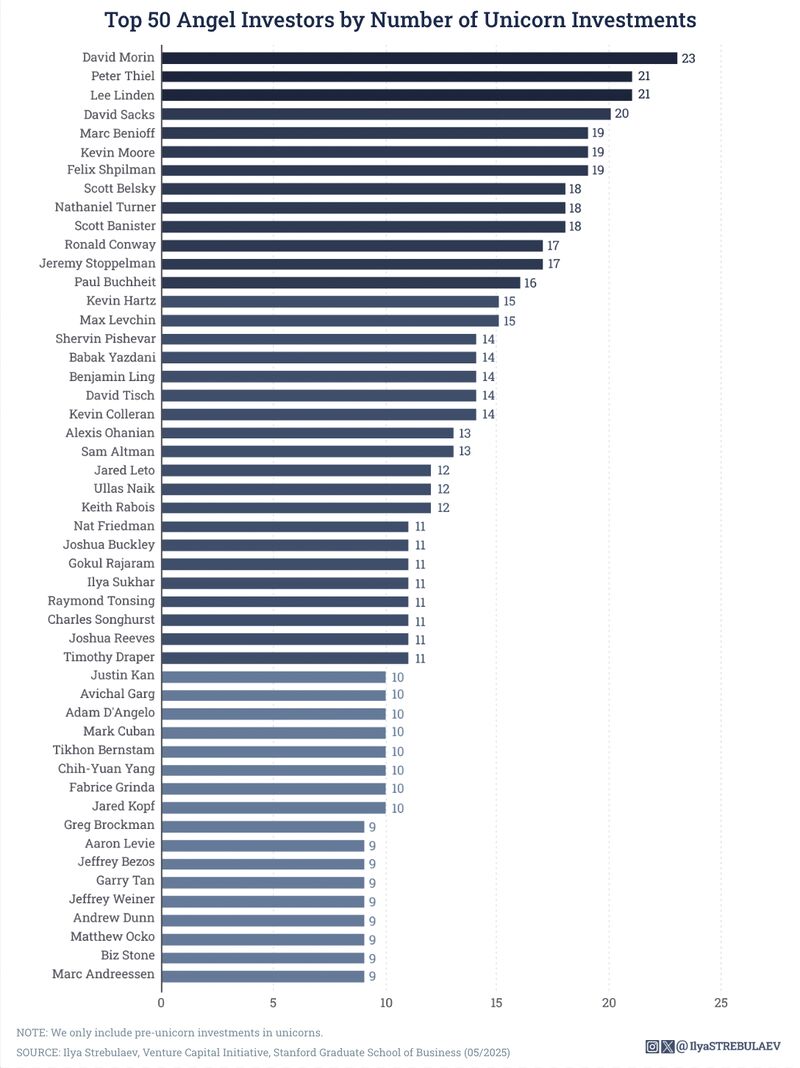
A Stanford professor analyzed 1,000's of angel investments to find out who's had the MOST unicorns.
The results are fascinating.
- David Morin tops the list with 23 unicorns
- Peter Thiel and Lee Linden follow with 21 each
- David Sacks at 20
- Marc Benioff at 19
A few things that stand out:
1) Almost every top angel was a founder or exec at a large tech company first. The clear signal here - they were mostly operators who earned their access.
2) Many co-invested together repeatedly. Thiel, Sacks, and Levchin all overlapped at PayPal and went on to back the same unicorns (Facebook, Airbnb, Palantir Technologies, SpaceX).
3) No women appear in the top 50. Sad.
4) The entry threshold to make this list is 9 unicorns (nuts!). The average unicorns across the top 50 is 13 (more nuts!).
I share this for folks to have inspiration to angel invest themselves!
There has NEVER been a better time - we are at a major tech inflection point.
If you're thinking about angel investing and forming angel syndicates, you should check out Verivend. Automated capital calls, one-click funding for co-investors, real-time visibility into who's in. Seamless software with a great team to hold your hand through it.
Try it yourself: https://t.co/qZ4U3OB2AY
Full credit to Ilya Strebulaev and his team at the Stanford for this research.
Some comments on Taalas HC1:
- It’s real. Try it yourself. At ~16k tokens/sec, the output is instantaneous.
- The current demo model is aggressively quantized (roughly 3–6 bits). The goal was to prove the system works end-to-end. Improving quantization quality, that's the easy part.
- Their next iteration, a mid-size reasoning LLM, will be much more accurate.
- The weights are frozen, but the chip supports LoRA adapters (high-rank), so you can still adapt it to your domain. In practice, you could also distill knowledge from newer/larger models into adapters to “refresh” what the chip can do without changing base weights.
- Frontier open-weight models to land on the platform this year.
Taalas just came out of stealth and the approach is wild - they hardwire AI models directly into silicon. No memory. No data shuttling. The model IS the chip.
Their first chip runs Llama 3.1 8B at 17,000 tokens/sec per user. For context that's 28x faster than Groq.
But the chip isn't the story. The process behind it is.
They built a reusable base chip where only 2 mask layers change per model. Meaning... new model to working silicon in 8 weeks. Not years. Weeks.
Here's the breakdown:
17,000 tokens/sec per user
$0.0075 per 1M tokens (13x cheaper than Cerebras)
200W per card, standard air cooling
25 employees, $30M spent of $219M raised
The honest trade-off - v1 uses aggressive 3-6 bit quantization so quality takes a hit. Great for data tagging, classification, voice agents. Not frontier reasoning yet.
The real bet here is that AI training changes fast but inference wants stability. Same model, millions of users, relentless cost reduction. If production models
stabilize on ~1 year cycles, an 8-week model-to-silicon pipeline changes the entire economics of running AI.
Try it yourself at https://t.co/HvhzcvxaOQ - can't wait until they bake in a MiniMax, Kimi, etc