اتمنى اني اكون غلطان وتكون صح
لكن كميه الاغلاط المباشره اللي تصير للمرضى فقط عشان تزبيط المؤشرات واهمال المرضى وتنويمهم احيانا تحت الاقسام الخاطئه فقط عشان المؤشر نذير شؤم
المريض صاير مجرد معامله لازم تنتهي في وقت محدد بعض النظر عن النتيجه النهائيه
الصحة القابضة … هل نجحت في قيادة أكبر تحول صحي في تاريخ المملكة؟
📌عندما أطلقت المملكة رؤية 2030، كان واضحاً أن القطاع الصحي سيكون أحد أكثر القطاعات التي ستشهد تحولاً جذرياً. فالنمو السكاني المتسارع، وارتفاع الطلب على الخدمات الصحية، وتغير توقعات المستفيدين، كلها عوامل فرضت الحاجة إلى نموذج جديد أكثر كفاءة واستدامة وقدرة على تقديم الرعاية الصحية بجودة عالية.
📌ومن هنا بدأت رحلة التحول الصحي التي انطلقت فعلياً منذ عام 2016 ضمن برامج الرؤية، قبل أن تتبلور ب��كل أكبر من خلال إنشاء التجمعات الصحية التي هدفت إلى توحيد الخدمات الصحية داخل كل منطقة جغرافية وتعزيز التكامل بين الرعاية الأولية والمستشفيات والخدمات التخصصية.
📌��كن التحول الحقيقي جاء مع تأسيس شركة #الصحة_القابضة في عام 2022، في خطوة مثلت نقطة تحول تاريخية في إدارة القطاع الصحي الحكومي. فقد تم فصل دور وزارة الصحة كمشرّع ومنظم للقطاع عن دور مقدمي الخدمة، وهو نموذج معمول به في العديد من الأنظمة الصحية المتقدمة حول العالم.
📌ولم يكن تأسيس الصحة القابضة مجرد إعادة هيكلة تنظيمية، بل صاحبه توجه واضح لاستقطاب نخبة من القيادات التنفيذية البارزة بالقطاع الخاص لقيادة المرحلة الجديدة. فقد أدرك صناع القرار أن نجاح التحول لا يعتمد فقط على الأنظمة واللوائح، بل على وجود قيادات تمتلك خبرات عملية في الحوكمة وإدارة الأداء والتحول المؤسسي والكفاءة التشغيلية، وهو ما انعكس بشكل واضح على طبيعة الإدارة الجديدة للتجمعات الصحية والمنظومة ككل.
📌وخلال فترة زمنية قصيرة نسبياً بدأت نتائج التحول تظهر بشكل ملموس. فقد شهد القطاع الصحي تطوراً كبيراً في الحوكمة المؤسسية، وارتفعت مستويات المساءلة وقياس الأداء، وأصبح التركيز موجهاً نحو جودة الخدمة وتجربة المستفيد بدلاً من التركيز التقليدي على حجم النشاط التشغيلي فقط.
📌ولعل من أهم مؤشرات نجاح أي تحول مؤسسي قدرته على التعامل مع الأحداث الكبرى والضغوط الاستثنائية. وهنا يبرز موسم الحج باعتباره أحد أصعب الاختبارات التشغيلية لأي نظام صحي في العالم، نظراً لما يشهده من تجمع بشري ضخم خلال فترة زمنية قصيرة وفي نطاق جغرافي محدود.
📌وقد أثبتت المنظومة الصحية خلال مواسم الحج الأخيرة، وبالأخص حج 2025 وحج 2026، قدرة استثنائية على التخطيط والتنسيق وإدارة الموارد الصحية بكفاءة عالية. فقد تم تقديم مئات الآلاف من الخدمات الصحية للح��اج، وإجراء آلاف العمليات والتدخلات الطبية المتقدمة، مع المحافظة على مستويات عالية من الجاهزية والاستجابة السريعة والتكامل بين المستشفيات والمراكز الصحية والخدمات الإسعافية. ولم يكن هذا النجاح وليد الصدفة، بل نتيجة مباشرة لبناء نموذج مؤسسي جديد يعتمد على التكامل والحوكمة ووضوح المسؤوليات وقياس الأداء.
📍📍ورغم ذلك، لا تزال بعض الآراء ��حاول تقييم تجربة الصحة القابضة من خلال ملفات وتحديات تاريخية سبقت تأسيسها بسنوات طويلة، وهو أمر لا يخلو من قدر من عدم الإنصاف.
📌فعلى سبيل المثال، فإن التحديات المرتبطة بسعودة بعض المهن الصحية أو التوظيف في تخصصات مثل طب الأسنان والصيدلة أو بعض الاختلالات المتراكمة في سوق العمل الصحي، هي ملفات موجودة قبل إنشاء الصحة القابضة، وترتبط بمنظومة متكاملة تشمل التعليم والتدريب والتنظيم والتخطيط للقوى العاملة. وبالتالي فإن تحميل الصحة القابضة مسؤولية هذه الملفات أو استخدامها كمؤشر للحكم على نجاحها أو فشلها لا يعكس قراءة موضوعية لمسار التحول.
📌إن المعيار الحقيقي لتقييم #الصحة_القابضة يجب أن يكون: هل أصبحت المنظومة الصحية أكثر كفاءة مما كانت عليه؟ هل ارتفع مستوى التكامل بين الخدمات؟ هل أصبحت تجربة المستفيد محوراً أساسياً للمنظومة؟ وهل أصبحت المؤسسات الصحية أكثر قدرة على إدارة مواردها وتحقيق مستهدفاتها؟
📌وبالنظر إلى حجم التحول الذي شهدته المنظومة الصحية خلال السنوات الماضية، وإلى قدرتها على إدارة شبكة صحية تخدم أكثر من 30 مليون مستفيد عبر 20 تجمعاً صحياً، وإلى النجاح التشغيلي الذي ظهر في مواسم الحج والأزمات الصحية والمبادرات الوطنية الكبرى، فإن الإجابة تبدو إيجابية إلى حد كبير.
📌فالصحة القابضة لم تكتفِ بإدارة عملية انتقال معقدة، بل نجحت في بناء نموذج تشغيلي جديد للقطاع الصحي الحكومي،وتعزيز ثقافة الأداء والحوكمة، ورفع جاهزية المنظومة الصحية لمواجهة التحديات المستقبلية.
✅الخلاصة :لا تزال هناك تحديات وفرص تطوير قائمة، فالتحول بهذا الحجم لا يكتمل خلال سنوات قليلة. إلا أن ما تحقق حتى الآن يؤكد أن المملكة تسير في الاتجاه الصحيح نحو بناء نظام صحي أكثر كفاءة واستدامة ،وأن الصحة ��لقابضة أصبحت أحد أهم الممكنات لتحقيق مستهدفات رؤية المملكة 2030، وأحد أبرز النماذج الوطنية الناجحة في إدارة التحول المؤسسي على نطاق واسع
💦 Diuretics in the ICU are not kidney therapy, they are fluid balance therapy, and only work safely when renal perfusion is adequate.
Recent PubMed indexed literature emphasizes that loop diuretics are first line for fluid overload in critically ill patients, but they should not be used as a reflex response to oliguria. Before giving furosemide, ask: is the kidney perfused? Is MAP adequate? Is venous congestion present? Is cardiac output sufficient? Is the patient still fluid responsive or already fluid overloaded? (Ostermann et al., 2024).
A practical ICU approach:
First, restore perfusion pressure and stop unnecessary fluids 🚨
Second, confirm congestion: lung ultrasound, venous Doppler, echo, CVP trend, weight, cumulative balance, edema, oxygenation and renal function.
Third, give a loop diuretic if congestion is present and perfusion is acceptable. Typical ICU furosemide dosing may start at 20 to 40 mg IV in diuretic naive patients, but higher doses are often required in CKD, chronic loop exposure or severe congestion. Continuous infusion may help maintain natriuresis, but dose response matters more than delivery style (Ferrari et al., 2025).
The furosemide stress test is not a “diuretic trial.” It is a tubular function test. Common dosing is 1 mg/kg IV if furosemide naive or 1.5 mg/kg if previously exposed; urine output below 200 mL in 2 hours suggests high risk of AKI progression or need for RRT (La Via et al., 2025).
Diuretic resistance should trigger reassessment, not blind escalation: check renal perfusion, albumin, chloride, sodium, nephrotoxins, intra abdominal pressure, venous congestion, and drug delivery. Sequential nephron blockade with thiazide type diuretics, acetazolamide or mineralocorticoid antagonists may help selected patients, especially in acute heart failure (Marques et al., 2025; Prata et al., 2025).
Do not persist with diuretics when there is refractory hyperkalemia, severe acidosis, uremic complications, pulmonary edema with failure of diuresis, severe AKI with oliguria/anuria, or hemodynamic intolerance. That is when fluid removal becomes RRT.
The ICU question is not about how much furosemide?, Is this patient congested, perfused, responsive, and safe to diurese?
#ICU #CriticalCare #AKI #Diuretics #Furosemide #FluidOverload #Deresuscitation #RRT #Cardiorenal #HemodynamicsReferences
Ferrari, F., Clinical Pharmacokinetics, 64(7), 987–997. https://t.co/dsCxzyPDTn
La Via, L., Journal of Clinical Medicine, 14(8), 2595. https://t.co/Uk4c8cJhdD
Marques, P.,. Cardiorenal Medicine, 15(1), 462–483. https://t.co/GWaEKpLB56
Ostermann, M., Intensive Care Medicine, 50, 1331–1334. https://t.co/x1P2DmNW39
Prata, A. A.,. Critical Care, 29, 474. https://t.co/g6lcN4esPn
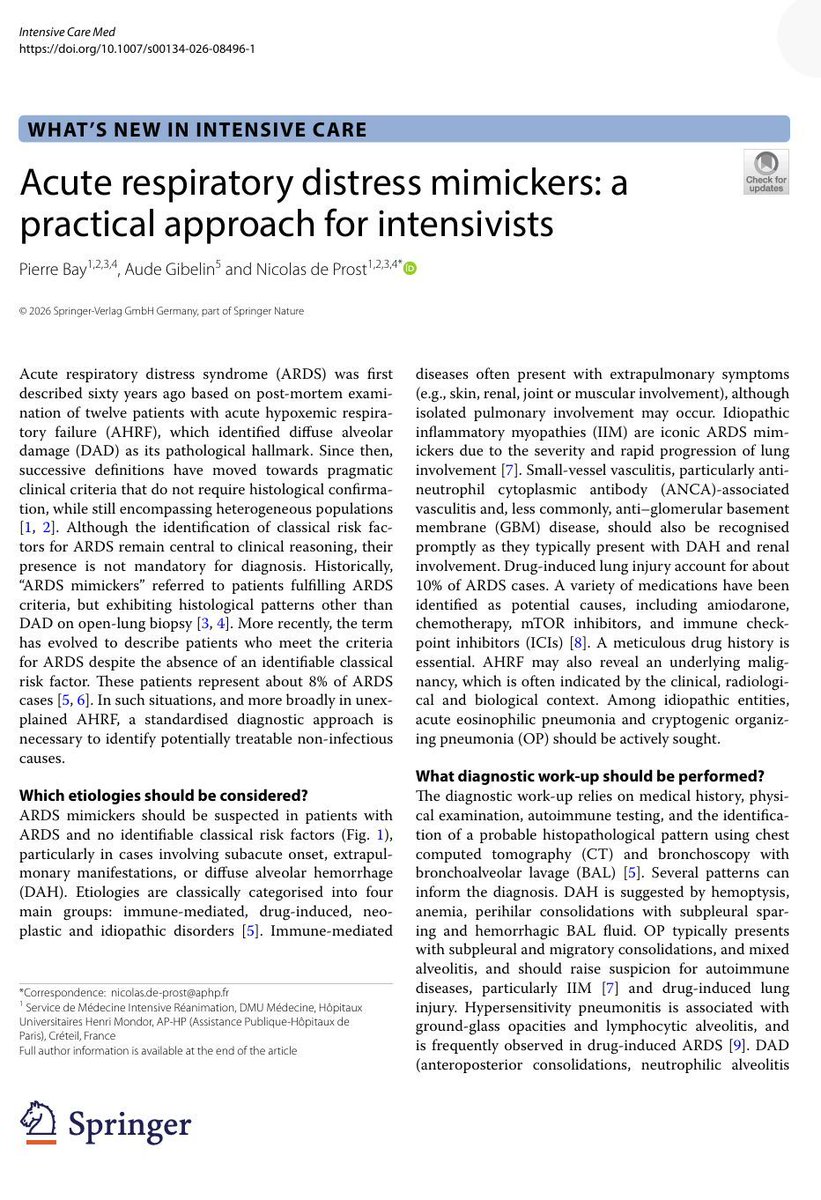
🫁 ARDS… or something else?
Every intensivist has faced it.
A patient arrives with acute hypoxemic respiratory failure, bilateral infiltrates, severe oxygenation impairment, and fulfills all clinical criteria for ARDS.
But what if it is not ARDS?
A timely review published in Intensive Care Medicine reminds us that approximately 8% of patients meeting ARDS criteria have no identifiable classical ARDS risk factor, and some of these patients harbor highly treatable diseases that require a completely different therapeutic strategy.
The authors propose a practical diagnostic framework for identifying ARDS mimickers, particularly when the presentation includes:
🔹 No clear ARDS risk factor
🔹 Subacute symptom onset
🔹 Extrapulmonary manifestations
🔹 Diffuse alveolar hemorrhage
🔹 Unexpected radiologic patterns
The major categories include:
✅ Immune-mediated diseases
• ANCA-associated vasculitis
• Anti-GBM disease
• Idiopathic inflammatory myopathies (anti-MDA5, antisynthetase syndrome)
✅ Drug-induced lung injury
• Amiodarone
• Chemotherapy
• mTOR inhibitors
• Immune checkpoint inhibitors
✅ Neoplastic pulmonary infiltration
✅ Idiopathic disorders
• Acute eosinophilic pneumonia
• Organizing pneumonia (OP)
One of the most useful concepts from this review is that diagnosis should not rely solely on the chest CT.
Instead, intensivists should combine:
📌 Detailed history and medication review
📌 Extrapulmonary examination (skin, joints, muscles, kidneys)
📌 Autoimmune testing
📌 Bronchoscopy with BAL
📌 Pattern recognition on CT imaging
The article highlights several time-critical diagnoses not to miss:
⚠️ Anti-MDA5 dermatomyositis and antisynthetase syndrome
ICU mortality approaches 50%, and up to 20% of patients require VV-ECMO. Early aggressive immunosuppression is essential.
⚠️ ANCA-associated vasculitis and anti-GBM disease
Prompt recognition of diffuse alveolar hemorrhage and initiation of immunosuppression can be life-saving and kidney-saving.
⚠️ Immune checkpoint inhibitor pneumonitis
A rapidly growing cause of severe respiratory failure in oncology patients that often responds to corticosteroid therapy if recognized early.
The key message is simple:
Not every patient fulfilling ARDS criteria has diffuse alveolar damage.
When classical risk factors are absent, the diagnosis should trigger curiosity rather than closure.
Because sometimes the difference between survival and mortality lies in recognizing the mimicker.
Question for the ICU community:
What is the most memorable ARDS mimicker you have encountered in your practice?
Reference 📚
Bay P, Gibelin A, de Prost N. Acute respiratory distress mimickers: a practical approach for intensivists. Intensive Care Medicine. 2026. DOI: 10.1007/s00134-026-08496-1.
📊 🍭 Blood Glucose in the ICU: Have We Been Asking the Wrong Question?
For years, critical care clinicians have debated one central question:
How low should we target blood glucose in critically ill patients?
This review suggests that the answer is more nuanced than a single number.
The key message is that blood glucose and mortality demonstrate a U-shaped relationship.
Both severe hyperglycemia and hypoglycemia are associated with worse outcomes, while the lowest mortality risk appears near normal glucose concentrations.
However, the real lesson from two decades of ICU glucose-control trials may not be about the glucose target itself.
It may be about how safely we achieve that target.
The authors highlight several critical principles:
✅ Avoid severe hyperglycemia
✅ Avoid hypoglycemia
✅ Avoid large glucose fluctuations
✅ Avoid insulin boluses
✅ Use accurate and frequent glucose measurements whenever tight control is attempted
One of the most interesting observations concerns nutrition.
The review reinforces evidence from EPaNIC, PEPaNIC, and subsequent studies showing that early full parenteral nutrition may worsen outcomes, partly by increasing iatrogenic hyperglycemia and suppressing beneficial metabolic processes such as autophagy and ketogenesis.
In other words:
Sometimes the best glucose management strategy starts with nutrition management rather than insulin management.
The authors propose a practical ICU approach:
🔹 Liberal control (<185–215 mg/dL) when tight monitoring is not feasible
🔹 Intermediate control (<150–180 mg/dL) for most critically ill patients
🔹 Tight control (80–110 mg/dL) only when supported by validated protocols, frequent measurements, experienced staff, and minimal hypoglycemia risk
Interestingly, recent evidence suggests that when tight glucose control is performed with modern algorithms that successfully avoid hypoglycemia, potential benefits may still exist, particularly regarding organ protection and possibly neurocritical care outcomes.
The review also looks ahead to future ICU glucose management:
🔹 Continuous glucose monitoring (CGM)
🔹 Closed-loop insulin systems
🔹 SGLT2 inhibitors
🔹 GLP-1 receptor agonists
🔹 Ketogenic and fasting-mimicking nutritional strategies
Perhaps the most important takeaway is this:
The goal is not simply lowering glucose. The goal is avoiding glucose toxicity while minimizing treatment-related harm.
That distinction may explain much of the controversy surrounding intensive insulin therapy over the last 20 years.
Reference 📚
Gunst J, Galindo RJ, Umpierrez GE, Van den Berghe G. Diabetes Management Strategies in Intensive Care Settings. Medical Clinics of North America. 2026;110(3):429–443. DOI: 10.1016/j.mcna.2026.01.015.
#CriticalCare #ICU #Diabetes #Hyperglycemia #Hypoglycemia #Nutrition #ParenteralNutrition #InsulinTherapy #Endocrinology #IntensiveCareMedicine #CriticalCareMedicine #FOAMed #MedEd #ICUNutrition #BloodGlucoseControl
أعجبتني جداً هذه الحلقة لصانعة المحتوى "Olga Loiek" تتكلم عن معضلة شائعة يعاني منها الكثيرون: "أحلم بأشياء كبيرة لكنني لا أفعل شيئاً"، وتشرحها من منظور علم الأعصاب مع تقديم حلول عمليّة للبدء الفعلي.
تقول يحدث هذا التناقض بين الطموح العالي والكسل نتيجة لآليات معقدة بداخل الدماغ 🧠
لما تجلس وتتخيل أحلامك الكبيرة ونجاحك المستقبلي، يفرز دماغك ناقلاً عصبياً يُدعى "الدوبامين" (هرمون المكافأة). هذا التخيل يمنحك شعوراً فورياً بالرضا والسعادة وكأنك حققت الهدف فعلاً، مما يقلل بشكل كافٍ من حافزك لبذل الجهد الحقيقي الشاق على أرض الواقع. القشرة الجبهية (Prefrontal Cortex) هي المسؤولة عن الأهداف الطويلة والتخطيط المنطقي، وهي التي ترسم الأحلام الكبيرة.
في المقابل، تتدخل اللوزة الدماغية (Amygdala) المسؤولة عن الخوف والمشاعر، وحين ترى حجماً ضخماً للمهمة المطلوبة، تشعر بالتهديد وتدفعك فوراً نحو الهروب إلى المماطلة والراحة لحمايتك من الإجهاد. تقول الأهداف الكبيرة غير المحددة بدقة تسبب صدمة إدراكية للنظام العصبي. يرى الدماغ المهمة كجبل عملاق لا يعرف من أين يبدأ في تسلقه، فينتج عن ذلك شلل تام في اتخاذ الخطوة الأولى.
أيضاً توضح معضلة ن��سية خفية تصيب أصحاب الطموحات العالية وهي الخوف من رتبة "المبتدئ":
لما تحلم بنجاح باهر، ترسم في مخيلتك ص��رة مثالية لنفسك وأنت في القمة. النزول إلى أرض الواقع للبدء الفعلي يعني ارتكاب الأخطاء وقبول فكرة أنك مجرد "مبتدئ" في البداية. الدماغ يرى في هذا الهبوط تهديداً لكبريائك وصورتك الذاتية، فيفضل البقاء في عالم الأحلام لحمايتها.
بالتالي تدخل في دوامة الكورتيزول والتوتر. الحجم الضخم للأهداف يولد ضغطاً نفسياً مستمراً. هذا الضغط يحفز إفراز هرمون التوتر (الكورتيزول) بمستويات عالية، مما يؤثر سلباً على وظائف الإدراك العالي والتحليل المنطقي، وينتهي الأمر بالشخص مستسلماً لحالة من الشلل السلوكي التام.
استراتيجيات الحل (كيف تبدأ أخيراً؟)
للتغلب على هذه العقبات البيولوجية يقدم علم الأعصاب أدوات لإعادة توجيه الدماغ:
• تقزيم المهام (Micro-stepping): تعمد خداع اللوزة الدماغية بتقسيم الهدف الضخم إلى خطوات مجهرية سخيفة (مثل: قراءة صفحة واحدة، أو كتابة سطر واحد، أو ممارسة الرياضة لدقيقتين فقط). هذه الخطوات الصغيرة لا تثير دفاعات الدماغ ضد التغيير.
• قاعدة الـ 5 ثوانٍ: يمتلك الدماغ نافذة زمنية قصيرة جداً بين ظهور الفكرة العظيمة واختلاق الأعذار للمماطلة. البدء في التنفيذ الجسدي خلال 5 ثوانٍ يقطع الطريق على التفكير الزائد.
• إعادة توجيه نظام المكافأة: توقف عن ربط الدوبامين بالنتيجة النهائية البعيدة، وابدأ بمكافأة نفسك والاحتفاء بإنهاء الخطوات اليومية البسيطة، مما يجعل الدماغ يربط المتعة بالعمل الفعلي لا بالأحلام اليقظة.
• التركيز على الهوية لا النتيجة (Identity-Based Habits): بدلاً من وضع هدف ضخم يربك الحسابات مثل "سأقوم بتأليف كتاب كامل"، يتم توجيه الدماغ لتبني هوية بسيطة: "أنا شخص يكتب صفحة واحدة كل صباح". هذا التحول ينقل التركيز من عبء النتيجة المستحيلة حالياً إلى سهولة الممارسة اليومية.
• تقليل "احتكاك البداية" (Friction Reduction): الدماغ يحسب دائماً كلفة الطاقة المطلوبة للتحرك. تجهيز أدوات العمل، فتح الملفات الأساسية على شاشة الحاسوب، أو وضع الكتب والمعدات في مكان بارز قبل بدء العمل بيوم، يقلل من المقاومة الداخلية ويسهل اقتناص لحظة الانطلاق الحقيقية.
🫀 Hyperkalemic Cardiac Arrest: Is It Time to Reconsider Vasopressin?
Hyperkalemia remains one of the most reversible causes of cardiac arrest, yet survival rates remain disappointingly low despite adherence to current Advanced Life Support algorithms.
A newly published experimental study in Scientific Reports explored an intriguing question:
Can vasopressin improve outcomes in hyperkalemic cardiac arrest better than epinephrine?
Using a porcine hyperkalemic cardiac arrest model, investigators compared four strategies:
🔹 Epinephrine + placebo
🔹 Epinephrine + antihyperkalemic therapy
🔹 Vasopressin + placebo
🔹 Vasopressin + antihyperkalemic therapy
The results were interesting.
Vasopressin significantly improved coronary perfusion pressure (CoPP), cerebral perfusion pressure, and brain tissue oxygenation during CPR compared with epinephrine. Most importantly, vasopressin increased the odds of achieving ROSC approximately eight-fold.
Antihyperkalemic therapy also independently increased ROSC rates and improved coronary perfusion.
The most impressive finding?
The combination of vasopressin plus antihyperkalemic therapy achieved a 100% ROSC rate in this experimental model, compared with only 30% in the epinephrine-placebo group.
Interestingly, neither vasopressin nor antihyperkalemic treatment significantly reduced serum potassium levels during CPR. The benefit appeared to arise primarily through improved coronary perfusion rather than accelerated potassium clearance.
This observation challenges a common assumption in hyperkalemic cardiac arrest management:
Perhaps restoring effective myocardial perfusion is at least as important as lowering measured serum potassium during resuscitation.
Of course, these findings come from an animal model and should not immediately alter clinical practice. However, they provide a compelling physiological rationale for further human studies evaluating vasopressin in suspected hyperkalemic cardiac arrest.
So, should future cardiac arrest algorithms become more phenotype-specific rather than relying on a one-size-fits-all vasopressor strategy?
Reference📚
Heo WY, Lee HY, Mamadjonov N, Ahmad H, Heo Y, Jung YH, Ryu SJ, Lee BK, Jeung KW. Effects of vasopressin and antihyperkalemic treatments on hemodynamics, potassium concentration, and resuscitation success in a porcine hyperkalemic cardiac arrest model. Scientific Reports. 2026. DOI: 10.1038/s41598-026-55405-z.
#CriticalCare #CardiacArrest #Hyperkalemia #Resuscitation #ICU #EmergencyMedicine #ACLS #Vasopressin #Hemodynamics #Nephrology #IntensiveCare #ScientificReports #FOAMed #MedEd #CriticalCareMedicine