Carney: "The U.S. introduced in the last hours, efforts to restrict our ability to have other trade deals. We're the partner of choice in many respects for countries around the world, and the Americans wanted to restrict that. Unacceptable."
The solution, obviously, is to place neoliberal leaders behind a barrier of international regulatory bodies and treaty obligations so that when they fail to deliver, no one can do anything about it. Ire and pandering neutralized!
“The problem with populist pandering is that it always leads to disappointment with leaders who fail to deliver, which only invites more populist ire and more pandering.” | @JonahDispatch
https://t.co/sih6G03q2o
@Charles_Benoit@DanielMKishi Lmao I literally cited the same blockchain trial you wrote about to address ROO fraud while explaining why ROO isn’t enough
@Charles_Benoit@DanielMKishi I think a reasonable reader, encountering an argument that’s exclusively about extracting concessions from Mexico in exchange for not walking away from USMCA, would not infer that I actually want to hand them a bunch of major new concessions
The TPP retcon ("If only we'd pivoted to Asia like Obama wanted...") is insane. TPP was a completely misconceived disaster that never would have worked.
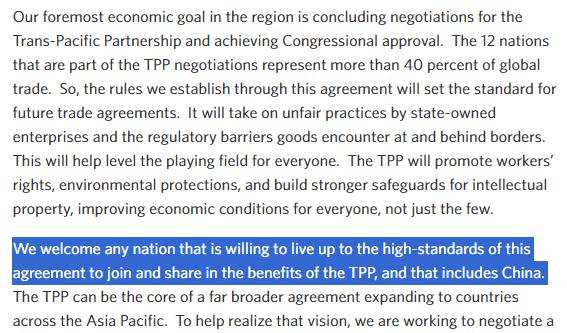
The theory of TPP was that the US could put pressure on China by creating a free trade zone with a bunch of countries in China's orbit. Under TPP, those countries could sell to the US tariff-free, giving them an advantage that would cause trade to divert away from China. Eventually, China would feel the need to join TPP in order to compete, at which point the agreement's various disciplines on state-owned enterprises, environment, investor protections etc. would finally turn China into the mythical "responsible stakeholder in the rules-based order."
The mind reels that serious people thought that this would work. To divert trade away from China, you'd have to lower tariffs by more than the Chinese export cost advantage. Nothing changes unless that's possible.
It wasn't possible, because US tariffs were already so low. Average weighted US tariffs were around 3%. But for the vast majority of products, China's cost advantage over the next-cheapest supplier was way bigger than 3%. If you cut a 3% tariff to zero in that circumstance, China keeps right on shipping. The trade preferences available through TPP simply weren't big enough to change anyone's behavior - because the US had already opened its market under the influence of free trade ideology. It had no leverage left.
To the extent TPP would have changed anything, it would have made it marginally easier to offshore to signatories like Vietnam, thanks to the regulatory alignment and investor protections it would have created. TPP would have given a little push to deindustrialization. And if the Obama administration's real goal of China joining TPP had materialized, it would have been a huge push, because we would have found ourselves in a free trade agreement with China.
Huge win that we never signed. Close call
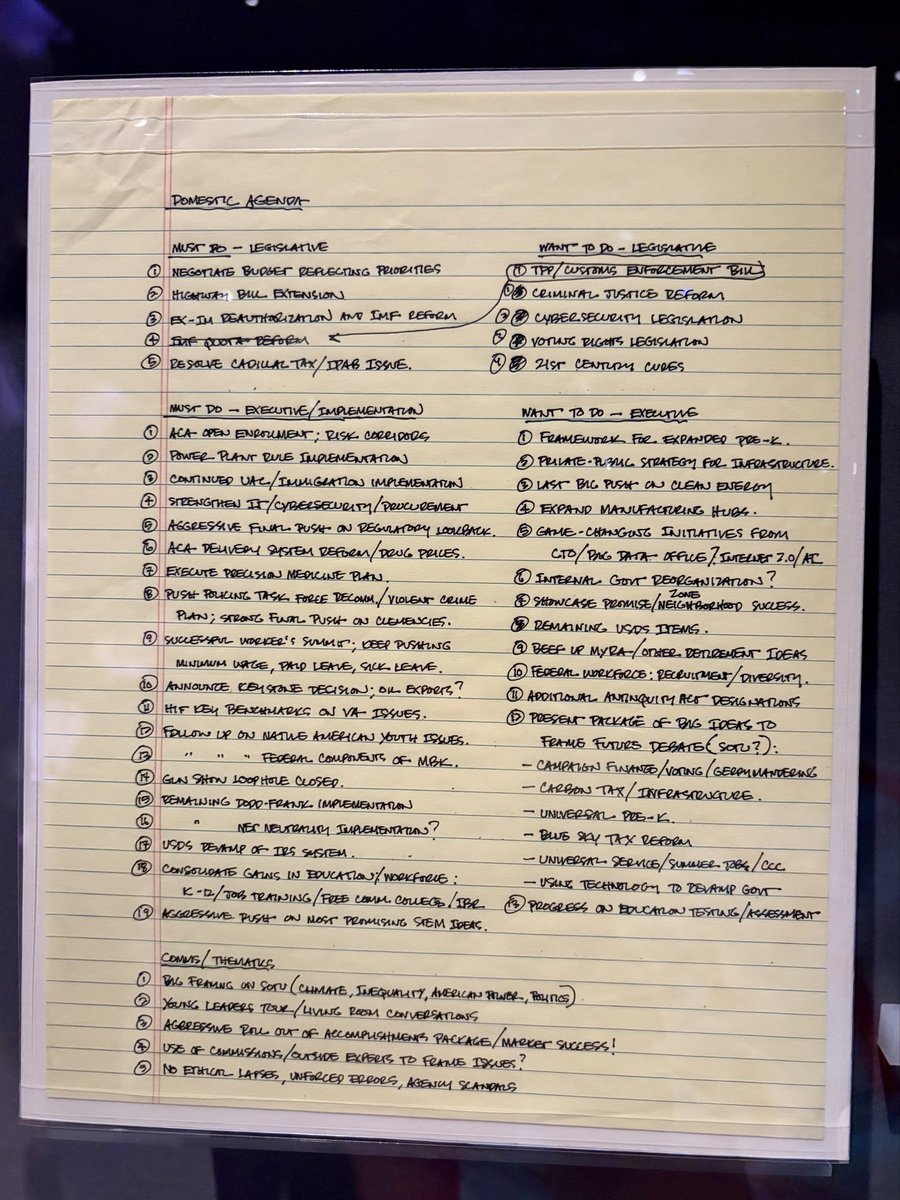
Hanging in the Obama Presidential Center is this handwritten list of the former president’s 2015 domestic agenda. You’ll notice he moves the TPP trade pact from the “want to do” column to “must do.” A relic from a bygone era.
The points about the definition of deindustrialization are fair enough - however, defining "deindustrialization" as declining share of employment for manufacturing runs into its own problems, namely that you'll find it where manufacturing expands at a slower rate than services, which I don't view as a problem in itself. Either way, this point remains orthogonal to what I argued in the piece.
The problems you've identified with low-percentage ad valorem tariffs are real. I hope we fix them. I would be strongly in favor of specific tariffs, sectoral tariffs instead of country tariffs, and raising the duty rates (at least on certain line items). Again, this is an entirely separate discussion. You're taking a proposal for reducing harm from USMCA to be a final treatment of the ideal trade policy end-state.
I appreciate you ceasing speculation about motive.
If we're defining "deindustrialization" as the emergence of a mentality, that's fine, but those aren't the terms I'm arguing under.
Below is what I actually wrote about global tariffs. As you'll see, the argument is based in industrial policy, not raising revenue, and combines a flat tariff with higher tariffs on strategic goods. High tariffs on strategic end-use goods alone aren't enough to reindustrialize. This proposal is not the "antithesis" of the American System, free trade is. Disagreement with my argument is welcome, after you've actually read it.
Further, I think you're the one lacking "awareness" of the context here. Chuck is criticizing me for allegedly working to keep GATT alive so that tariffs can be selective and pay-to-play (antidumping, countervailing duties, safeguard) instead of the baseline norm, available to all. He thinks I want this to keep making money from AD/CVD cases. A global tariff is not pay-to-play and is available to all, so it's responsive to Chuck's accusation.
https://t.co/piZtiYAnX0
Happy to respond, Chuck.
On Senator Taft and the labor movement, I'd concede the point if I'd argued it. "That was before anyone worried..." is a rhetorical expression to quickly make the point that deindustrialization had not yet occurred and was not a salient issue pre-NAFTA. It's pedantic to treat that line as a substantive argument. This piece wasn't meant to recapitulate the state of trade policy debate in 1934.
There are actual neocons out there, and their views on trade are very different from the views I expressed. I think you don't bother drawing a distinction because you're primarily interested in purity testing instead of engaging with the substance of the argument, which you've incorrectly summarized as calling for a "doubling down" on the NAFTA model. I called for major changes to the model, and if you don't think they go far enough that's fine, but it would be better if you just explained why instead of using inaccurate generalizations.
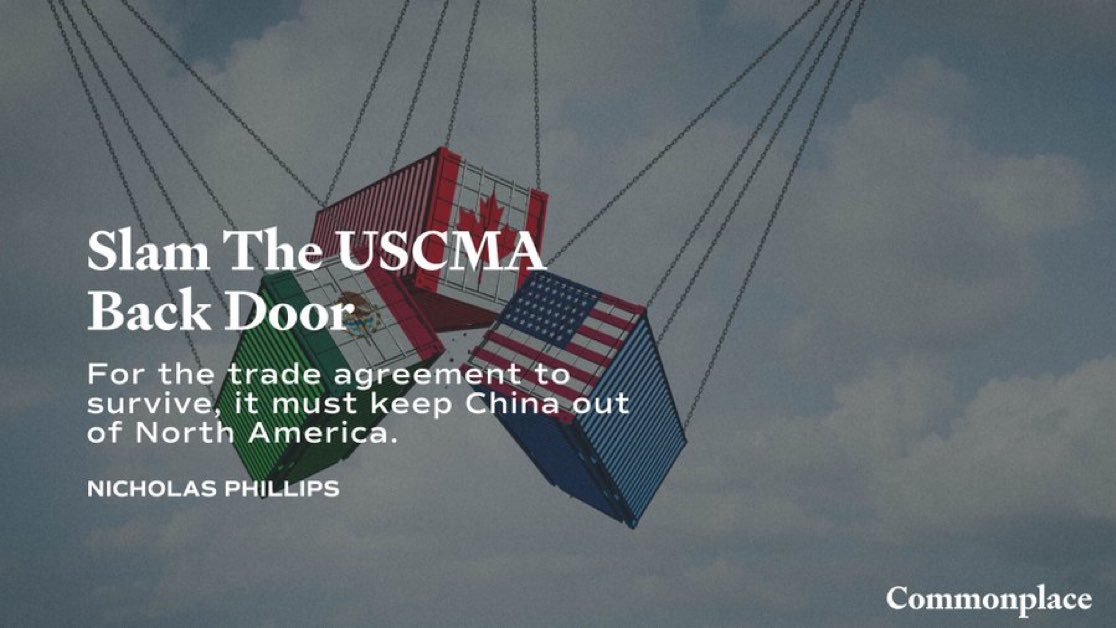
I wrote about USMCA for Commonplace. The agreement has become even more economically important now that it’s one of the few tariff-free routes to the American market. That’s leverage to push Mexico and Canada to exclude China from North America
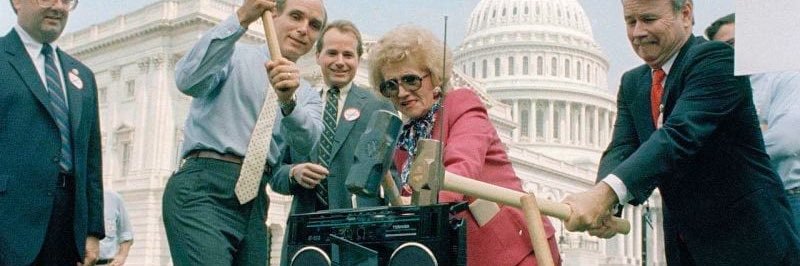
@ishaantharoor Dems in Congress were, if anything, more alarmist about German and Japanese auto exports in the 70s than Republicans have been about Chinese autos in the present. Back then, Democrats spoke for labor, now they speak for upper middle class consumers who’d like to buy a Chinese EV
Back when the American left represented working people, it fought to block German and Japanese auto exports and successfully induced BMW and Toyota to make their cars in America. Now, the American left represents upper middle class consumers and views restrictions on Chinese EVs as a possibly racist lifestyle infringement
I’m curious about this conversation. Just returned from India, where new Chinese EVs now populate the streets of big cities. Was it an “assault” when German or Japanese automakers began to dominate foreign markets?