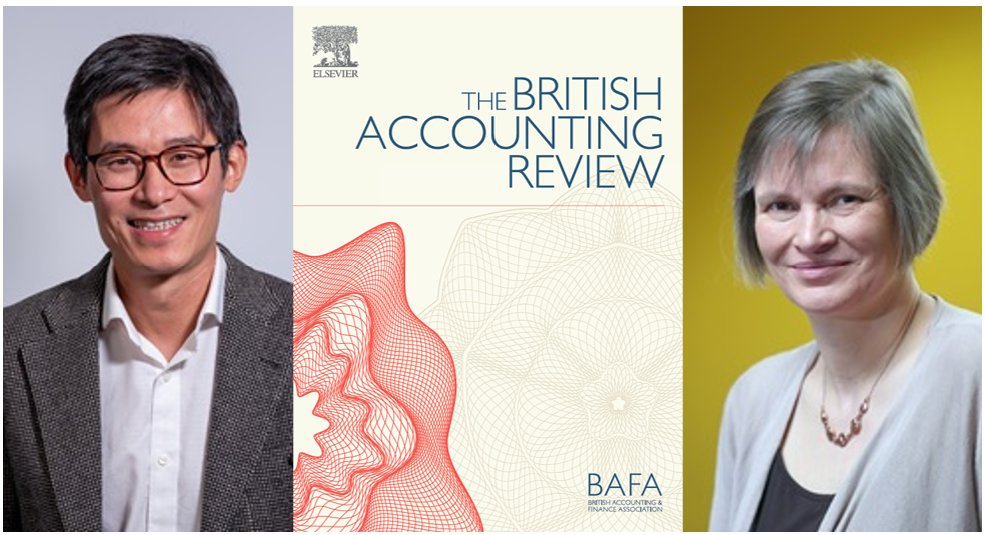
Thank you for all the kind words and support as we begin our tenure at The British Accounting Review! Excited to work with the Editorial Board, BAFA and the brilliant Shereen Awan. Our priority: maintain the journal’s excellence and continue its rich tradition.
— Lisa & Charlie
New in @BritAcctReview!
“What Do We Know About Sustainability Reporting Assurance Quality?”
by Zengin-Karaibrahimoglu, Homroy & Lobo
A timely review of how ESG assurance shapes credibility, transparency, stakeholder trust & capital markets.
🔗 https://t.co/CukoJ8toJ1
#ESG#BAR
📘How do accounting students develop a professional identity?
Using student reflections from work-integrated learning experiences, Twyford & Dean show how mentoring, reflection & workplace exposure shape confidence, adaptability & career readiness.🔗https://t.co/NMcI5avCrm
#BAR
📘 New in @BritAcctReview!
Maharaj, Moreno-Lopez & Porporato show how accounting systems and transparency initiatives reshaped power dynamics between municipal governments and public sector unions in Córdoba, Argentina.
🔗https://t.co/72siga13nd
#Accounting#CriticalAccounting
📘 New in @BritAcctReview!
Dong, Wang, Liu & Taghizadeh show that climate-resilient city pilot policies significantly reduce carbon emission intensity, with AI, fiscal decentralization, and urban greening strengthening the effect.
🔗https://t.co/TXLtQevHfE
#AI#CarbonNeutrality
🎓New in British Accounting Review!
Using Chinese listed firms, Jiaoliang Jiang & Hengmiao Bao show that firms in regions with more aggressively amplified growth targets are significantly more likely to engage in corporate misconduct.
🔗https://t.co/5W9uVyebLp
#BusinessEthics
⚠️New in British Accounting Review!
Evidence from China shows firms facing greater uncertainty experience poorer workplace safety outcomes and higher accident risk.
A study by Chenxi Xu, Qian Xin, Xu Li & Yuchao Jin
🔗https://t.co/URHVO4Pg1n
#MarketUncertainty#EmployeeSafety
💡New in British Accounting Review!
Huang, Tian & Lu find that government intervention drives labour cost stickiness—but unrelated state shareholders act as monitors, reducing inefficiency (mainly via wage flexibility).
🔗https://t.co/zL7wO1DgaG
#SOEs#LabourCosts
📊New in British Accounting Review!
Does integrated thinking improve performance?
Xinyu Zhao, Mohamed Omran & Sardar Ahmad link firms adopting integrated reporting with better performance and deeper organisational alignment. 🔗https://t.co/1ipwHFYFpd
#Integratedthinking#ESG
🚦New in British Accounting Review!
Does traffic congestion affect cost of debt?
Jie Hao & Viet Tuan Pham show lenders impose stricter loan terms and monitoring on firms exposed to congestion, concerned over operational disruption.
🔗https://t.co/Bu29wrmP9K
#CorporateFinance
🔗New in British Accounting Review!
Do firms exploit supplier distress?
Evidence shows customer firms increase real earnings management (REM) following supplier litigation, driven by opportunism, not risk.
Mengtao Chen & Yongming Sun
🔗https://t.co/r8bqFQj36F
#SupplyChain#REM
🧠New in British Accounting Review!
What drives accountants to report fraud?
Steve Kaplan, Carly Moulang & Xinning Xiao show that psychological capital strengthens reporting intentions by increasing personal responsibility to act.
🔗https://t.co/BkuvuGKZxf
#Fraud#Whistleblowing
📊New in British Accounting Review!
Zongxi Chen & Andrew B. Jackson show that industry-specific models outperform economy-wide models mainly for less diversified firms, where a dominant business segment shapes performance.
🔗https://t.co/90GHPz2m0J
#Forecasting#Accounting#BAR
🌍New in British Accounting Review!
Amrinder Khosa, Carla Wilkin & Rakesh Pandey show that curriculum change is often driven by individual institutional entrepreneurs pushing sustainability into accounting education.
🔗https://t.co/gZI8BtvOBl
#AccountingEducation#BAR
🏛️New in British Accounting Review!
Guanming He, Yuhang Liu, Ling Yu & Zhanqiang Zhou show that commercial reform improves corporate investment efficiency through better administration, transparency and oversight.
🔗https://t.co/Ue5xSPAWno
#CorporateInvestment#Governance
📉New in British Accounting Review!
What happens when firms stop disclosing segment asset information?
By Maiying Sui & Yi (Ava) Wu
Ceasing disclosure leads to higher analyst forecast errors and greater forecast dispersion.
🔗https://t.co/q2UAa1oNZi
#Disclosure#CapitalMarkets
🧠New in British Accounting Review!
Overconfident CEOs extend more trade credit, helping firms gain sales growth and market share, but at the cost of lower short-term profitability.
By Nga Nguyen, Thanh Vu & Kiet Tuan Duong
🔗https://t.co/wM3Nql04wy
#Overconfidence#Tradecredit
📘New in British Accounting Review!
“Do managers care about analyst attention to ESG?”
Jeonghu Pak, Jiyong Eom, Kevin H. Kim & Jonghan Park
ESG questions in earnings calls → fewer future ESG incidents. Negative tone → stronger effects.
🔗https://t.co/3pvVRhM4Is
#ESG#BAR
📘New in British Accounting Review!
“Business Strategy & ESG Performance”
by Moses, Tariquzzaman, Michael, Islam & van Zijl
Prospector firms outperform Defenders in ESG — especially in Environmental & Social pillars.
🔗https://t.co/fGjd7VYEz3
#ESG#Sustainability#BAR