OK, let's make this simple.
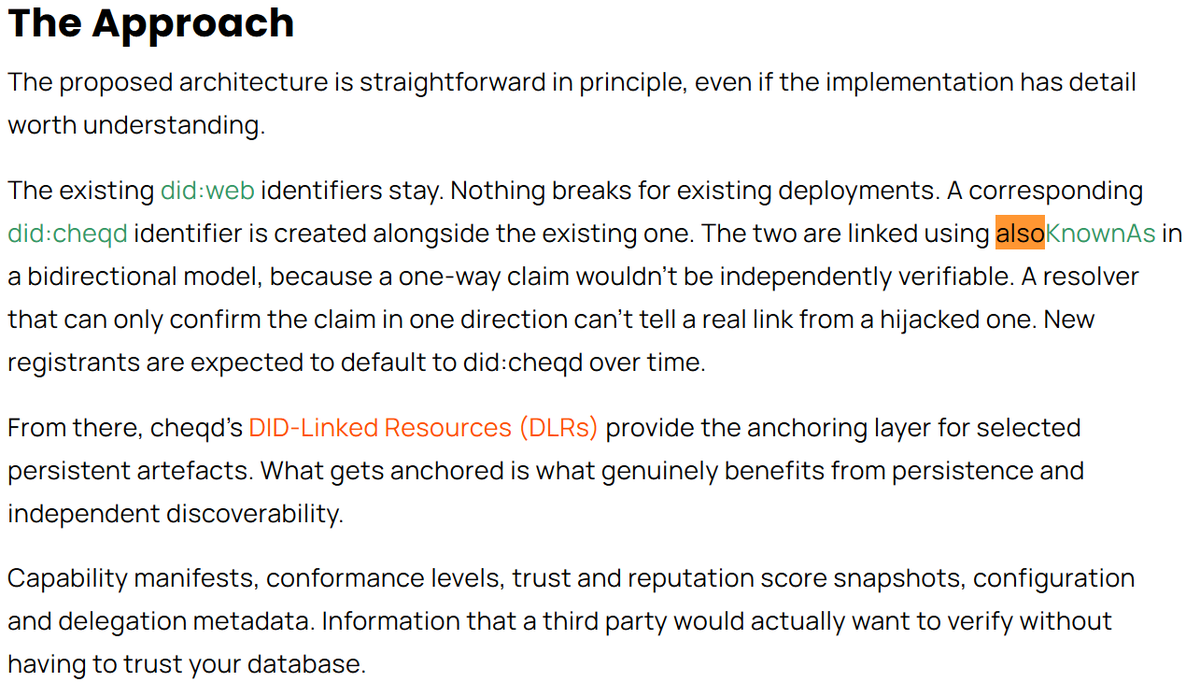
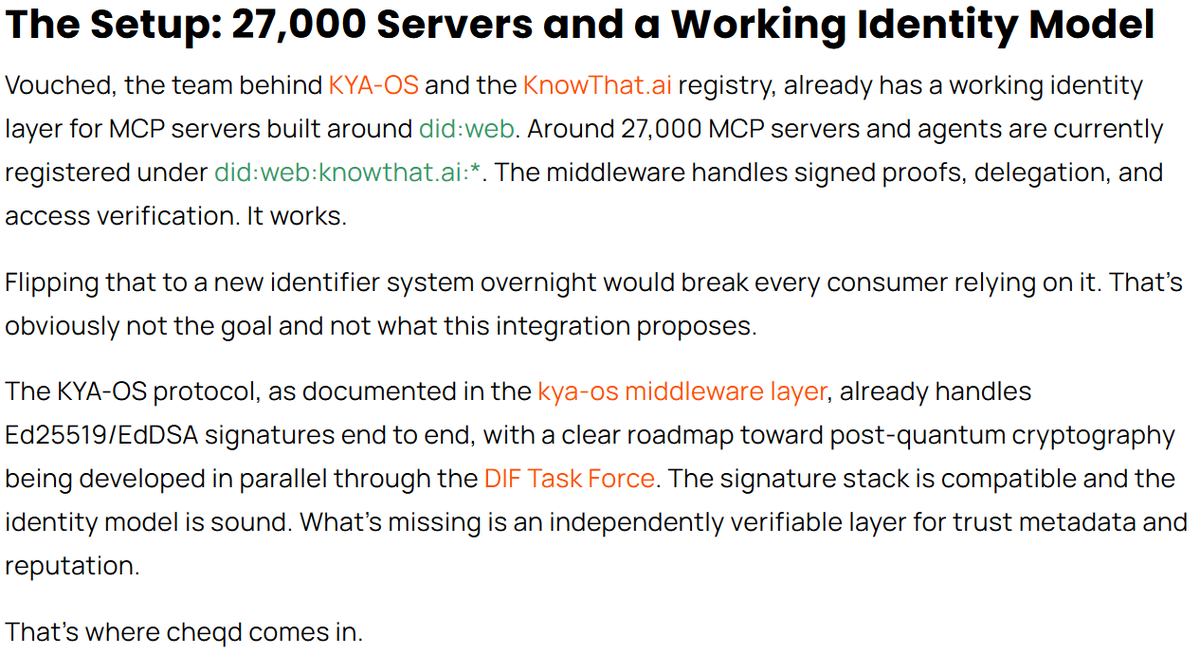
Current = DID:WEB......
Coming = DID:CHEQD......
Coming = DID:CHEQD artefacts
Artefacts aka = #DLR - DID(:CHEQD) Linked Resources
NEW DID = $2.00 operation
NEW DLR = $0.20 operation
@cheqd_io built a pricing oracle for live conversion of $CHEQ used for settlement of these operations.
So, $CHEQ @ $0.002~ means ;
27,000 NEW DIDS = $2.00 / $0.002 = 1,000 cheq PER DID
27,000 x 1,000 = 27,000,000 tokens ; or 2%~ of supply and 99% burn rates.
You can find the link in the comments.
Vouched donated MCP-I to the Decentralised Identity Foundations #DIF
That MCP-I, is now KYA-OS.
https://t.co/McSZPQcKNf is an implementation of this code.
We are approaching a world where 27,000 agents would not even make up a rounding error.
Also, AI agents / Autonomous agents are not confound to maturity of 18 years or so like an adult.
They can be spun up at will. 🧠
8b humans with 10 agents = ?
We’re excited to partner with @VouchedID.
Vouched KYA now integrates the cheqd network, adding cryptographic agent identities, verifiable credentials and tamper-proof audit trails, without vendor lock-in.
Know more: https://t.co/anX0p1DXJt
Yesterday, @fraser_again spoke at the 'Building trust in digital supply chains with organisational identity' event hosted by @DigiCatapult.
Proud to be part of a small but strong group helping shape the future of trust and organisational identity in the UK.
This Vouched partnership is honestly one of the biggest signals yet for what $CHEQ is becoming.
This is not another random “AI partnership”.
Vouched is a serious identity verification company operating in regulated industries and verifying millions of identities.
And now they are integrating:
➡��� cryptographic agent identities
➡️ Verifiable Credentials
➡️ decentralized trust chains
➡️ tamper-proof audit trails
➡️ DID infrastructure anchored on cheqd
Why this matters:
AI agents cannot scale globally on “trust me bro” systems, centralized reputation databases or static API keys.
Autonomous systems handling:
🟠 payments
🟠 healthcare
🟠 contracts
🟠 enterprise workflows
🟠 sensitive data
need:
➡️ verifiable identity
➡️ delegated authority
➡️ revocation
➡️ cryptographic proof
➡️ interoperable trust registries
This is literally the Internet of Trust thesis playing out in real time.
The market still prices $CHEQ like a dead low-cap altcoin.
But if serious enterprises start routing AI trust and identity infrastructure through cheqd, the repricing potential becomes enormous.
This is how infrastructure narratives start:
quietly… until suddenly everyone realizes the rails are already being built underneath the next era of the internet.
Most people still think digital #identity and #SSI are niche.
I think they are potentially becoming foundational infrastructure for the AI era.
Because once #AI agents start operating autonomously across commerce, finance, healthcare, logistics and the internet itself, trust becomes the bottleneck.
Agents need:
🟠 cryptographic identity
🟠 verifiable permissions
🟠 trusted registries
🟠 decentralized key management
🟠 interoperable trust rails
And increasingly, governments, enterprises and cybersecurity agencies are all pointing in the same direction.
If it proves true that decentralized trust becomes a core internet primitive, then the upside scenarios for infrastructure providers like @cheqd_io - $CHEQ stop looking crazy very quickly.
That is the bet.
I wrote a deeper thesis below on why I think the “Internet of Trust” could become one of the biggest infrastructure narratives of the next decade:
The France digital identity breach exposing data from millions of citizens is exactly why the next generation of identity infrastructure matters.
The old model:
→ giant centralized databases
→ single points of failure
→ institutions storing everything
→ trust based on “just trust us”
In the #AI era, this becomes unsustainable.
Deepfakes, synthetic identities, automated phishing, and AI-driven fraud are scaling exponentially.
This is why I’m increasingly interested in infrastructure like @cheqd_io - $CHEQ.
Not as “another crypto project”, but as part of a future trust layer for the internet:
🟠 verifiable credentials
🟠 decentralized trust registries
🟠 issuer verification
🟠 cryptographic trust chains
🟠 portable identity
Europe is already moving toward EUDI/eIDAS wallets and interoperable digital identity frameworks.
The next step is making identity and trust:
→ verifiable
→ interoperable
→ privacy-preserving
→ not dependent on massive centralized honeypots
AI is forcing the world to rethink trust infrastructure faster than most people realize.
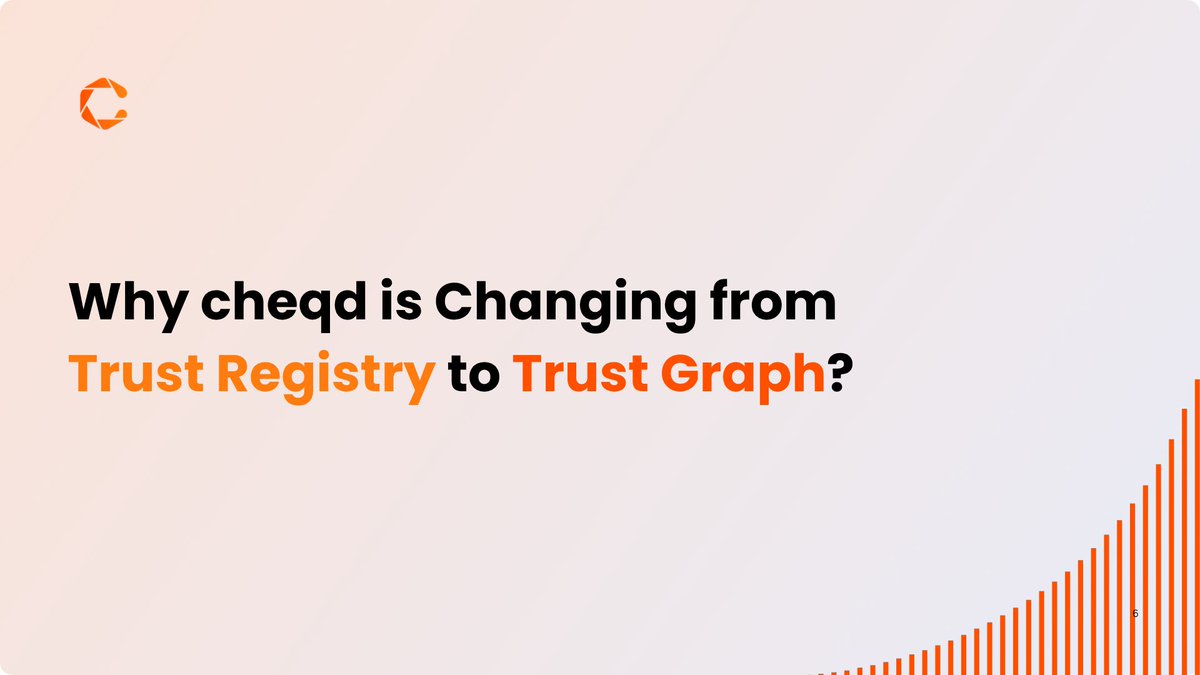
We're retiring "Trust Registry."
Static lists can't keep up with AI agents, decentralised ecosystems, and constantly shifting relationships.
We're moving to Trust Graphs, living, dynamic networks that show not just who is trusted, but how, why, and to what degree.
We built an MCP-enabled Agentic Trust solution that gives AI agents cryptographically verifiable identities and permissions.
Developers can now build apps where agents manage their own DIDs and Verifiable Credentials, backed by our Trust Graph.
https://t.co/UdvhB6YvOs
Europe wants to ban under-16s from social media. Sounds simple. It's not.
Current age checks;
enter your birth date (🤣)
or upload your passport(🤯).
There's a third path: decentralised ID. Prove you're over 16 without revealing your name, DOB, or anything else.
Trillions of dollars of value is locked inside data silos.
Not because people don't want to share it, but because there's no trusted, privacy-preserving way to do it.
Deepfakes are now being used to bypass identity verification systems.
Security teams are warning that AI-generated identities are passing basic checks.
In some cases, attackers are:
• generating synthetic faces
• producing fake ID documents
• creating full digital personas.
Gartner notes that by 2028 a significant majority of governments plan to deploy AI agents for routine decision making, yet fragmentation and legacy systems remain major hurdles.
https://t.co/0nF1diKm36
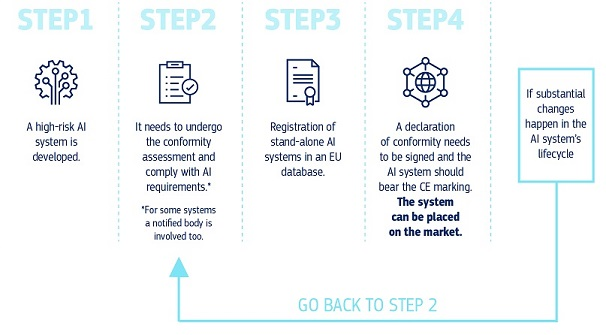
The EU AI Act transparency obligations kick in August 2026.
Every piece of AI generated content such as images, audio, and video must be:
→ clearly labelled
→ machine-readable
→ technically detectable
Deepfakes aren't just a trust problem. From August, they're a compliance problem.
Everyone is talking about decentralizing identity.
But no one is asking the more important question:
Who decides what is trusted?
If anyone can issue a Verifiable Credential…
→ who verifies the issuer?
Decentralization doesn’t remove trust. it redefines where trust lives.
We’re moving from:
→ central authorities
to:
→ verifiable trust registries + reputation layers
This is where things get interesting.
I believe networks like @cheqd_io - $CHEQ will play a key role:
Not by controlling identity, but by enabling trusted issuance + verifiable provenance at scale
Because in the end:
Identity is useless without trust in who issued it.
📰 Gartner predicts more than 1,000 legal claims against enterprises for AI agent harms by the end of 2026.
Insufficient guardrails. Inadequate oversight. No audit trail.
Here's the uncomfortable truth about AI accountability. 🧵