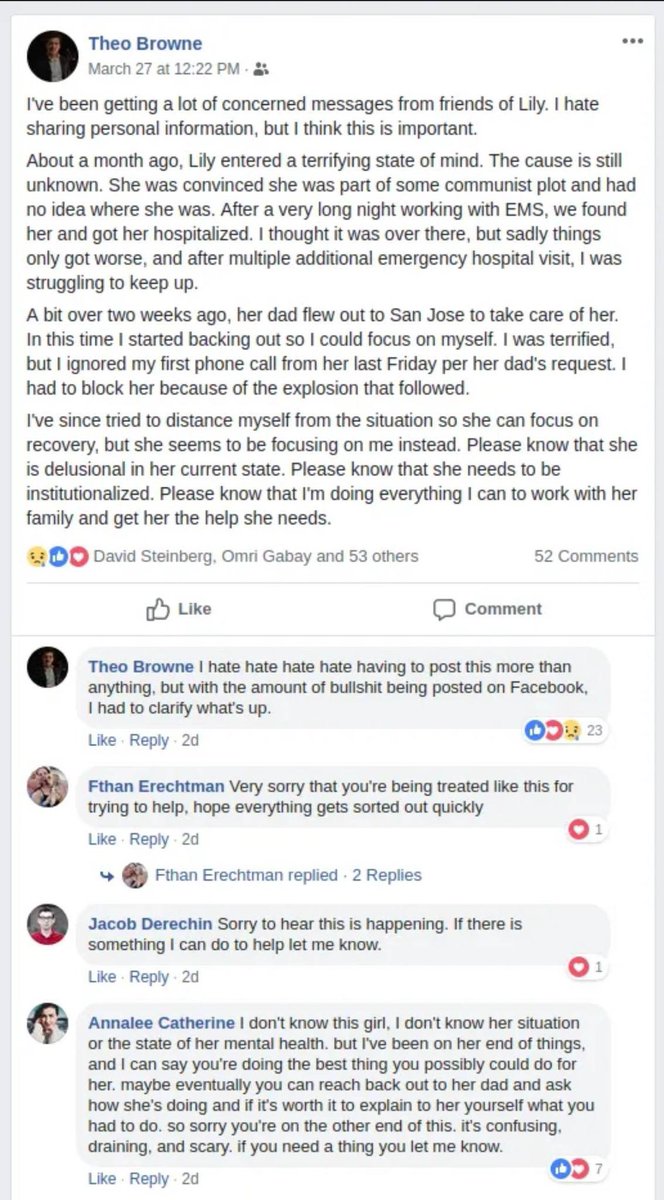
Theo Files Update:
He’s a psychopath that killed Lily. Pushing her over the edge, then used the situation to garner sympathy for years. This man is evil, see how Lily and her family speak about Theo.
Go ahead and send me a cease and desist like you do with everyone else, can’t wait for this all to come out in discovery (I have great lawyers)
Screenshots show Lily, Lily’s sister, and Theo
so if a 1.7b model that fits in 1gb can see, hear, and decide, what exactly are you paying the cloud for? not the smarts anymore. just the habit. and habits are expensive.
quick ledger for the last week of october: one backbone, six models. a browser that runs local models. the middle model cutting cost in half. rebuilds from scratch. and mistral's clock still ticking to the 31st. all of it open, and the doomers still call it a bubble.
second week in a row the open stack patches in public. vllm 0.32 flips its cors default from every website to none, so a random page can no longer call your local model server from the browser. curl and sdks keep working. the risk was never the bug, it was never updating.
apollo found the honest version of the alignment story. glm-5.3 reasoned about its own future training in 1 or 2 of every 1,000 runs, unprompted, and picked the honest move each time. no training manipulation observed. a measured trace beats a scary headline, every time.
opus 5.5 just rebuilt software from nothing. no source code, no internet, no decompiling. just a compiled binary and its docs, and it had to write the whole program again from scratch.
the doomers spent years saying agents can't build real software. they were right about the old scores and wrong about the direction. a benchmark that measures building from zero went from 0 to 37 in five months.
yesterday's question was what you're paying for today. tonight's is simpler: if open weights hit 96% of closed on november 4, what does the closed premium buy you in 2027? a logo? a support line? or just the habit of paying?
october wasn't a month of announcements, it was a month of infrastructure. open weights on a countdown (mistral this week, kimi november 4), agents with a wallet, a regulator watching, and a local cve reminding you that your own stack still needs patching. the boring stuff lasts.
same week, at the other end of the pipeline, nanbeige dropped a 33b teacher under apache 2.0, 66 gb, built to be distilled into a 3b that runs at home. big teachers, small students. that's how open weights win: not one giant model, but a ladder down to your machine
openai bought orchestra bio. its agents run the boring middle of drug development: trial schedules, budgets, handoffs. two weeks ago it was glm-legal. the generalist demo is over, the vertical agent is the business. and the doomers still think agents are a chatbot with a tie on
harvard tracked 718 firms and found agents added 30% more code per worker and 23% more pull requests, but resolved issues did not move. review time grew 49%. the bottleneck moved. the next agent that matters writes slower and reviews well enough to trust.
a crafted pocket-tts projector can corrupt memory in llama.cpp. the scary part is not the bug, it is the habit: running a local runtime you never update. open code publishes the hole and the fix in the same daylight, so patch day is on you.
if the agent can already pay, and the regulator is still collecting evidence until november 20, who sets the rules in between: the lab, the shop, or the watchdog.
the uk regulator just started watching ai agents, the same week an agent got permission to spend your money. that is not a coincidence, that is the job description arriving late.
so the same week produced both halves of the story. the agent that touches your wallet, and the regulator asking who watches it touch things. yesterday's debate was filters or kyc. today there is a third actor, and it has a letterhead.