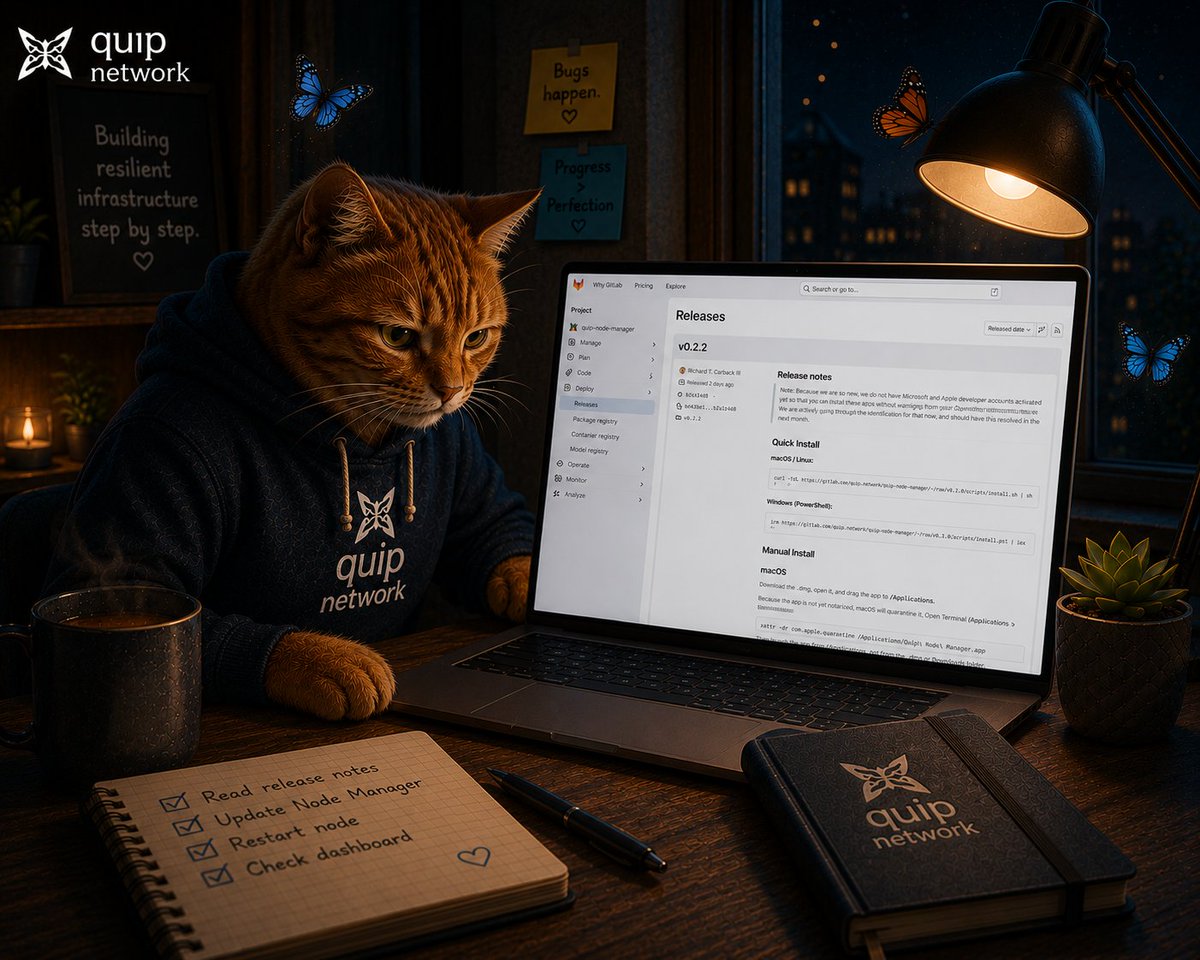
Like @quipnetwork , like open source, like cats. Maybe this 0.2.2.1 is good time to start node without VPS but on my personal laptop... At least I can try
https://t.co/sFxLQoGAVA
Small improvements make infrastructure stronger.
@quipnetwork Node Manager v0.2.2 improves Docker image handling after the recent repository rename, helping node updates run more smoothly.
I also like that Quip is open source. The release notes and code are available on GitLab, so anyone can dive in, see what's changing, and contribute if they want.
https://t.co/spTxCmM3Fl
Like @quipnetwork , like open source, like cats. Maybe this 0.2.2.1 is good time to start node without VPS but on my personal laptop... At least I can try
https://t.co/sFxLQoGAVA
Small improvements make infrastructure stronger.
@quipnetwork Node Manager v0.2.2 improves Docker image handling after the recent repository rename, helping node updates run more smoothly.
I also like that Quip is open source. The release notes and code are available on GitLab, so anyone can dive in, see what's changing, and contribute if they want.
https://t.co/spTxCmM3Fl
I’d love to share some facts about Ergo Proxy, but I still haven’t finished watching it... At least after episode 10, it got better... Goodnight to all the good people! 😴
Happy Birthday ETH.
For @quipnetwork want to wish to come the same (or maybe even more? )) famous and useful network. Let this great community bring a lot of value together, and lets all be happy
@PoliAir We have more and more AI, more and more date centers for AI... not sure its good btw... And they are required huge resources. If quip help to cut resorces for them, that's would be great, I think
GM, CT! Happy Friday☀️
A little quantum computing history today 🧵
1/ In 1980, physicist Paul Benioff described a computer operating according to quantum mechanics.
2/ In 1985, David Deutsch described a universal quantum computer. Then, in 1994, Peter Shor introduced an algorithm that could theoretically factor large numbers much faster than known classical methods.
Quantum computing was no longer just an unusual physics idea.
3/ But building real hardware proved much harder.
D-Wave, founded in 1999, became the first commercial supplier of quantum computers. Later, IBM, Google and others developed their own approaches.
4/ Still, quantum computers have not replaced classical machines. Current quantum hardware is noisy, difficult to scale and useful only for specific problems. For most everyday tasks, CPUs and GPUs are still faster, cheaper and more practical.
5/ In 2016, IBM opened cloud access to a real quantum computer. This allowed people outside major laboratories to experiment with quantum hardware, but access remained fragmented across different providers and platforms.
6/ Now, in 2026, @quipnetwork is building toward a decentralized marketplace connecting quantum hardware amd classical nodes, developers and users.
The Quip idea: you should not need to own a quantum computer to use quantum computing 🦋
https://t.co/CsYzf3fWHo